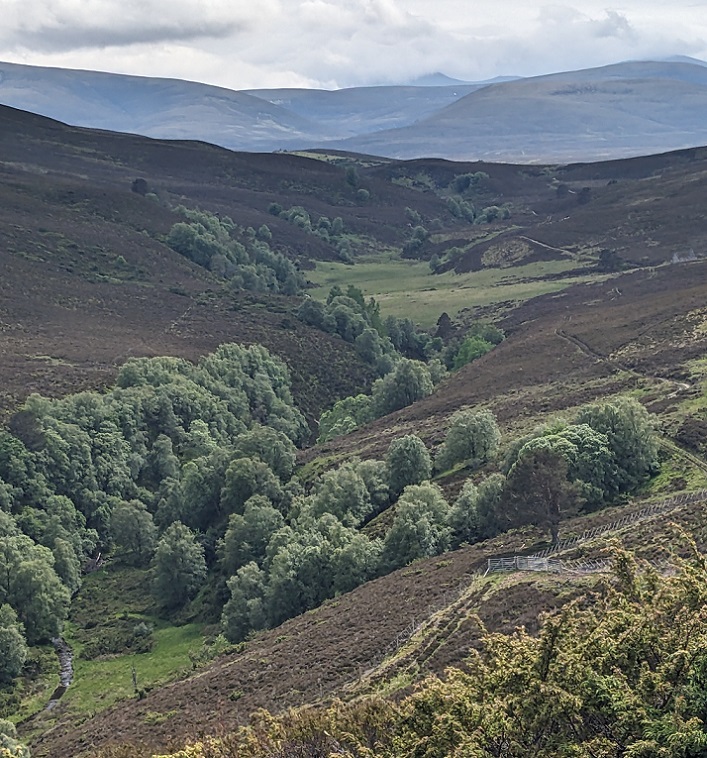
A month before large areas in Strath Nethy and Glenmore were consumed by fire, I went for a short walk to have a look at part of the Caledonian pinewood around Glen Brown which also lies within the Cairngorms National Park. This fragment of Caledonian pinewood is located on the Dorback Estate, which was purchased by Oxygen Conservation (OC) towards the end of 2024. At the time OC described their purchase, which was not vetted by any public body, as ‘one of the most significant natural capital acquisition (sic) in history’ (see here).
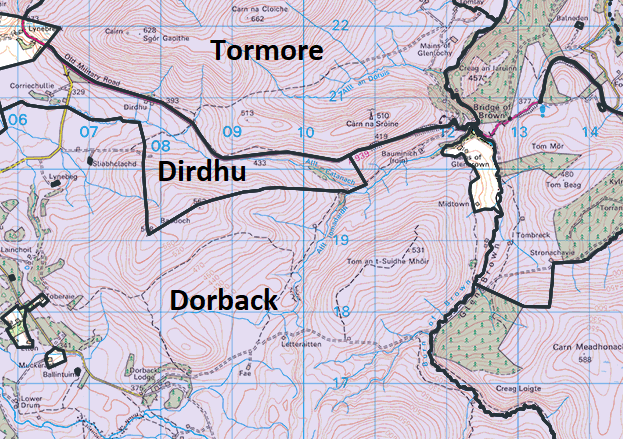
After a visit to the southern part of Dorback in January 2025, I had argued OC’s acquisition presented the opportunity for the Caledonian pinewood at Abernethy to expand northwards through natural regeneration and to save the capercaillie by removing deer fencing (see here). Ron Summers, who had previously worked as a scientist for RSPB at Abernethy, later alerted me to the parlous position of the Caledonian pinewood on the northern part of Dorback. He then suggested to OC, and their advisers TreeStory, that there was an opportunity for it to expand southwards through natural regeneration and eventually connect with Abernethy.
Having never visited the pinewood, I was keen to do so and stopped off on the former military road between Tomintoul and Grantown on my way back from my stay in Glen Livet (see here and here) .
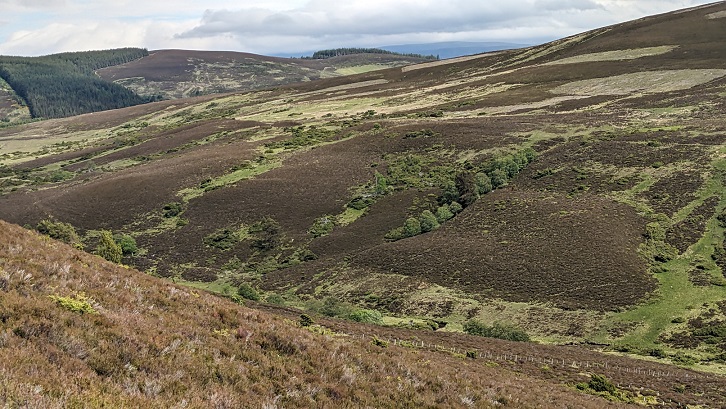
In the past intensive grouse moor management, including extensive muirburn, have served as a major constraint on the ability of the surviving Glen Brown Caledonian pine to spread back onto moorland naturally. OC announced they would stop ‘shooting birds’ as soon as they bought Dorback, creating a major opportunity for the pinewood to regenerate and expand naturally.
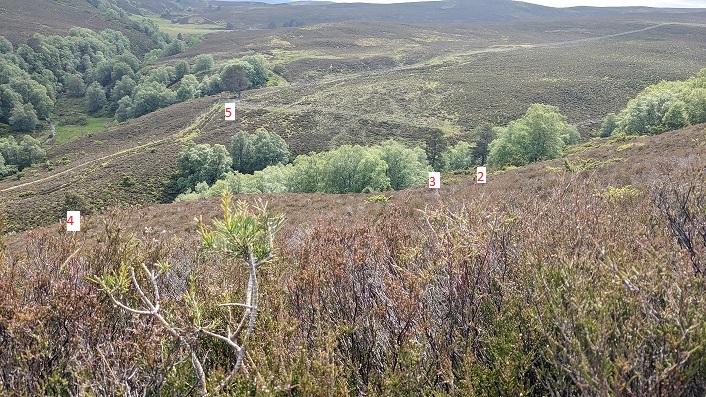
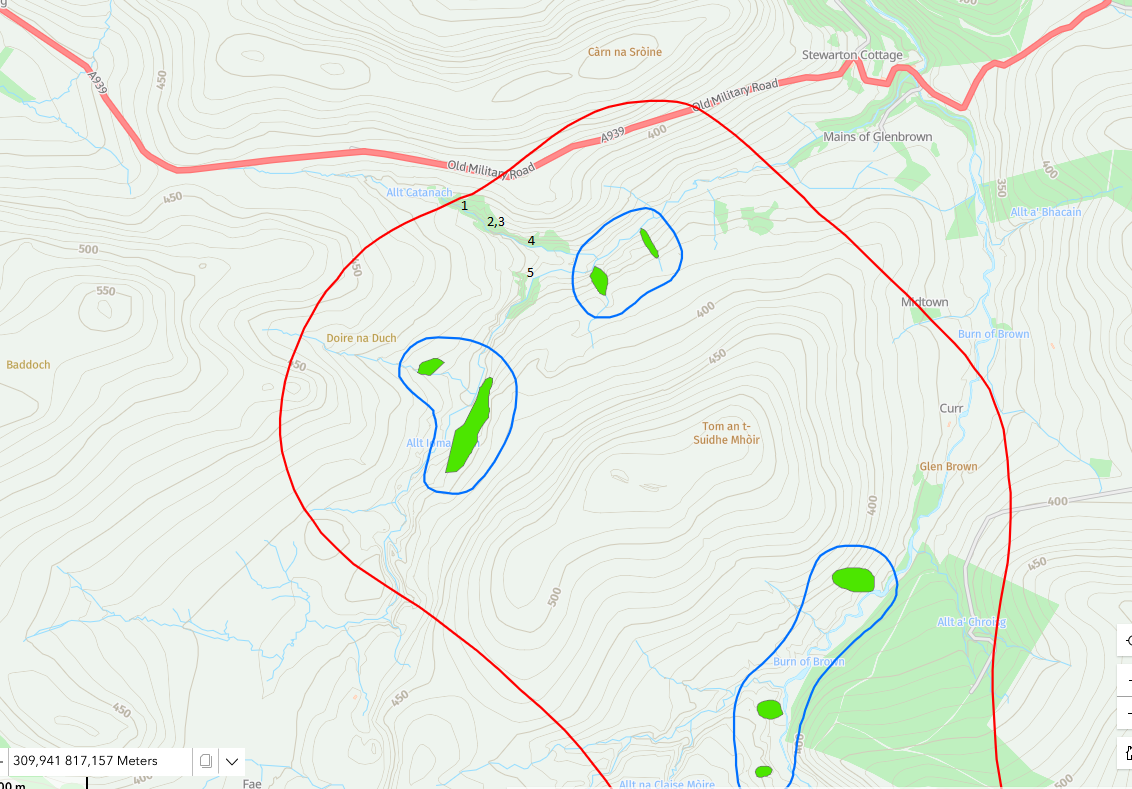
Scots pine seed blows uphill far more readily than is recognised in the literature and I saw evidence of that below the old military road. I have been unable so far to ascertain why the Scots pine along the Allt Catanach, the burn that runs below the road, are thought not to meeting the accepted definition of Caledonian pinewoods, i.e. that they are the “lineal descendants of those of early post-glacial times” and “have been regenerated naturally from ancestors of like origin”.
Establishing the origins of scattered Scots pine, however, and deciding what should be included in core zones of Caledonian Pinewood Inventory (CPI) sites like Glen Brown can present quite a challenge without genetic testing:
(You can view CPI sites for anywhere in Scotland, including the rest of Dorback, on Scottish Forestry’s map viewer (see here) – go to layers and then choose ‘Surveys and Inventories).
There are more Scots pine in the core zones along the Alt Lornadaidh than there are in Glen Brown which is why I chose to visit there. .After a look around the woodland along the Allt Catanach, I headed to the track and to the Scots pine (tree 5) which is located just inside the Dorback estate. The new native woodland scheme on the Dirdhu estate had been planted right up to the deer fence and this mature Scots pine.
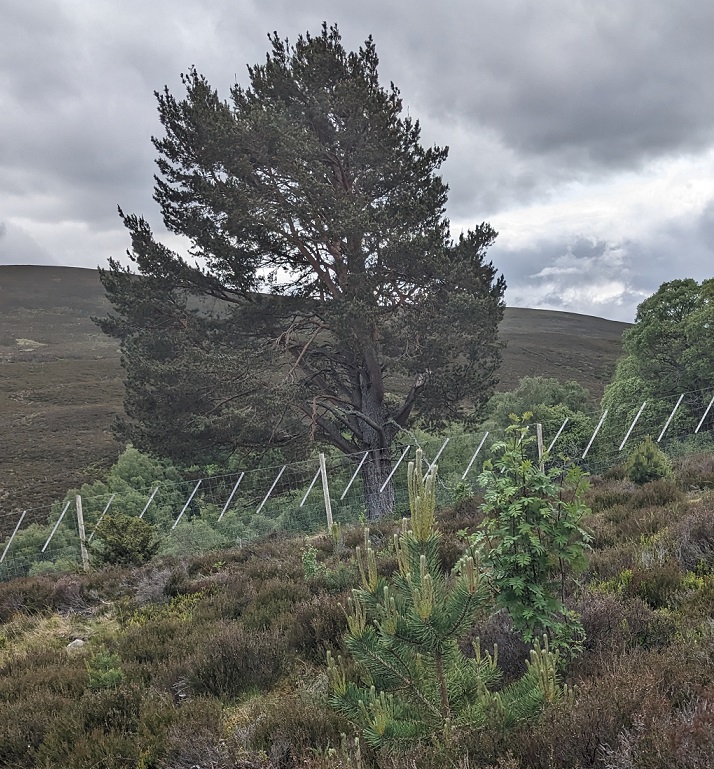
Whether or not this Scots pine is a direct naturally regenerated descendant of the Scots pine which colonised this area after the last ice age, with grazing pressure reduced by fencing, it was surrounded by numerous naturally regenerated seedlings among the planted trees. There was no reason for planting here but Scottish Forestry map viewer shows (Case Ref 20FGS54325) that it paid out forestry grants in 2022 to plant this area with Scots pine. That was both a complete waste of public money and a completely unnecessary intervention within what was supposed to be a buffer zone to protect the Caledonian pinewood.
Driven by planting targets, the risk is that Scottish Forestry now agree to similar planting proposals from OC on the Dorback estate.
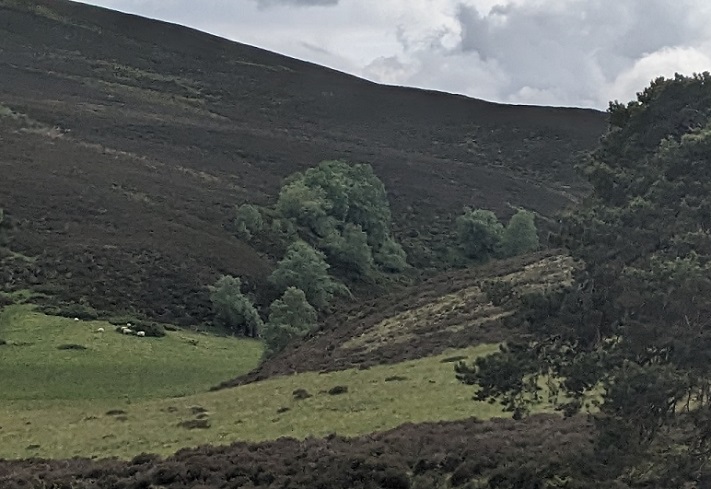
Approaching the ruin at Rynelrich there was a small herd of sheep grazing by the edge of the largest Caledonian pinewood core zone. Whether these sheep belonged to OC or had managed to find a way through the extensive fencing, it appears that OC have failed to protect this Caledonian pinewood for which they are now responsible. Searching around the Caledonian pine on the right of this photo, it was hardly surprising I was unable to find a single Scots pine seedling.
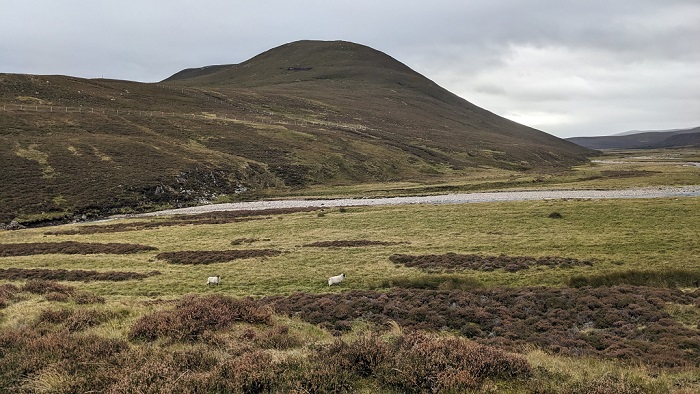
This conservation management failure on the part of OC is not a one-off, as I have also observed sheep grazing along the River Dulnain on their land at Kinrara. This is where, according to what OC and TreeStory staff told Vicky Allan of the Herald last month (see here), OC are now in discussions with the Spey Catchment Initiative about planting more native woodland between the fenced blocks paid for by Scottish Forestry (see here). The way the system works is that if the land is grazed to bits, it much easier for landowners to get grants for planting.
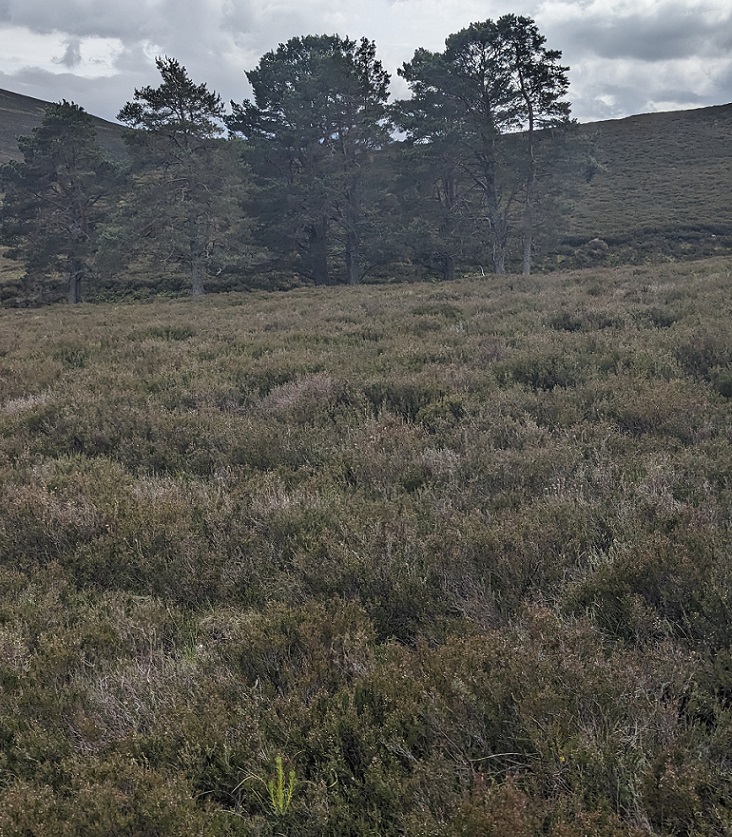
The largest group of Scots pine (12 trees) included in the CPI core zone were just to the west and above Rynelrich croft. Their survival, and that of the tree below the croft, are unlikely to be an accident, but because the people who used to farm here wanted to retain some trees. Whatever the explanation for their survival, I found numerous seedlings in the heather moorland and along the track to the north of Rynelrich, some beyond the 100m regeneration zone shown on the CPI.
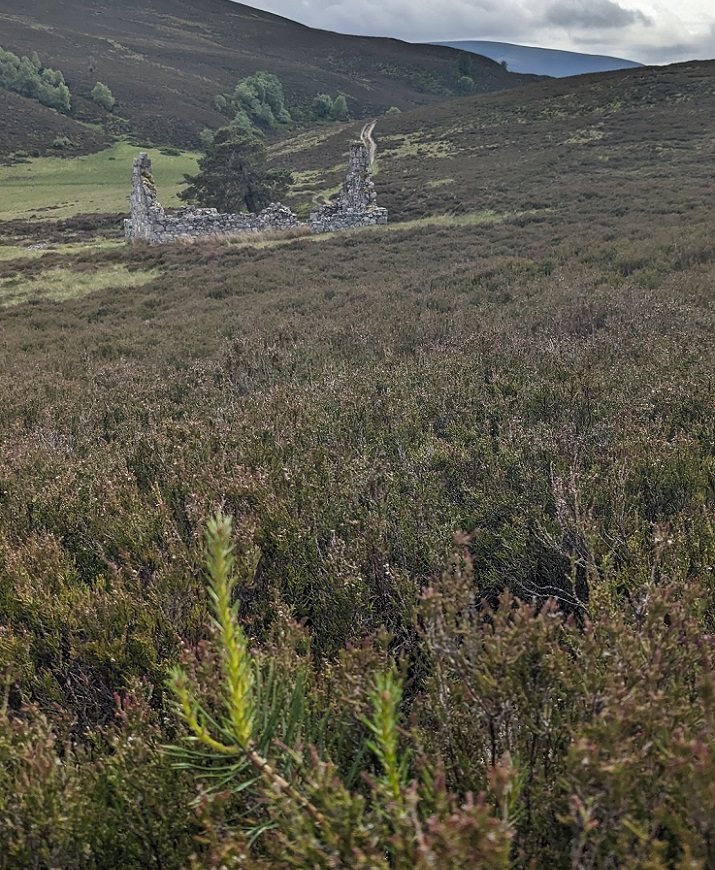
This regeneration process is not new but in the the last couple of hundred years every time a seedling has popped its lead shoot above the surrounding vegetation it has been eaten. With OC allowing sheep to remain on site, that process is likely to continue. Once they have exhausted the grassland, the sheep will move into the heather and eat what they can find. It would not surprise me if none of the seedlings I saw fail to survive to next year –
OC’s plans for the Glen Brown Caledonian pinewood area
In April 2026 OC published (see here) what they describe as a masterplan for Dorback. This has a section native woodland expansion, which starts with the Caledonian pinewood on the estate, including Bridge of Brown:
“It is our aim that Dorback Estate will be the site of an ambitious native woodland expansion project across the landscape from the Braes of Abernethy to Bridge of Brown. We are the custodians of two remnant Ancient Caledonian Pinewood sites (of only 84 that remain in Scotland), from the eastern portion of the Abernethy Forest to small pockets down Glen Brown and the Allt Lomadaidh. Our vision is to connect these fragments through continuous habitat progressions of native Scots Pine and mixed broadleaved woodlands, transitioning to open structured Montane Birch and willow dominated woodland at higher altitudes. We are aiming to enable the natural colonisation and spread of woodland and to plant native tree and shrub species, including Aspen, Birch, Scots Pine, Alder, Oak, Rowan, Willows, Bird Cherry, Hazel and Holly to expand the woodland further.
The vision to connect the Caledonian pinewood fragments sounds laudable but the proposal is do so by both ‘natural colonisation’ AND planting. In practice, as this map extract shows, planting predominates:
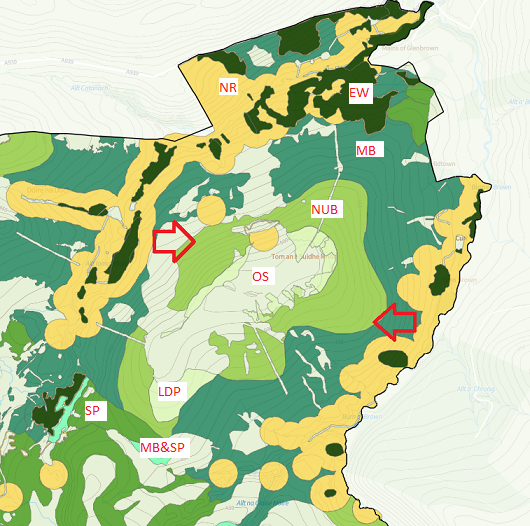
The two main areas of yellow earmarked for natural regeneration do lie around the surviving Caledonian pinewood and other areas of native woodland, including that shown in my photos. These areas appear to be approximately 100m wide, the minimum distance used for the regeneration zones on the CPI. They are also likely to be the minimum that Scottish Forestry would require to approve this scheme (although TreeStory is proposing a ‘regeneration zone’ only 50m in Glen Falloch (see here).
Not only that, but OC and TreeStory are proposing to insert three different types of woodland between the two halves of the Caledonian pinewood, mixed broadleaf, upland birch and low density planting. What species will be included in low density planting is not explained although this is described as a ‘type of woodland is now largely missing in the UK and Dorback is the ideal location for its return’. OC and TreeStory’s planting proposal, if approved, would appear to make it impossible for the two halves of the Glen Brown CPI site to join up, either by natural colonisation or planting.
OC and TreeStory are proposing to plant Scots pine to the south of the Glen Brown CPI site (bottom left of map extract). This is apparently with a view to creating a pinewood between the Caledonian pinewoods at Abernethy and Glen Brown, but this planting is similarly separated from Glen Brown by a proposed area of mixed broadleaves. Even from the perspective of those who wrongly believe you can restore the Caledonian pinewoods by planting, the proposals appear totally incoherent. From the perspective of someone who believes the primary aim of conservation should be to restore natural processes, it represents further vandalism to Scotland’ pinewood heritage.
OC and TreeStory’s map does not show the core, regeneration and buffer zones recorded on the CPI. Nor do they refer to the Forestry Commission’s Guidance Note 7 on the management of semi-natural woodlands, which is about native pinewoods and still applies to Scotland (see here). This states:
‘Natural regeneration is strongly preferred to planting in native pinewoods. It conserves the local genotype, unless non-local stock is close by, favours the natural distribution of tree species in relation to site conditions and tends to create a more irregular structure and mixed species composition than planting.’
It goes on to say:
“Unless there is not a suitable local seed source for natural regeneration, planting should be the
last resort [my emphasis], and planting proposals should only be advanced if the effect of a good seed year, together with ground preparation if appropriate, and protection against browsing has been adequately tested and found wanting”
OC and TreeStory appear to have decided to adopt tree planting as a first resort across Dorback and within the existing Glen Brown CPI buffer zone. They appear to have made no attempt to test natural regeneration in this area, although the evidence I saw suggests it would be extensive if sheep were removed from the site and deer numbers reduced:
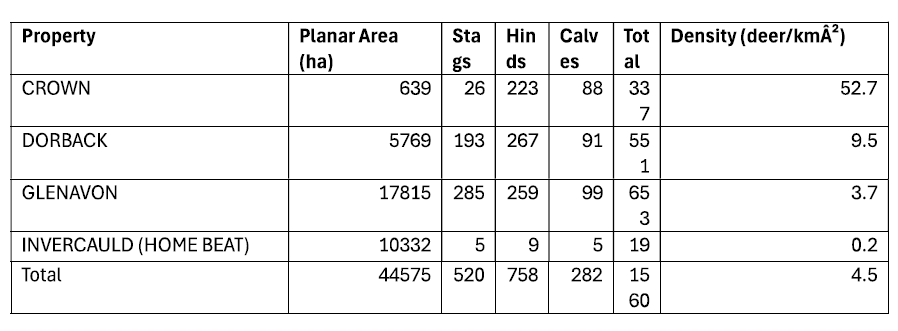
9.5 deer per square km is far too high for woodland to regenerate naturally. While OC have been reducing deer numbers since 2023, the fact they are proposing new fencing suggests numbers are well above the 2 deer per square km which would allow natural regeneration to establish quickly. As Guidance Note 7 explains:
‘Mention has been made several times of the desirability of expanding most pinewoods outside their present boundaries, both because of their fragmented state and because they naturally tend to regenerate onto open moorland, so that over a period of centuries the woods alter their shape as their margins shift to and fro across hillsides. This expansion should be achieved wherever possible by natural colonisation following the principles outlined earlier. Expansion onto heather moorland soon after burning or removal of grazing can be quite rapid.’ [my emphasis]
OC may have stopped burning at Dorback, creating very favourable conditions for the Glen Brown Caledonian pinewood to regenerate, but are undermining that potential by failing to reduce the number of large herbivores sufficiently.
OC’s business model
The problem, as I see it, is that if OC followed the Forestry Commission’s guidance, reduced grazing and allowed the existing native woodland, including the CPI sites around Glen Brown, to expand through natural regeneration they would likely go bust.
The background to their business model is well explained on the Community Benefits section of the Dorback website:
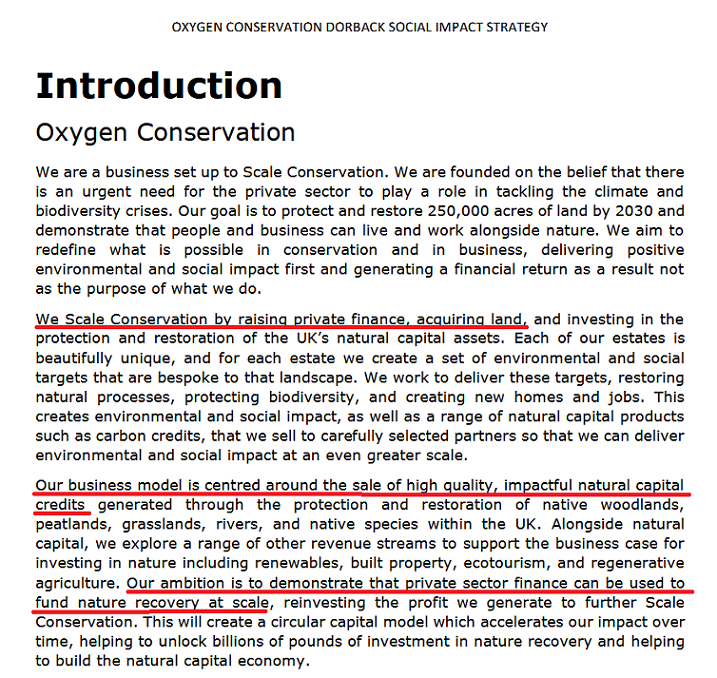
The key point to understand about this business model is that investors expect a return on their money. OC and TreeStory were good enough to meet Dave Morris, Ron Summers and myself in Spring 2025. At the meeting we made the case for co-operating with the RSPB to remove the deer fence with Abernethy (see here) and for allowing the Caledonian pinewoods to expand through natural regeneration, including the point Ron raised about linking the Glen Brown and Abernethy sites through natural regeneration. The staff were quite open, informing us that natural regeneration would not be quick enough to generate the returns that were required by investors, unlike planting. Where we disagreed was on the impacts of planting. The need to pay investors a return explains why the areas allocated for natural regeneration in Dorback’s subsequent woodland expansion plan only meet minimum requirements.
The full impact of OC’s finances on their conservation practice, however, only became apparent when when Andy Wightman revealed a few months ago that OC had paid £28,495,220 for the Dorback estate (see here). My understanding is that typically wealthy private investors expect returns of around 10% on their money and I have found nothing in anything I have read from OC suggesting they have agreed lower ‘conservation rates’. I could be wrong of course but if that is the case at Dorback, it would mean the estate would need to generate around £2.8m in profit each year, primarily from the sale of carbon credits, to satisfy their investors. That is a huge sum to make out of nature.
The previous owners of Dorback had planted an area around Baddoch Hill, which they registered under the WCC. Sales of Pending Issuance Units from this could potentially provide a return to investors in the first few years after the standard initial interest/repayment holiday on investments. However, the only way to meet those financial commitments in the medium term is to restore peatland (which OC have started to do), with a view to selling peatland carbon code credits, and plant, plant, plant with a view to selling Woodland Carbon Code (WCC credits)..
The contradiction which in my view lies at the heart of OC’s business model, is that planting does not create the sort of high quality natural capital assets they are claiming but instead, as with their proposals at Glen Brown, is undermining the potential of natural processes to restore nature.
It is worth highlighting that a similar contradiction lies at the heart of Scottish Forestry: as regulator SF are responsible both for protecting and restoring the woodland listed on the CPI they are also expected to deliver Scottish Government planting targets and oversee and promote the WCC as a means of meeting these.
The future of OC and the Caledonian pinewood at Glen Brown
A recent post by Richie Stockdale, Chief Executive of OC on Linked In makes very interesting reading (see here). It starts with the claim that:
Oxygen Conservation has been a data and technology company from before we were founded — the modelling work that became CLAUDIA predates the company itself. We built our AI and data infrastructure before large language models became a household concept, before every fund slapped “AI-enabled” on its pitch deck, and before the race to layer intelligence onto broken operating models became the defining feature of corporate strategy in 2025.
CLAUDIA ingests biophysical data, land registry records, soil carbon assessments, ecological surveys, planning designations, hydrology models, and natural capital pricing dynamics – in total more than 100 individual datasets. She models restoration potential across every land parcel in the UK.
Mr Stockdale’s openness about OC’s internal systems – many would treat this as a commercial secret – is to be commended, but the outcome at Dorback is what appears to be another fairly standard native tree planting scheme that undermines the potential of nature to restore itself.
A quote from the end of the post, under the heading ‘The Structural Bet’ is equally significant:
‘The investment logic is simple. If you believe that land will continue to appreciate, that carbon and nature markets will mature and reprice upwards, and that verified, high-integrity natural capital credits will command a structural premium over alternatives, then large-scale Scottish landscape is more than a good investment. Right now, it is the correct allocation: long-duration, inflation-protected, regenerating in value as the natural systems recover under management.
We built CLAUDIA to find the opportunities others haven’t modelled. We built Portfolio One to hold them. And now we’ve built the platform to replicate that process as we begin building Portfolio Two.’
The current evidence on land prices and the pricing of carbon markets suggests that OC may have bet wrong. If correct, that would mean it will have great difficulty repaying investors and will be vulnerable to financial collapse. The consequences of that are difficult to predict but might not necessarily be a bad thing, it could re-open the door to nature restoration driven by ecological science, not money.

There is no question that the carbon trading model encourages planting to try and get a uniform result in a predictable timeframe. The planting/ regeneration plan that TreeStory have devised is, I would say, the best that they could come up with, given the parameters that they have to work within. I dont see a problem with the birch, mixed broadleaves and low density woodland options. Pinewoods dont just consist of pine trees, these other species will bring added value to the whole, and I would imagine the pine will find spaces to regenerate within them. I suspect it is also quite likely that a small 5-10% proportion of pine will be planted within the broadleaves, and will then be enriched by a proportion of pine regen. As to the financial model and the price of land, OC are obviously speculating on a certain outcome and talking up what they are doing, but the fine print on all such undertakings will have a caveat along the lines of “The value of your investment may go down as well as up”. I am quite sure OC will understand that, so we cant be too sympathetic towards them if it happens. A market correction in land values would be a good thing, in my opinion, but we will have to see who is left holding the baby when the music stops. OC, more than anyone else, understand the dangerous game that they are playing. I just wish that our banks, including publicly owned ones, would stop fuelling the bubble by lending them money.
well indeed–root cause? http://www.slrg.scot
Today, as media reports indicate that the Cairngorms wildfire is advancing eastwards towards Dorback Estate, we must ask if, along with the burning trees, the business plans of Oxygen Conservation and TreeStory are also going up in smoke. Furthermore, In the aftermath, we must ask if Scottish Forestry, along with the investors and other financial supporters who are responsible for inappropriate planting around our naturally regenerated ancient Caledonian Pinewoods, are wasting massive amounts of public and private money in places where nature can do a better job, at minimum cost.
we can only live in hope( with Schadenfreude waiting in the wings) and that the fingers being burned are metaphorical and institutional financial ones.
Well, what a classic example of the land hegemony privateers doing what land value parasites do. The ghosts of the East India Company must be laughing up the sleeves of their shrouds. Their catamites in the political stooge-burrows of Holyrood I daresay may be a wee bit concerned, but not yet enough.
Is it only me that’s mystified that this is happening in a ‘national’ park, but of course it’s not really a true national park is it? Would it be surprising to find out that the owners of these estates are part of that group of 408 that own half of Scotland’s private land? And Nick, when you’re in the Alps and visiting national parks there, could you find out if there’s equivalent activity going on in these parks?
Nick, thanks very much for an excellent post and highlighting that article from Rich Stockdale-it really riles me!
The arrogance of commodifying Scotland’s Natural Capital, whilst taking tax-payers money in grants and side-lining communities, is appalling. These sentences say it all about the exploitative nature of their business model:
“Natural capital credits are the anchor, but not the ceiling. Scotland’s large-scale estates carry a revenue stack that most conventional land markets cannot replicate.” and
“This is the platform argument for Scottish natural capital: the same acres that generate peatland carbon and nature credits also support wind energy income, premium tourism revenue, and — as Scotland’s housing demand keeps outstripping supply — long-term development optionality. No other asset class in the UK offers that combination at scale.”
You have done a great job at exposing the fragility of their business model and its good to see that the bubble may have already burst (despite all their bluster!) – if the report by the Scottish Land Commission is anything to go by (page 4):
https://www.landcommission.gov.scot/downloads/Rural-Land-Market-Insights-2026-%E2%80%93-Policy-Briefing.pdf
The OC model leans heavily on potential income from natural capital, but it really is just a speculative pitch. Like all colonial investment models it has nothing to do with community benefits, nor ecological gain, nor local economic growth. The aim is simple, sell at Year 10 and pocket the dosh. This model relies on their being gullible buyers out there that believe the story. Hopefully your article we help burst their bubble!
I am sad to say this is exactly the ‘model’ the Scottish Government wants . OC are not doing anything sneaky – they are just doing exactly what the Government intends – harvesting public grants optimally and planting up as many hectares as possible. That’s the real scandal here.
Oxygen Conservation appears to have been struggling to sell its carbon credits with only one much-mentioned deal announced so far. That was by Burges Salmon, its solicitors, who bought credits for up to £1m at £125/tonne. I have not seen any other announcements of completed BNG sales and unfortunately £1m does not go far when one considers the capital sums.
https://www.burges-salmon.com/oxygen-conservation-and-burges-salmon-seal-1-million-partnership-for-8000-uk-based-premium-quality-carbon-credits/
The problem of finding ready buyers for BNG credits extends well beyond OC. Nattergal — led by Charlie Burrell of Knepp fame – has also been struggling to close sales even with the Goldsmith heft behind it. Progress at their development at Boothby in Lincolnshire had slowed noticeably and they have only announced one real success in carbon sales: £1m up front on a sale of 10,000 tCO2e carbon units under the Wilder Carbon Standard at £100 a tonne when both Nattergal and OC had talked of £400 being reached. The problem is at the moment demand for Carbon Credits is thin.
Even without BNG sales Knepp is profitable by exploiting other revenue streams — but while people will travel to experience Knepp, exploiting visitor revenue is more problematic the more sites you add and keeping locals on board is a challenge.
https://www.theguardian.com/news/2026/jul/09/it-makes-your-heart-sing-rewilding-britains-bleak-farmland
While the Povlsens seem to have the capital to develop a fully integrated rewilding/tourism project with Wildland — and it has a natural customer for BNG credits in other Povlsen-owned businesses, Oxygen will rely on securing BNG sales in a market that is still forming. At the moment at least carbon unit sales are hard to come by and priced at well below the level that premium vendors such as OC and Nattergal are hoping to achieve.
Well said