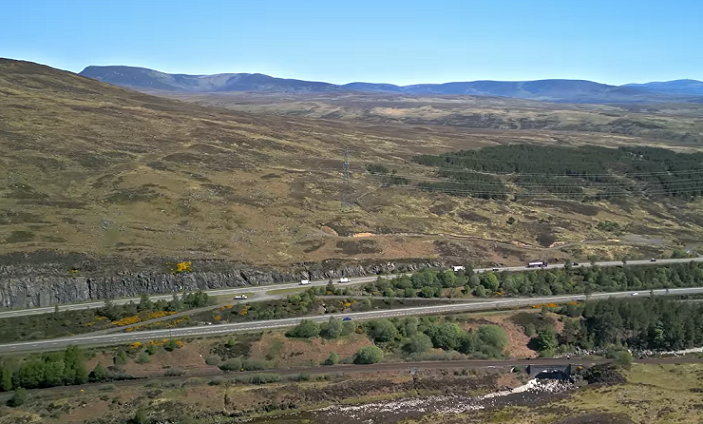
The section of dual carriage way on the A9 between Dalmamein and Dalnaspidal, just south of Drumochter, was opened in November 1979. The woodland along it is highlighted in Lesley Riddoch’s film, “Scotland’s Missing Forests: the Great Eco-Conspiracy” (see here). That film, which has had over 200,000 views, focuses on the restorative tree planting by Ron Greer, Derek Pretswell and others at nearby Loch Garry:
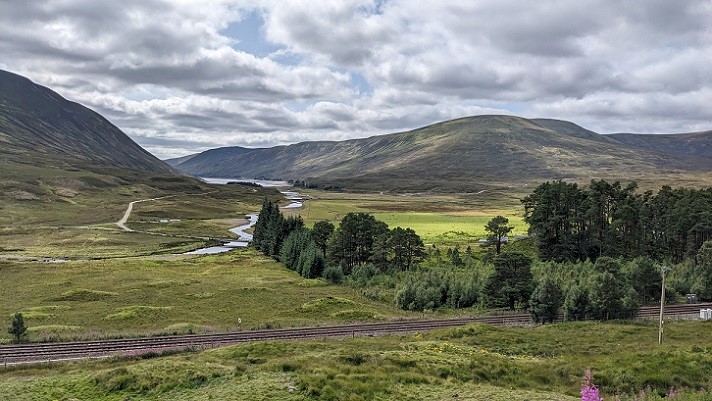
I had long been meaning to write about woodland along the A9, contrasting recent planting with past natural regeneration, but someone advised me last year they thought Ron Greer had planted some of the trees along the dual carriageway south of Drumochter. Near the end of August, I went with Ron – whom I had never met before but who has contributed to parkswatch (see here), (here) and (here) – to have a look at what he had done and to talk about the merits of tree planting v natural regeneration on site.
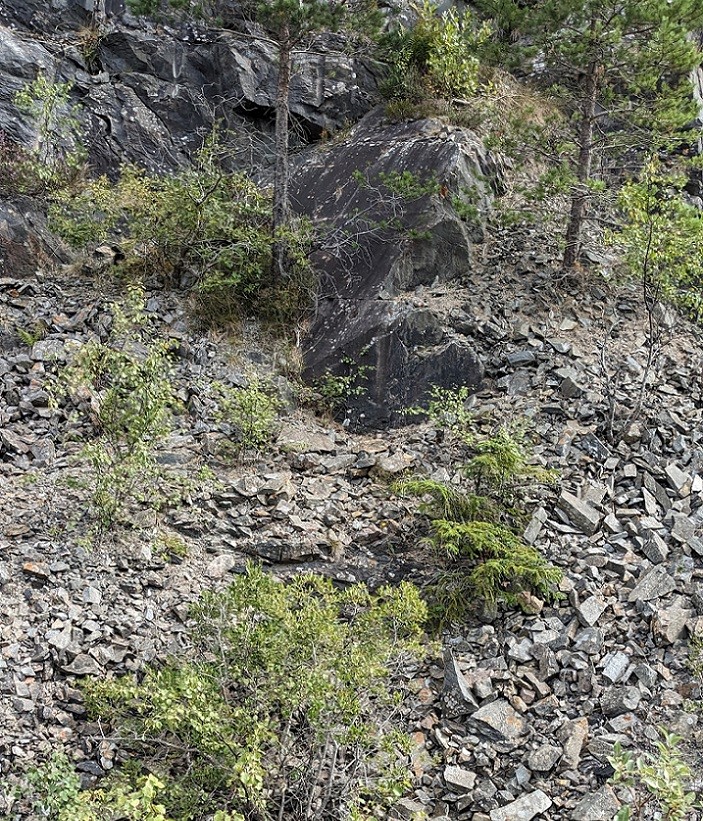
The first thing that Ron emphasised was that when the dual carriageway the area affected by the construction had been left almost completely barren and the newly exposed rock faces held little or no soil. It was the type of ground and at an altitude (above 400m) where most people in Scotland thought it was impossible for trees to grow. This was at a time when the Drumochter was regularly closed by windblown snow but, from what he had seen in Norway and Alaska, Ron thought they were wrong. He therefore planted a small number of trees, less than 30 in total, to see what would happen.
Ron’s project was therefore scientific in nature and purpose and completely different to the large native woodland planting projects that have proliferated over the Highlands since the 1990s (see here and here for two early examples).
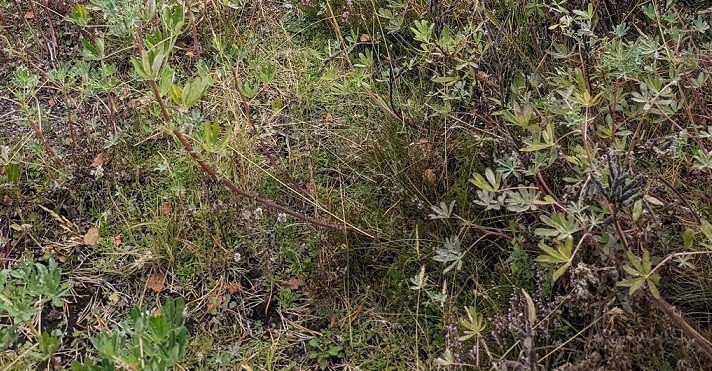
Ron also used the area along the dual carriageway as a nursery for lupins, soil improving plants, whose seed he then used along the shores of Loch Garry to help the trees he planted there to get established.
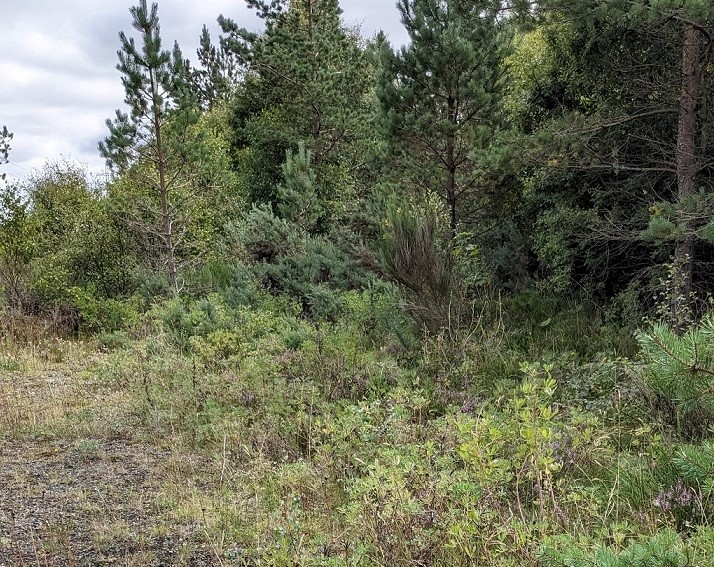
The progeny of those lupins can still be seen in some of the remaining open areas along the central section of the dual carriageway. Lupins, as Ron explained, quickly get shaded out and the ones you can see now are in different places to where they were originally planted. Although the lupins may have helped some of the trees to get established, they never proliferated to the extent that they account for what has happened since.
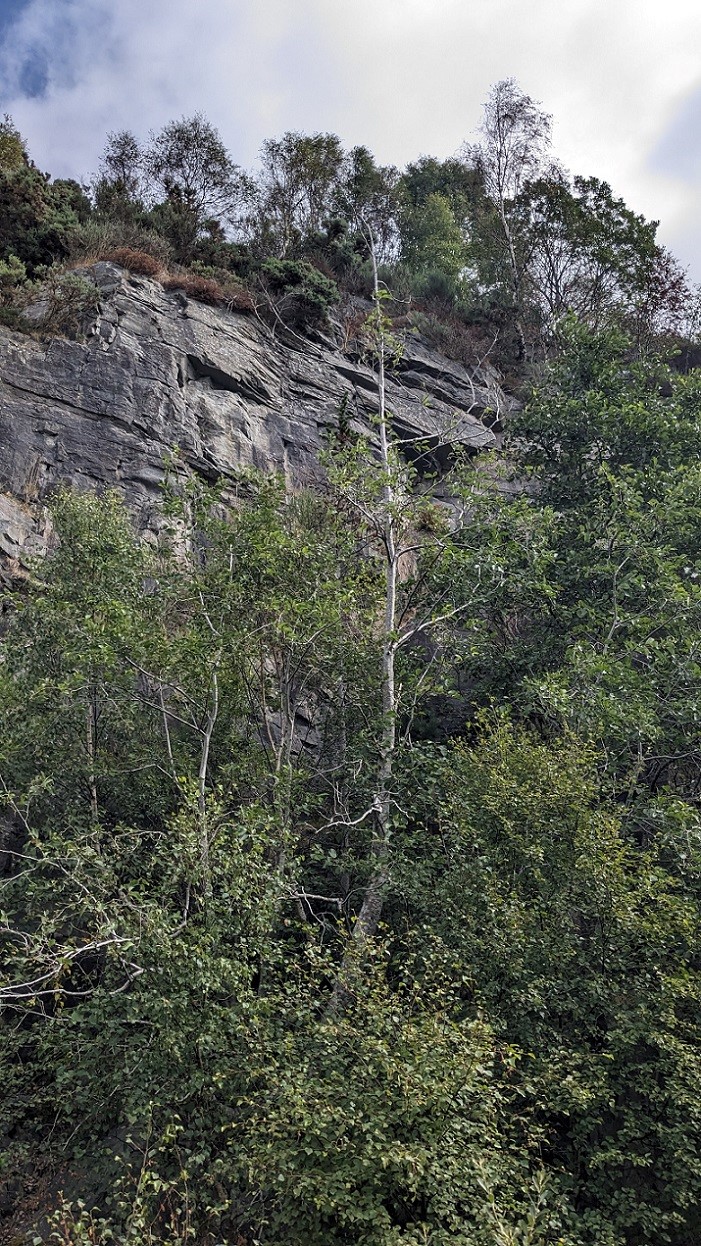
Ron stressed that the vast majority of the trees that we saw owed their origins not to the trees he had planted but rather have colonised the area by natural means. He is certain about this because many of the species now found on the site are different to those he planted. He has also been monitoring ‘his’ trees ever since he planted them, keeping track of those that have survived and noting those that have started to produce seed and regenerate naturally.
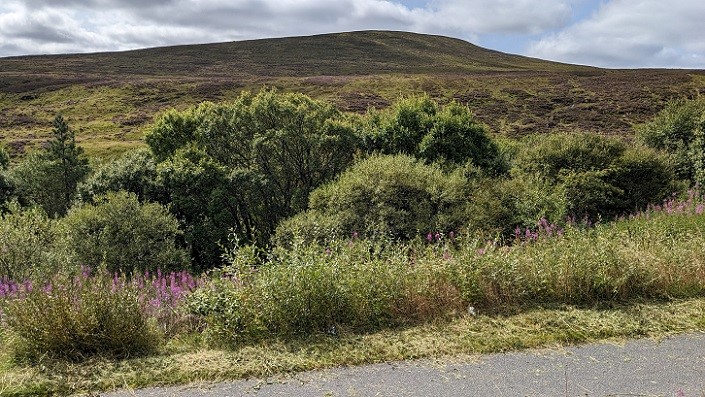
While almost two hundred years of muirburn and overgrazing by deer had removed trees from the hillsides south of Drumochter, pockets of native woodland had survived along the banks of the River Garry inaccessible to grazing,. It appears these then spread along the narrow area on either side of the railway protected by fencing (see top photo).
A local seed source of this extent would now be considered by Scottish Forestry as insufficient for natural regeneration and used as a justification for planting native trees with public money under the Forestry Grants Scheme. The evidence, however, shows that despite the harsh environment, it has taken less than 45 years for trees and many other species to colonise the much wider corridor created by the A9 dualling and form new woodland.
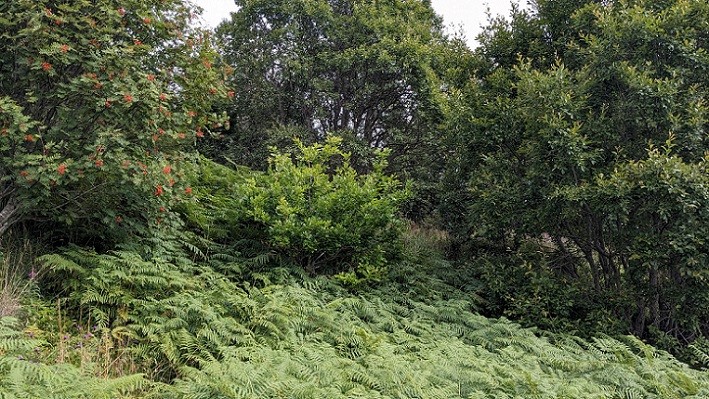
This is partly because much natural regeneration does not depend on the availability of a local seed source. Birds, mammals and the wind can all transport seed considerable distances and in the case of species like rowan, miles and miles. This seed gets scattered all over the countryside but in most cases any that takes root then gets eaten or burned. As soon as an area is protected from overgrazing or muirburn, as on the A9 corridor, trees start to get established. Part of the importance of the natural regeneration along dualled section of the A9 is it shows just how little time it takes for diverse woodland to develop.
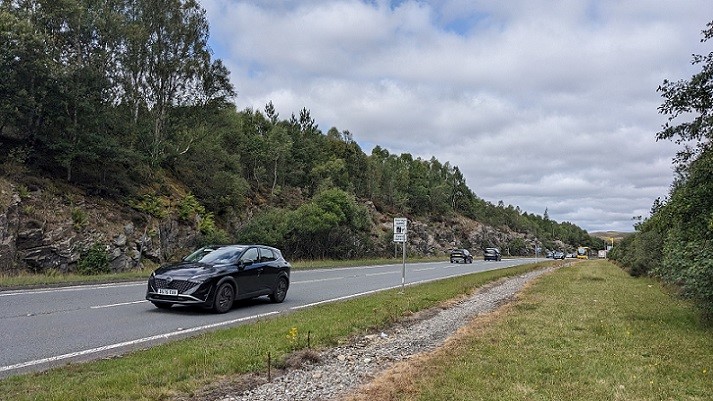
The naturally regenerated woodland along the single track section of the A9 just to the east of the dual carriageway contains a fair amount of birch and Scots Pine, the species most commonly planted under native woodland creation schemes and the Woodland Carbon Code (see here and here for example). Ron highlighted, however, that the naturally regenerated woodland along the dual carriageway is far more diverse and contains a high proportion of willow species.
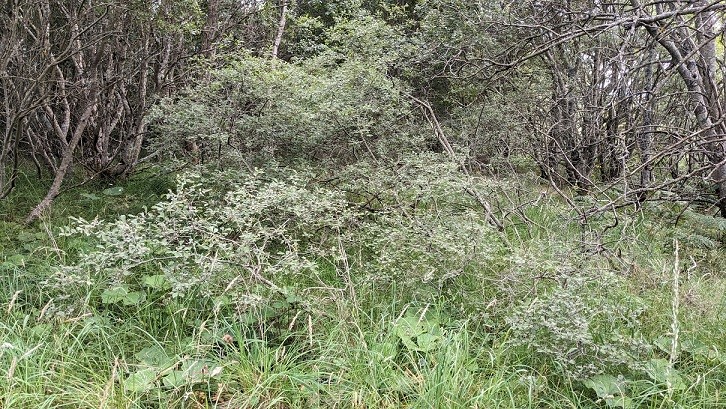
While noting every area is different and what tree grows where is affected by multiple factors, Ron also observed that the forest industry at present is planting what appears, from the evidence on the ground, to be an unnaturally high proportion of birch. That observation is supported by an analysis of tree records in the Cairngorms National Park by Andy Amphlett (see here) which he cited in his recent post on the Altitudinal Range of the Abernethy/Glenmore wildfire (see here): Andy’s analysis showed that downy birch (betula pubescens) came 7th or 8th in the tree species most commonly found between 500 and 1000m.
Everyone who professes to care about the landscape of the Highlands – whether conservationists, land-managers, politicians or members of the public– should consider what can be learned from the natural regeneration of woodland between Dalnamein and Dalnaspidal and the implications for land-use and management in Scotland. Even better, if driving up the A9, they should stop off in one of the laybys and take a look for themselves. A few interpretation boards from the Cairngorms National Park Authority would be money well spent.
At Dalnaspidal Ron had been banned by estate staff from parking because of what he had explained in Lesley Riddoch’s film. After they found red grouse (supposedly a moorland bird) were nesting in the woodland enclosures and their chicks were getting trapped, they opened up the fencing but without removing the sheep. In the film Ron noted, with some surprise, just how quickly sheep had destroyed the woodland understorey.
I was able to park, however, and we went to have a look at the “restoration” of the ground affected by the construction of the Beauly Denny powerful, an area Ron had not visited before and hidden from the A9 by trees. I will consider what we saw in a further post.

Interesting article re the recent dualling of the A9 which is continuing on single scections between Perth and Inverness
For those of a certain age they will only too well remember the original A9 upgrade back in the 70s and 80s.
But lesser known is the fact that when building the A9 in the 70s and 80s the then new road in places intersected parts of the old General Wade roads installed to subdue the.Highlands.
One wonders of the upgrades that progress today along with the explosion of wind farms and ultra high capacity electricity interconnectors and massive new pump storage schemes scheduled for the Great Glen.
Power from the glens for the glens, its interesting what the future holds as all this infrastructure progresses in our environment. Good and or bad and for who.
The A9 central reservation has grown up in the way that many roadside verges and river/loch sides have in the last 50 years in places where grazing has been removed. The reason the hills around look different is that they have been managed to a different objective. If you look at the west of the A9 from Killiecrankie northwards, there have been 3 X large planting schemes over 30 years or so taking things up to the Trinafour road, and now we also have the large Dalnacardoch Estate trying to “rewild” as well. So people can change their management if it makes sense for them to do so. I dont want to p*ss on Ron’s chips here, he is making his points in a well structured and patient way, but we do know all this stuff already. The evidence in front of us is that people are already changing the way we manage land. If we want them to do that more quickly, then we make greater resources available. The only thing we have to watch is that changing carbon rich moorland, which is what the A9 is surrounded by, in to woodland is going to release CO2 in the short to medium time. While people are cautious of birch, it is still the most useful pioneer species we have, and an important component of almost every other woodland type. I have however always liked that mixed willow habitat that springs up when native woodland gets half a chance, and perhaps it is a much more valuable species/ family of species than we sometimes give it credit for. I am a big fan of the Loch Garry Tree Project, and from an historical perspective, it deserves an interpretation board as well. It certainly helped inspire me as a student, and I know many others as well.
Dinnae worry Victor, people , including the senior management level of my previous employer and some in the wider conservationist NGO-Quangocracy have been pissing on the Loch Garry chips since I started planting trees to help fish 50+years ago. Now, these days, riparian woodland planting is almost de rigeur. To that extent , I’ve had the pleasure of seeing the clans McShouldnae, McCannae and MacWulnae proved wrong, if not yet defeated.
I’m not passing judgement on birch as a species, only on those blinkered ‘betulaphiles’ and the simple expansion of birch woodland as the single species potential when the bioclimatic, edaphic and visual evidence suggests a very much more diverse option as is unfolding before our eyes when muirburning ceases, sheep are removed and deer numbers reduced.
Aye of course, those of us operating in our specific interests in the natural environment have long known that the Highlands are not the unspoiled wilderness of erstwhile popular mythology, neither are they the’ wasteland ripe for development’ of the political-bureaucratic philistines, but there are many out there, who maybe otherwise articulate and well educated who do not appreciate the current situation and the historical circumstances that gave rise to them. This point was made clear to me after the showing of the film I made with Steve Rawson on the A9 embankments, prior to the one we made with Derek Pretswell and Lesley Riddoch, that the up[land the upland when a local person with a doctorate told me that she did not appreciate that the upland environment which surrounded her was not natural.
Aye, Victor, what we did a Loch Garry, through not just our own efforts, but also through pre-social media concerted and cogent media coverage, certainly played its part in influencing peoples perceptions of what the upland environment was capable of. It also brought in an increased awareness of international bioclimatic analogies, especially in respect of Iceland and Norway. Something Derek and I developed further in relation to our comprehensive New Caledonia rehabilitation project which was 40 years ahead of what Anders Povlslen and The Durell Trust are doing in what would have been its core area, the difference being that what we proposed would have had an inbuilt, locally based human community regeneration component from day one— internal bottom up and not external top down as is happening now. There was a quite a bit of media coverage of this too as well as NGO-Quango inter communication about it. I would not be in the least surprised if both these and the planting schemes you mentioned, were influenced by it.
You’re right, Victor, about lots of other roadside verges showing tree regeneration, but the thing about the A9 is its sheer scale as it runs through core parts of the waste scape of the Victorian Edwardian Dystopia, demonstrating to millions of drivers and passengers each year that the surrounding landscape is not the only option or perhaps even the optimum option
This is much appreciated and clears up/highlights pertinent issues.
The vast majority of the regen, both of native and exotic species is natural deriving from scattered stands along the Perth-Inverness railway, inaccessible gullies/steep slopes and already established commercial stands. In respect of native species there is apart from one or two sections, not so much birch as some conservationists may have expected and more rowan and willow than might at first have been predicted. As Derek Pretswell, Stuart Adair and myself have oft times commented ‘the trees will tell us where they are going to grow’
Great to see this excellent example written up so well, to remind us all what is possible. And heartelt thanks to Ron Greer and colleagues for all their pioneering and ongoing work on these issues. We have just driven past this area a few times in recent weeks en route to continuing our multi-decade documentation of natural regen of woodland in the Cairngorms, and feel gratitude to you all every time we pass by.
Patricia & Angus Macdonald
Perfect & delightful.
Thanks indeed Patricia, much appreciated. This is not the official response I might have got when I first started planting deciduous trees at a site 1400ft in altitude in order to help fish, some 50 years ago!. This change in official attitude just took a lot of time and effort by the Loch Garry Tree Group, Scottish Native Woods , various other individuals and of course Derek Pretswell and myself. Derek and I had the pleasure of meeting, getting support and advice from Donald McVean, Jim Lockie and Duncan Poore. A key piece was given to me by Donald ‘Ron when you start a tree-planting project, you must pretend that you are immortal’ and another was ‘it does not pay to be ahead of your time’ Derek and I have vindicated both!!
hi Ron, great to see that you are getting the message out for tree regeneration, i read somewhere that some seeds germinate better if passed through a wolf, forget which seeds though, but with the loss of such wildlife that could account for poor regeneration? maybe with the breed and release of pine martens trees such as rowan may do better?
Well hopefully, but since John Swinney can’t engage with the concept of Lynx we have some distance to go yet.
and further Patricia and Angus it is very gratifying and enheartening to know that our pioneering work is so appreciated. It is also so encouraging to know that a long term monitoring process is in progress. Tis 50+ years since I started at Loch Garry, but on a tree time scale, it was only 5 minutes ago! I just made a start–that’s all
This area demonstrates well how woodland would have expanded after the ice age on largely mineral soils (the Mesocratic phase). Trees certainly regenerate well on disturbed ground, but this not particularly relevant to tree distribution after millennia of leaching and development of stratified soils, including development of ironpans, i.e. in today’s oligocratic phase.
Hence this area has no particular relevance to expected tree distribution today. The Roy map of 1750 shows no woodland in this area, although there is some further south at Bruar.
The Roy map shows woodland on Meall na Leitrach as of 1755. The Great White Sheep and the associated burning regime came around 1790. No need to call in Sherlock Holmes. No worries James, if the soils are not suitable for tree regeneration they won’t regenerate naturally in the absence of non-native sheep and the muirburning regime of of the VED regime eh?
Your note about Roy’s Map of 1755 showing trees in Meall na Leitrach is interesting and adds weight to your view that sheep grazing and burning has caused the demise of that woodland. Do you have any views on why that is the only piece of woodland mapped by Roy in 1755 on the 22 miles route between Allt nan Cuinnaeg NW of Calvine, through Dalwhinnie and up Loch Ettridg. I’m also wondering why there were no trees on the NW shores of Loch Garry and very few on the NW shores of Loch Ericht
The planting of lupins, for the reasons highlighted by Nick is valid, but was secondary to the main reason for using them being their capacity to tolerate the conditions in the draw-down zone of hydro-electric reservoirs in a way that native plants cannot do. In so doing they can contribute 2-4 tonnes of nutrient rich biodegradable per annum, per hectare of leaf-litter that feeds invertebrates, thence fish and further thence piscivorous ‘starbirds’ so beloved of conservationists. A key element in this nutrient supply is that of biologically available organic nitrogen at a rate of 50-100kg per hectare per annum. Nitrogen being the basic building block of amino acids that in turn forms the muscle tissue etc in higher animals.
Further to Nick’s mention of some earlier pieces I contributed to PWS, I would recommend, in order to get a fuller background to our work at Loch Garry and the motivations for planting trees and lupins that readers take a look at the PWS article ‘The Hidden Horrors of Hydro’ in the August 2018 chapter.
The new trees inside and beside the A9 are highly visible to many, but if heading up that road, then take a left at Dalwhinnie and head off to Creag Meagaidh. Acquired by the government in 1986, and the brainchild of the late great Dick Balharry, this vast estate was cleared of sheep, the deer population reduced to about 10% of previous numbers, and the land was left alone. I went up there in the mid nineties with Dick and a film crew, the trees were coming back then, we found saplings as high as Lochan Coire Adair. It is now a forest walk from the car park for quite some considerable distance. Surely the best large scale example of natural regeneration in Britain. I wrote about it on this site some years ago, perhaps Nick can add a “hotlink” to my piece?
Dick Balharry was one of my inspirations and it was a privilege to meet him in life and to be asked to write a eulogy in his honour in the Scotsman after his all too early death. The Loch Garry Tree Group, paid a group visit to Creag Meagaidh not long after its founding in 1986 and as a fairly frequent passer by in my loch studies it is fascinating to see how the expansion of woodland by natural regen has occurred once sheep were removed and the deer pressure reduced.. One of the hotlinks Nick posted describes how I see this area’s potential for the establishment of a National Wildlife Refugium. I’m sure you’ll be interested to see the screenplay I’ve developed and the novel I’m now writing enter the public doman.
Here is l
In this post, Nick refers to planting of ‘Lupins’, and Ron Greer clarified (in a reply) that the main reason for using them was their capacity to tolerate conditions in the draw-down zone of hydro-electric reservoirs. My understanding is that Ron planted Nootka Lupin (Lupinus nootkatensis).
Today across the Cairngorms National Park, the most widespread Lupins outwith gardens are Russell Lupin, the ones with multi-coloured flower spikes (Lupinus arboreus x polyphyllus = L. x regalis), Garden Lupin, which perversely is not usually grown in gardens (Lupinus polyphyllus) and probably backcrosses between them. These are especially common along some sections of the River Spey. In my experience (Rivers Spey, Beauly and Glass), Nootka Lupin is not invasive. Along the Spey it has either declined or was (quite possibly) misidentified in the past, and is now only found at Grantown on Spey, where in 2025 just two small patches remained. But (and it is a big BUT), the other Lupin taxa mentioned above are an absolute menace to native plant species diversity along riversides, including open shingle habitats. Those Lupins are anything but a benign addition to the landscape.
I have only planted Lupiinus nootkatensis in specific locations for the specific purpose stated. and outside of the draw-down zone of the man-made aquatic deserts of hydro-reservoirs, only on other man-made situations as a seed source for the main purpose and not in any high-conservation status environments.. They have been here for over 100 years and if they were going to be a problem we would probably know about it by now. They are defo not in the same category as Knotweed, Sitka, Rhodies or sheep.
Nick’s post focuses on the dual carriage way section of the A9 between Dalmamein and Dalnaspidal, just south of Drumochter. North of Dalnaspidal, there are further interesting examples of natural regeneration of trees and shrubs between the single carriageway A9 and the train line.
Of particular note are three exceptionally large bushes of Downy Willow (Salix lapponum) at 450 m altitude at NN62987628. These are easily accessed by walking c. 200m north along the cycle path from the large lay-by at NN631760. One of these bushes is shown in Figure 30 of my paper that Nick provided a link to in his post. These bushes are in wet ground, which was unlikely to have been disturbed when this section of the road was constructed.
There is another huge Downy Willow at 374 m altitude at NN63948316 (on the east side of the River Truim, just north of the A9 / A889 junction. This bush may be lost when the A9 is dualled, so worth seeking out.
Aye, indeed Andy and we’ve been keeping an eye on this section between the railway and the A9, for over 30 years and have collected both seed and cuttings from these willows for use at Loch Garry, but now that the estate has taken down the fences the non-native sheep have damaged or eradicated them.
Further to your and our observations, what appears to be happening is the development of at least a quasi forest-bog situation, but let’s hope Victor Clements and James Fenton don’t recommend it’s destruction in the name of the great god Carbon. The A9 dualing may destroy it anyway.