This morning the board of the Cairngorms National Park Authority (CNPA) is meeting for the first time since the Abernethy/Glenmore wildfire which started on Wednesday 15th July. Increasingly the CNPA has started to resemble the Loch Lomond and Trossachs National Park Authority where staff take all the decisions and the board acts as a figleaf. The agenda for the meeting (see here) is threadbare. Given the significance of the wildfire for the National Park Authority at the very least one might have expected a dedicated agenda item under which board members were asked to consider what happened and the implications for the future but there is none. Instead, scattered through the Chief Executive’s and Convener’s 15 page “report” (see here) there are various titbits of information about the CNPA’s response to the wildfire, without any attempt at structured description or analysis.
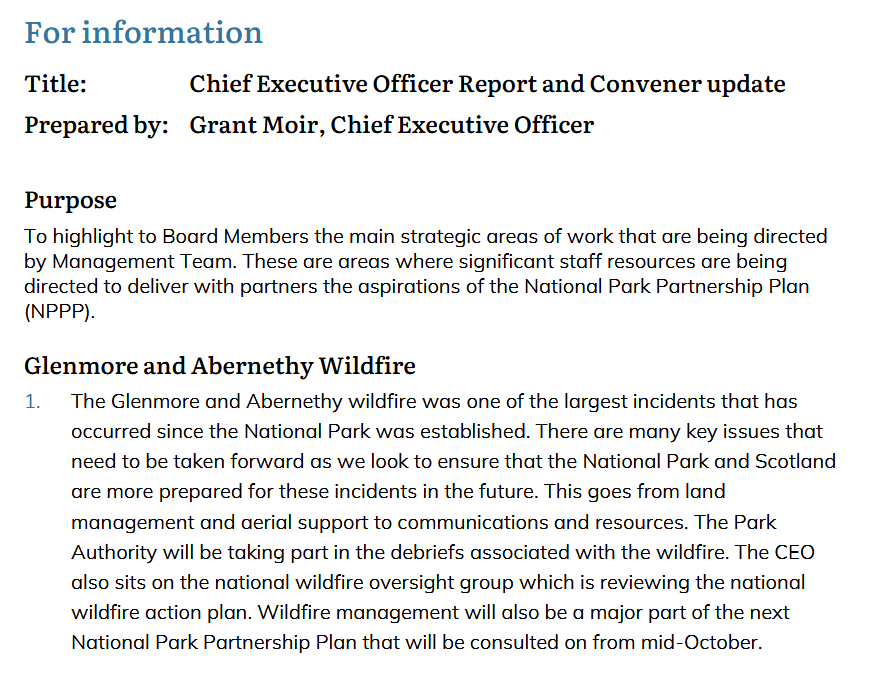
So why, if “there are many key issues that need to be taken forward” as a result of this “incident”, are these issues not even listed? And who has decided that “wildfire management will also be a major part of the next National Park Partnership Plan (NPPP) that will be consulted on from mid-October”?
The CNPA’s current NPPP (2025-27) committed to reducing wildfire risk by developing an Integrated Fire Management Plan. This was adopted in July/August 2025 (see here for plan). The statement from staff that wildfire management needs to be a “major part” of the next NPPP is an acknowledgement that the CNPA’s new Integrated Fire Management Plan was found wanting when it came to fighting the Abernethy/Glenmore wildfire. So why have they not described in a board paper what worked, what didn’t and ask board members what needs to change?
Nowhere in the CEO’s report is there a suggestion that the current Integrated Fire Management Plan needs to be reviewed as a matter of urgency, so improved arrangements for fire fighting can be put n place before next year. Nor is there any consideration of the cause of the wildfire and whether the CNPA’s Fire Management byelaw made any difference.
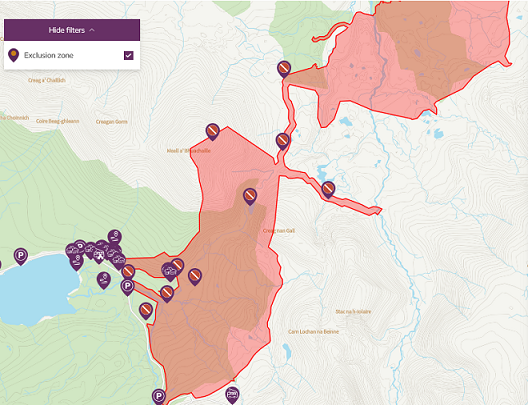
As for consideration of other important matters, like the impact for conservation or management of access rights, both of which have been covered in various posts on parkswatch (see here and here for example) there is not a mention. CNPA staff have not even provided board members with a map of the areas and landholdings affected by the fire, despite apparently flying drones all over the area in an attempt to find thermal hot spots.
While it is truly fascinating to learn that the CNPA’s following on social media has increased as a consequence of the wildfire (e.g. Facebook followers are up 11,251 to 53,316), the only significant information comes in the “Update” from the Convener of the Board, Sandy Bremner, and concerns helicopters.
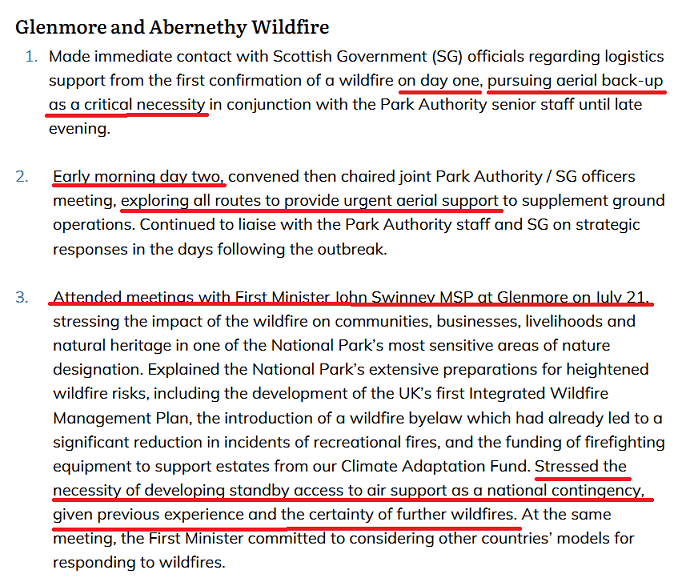
Sandy clearly made strenuous efforts to get the Scottish Government to agree to helicopters being deployed to fight the fire from Day 1. Unfortunately, it appears the Scottish Fire and Rescue Service did not deploy helicopters until about 30 hours after the wildfire had started, by which time it was completely out of control and uncontainable even with helicopters. 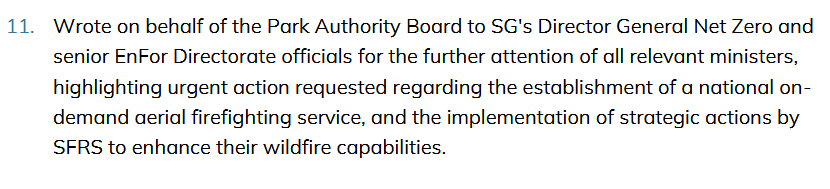
It is also very significant that Sandy also then highlighted the need for a “national on-demand aerial fire fighting service” to the Scottish Government. It appears his efforts, along with the local campaigning on the need for helicopters, prompted the announcement from the Justice Secretary, Neil Gray, on 3rd September, that helicopters would be put on standby at times of high fire risk in future (see here).
This raises the question, however, of why Sandy and other board members did not demand an “on-demand aerial firefighting service” before approving their Integrated Fire Management Plan last year? Instead of a national fire fighting service that plan recommended the use of helicopters should be up to estates who should take out insurance to pay for them:
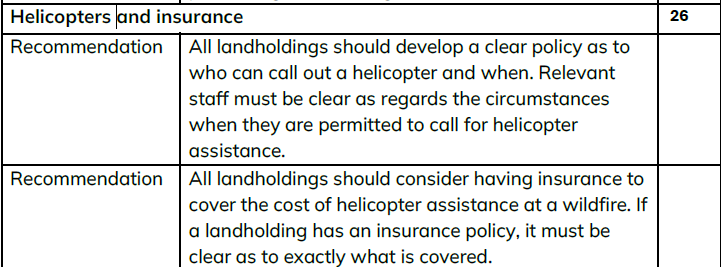
This was always pie in the sky. Helicopter insurance is not even a requirement of the muirburn licensing scheme which came into effect 10 days ago. No helicopter company is going to keep helicopters on standby just in case muirburn gets out of control or is started accidentally, as when a flare from another helicopter was responsible for the first of the wildfires on Dava Moor last year. The cost of fighting wildfires that get out of control and last for days, such as that at Glenmore/Abernethy, is also so great as to be uninsurable. (While I believe helicopter wildfire insurance is unworkable, I am in the process of submitting FOI requests to find out which of the landholdings affected by the Abernethy/Glenmore wildfire had insurance).
So why did Sandy and other board members ever agree to these recommendations when clearly Sandy and senior staff knew from the moment this wildfire started that helicopters were required?
And more to the point, why not admit publicly in a board paper that this and other recommendations in the Integrated Fire Management Plan were not fit for purpose and therefore that that plan needs to be revised?
Sandy’s update report also provides another more minor example of the need for this in a very honest paragraph in which he states he was “meeting volunteers, support staff and community representatives at the village hall in Nethy Bridge before being excluded by a SFRS’s Incident Commander, along with other elected representatives of public bodies”. Unfortunately, it is left to others to draw the conclusions, that the CNPA’s Fire Management Plan is far from “integrated”, has failed in important respects to improve joint working between public authorities and the current version needs to be incinerated sooner rather than later.

The CNPA Fire Plan is the sort of document that is required to satisfy the requirements of a board meeting or policy development, but which assumes any fire arising will happen to someone else and not you. The statistic that we are missing here and which would transform things is an educated estimate of the cost of the fire this summer, including a daily rate applied to all those attending, and for various kinds of equipment involved. The £3 million compensation will just be part of it. Putting a price on the number of tonnes of carbon lost would be a good exercise as well. If we can do these things, then we will get to see the full picture…… and I can assure you the total will scare people. We also have to remember that the Cairngorms fire this summer was really the only one. What would have happened had there been multiple fires in different locations across the country at the same time? That is what we need to be ready for, and that would be a MUCH bigger test. I agree with Nick on this. An insurance based scheme will not work. We need a couple of helicopters sitting at airport in Inverness which can go wherever they are required.
I think it’s worth highlighting that at present there are only two helicopter companies in Scotland that currently undertake aerial firefighting (PDG and Skyhook). They have <25 helicopters in total between them, and although I don't know how many of them are able to be equipped to conduct firefighting, it is likely to be less. This is further compounded by the fact that they are commercial operations, so they may be contracted out on other work and not available when fire breaks out. This is a very limited resource available to undertake firefighting especially when there are multiple large incidents ongoing .This means that even in instances where insurance for aerial firefighting is in place or a landowner is willing to front the costs, sometimes there just aren't any helicopters available to undertake the work, or they need to travel large distances to move between outbreaks resulting in delays that allow the fire to escalate. I'll need to see if I can find the source, but I believe this was stated to be one of the contributing factors in why the Glenmore fire got so out of hand. As stated in this article, the call for a helicopter was made early, but nothing was available to come as they were already engaged elsewhere. Increasing the availability and accessibility of equipment for aerial firefighting would go a long way to preventing these incidents from escalating so severely, which would then reduce the cost of fire control and risk of environmental damage. Strange that SFRS don't have at least one or two in their armoury.
Why does this CNPA report not explain that the actions of the Scottish Fire and Rescue Service when dealing with the Cairngorms fire was a total shambles? The damage done by the fire and the SRFS attempts to control it, through the creation of access roads and firebreaks through some of the UK’s finest areas of wildlife and scenery, will live with us for decades. The SFRS senior management was totally unprepared for a fire of this type in such an area. And the CNPA can do no more than whimper in response! All are part of a chronic system in which every public body in Scotland works to protect the backs of every other public body as a first priority. This is why the Councillors of Highland Region are demanding a public inquiry so that the incompetence of the senior management of SFRS and others will be exposed to proper public scrutiny.
Nobody, including the fire services, can afford to have helicopters with trained crew on standby. As Coup has pointed out the helicopters based in Scotland were fighting huge blazes in North Wales and in the Manchester area when the Cairngorm fire was started. Perhaps the RAF should have a couple of fixed wing water bombers based in the UK,, maybe in partnership with Europe. They deliver massively bigger amounts than a helicopter. But given that there is really no such thing as a wildfire, they are all started by human agency, our governments need to invest in a big public information programme on fires and cooking in the countryside. Stop them being lit in the first place.
I know very little about helicopters and nothing about flying them. Others will know more. Nonetheless it seems logical to assume suitably qualified and experienced pilots are needed to fly them plus a supporting/refueling crew. Pilots presumeably have defined flying hours within a multiday fire and are ticketed for different type of helicopter. Experienced fire fighting pilots appear to be in demand world wide with that demand set to increase.
It was alleged that a delay in aerial support for the 2025 Dava fire was due to pilot flying hours being taken up in support of filming for the Odyssey movie and a requisite break was required before they could take to the air again. I’m also told that much beyond the ‘golden hour’ after a fire starts it is usually ‘boots on the ground’ with the right kit and high volume pumps that are the most effective suppression measures. Accepting hard to reach and steep ground locations. Day time aerial support with 1000 litre ‘Bambi buckets’ beyond a single dip and drop 5 -10 min fly time has its limitations. Aerial spread of wetting agents and retardants to create stop lines is an option but come with significant contamination risk.
As Victor says, the current CNPA Fire Management Plan looks good at a Board Meeting, but doesn’t meet the real requirements of a plan to tackle a wildfire. I read it and also came to that conclusion. This is especially true when it appears this CNPA Board is just fed platitudes from the senior CNPA staff. However, as we know too well, CNPA behaves just like so many other public bodies in the way it uses its Board as a ‘rubber stamping’ Committee. Other examples include LLTNPA and HIE. I suspect this misuse of Boards is endemic amongst Scottish Government sponsored public bodies….. and probably there is where the rot starts, our Scottish Government and its gloss to try to cover up the numerous failings of our Scottish Government.
The Cairngorms Crofters & Farmers Community group hosted a Wildfire Public Meeting on the 18th Sept, which over 300 people attended.
A resident from Tulloch stood up and told Jim Fairlie MSP and Kenny Barbour from SFRS that on hearing there were no helicopters available, he took it upon himself to call the helicopter companies, to be told by one that there was one available! An independent enquiry is most definately needed, otherwise both Scotgov and SFRS will just “mark their own homework”.