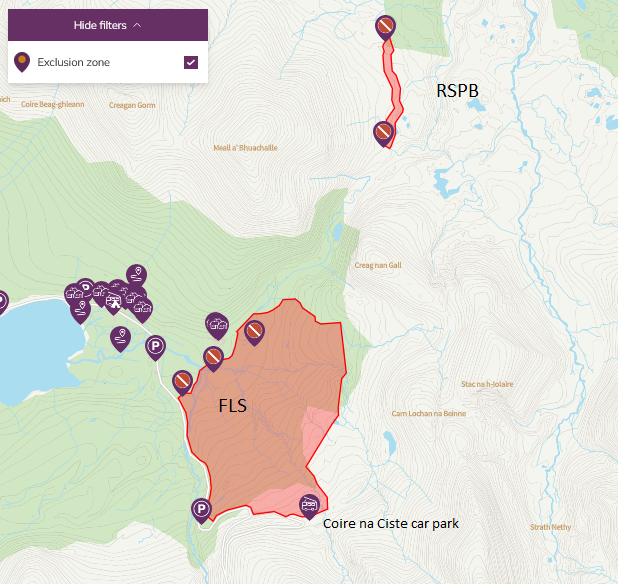
Last Friday, 2nd October, the area still covered by the Cairngorms National Park Authority (CNPA)’s unlawful exclusion zone (see here) Abernethy and Glenmore was significantly reduced in size.
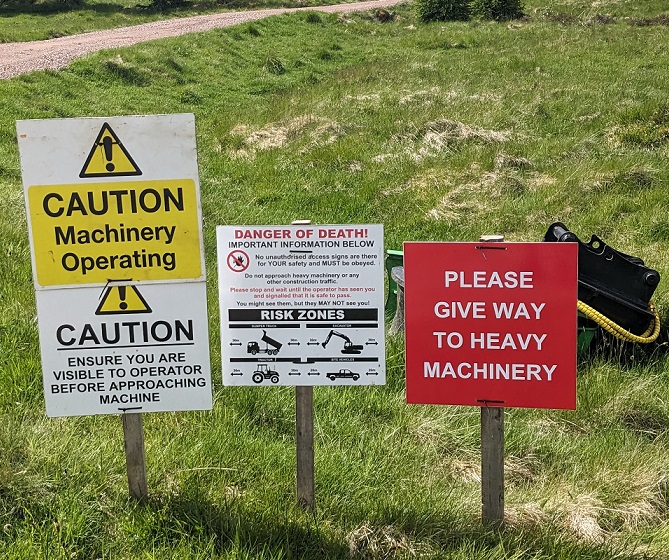
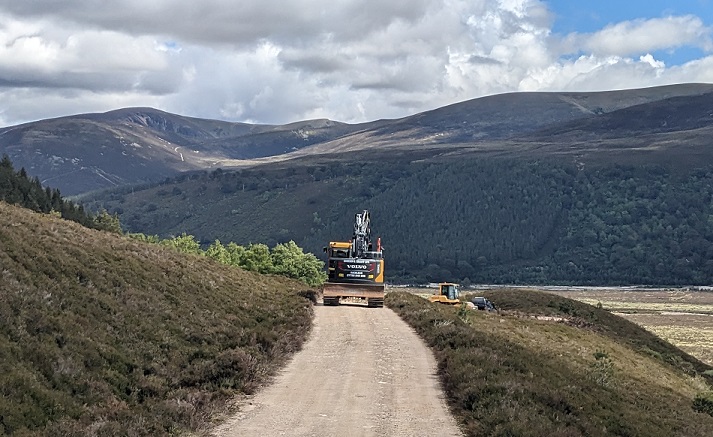 A little way beyond there were two machines re-surfacing the track. Rather than interrupt the work, I decided to walk through the heather, out of range of the machinery, but the operators saw me, stopped work and beckoned me back on to the track. Really nice people and a good demonstration that there is no need to “close” tracks to manage safety issues relating to machinery working on or using tracks.
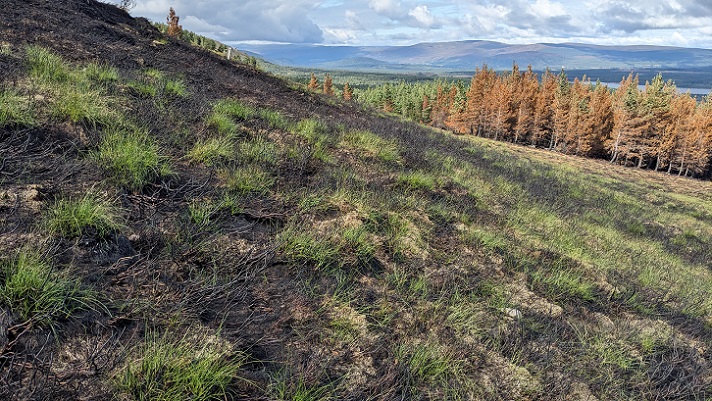
I walked over some of the land below and around the Coire na Ciste car park six weeks ago to look at the impact of the wildfire there (see here). The risks of walking over the open ground were no greater than walking over any area of land which has recently been subject to muirburn: not great and fairly obvious.
A significant proportion of the land in the National Park is subject to regular muirburn but the CNPA has never, up until the Abernethy/Glenmore fire, tried to exclude the public from such land on grounds of public safety. If the CNPA’s handling of access after the Glenmore/Abernethy fire is allowed to set a precedent the implications for access rights would be horrendous. The organisations representing recreational interests, such as Mountaineering Scotland and Ramblers Scotland, should be saying publicly that the CNPA’s attempt to exclude the public from such land is both unacceptable and unlawful.
I had initially thought that Forest and Land Scotland (FLS), who manage Glenmore Forest on behalf of Scottish Ministers and us, the public, were a party to the unlawful Exclusion Zone. Perhaps they were, but the latest information on their website about the wildfire damage in Glen More (see here) suggests they have seen sense:
“We have removed fire-damaged and unstable trees from the edges of the forest roads and our promoted walking trails, but many dangerous trees remain within the burned area.
Due to the risk of falling trees and branches, we strongly advise that you stay on the open forest roads and waymarked trails if you are within the area between the Ryvoan Trail and the ski road. This is especially important during windy conditions.”
This text does not use the term “Exclusion zone” and is consistent with the framework for managing access and advice to land managers set out in the Scottish Outdoor Access Code. It informs the public of the risks, highlights these are greatest in windy conditions and while “strongly advising” the public to keep to the track leaves it to individuals to make up their own minds. That is exactly how it should be. The way people choosing to walk through an area of burned forest should be managed is no different in principle to how people choosing to climb crags, descend steep icy slopes or swim in cold lochs and rivers (etc etc) should be managed. As with all outdoor recreation you do so at your own risk except where land-managers have created risks (mineshafts, unexploded bombs, fields or forests sprayed with pesticide etc)
The risks FLS describes are restricted to falling trees and branches. There is therefore no need for the CNPA even to advise people to avoid the moorland areas with scattered immature trees above the main forest, as the risks there are minimal and obvious, but despite this they are still trying to exclude the public from these areas. In doing so they are both acting ultra vires and undermining Scotland’s precious access rights.

The CNPA web page – https://cairngorms.co.uk/visiting/need-to-know/path-closures – while displaying the updated “Exclusion Zone” map, still insists, if you scroll down, that “the route from the Dorback road to Abernethy forest via Eag Mhor and Loch a’Chnuic is closed due to the wildfire incident and ongoing repair and safety works”. It isn’t (see the map on the same web page).
Similarly, as Nick pointed out, there is a significant difference between the FLS and CNPA websites. FLS gives advice “if you are within the area between the Ryvoan Trail and the ski road”, while CNPA map the area as within their Exclusion Zone.
As the Access Authority the CNPA “has a duty to uphold access rights which involves asserting, protecting, keeping open and free from obstruction any route or waterway” (from https://cairngorms.co.uk/our-work/outdoor-access). They seem to have forgotten that this is their role.