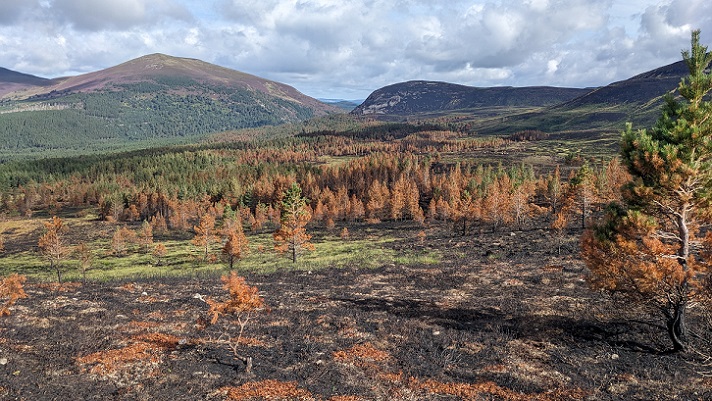
I went to have a look at the southern edge of the area affected by the Abernethy/Glenmore wildfire on 23rd August, about five weeks after the fire started and two weeks after Glenmore had been re-opened on 7th August (see here for timeline from the Scottish Fire and Rescue Service). All the photos in this post are taken from around the Coire na Ciste car park which is where the BBC’s Out of Doors programme interviewed Sarah Henshall, head of conservation at the Cairngorms National Park Authority (CNPA), on Saturday (listen here at 37 mins). The programme also included follow up comments from Duncan Orr Ewing of the RSPB (at 58 minutes).
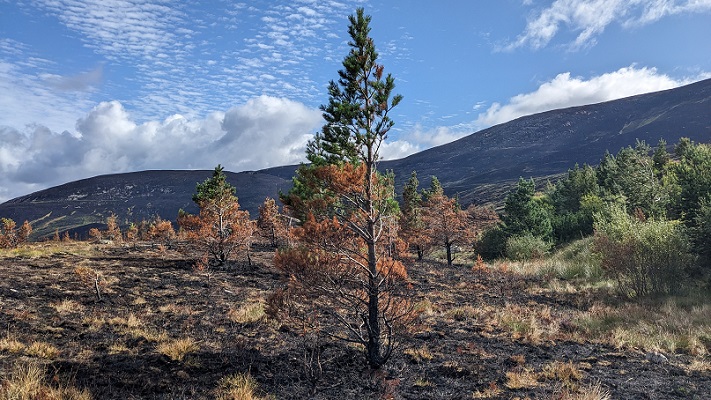
Dr Henshall made some excellent points about the variable intensity of the wildfire, how this will have affected its impact on vegetation and that it is too early to tell how many burned trees will survive. While deciduous woodland is less flammable than Scots Pine, Coire na Ciste was easily accessible by fire fighting vehicles and teams and the impact of the wildfire in this photo is likely to have been limited/affected by their efforts.
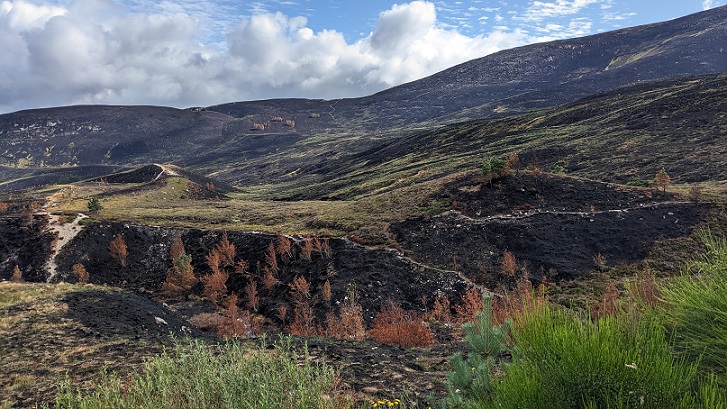
One did not have to look far, however, to see how the intensity of the wildfire was modified by natural factors. More specifically in relation to topography, steeper slopes appear to have burned more intensely. That is likely to have been a consequence of them being better drained, and therefore drier, but also because the up draught fans the flames or, as one experimental study using pine needles (see here) puts it, ‘as slope increases, fireline curvature, spread rate, radiative heat flux, and convective heat flux all rise, whereas flame inclination decrease’.
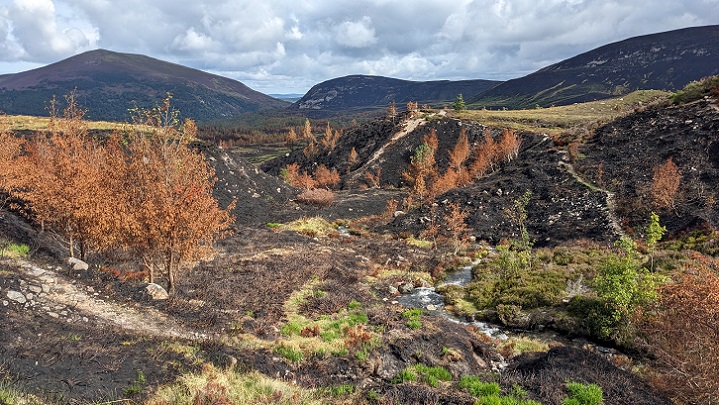
Dr Henshall talked about ground conditions and fire breaks which helped limit the spread of wildfire including watercourses and paths. Whether such features – or any firebreak – helps stop a wildfire spreading depends on its intensity. The wildfire appears to have been unaffected by the breaks formed by the Allt Coire na Ciste in the middle distance and the path in the foreground but by contrast did stop where the angle of the slope changed abruptly.
While the watercourse may have helped stop the spread of the fire in the foreground (which includes a oatch of heather on the right bank), that could also have been due to the efforts of fire fighters. The reason paths and small watercourses sometimes act as firebreaks – as with the walkers path up the edge of Coire na Ciste (see here) – is due to the intensity with which the fire has been burning. In different conditions, wildfire may cross these and much larger firebreaks (such as the road across Dava Moor).
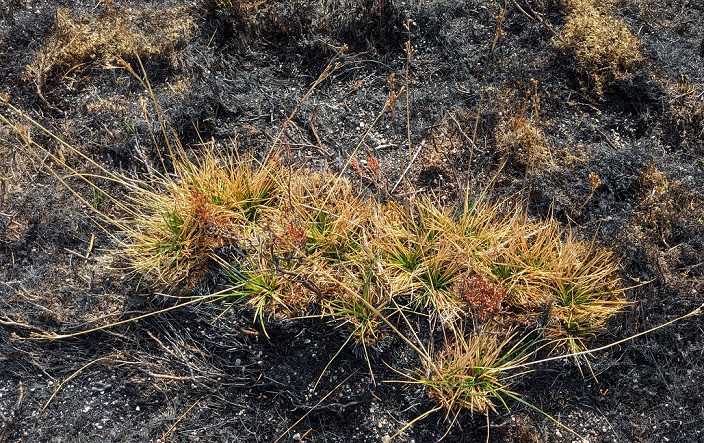
The intensity of fires is also affected by the vegetation. I have previously observed (see here) how clumps of heath rush, a bog forming plant whose long roots help hold in water, survived the out of control muirburn on Tinto Hill. It was the same in Glenmore, whereas the heather roundabout had been completely incinerated. Heather is highly flammable and the more of it there is, the greater the likely intensity of the fire. It is also more tolerant of burning than other plants, which is why regular muirburn reduces biodiversity and increases fire risk.
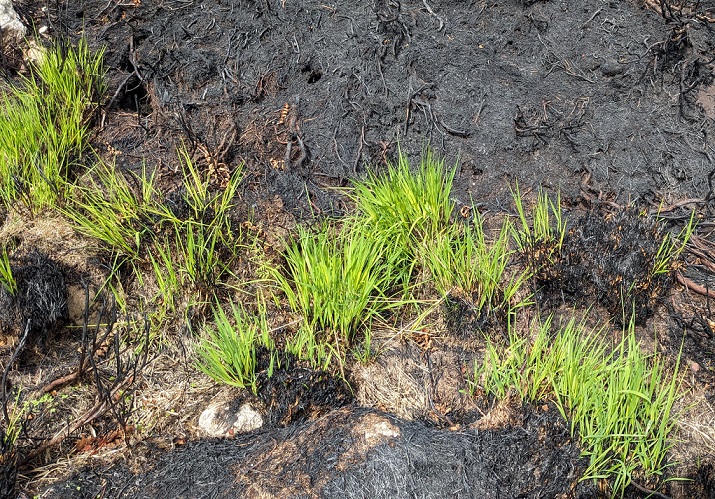
One-off fires, however, can have a regenerative effect as has been well documented for the Caledonian pinewoods (see here and the chapter on fire Ron Summers book on Abernethy Forest). My short visit showed just how quickly nature has started to recover after the fire. The bright green shoots of purple moor grass were evident in several places: the photo shows just how quickly scorched tussocks recover so long as their root system is affected. While dense vegetation such as this may reduce the likelihood of new Scots pine seedlings become established it also helps reduce the erosion of soils by water (as happens with muirburn) that might otherwise increase following a fire.
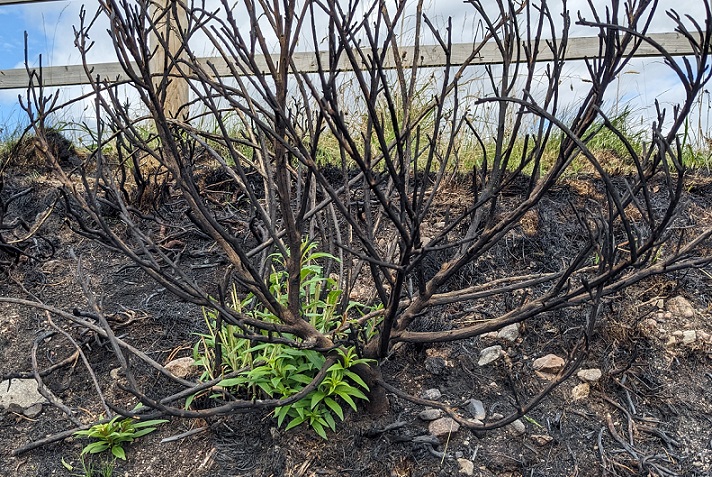
I should have anticipated the rapid establishment of rosebay willow herb, also known as fire weed, at the edge of the car park but the new shoots of wood sorrel came as asurprise:
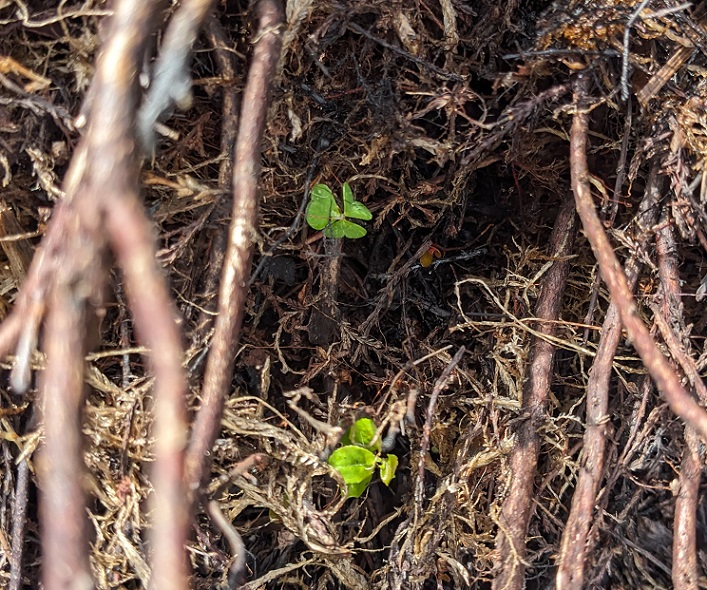
As was the recovery of tormentil:
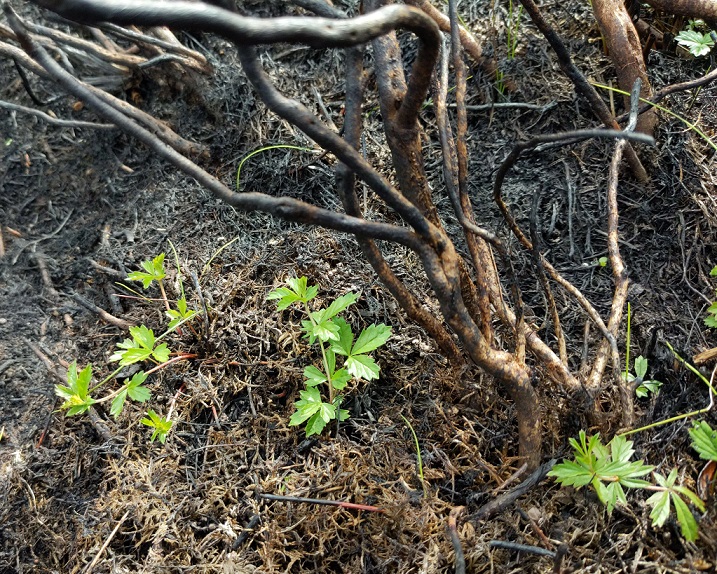
From my observations, the timing of these plant re-appearances appears linked to the intensity (and depth) of the fire. This does not make ‘light muirburn’, as many grouse moor interests claim, a good thing since repeated burning may have greater impacts in the long-term than one intense burn
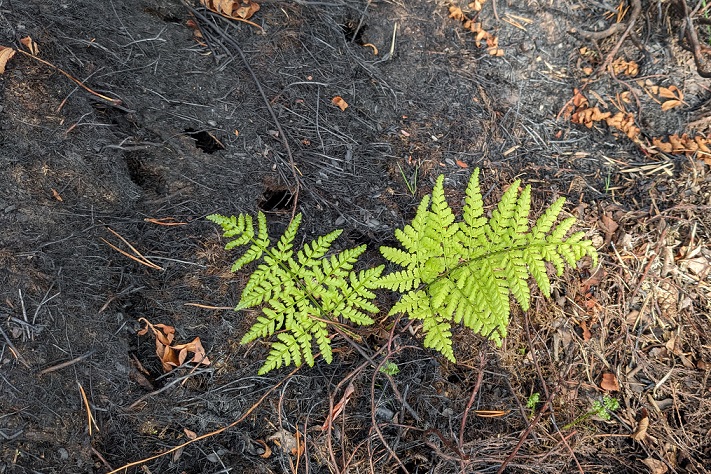
Just four weeks after the fire there was enough to show that the timing of vegetation recovery depends on several factors including the depth of the fire and the plants involved. It is too early yet to see the extent of tree recovery – that won’t become apparent for another couple of years – but because of that it is also too early to tell whether Duncan Orr Ewing was right when he said to Out of Doors that the wildfire has undone 30 years of woodland regeneration at Abernethy (I agreed with almost everything else Duncan said).
It may be that the wildfire speeds up the process of natural regeneration by removing the denser heather vegetation which can impede tree growth and by providing a new seed bed. If that happens, the natural regeneration of the Caledonian pine forest in thirty years time might be far more extensive than it would have been without (as happened following the last major wildfire in Glenmore in 1960).
Whatever the case, the wildfire provides an opportunity to allow nature to develop without interference (the RSPB had planted parts of Abernethy where the fire started because natural regeneration was not as quick enough for their management) and see what happens as a result, not just in the woodland zone but the montane areas above.
Much of the research into the ecological consequence of wildfire on pinewoods (see here for example) has been undertaken with a view to giving nature a helping hand. This sounds good but tends to result in ‘restoration’ which fits certain vested interests preconceptions of what nature should look like. This is why the RSPB is now managing Abernethy primarily with a view to saving the capercaillie, rather than allowing the Caledonian pine forest to develop naturally, and producing habitat which they believe is important for it. (That is not necessary, as my example see here from Slovenia showed). The outcome is significantly different to what would actually would happen if natural processes were allowed to follow their course.
I saw enough on my visit to the area around Colre na Ciste to re-affirm my belief that natural processes should be valued in their own right. While it was very positive that Sarah Henshall acknowledged the value of natural processes and said we should see what happens, she still allowed for intervention to ‘help’ nature in the medium term even in what should be the core of the National Park. In my view until that changes the organisation she works for will never be worthy of its name.

Well, the timing for Fireweed seeding could not be better. It’s great Moose food, but of course we’ve wiped out our Moose. It’s also good browse for other herbivores as indicated if you drive along the A9 and observe the purple bloom on the sheep free, deer protected side of the fence.
Another interesting prospect is the seeding potential for willows and perhaps with warmer summers, Aspen. Will the interventionist ‘ betulaphiles’ be out there moaning and uprooting if things don’t turn out as they expect?
Yep. 100% in accord.
Interesting to hear about the regrowth of the various species of flora etc. What about the fauna? Any deer visible browsing on the unburnt patches or the periphery? Much bird life in the vicinity?
I did not see or hear any birds or animals apart from ravens and a glimpse of a raptor in the distance when I wasn’t wearing my specs! I am not surprised at the lack of animals, while flora is making quite a rapid comeback there is not sufficient to feed herbivores. There was also no sign of the ring ouzel that can regularly be seen around the Ciste car park but then a significant part of their habitat has disappeared. While the wildfire was raging would have been a very good time to monitor all the killer deer fences which can be found around Abernethy: my guess is more birds will have been killed flying into fences while getting out of the way of the fire than were killed by the fire.
Having walked very recently along the Meall a’ Bhuachaille ridge and noted the quantity of invasive non native tree seedlings and older regeneration there, my fear is that in amongst a sea of birch will be an eruption (excuse the mixed metaphor) of Sitka spruce and probably lodgepole pine.
Sitka is a very real threat and, just before the fire, I was going to blog about the Sitka in Coire Laogh Mor – it will be interesting to see if they have been destroyed by the wildfire. There is still an area of Sitka within Glenmore which FLS decided to leave until mature (i.e after the trees had started to produce seed). This was always a terrible decision but now there is every reason to remove those Sitka as a matter of urgency. Lodgepole is likely to be an even greater problem
Here’s a thought: make sure Sitka spruce (and lodgepole pine) are, like rhododendron and others, considered invasive non-natives and require those that plant them to keep them within their ownership.
A fund to support their removal created by a levy of a certain percentage on every cubic metre of spruce timber sold.
The wind cannot read and a fence cannot stop airborne seed. How will the government put a levy on itself for the seed emanating from state-owned forests? How will the billionaire landowners and the financial corporate bodies( the oligarchy that actually runs the country) react to such an impost?
A levy on sitka timber sold goes into a fund managed by I don’t know SISI? Then affected landowners bid for money to help with removal? (FLS currently bid into the Peatland Restoration Fund so even they could apply I suppose)
What do you suggest?
Well, we can’t stop seed and pollen blowing around for miles and identify whose plantation it came from. So landowners who were paid government grants to plant Sitka, now get more money for getting rid of it? Well, back in the 1980s we used to pay them NOT to plant Sitka. We are now faced with farting against thunder and pissing into a Force 10. Locking the stable door after the horse has bolted looks more sensible and Pandora’s box looks like a minor social work issue.
We should concentrate on creating ‘ eco redoubts’ in areas of high biodiversity value, where efforts against Sitka etc can be intensified. Over large areas of the country we are dealing with an industrial wasteland in any case and not pristine ecosystems. As long as our cellulose factories( they are not actually forests) are based on Sitka then the problem will persist.