An RSPB newsletter I read before leaving Scotland for Slovenia, referred to capercaillie as birds of the Caledonian pine forest. This may now be the case in Scotland but wasn’t always so, as when capercaillie inhabited the mixed woodland on the Loch Lomond islands.
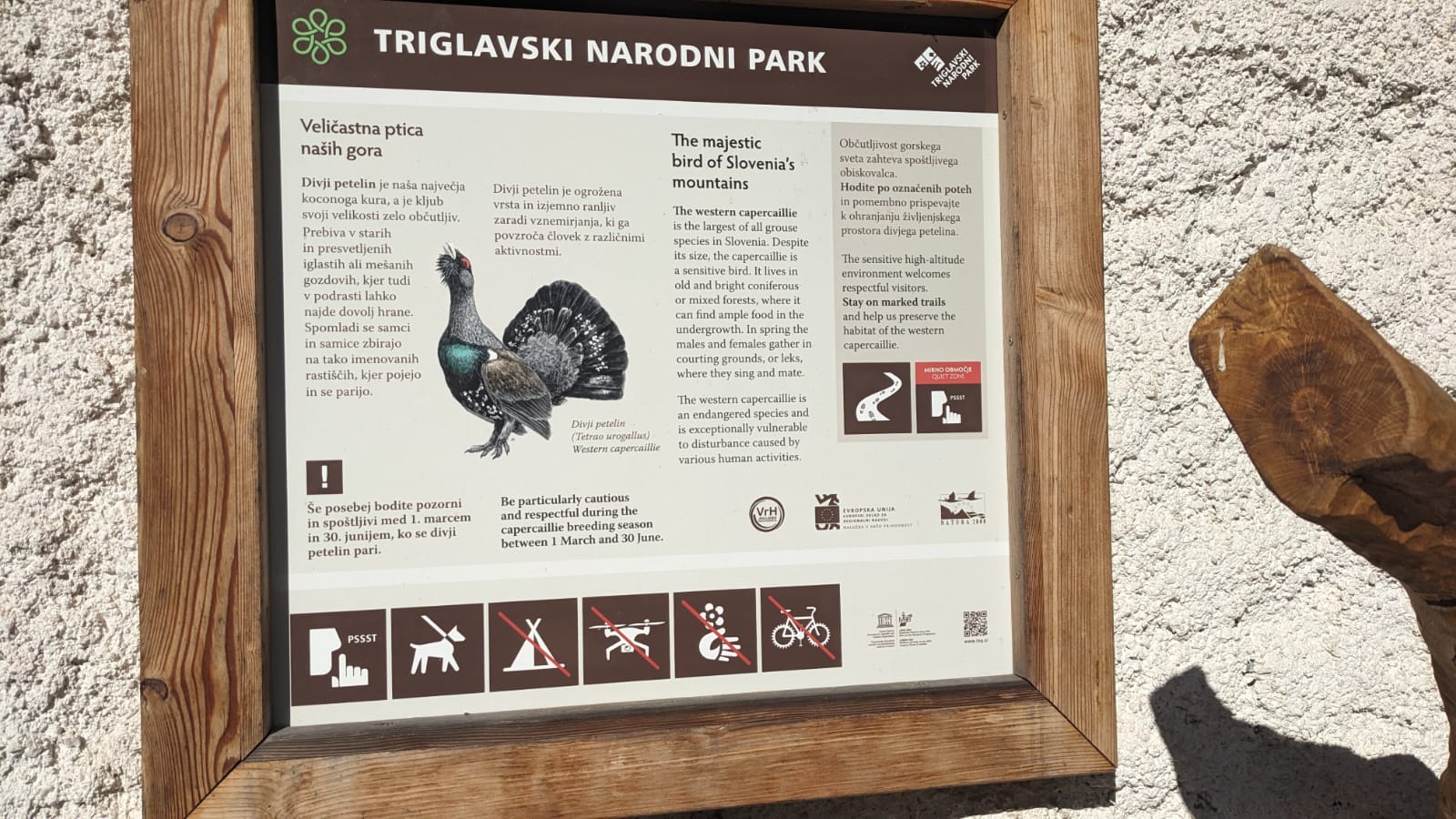
Capercaillie, while mainly found in the boreal zone, are also distributed through the eastern Alps and down into the Balkans, where they live in very different habitats to the Caledonian Pine forest. We saw this sign on the limestone plateau above the Pokljuka Gorge, where beech began to transition to European spruce and there was not a Scots pine in sight.. There was, however, plentiful bilberry which, together with its associated invpertebrates, provides a crucial food source for capercaillie in Scotland.
While we did not see or hear capercaillie, if it they can survive in the forests dominated by European spruce (also known as Norway spruce, Picea abies), this suggests there is no reason why they shouldn’t also be able to do so in Scotland. That they aren’t found in Scotland’s European spruce plantations and have steadily been disappearing from Scots pine plantations says something about the impact of how forestry is practiced in Scotland compared to much of the Alps: drainage and densely planted monocultures instead of the species mix that results from natural regeneration; tolerance of high numbers of herbivores; clearfell. Industrial forestry rather than Continuous Cover Forestry. The loss of biodiversity, of which capercaillie are just one small part, is the inevitable consequence,

I note the proscriptions on camping, drones and bicycles, but not walking dogs on leads. Presumably to limit disturbance on wildlife, more especially the capercaillie. Lessons for the Scottish non-national parks?
Aye, the structure and management regimes of the forest is at least as important as the species of trees used.
I ask again, who owns and management this National Park?
I provided a brief answer below. I am against camping bans but in the Triglav NP such bans are more or less redundant as the karst landscape means there is very little surface water and very few pkaces flat and grassy enough to camp, Setting that aside, tents function like bird hides..
is this park owned by the nation state and managed by a national parks service?
so why have the banned camping?
Thats one of the reasons I have on a couple of occasions questioned on this site the use of Caledonian “pine” forests, in stead of the Caledonian forest……..with all its variety of plants, which would include species such as oak, wych elm, ash, hazel, to name just a fraction of even just trees. Though the misrepresentation is far from Parkswatch’s alone with the serious error stretching back decades with conservation bodies.
Capercaillies biggest issue in the Highlands is human disturbance and I can’t see how that can be resolved.
Parkswatch at times definitely requires a parkswatch-watch.
Capercaillie, also previously inhabited forests dominated by beech in the Cantabrian Mts of N. Spain, though I’m not sure if prevail there. It wouldn’t surprise me to learn of other habitats they inhabit presently or in the past.
Dave
Disappointing to see my comments, after the first paragraph/point have become jumbled up; I do hope that can be rectified?
Sometimes happens, but then is sorted out, however your message was still intelligible. Aye, we need to face up to disturbance issues and pressure of human numbers in regard to Capercaillie. As I’ve pointed out previously, the NGO-Quangocracy are part of the problem in a national park that is not national.
Capercaillies biggest issue in the Highlands is human disturbance and I don’t see how that can be resolved.
Well , it certainly won’t be solved within the current management and ownership regime in the so-called ‘national’ park, where the emphasis appears to be on attracting more visitors, more urbanisation and more industrialisation. None of which is going to be beneficial to the Capercaillie and other wildlife. I proposed a solution in the April 2016 archives of this site, but we still seem obsessed with increasing access and in the myth of the natural environment having an infinite capacity to absorb all our varied demands upon it
Parkswatch at times definitely requires a Parkswatch-watch
Capercaillie also previously inhabited forests dominated by beech in the Cantabrian Mts of N Spain though I’m not sure if they still prevail there. It wouldn’t surprise me to learn of other habitats they inhabit presently or in the past.
Hi Dave, the sign was, as I said, at the transition zone between beech and European spruce and it would be interesting to know the extent to which the caper used the beech………it is also the case that there were beech on the Loch Lomond islands which are still designated an SPA for capercaillie but which NatureScot decided to remove as they were non-native trees.
When I briefly held the post of Assistant Manager at Tilhill Forestry Ltd (out of Sauchieburn, Stirling), Tibbemore forest near Perth was one of our properties. It was a large mature pine plantation that happended to be home to one of the most southerly population of capercaillie in the country. (One of my colleagues was ‘attacked’ by a male caper on one of his management forays there).
A few years after I left Tilhill, the entire plantation, which was around 100 hectares, was clear felled in one go and the capercaillie were sadly no more. This was the mid 1990s. Reckless and destructive forest management I would say. Are we confident this could not happen again?
Scotland: the Moorland Myth Brigade; the Star Birders; the Cellulose Factory Managers.