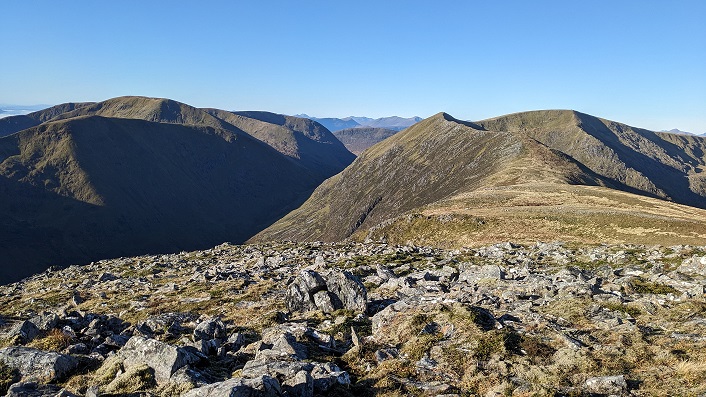
Following David Jarman’s highly informative 2024 powerpoint comparing the impacts of the various pumped storage hydro (PSH) schemes being proposed for Scotland (see here), I have been to look at Coire Glas, the site of SSE’s proposed scheme above Loch Lochy, twice in the last eighteen months. The first time was on a walk up Ben Tee, a prominent Corbett, by the most popular route; the second time a few weeks ago along the unfrequented east ridge leading to the Munro Sron a’ Choire Ghairbh.
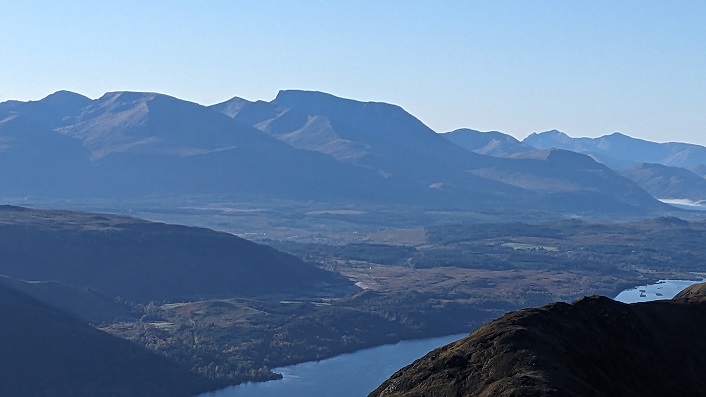
There is no doubt these hills are beautiful and, on a fine day, the views in all directions are stunning because the summit areas are higher than the neighbouring ground.
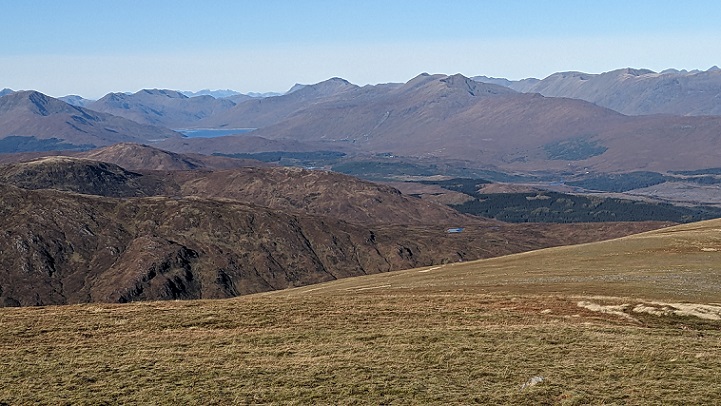
The Coire Glas PSH, however, is tucked away and my visits confirmed that David Jarman was right to argue its impact on this landscape would be limited compared to the proposed PSH scheme at Lochan na h-Earba (see here).
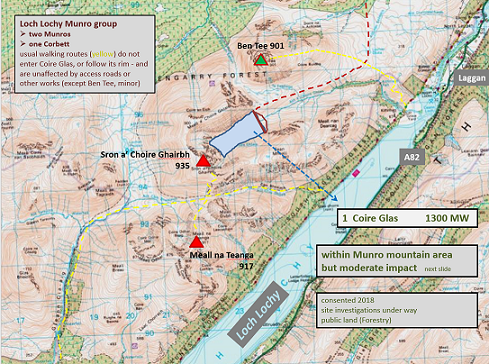
There are two major reasons for this. The first is the proposed dam for the upper reservoir is located near the top of a 4km long glacial trench. It would be shielded from view from the lower ground and most of the neighbouring hills.
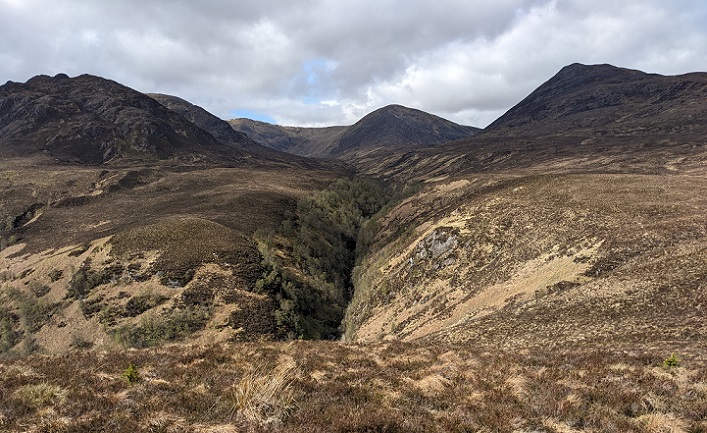
The views that would be most affected are those from the horseshoe ridge around the coire and the summit of Ben Tee:
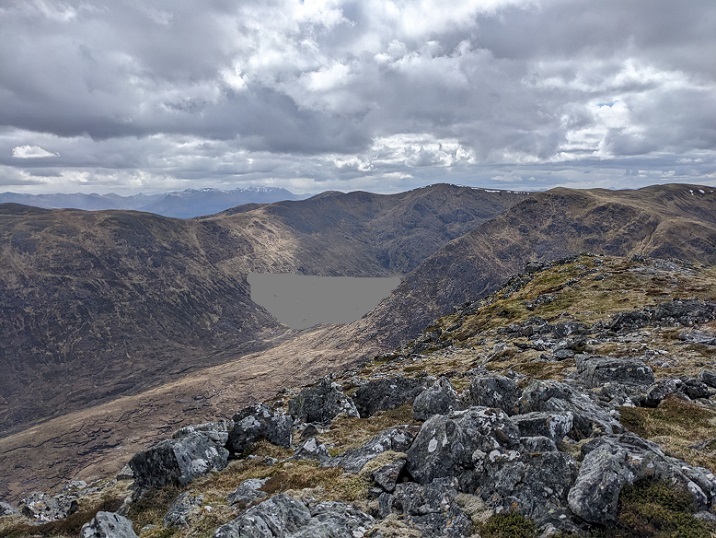
Walking along the east ridge of Sron a’ Choire Ghairbh, there were only occasional views down into the coire until I reached the narrow upper part of the ridge. Most hillwalkers approach Sron a’ Choire Ghairbh by the fine stalkers track to the south (the yellow line on David’s map) and will not see the dam or reservoir until close to the summit.
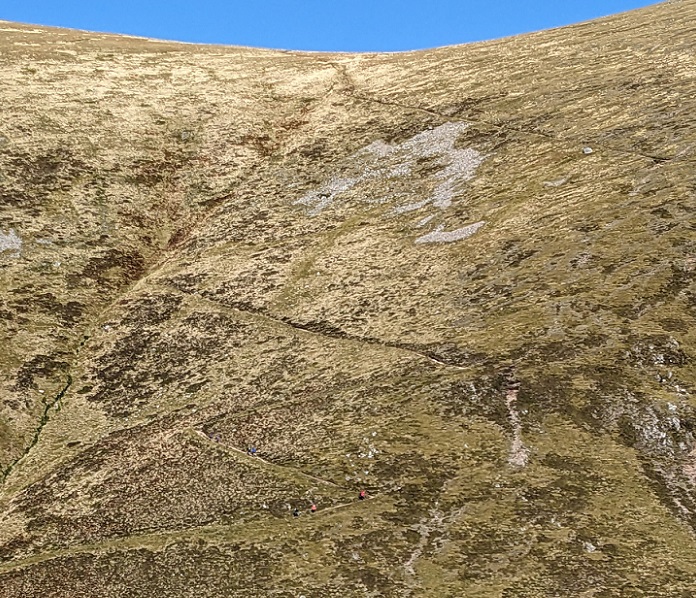
There is no doubt, however, that the view down into the glacial trench from the summit rim would be totally changed and that when the reservoir has been emptied, as it could be each day, there is no avoiding the fact that the drawdown scars would look horrific.
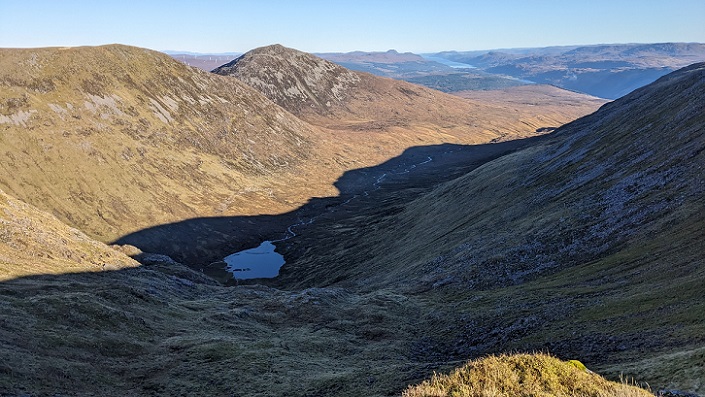
Hillwalkers would either need to get up early, when the reservoir is most likely to be full, or look the other way. Nevertheless the visual impact would be far more limited than the reservoir for the Lochan na h-Earba scheme That would be visible for much of the ridge between Geal Charn and Beinn a Chlachair, while the dam would also be visible from Carn Dearg opposite, Ben Alder and the Drumochter hills beyond.
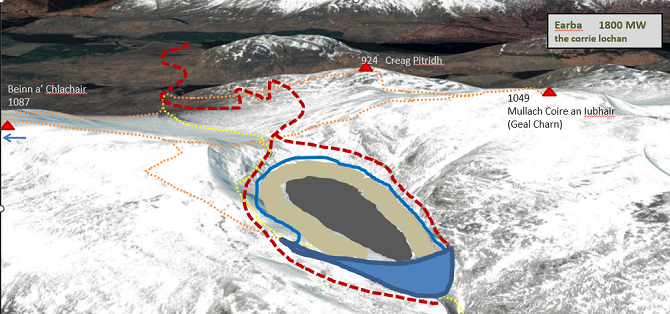
A further significant difference in the visual impact of the two schemes is that the access track to the the upper dam for Lochan na h-Earba would cross the high Bealaich Leamhain, between Geal Carn and Beinn a Chlachair, and then descend to the loch of that name whereas the access track to the Coire Glas dam would be from below and on much lower ground.
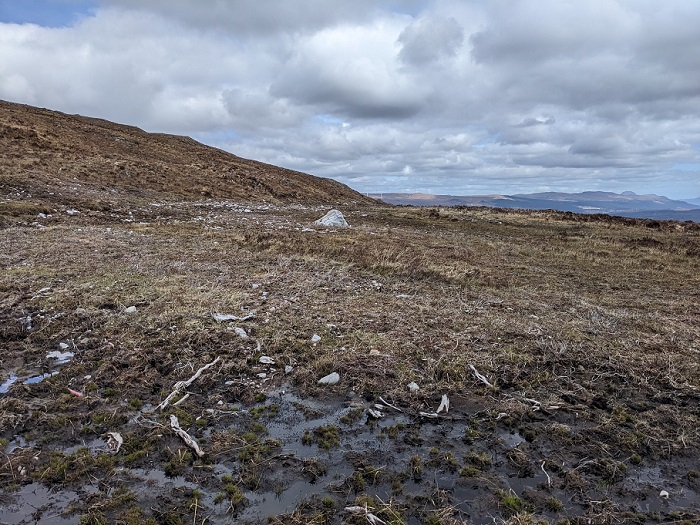
SSE’s recent record on site restoration in respect of powerlines may not be good, (see here) and (see here), but, if properly supervised there is no reason why they shouldn’t do as good as job as they have done restoring the temporary access track into the coire.
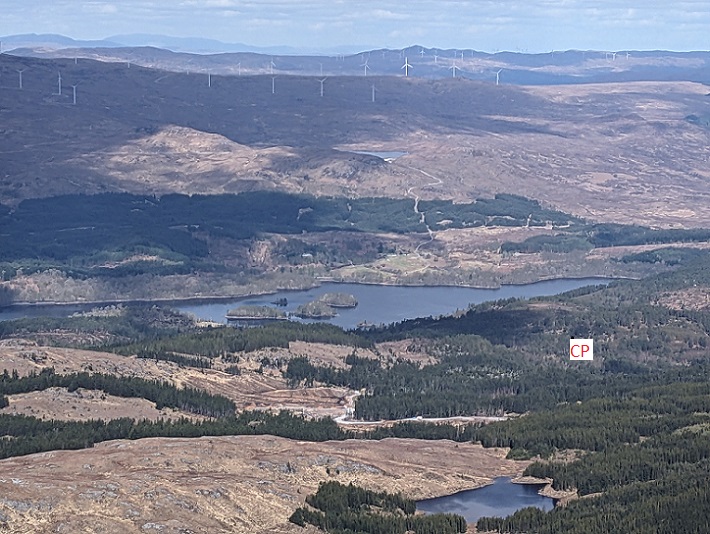
Moreover, because of the differences in altitude of the access tracks, there should be opportunities to “lose” the access route to Coire Glas in regenerating native woodland in the medium to long-term. All that requires is for Forest and Land Scotland, who owns the land, to cull deer and weed out the regenerating Sitka. With the same planning authorities involved in both cases and the land at Coire Glas in public ownership, the long-term landscape impact of the access track at Coire Glas should be far less than Earba.
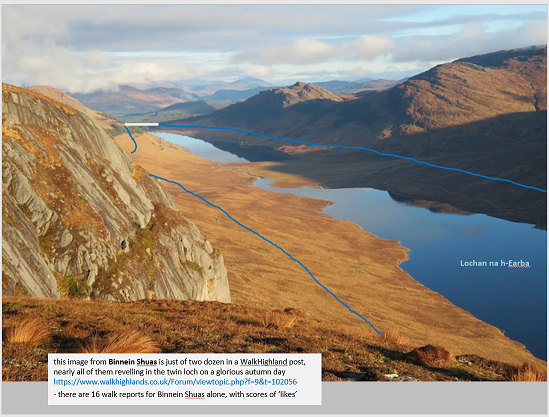
The second major reason why the impact of Coire Glas scheme would be far less than Earba is that Loch Lochy, which contains a vast quantity of water, would be used as its lower reservoir. By contrast at Lochan na h-Earba, the two existing lochs would need to be joined and raised by 32m to store sufficient water. The impact of drawdown scars on the landscape and ecology of Lochan na h-Earba will be horrific whereas Loch Lochy is so large that drawdown will be invisible and any ecological impacts localised.
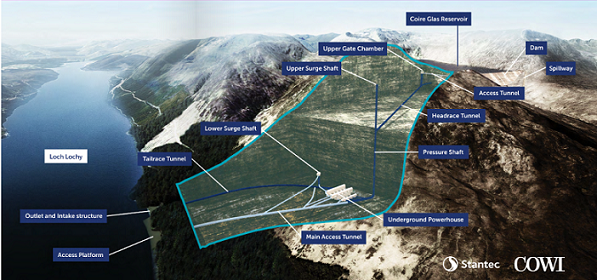
Apart from the upper dam, the access track and the entries to the various shafts and tunnels, the whole of the Coire Glas scheme will be underground, following the model at Cruachan, whereas Earba would include:
- two further dams at either end of Lochan na h-Earba and associated access tracks;
- “a surface building which would contain an overhead crane and other facilities including offices, storage, transformers and other equipment”,
- open viaducts along the flanks of Binnein Shuas and Creag Pitridh to channel water into Lochan na h-Earba (that is not an issue at Loch Lochy which is fed by a large number of sources)
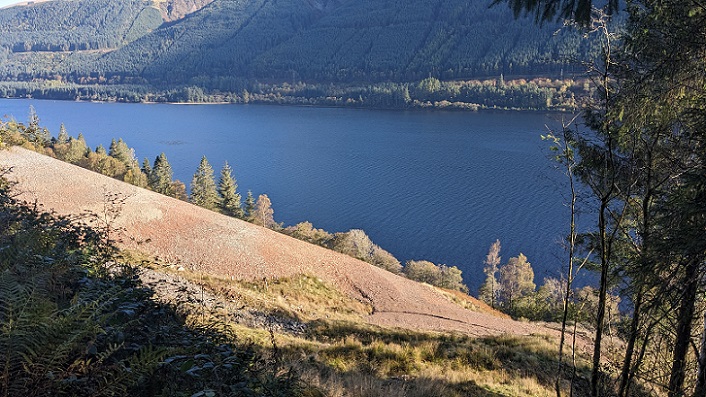
Under-grounding creates challenges of what to do with the spoil and only some will be able to be re-used in the construction of dam in Coire Glas. According to the Coire Glas PSH website (see here) SSE has invested over £100 million so far to progress Coire Glas and “site investigations have included the excavation and completion of a major 1.2km-long exploratory tunnel built into the hillside above Loch Lochy…………..with over 90,000 tonnes of rock and earth excavated.” It appears that so far no final solution has been agreed for its disposal/re-use, with the spoil currently forming a blot on the landscape, although there have been discussions about removing excess rock by barge, a more environmentally friendly method than lorries.
By contrast the Earba scheme appears to be excavating less material and can re-use more above ground because of the extent of the development which is on the surface: their documentation implies they believe they can re-use all the spoil. That appears to be the one thing that can be said to be in favour of the Earba scheme.
Discussion
In June the UK regulator, Ofgem, gave the provisional go ahead (see here) to three PSH schemes in Scotland: Coire Glas, Lochan na h-Earba and Loch Kemp above Loch Ness along with other energy storage schemes. In our privatised energy market, it is left to private interests to decide WHERE to back developments like PSH and ultimately WHETHER to invest. Their investment decisions are made on the basis of their likely profits after taking account of the impact of the UK Government’s cap and floor regime on energy prices which guarantees minimum prices but also caps maximum charges.
The finances are still under negotiation between the UK Government and the developers in respect of PSH schemes and, while the Scottish Government has granted planning consent for both the Coire Glas and the Earba schemes, it is still not certain either will go ahead. As SSE puts it on their Coire Glas website: “Any final decision to progress the project would be taken in line with SSE’s continued focus on capital discipline and with strict adherence to its return thresholds.”
Unfortunately, both the UK nor the Scottish Governments are far concerned that PSH schemes and other renewable energy developments go ahead than their impacts which are determined by where they are located. This post has deliberately avoided using all the normal planning jargon and referring to planning considerations like designations and purely considered these two schemes in terms of their impacts. From this perspective, if we need PSH, Coire Glas looks an appropriate place for such a scheme whereas Earba does not, yet the Scottish Government has approved both.
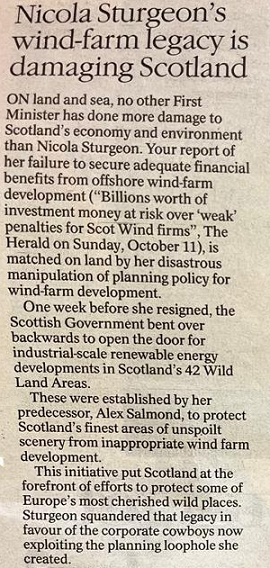
The Scottish Government would not have been able to approve the Earba scheme if, as Dave Morris explained in the Sunday Herald two weeks ago (left), had Nicola Sturgeon not removed a major planning constraint on where they could be located, Wild Land Areas. While the way the Nicola Sturgeon manipulated planning policy was scandalous, the underlying issue is the absence of any national planning by the Scottish Government to determine where renewable energy developments would be best located. In the case of windfarms that might be out at sea and in the case of PSH in coires tucked away above large volumes of fresh water.
Instead, the Scottish Government has relied on the designation system as the main means of directing where renewable energy developments should be situated and then left it the market. Lobbied by that market Nicola Sturgeon scrapped one of the main constraints on that market, Wild Land Areas.
It just so happens that Coire Glas and several of the other PSH schemes above the Great Glen are not in areas nationally designated for their landscape or wildlife. That, however, doesn’t seem to me to be the key point about Coire Glas. Its in a beautiful location and given a slightly different history might have been designated for its landscape or its wildlife. If it had been, it would still be a good location for a PSH, tucked out of view and with a large loch to act as a reservoir below, whereas Earba is not.
Our planning system has become encrusted with rules and regulations that both developers and government, at the local and national level, manipulate to serve their interests. What the Coire Glas and Earba PSH proposals show is we need to find a way to cut through all of that and get back to basics like, if we need PSH, where would they best be located?
Such decisions would be best taken by the public and elected representatives acting on the public’s behalf, not unaccountable planners at the Energy Consents Unit. The job of the planners should then become to ensure developments agreed in principle by the public are developed with the least impact and to the highest possible standard.

The herds of’ ‘elephants’ in the room is the impact on the aquatic biodiversity of the lochs being altered. In terms of freshwater fish such as Arctic Charr and Brown Trout, this represents some of the last original post glacial colonising populations of vertebrates that we have, ( we already wiped most of the large mammals,) but there are also impacts on aquatic birds, amphibians and invertebrates. But who gives a shit?
For further background on the impacts of hydro regulation on freshwater ecology check out the archives on this site ‘The Hidden Horrors of Hydro’ and ‘The Perils of Pump Storage’. There are no free energy lunches and there is no restoration of eco-virginity
Good piece Nick.
There has been recent discussion in Highland (and at the Scottish Parliament) about whether we should celebrate the 50th Anniversary of our NSAs by Loch Ness becoming our 41sr NSA. When the idea first floated past me, I have to say it excited a deal of support. Hopefully it would not be a designation too late though. We do ‘barn door horse bolted’ legislation very well in Scotland and the wider UK. The really big question about the 3, 4. 5 (which is it?) Pump Storage Schemes is the incredible effect on Loch Ness itself and the River Ness flooding through Inverness. To quote the river Ness fishery folk… “The combined drawdown if all four schemes were consented could be as high as 1.25m. This would have a huge impact on flows down River Ness, will have a detrimental impact of the shoreline ecology of Loch Ness, impoverishing the rich shoreline invertebrate ecology, and add to the considerable navigational, and operational difficulties already experienced by commercial, rescue and recreational boat users on the loch.” [https://ndsfb.org/pump-storage-hydro/]
Loch Ness would in effect become….an “Inland Tidal Loch”: The frequent and rapid pumping and generation cycles would effectively turn Loch Ness into an artificially regulated inland tidal body, disrupting the stability of its natural cold temperatures and altering flows down into the River Ness. To many people daily drawdowns, on one of the biggest lochs in Scotland is simply unconscionable. – but, as you say, the ECU (even with its strategic shift to the ScotGov Planning Department) is just a crazy law unto itself.
Aye ,Bob, it’s a comprehensive clusterboorach with malice and aforethought
Essentially PSH is in competition with battery storage to provide the essential capacity to smooth out supply/demand
With the steady increase in construction costs and the fall in the price of batteries I am sceptical that any PSH will be built. But I agree that this site is much the best.
Chemical battery storage are another consideration altogether. They will have their place in how the mix of how of the network energy is stored for later use. And as we know, energy storage, chemical battery storage can range from a few KW hours in the case of a home storage where there is home with solar panels and or a small wind turbine to bigger local storage or bigger again. Pumped hydro storage of course is a different story in terms of big schemes where millions of tonnes of water is pumped up an elevation to later run down to generate power when needed.
The point that Nick makes about energy infrastructure being driven by market c9nsiderations is a good one. The market I think is most would agree is not the best way to determine energy infrastructure. If health care was determined on profit or other similar, then care would be unavailable or unavailably expense in remote area or any other areas or sections of society where the service does not make a buck. This is reality. Look at the US healthcare system for an example of that. that.
Power from the glens for the glens may have been a tagline from a bygone era but the underlying sentiment begs a big question today. Scotland by the grace of what planetary evolution gave it is a huge energy resource. But who profits and to what scale.
Indeed, consider the nonsense of wind farms where operators have to turn off generation and get paid for it because there is inadequate capacity like pumped storage or battery to store it or inadequate capacity transmission lines to move the power to where it could be used. Rome was not built in a day, but like the Chinese today they do seem to have a plan.
So yes, without overtly wishing to stray into political territory, who is the big winners and losers in our so called Energy Market. Are we being best served and by we, who does that mean. Why do we have so many in fuel poverty. Why are our electricity prices in Europe.
But to conclude I recall the reported words of a commercial quarry operator involved in the demolition extraction of aggregate fr9m what is a volcanic plug at Dumbuck near Dumbarton. And quip, half in jest, was that there was a good drop of stone in the nearby volcanic plug that the iconic and historic Dumbarton Castle sits on. Kind of reflected market driven sentiment. But the point is real.
Glen Sanda or Edinburgh Castle perchance. Everything is a trade off but for who, and at whose cost.
and the concerns over the status of Dumbarton and Edinburgh Castle are not unlike my concerns over the unique biodiversity of the lochs to be devastated by pump storage exploitation
Yes exactly Ronald Greer. Uncontained market desire destroys, uncurtailed greed destroys and irreversibly destroys at that.
Every where you look in fact. And the agencies that are in place to protect repeatedly fail to do so. The God of Money works in so many many ways. And National Parks I would suggest are another example of that. The failed gold mine at the top of Loch Lomond leaving behind mine arisings. Or the 7 million tonne waste dump in the hill above Balloch and the Bonnie Banks. Covered over less than a year ago after having leaked toxins into the soil and watercourse for years the environmental agency failed to do anything about it despite them being provided with year after year test analysis. showing it to be so. Indeed, SEPA sought to restrict disclosure of the year on year breaches until disclosure was ordered by the information commissioner.
And fish deaths, in watercourses that used to team with fish, and bailiffs. Not the 7 million tonne waste tip on the Bonnie Stanks of Loch Lomond.
And so it goes on and in so many ways. Money interests talk and talk big. But you know what, the huge outpouring of rejection against Scottish Enterprise and the LLTNP’s plan to allow the Loch Lomond Flamingo Land proposal eventually after a hard fought fight stopped the lochside development.
But it takes effort and as we can see the government and theircagencies are far from being on side.