The following is a short summary of a draft report that I have prepared for my colleagues in Badenoch Climate Action to facilitate discussion about the origins of the Cairngorms wildfire in July/August 2026, its suppression and future considerations.
Given the national and international reputation of the Cairngorms for wildlife, scenery and outdoor recreation, the impact of this fire will be of concern to many people, including local communities put at risk as the fire spread. My report I draws on published accounts and conversations with those directly involved.
Key findings
- More than 500 people made the decisive difference in containing this fire, with volunteers working alongside official responders under exhausting and sometimes dangerous conditions; without their effort, and some favourable shifts in wind, the fire could have reached the villages of Glenmore and Nethy Bridge and destroyed even more tracts of ancient Caledonian Pinewoods.
- Scotland’s public bodies were poorly prepared, despite clear warnings from two recent comparable fires (Cannich 2024, Dava Moor 2025) and years of advice on the need to be better prepared as climate changes begin to impact through frequent extreme weather events. More specifically, there are serious questions to be asked about what, if any difference, was made by the Cairngorms National Park’s Integrated Fire Management Plan (see here), adopted in August 2025 and Fire Management Byelaws which first came into force on 1st April (see here).
- Critical helicopter support, requested by the RSPB within the first hour of the fire starting during the morning of 15 July, did not arrive until the following day. Such aerial support was urgently needed, in the first few hours, to simply to move firefighters and equipment to off-road locations to curtail the initial fire spread. The late arrival of a more specialised aerial water-bombing helicopter, using water from the nearby Loch Morlich, was too little too late. By then the fire was out of control, with its spread primarily dependent on changes in wind direction.
- There needs to be a police investigation into the cause of this Cairngorms fire, as with other recent large-scale fires. See https://roydennis.org/roys-blog-august-2026/
- Scottish Fire and Rescue Service (SFRS) leadership, equipment, clothing, and vehicles appear poorly suited to remote terrain working, or indeed any distance from the public road. Many gamekeepers, forestry and conservation workers appear to be much fitter and have more appropriate clothing and equipment than SFRS personnel, enabling them to be more effective in dealing with rural fires, at least in the early stages. The speed of some critical decision taking by public bodies appeared to be inadequate.
- Helicopter deployment for wildfires is based on private helicopter support, governed by a slow, permission-and-insurance-based system, unlike the rapid response protocols used for mountain and coastal rescue, with military aircraft playing key roles.
- Public communications from the Scottish Government and SFRS on the Cairngorms fire were too complacent relative to the situation on the ground. The Nethy Bridge Community Council provided more credible updates.
- Post-fire “Exclusion Zones” imposed by the Cairngorms National Park Authority appear to exceed the authorisation provided by the Land Reform (Scotland) Act 2003 (section 15) and also appeared to be inconsistent when applied across neighbouring landholdings.
- Some significant damage has been done to the Cairngorms natural environment through new track construction, tree felling and fire break construction, carried out with urgency and necessity. A lot of this damage could have been avoided if the public bodies had been better prepared and coordinated.
What needs to happen now
- The Scottish Government should commission a full independent public inquiry. This should happen within the coming months and be completed by early 2027. It should cover organisational response, equipment standards, helicopter deployment, fire-cause investigation, and the legal basis for access restrictions. The Highland Council’s call for such a public inquiry is very welcome.
- Helicopter support for wildfires should be restructured to match the rapid-response model already used for mountain and coastal emergencies.
- Community-based volunteer wildfire response groups should be formalised. They should receive proper training, equipment and insurance. This should follow the existing model of mountain rescue and lifeboat services.
- Forestry and Land Scotland and NatureScot should ensure locally based staff are equipped and authorised to take immediate direct action against fire outbreaks.
- Future post-fire access restrictions should rely on risk-advisory notices rather than blanket exclusion zones.
- The Scottish Government should reconsider the role of muirburn, given that comparable upland countries, such as Norway, manage similar terrain without routine burning. Following the Cairngorms fire the vegetation should be allowed to regenerate naturally, up to climatically determined tree-lines. Management should focus on grazing control, without fencing, tree planting and seed distribution. Natural ecosystem development, creating mosaics of woodland and open spaces, will help to constrain future wildfires.
The full draft report is available for anyone with an interest in these issues – do email me at davemorris2@btinternet.com for the latest draft.
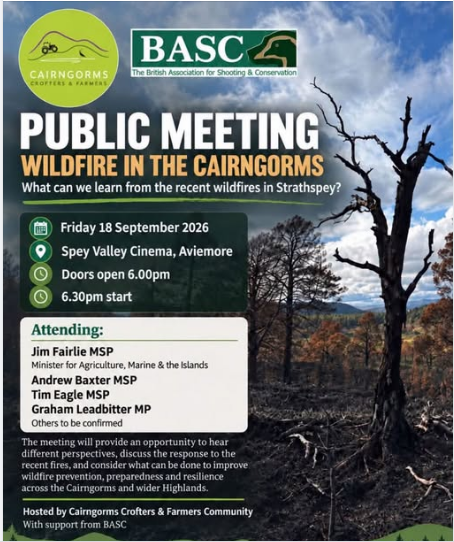
[Editor’s note: one hopes that the call for a public inquiry and the issues raised by Dave and by other people who have contributed to Parkswatch on the Abernethy/Glen More wildfire will be discussed at the public meeting in Aviemore this evening].

The problem with public enquiries are that they are expensive and very slow. We dont want to be sitting here in 5 or 10 years waiting on one to report, when there will be any number of fires in the meantime. In practice, any inquiry that is critical of ScotGov of its agencies is likely to be hindered in producing its final report. Witness the Edinburgh trams enquiry…… still waiting after 15 years. I dont know exactly what the option is, but I dont think a public enquiry is the answer, unless it is down at a level above ScotGov. That is important because Mr Gray certainly put his foot in it and contributed to the problem, so he needs taken out of the equation when it comes to conflicts of interest, as does CNPA. Their park fire plan reads like a “nice to do” list, with no-one compelled to do anything at all. A paper tiger with no consultation, and no teeth.
Thanks Victor, I agree we do not want a public inquiry running over even one year. There are shorter ways to deal with this. For example Highland Council passed a motion, yesterday, which proposes that a HC inquiry into the fire is set up, funded by the Scottish Government, with a requirement to report by next March. The crucial requirement is to have a clearly independent person to chair such an inquiry and to have a structure and remit which allows for an early conclusion.