Yesterday, I discovered by accident when looking through Scottish Forestry (SF)’s register of woodland creation and felling permissions (see here) that a public consultation on native woodland restoration proposals for the Glenfalloch Estate opened on 23rd June. While SF’s website now provides a tab allowing the public to comment on grant applications, it provides little information about the proposal apart from the extent of the planting (458.84 hectares in this case, Ref 26FGS92639). Without knowing what has been proposed, informed comment is impossible.
SF’s consultations only last four weeks – this one closes on Tuesday 21st July. So even where a member of public were to check through the consultation register once a week, by the time the related documents have been requested and supplied, there is very little time to comment. That in my view is not accident. If local authorities and even the Scottish Government’s Energy Consents Unit can publish planning documentation online, SF could do the same with forestry documentation if they wished.
By cross-checking with Scottish Forestry’s map viewer – there are no links between the consultation register and the map viewer – I have been able to establish that the ‘Native woodland Restoration’ grant application covers a similar area to the planting proposals for the Glenfalloch estate produced by Tree Story (see here):
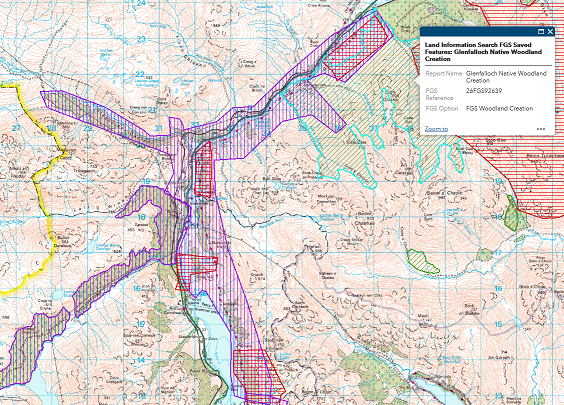
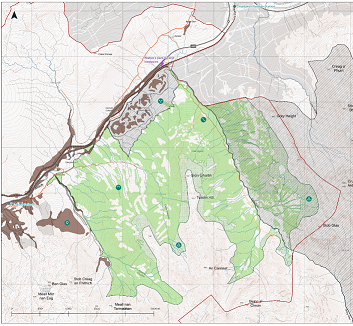
The area outlined in light blue on the map has the same reference number as the consultation advertised on the register and similar boundaries to the indicative concept map (see here for full sized map and key) produced by Tree Story for the Glenfalloch native woodland restoration project:
How to wreck a Caledonian Pinewood – prevent it expanding naturally by planting
Glen Falloch is one of the very few areas in the Loch Lomond and Trossachs National Park where semi-natural habitats survive on lower ground. This is reflected in the survival of the Caledonian Pinewood fragment whose history goes back 4,300 years. The LLTNPA half recognised this in a blog on the importance of ancient native woodland which specifically focused on the two Caledonian Pinewood fragments in the National Park (see here):
“Their age is what makes them so significant. Over centuries, ancient woodlands have developed a rich diversity of species and wildlife. The undisturbed soils , along with the accumulation of dead wood and leaf litter, create a unique habitat for fungi and invertebrates.
Once lost, these woodlands cannot be recreated. Restoring new trees is just the start; it takes centuries for biodiversity to return and for the woodland ecosystem to rebuild [my emphases].”
Instead of allowing the woodland to expand naturally after two centuries of overgrazing, assuming the Forestry Grant application is similar to the proposals on TreeStory’s Glenfalloch restoration website, the plan is to plant all around it. This ignores the extensive seed source in Glen Falloch (brown on map) and the current policy framework for Caledonian Pinewood Sites, which includes a 100m regeneration zone and a 500m buffer zone beyond that. That policy framework is now very out of date, as evidenced by the much more extensive natural regeneration which has been taking place in Glen Feshie and on Mar Lodge estate since deer numbers were reduced to less than 2 per square km.
No one should be fooled by the claims TreesStory made on their Glenfalloch restoration website to an ‘innovative no fence approach’ and:
‘Sensitive cultivation methods to produce variable tree spacing that mimics natural patterns of regeneration / organic fertiliser / no chemical herbicides / biodegradable (or no) vole guards’.
Wildland Ltd stopped erecting new deer fences 20 years ago, so not using them on the Glenfalloch estate is hardly innovative. Wildland Ltd were able to stop fencing because their focus was on reducing deer numbers to enable natural regeneration. TreeStory by contrast have been overseeing the development and implementation of tree planting plans for Oxygen Conservation at Kinrara (see here), Dorback and Invergeldie (see here), all of which depend on deer fencing as a substitute for reducing deer numbers to sustainable levels. (Oxygen Conservation revealed to the Herald last month they are aiming for 4 deer per square km (see here), about twice the deer density required for natural regeneration to take off).
As for TreeStory’s other claims:
- Fertiliser is fertiliser, whether organic or not, and is intended to enable trees to get established on peaty soils where they would otherwise have great difficulty growing.
- Clearing vegetation, whether by organic herbicide or screefing, will have the same effect – enabling trees to grow in areas that might now unsuitable for trees.
- And the only vole guards proven to be biodegradable are made out of cardboard or paper, fall apart when wet and are easy to gnaw through…………
How does this grant application fit with wider plans for Glen Falloch?
Also visible on SF’s map viewer is a much larger Y-shaped area of land outlined in purple. This demarcates an area covered by what id described as the Glenfalloch LTFP (long-term forest plan). This has a different reference number, 26FGS90879, to the Forestry Grant application but the 26 shows it also relates to the current year.
As yet SF appears to have undertaken no public consultation on this wider plan, which covers both sides of the River Falloch and the lower reaches of the Allt nan Caorann to the west. Bizarrely SF’s map viewer show that some of the higher areas included in the Forestry Grant Scheme application fall outside the boundary of the LTFP – why?
In submitting a Forestry Grant application before any LTFP consultation, TreeStory/the Glenfalloch estate appear to have pre-empted the LTFP the purpose of which is create a framework for woodland within an area and ensure that specific proposals are consistent with the wider whole. For example, as I showed in my last post on Glen Falloch, all the native woodland glen is threatened by invasive Sitka, and one would expect the LTFP to contains proposals for its removal which would then be incorporated in specific plans, such as those produced by TreeStory.
It is also unclear how the Glenfalloch estate’s woodland creation project and wider long-term forest plan fit with previous work, including a tree nursery, funded through Nature Scot’s Nature Restoration Fund, or the Loch Lomond & The Trossachs Landscape Connections initiative, backed by the Loch Lomond and Trossachs National Park Authority (LLTNPA) and the National Lottery (see here). The brochure for the Landscape Connections initiative (see here) suggests plans are still in the course of development but also claims there is an opportunity to:
’embed communities and land managers as an integral part of the nature recovery process, supporting inclusion and agency to ensure that actions are coordinated and from those who are essential for long term success.’
So what is the LLTNPA doing to co-ordinate actions in Glen Falloch and to ensure that the outdoor recreation community, by far the largest community to have an interest in the glen, is involved in plans which will affect its future and that of the Caledonian Pinewood there?

Here we go again – yet another ancient Caledonian Pinewood, naturally regenerated for thousands of years, since the end of the last Ice Age, being degraded by inappropriate planting. When will Tree Story learn that they are a threat, not a solution, to Caledonian Pinewood restoration?
I lived in Ardlui and Crianlarich in the late 1970’s and 1980’s. I was amazed at the regeneration which occurred after the very limited fencing around even a few trees in the Glenfalloch remnant above Derrydarroch and up to the Black Style Corner. The grazing pressure then must have been immense. This proposal does seem to swamp and surround the old fragment and seems contrary to the interests of the real local trees.
Allowing such a valuable site to be ‘destroyed’ by tree planting is such a mindless thing to do.
It is a shame that financial incentives fail natural regeneration so badly – less than 3% of all new woodlands in Scotland are created through natural regeneration. Though this is partly a hangover from the ‘maximise timber production days’ (not so long ago) it is more likely connected to the strong desire among Scottish Forestry civil servants not to upset the sporting estate lobby by incentivising deer control close to their own estates.
I also lament the failure of Scottish Forestry to keep grant applications on line and accessible for people to see much longer than a few weeks! I cant see the justification for this at least in terms pf public interest!
Good points Douglas. Earlier today, in Norway, I was taking photos of huge timber stacks, ready for transport to the mills, close to superb native pine and spruce forests, produced from prolific natural regeneration and felled in ways which maintain sufficient mature tree cover to provide seeds for the next generation. Makes you realise how completely bonkers is Scottish forestry policy, in a similar climate, soils and geology, driven by grant and taxation incentives that favour rich landowners, corporate interests and financial speculators. The whole system needs to be scrapped and redesigned so that public interest is favoured instead of private exploitation.
100% agree Dave!
and as you know, Douglas, that report we produced for the SNP land commission that we were both part of and that was supported by acclamation at the SNP National Council, was promptly just binned. Here we 30 years later with the concentration of landed power in even fewer hands and no effective land reform instituted. Further, there are no signs of either the SNP or Greens actively engaging with it. Any aspiration we have for the alternatives that we seek will be thwarted, because these alternatives will require legislative action from Holyrood.
Aye Dave, couldn’t agree more, but the tragedy is that this has been explained multiple times to the SNP hierarchy; eg by Derek Pretswell and myself( including sharing public platforms with them) since the early 1980s, by Reforesting Scotland etc since the early 1990s, more recently by Duncan Halley of NINA and more generally in recent times by Lesley Riddoch. The decision not to carry out the radical reforms urgently and deeply required can thus only be considered as being cogent, deliberate and perhaps even sanguine.
Right with you on all of that Douglas. The shadow of the landed hegemony still haunts the corridors of the NGO-Quangocracy run by the managerial minimalists so favoured by the politicians.
No one in the corridors of power is listening to anyone but the large landowners and the corporates Ron
Aye, this was raised at the Revive meeting in Perth by two Holyrood insiders who pointed out that the Scottish Gov pays more attention to the lobbyists from SLE etc than its own SNP membership. The landed hegemony permeates the whole carcass.
further to my earlier answer; traduced, suborned and infiltrated
Aye, Douglas the AI ‘green’ data centres are a case in point. One can only wonder about the number of ‘green’ envelopes going under the table.
What is there to say other than it’s criminal but apparently not illegal, and depressing.
what’s really depressing, Alison, is that it is considered normal
While I think there are some important questions being raised here and I agree that SF’s consultation platform is quite poor, it seems like the author has some fundamental misunderstandings on how the forestry grant scheme works in Scotland, particularly around LTFPs, which should be corrected. Work on a Long-term forest plan proposed for grant funding must receive grant approval from SF before work to produce the plan can be commenced to ensure SF can control their funding levels and not commit to supporting works above their budget and any plan where work is started before grant approval is given will not be eligible for grant funding. This is why the LTFP application referenced has a grant number, but will not have been on Scottish Forestry’s website for public consultation.
Once the grant is allocated, the applicant is then required to undertake a scoping exercise themselves for a minimum if 4 weeks with relevant stakeholders (statutory bodies, utilities providers, relevant NGOs, community councils/interest groups and local residents etc.) where they provide an initial indication of their proposals to these parties with the intention that these parties then respond to highlight potential issues, conflicts of interest, concerns and amendments based on more specialised knowledge. Once scoping is completed, any further information required like surveys will be undertaken and issues will be solved in consultation with SF and the relevant parties. Once this is done, the full draft plan is written which should draw together all of the above. This draft plan is then reviewed by Scottish Forestry and if they deem it has suitably addressed the issues raised it is then placed on their public register for final consultation. If any further issues are raised during this final consultation then the applicant will be required to amend the draft document to account for these if required, before the plan is signed off as approved. Given the plan highlighted has a claim year of 2026 (claim years typically run to the end of March the following year, e.g. 2026 claim year can be claimed until end March 2027) I would suggest that there is nothing untoward about the plan not yet having been on the public register with SF just yet.
Thanks very much for the explanation of how things work. Isn’t this system using finance, ie grant approval, to determine the shape of forest plans? And if all the funding is agreed first, doesn’t that effectively mean the LTFP is a fait accompli and the consultation a farce? I admit I didn’t understand this but if its the case the system for LTFPs is even worse than I thought. It seems to me this system also systematically operates to exclude natural regeneration of woodland, which basically just requires reduction of grazing levels, and does require not money for all the usual things forestry grants pay for: cultivation, planting, fences, plastic tree tubes etc. I accept that SF are now providing some funding – the amounts are pitiful – to landowners to reduce deer numbers as an alternative to planting trees but it seems to me by basing LTFPs on grants SF are perpetuating the current system of forestry as it operates in Scotland and excluding alternative models.
Hi Nick, I’d disagree with that assessment. A long-term forest plan can be prepared without grant funding from SF, and the approval of the LTFP is separate to the grant funding. Once approved an LTFP sets out the felling, thinning and restocking proposals and management proposals for a 20 year period, with approval for operations to be undertaken in the first 10-year period. Approval is contingent on the LTFP being compliant with the UKFS (the legal standard forestry practice is required to meet in the UK) and suitably addressing all the issues raised during consultation before it is approved by SF as the governing body. LTFP grant funding is there to help landowners with the cost of preparing these long-term plans, which is a detailed and time-consuming process, depending on the location this can take 1-3 years to be approved, sometimes longer. Allocation of the grant just means that there is funding set aside to help with these costs, but this is not paid out until the long-term forest plan is approved and this money does not in any way guarantee approval. This funding is to encourage more forest owners to take a longer term approach to the felling and restocking of their properties with a view to tackling issues at a larger, more cohesive scale, rather than doing smaller scale planning for individual coupes via the felling licence system and ending up with a more fragmented approach. Natural regeneration of suitable areas is allowed and supported within a long-term forest plan system, so this can and should be used in appropriate circumstances and is exactly the kind of item that should be highlighted during the consultation process to the applicant writing the plan if it is not already proposed. Fully agree with you that deer numbers are a major problem and it would be great to use less deer fences and plastic protection, but this really needs a national approach due to conflicting interests of sporting estates wanting high numbers of deer and most other landowners wanting less meaning that some physical protection of planting is required as deer unfortunately care little for legal boundaries!
I am sorry but the system of consultation for new woodlands does not work well. Take access for example, the first thing an outdoor user often knows about afforestation of his/her favourite route is when access to the hills is blocked off by a deer fence. And before you say is does not happen I can assure it does. And there is nothing anyone can do about it except plead with the landowner to unblock the route which they probably wont. Deer fences should not be grant aided as they are an assault on the public rights of access and a absolute menace to current biodiversity and the future ecological value of the woodland.
Hi Doogie, I completely agree that the current system of consultation doesn’t work as it should and needs improvement. I think a lot of the anxiety around proposed planting schemes comes from the process feeling almost secretive, which shouldn’t be the case. SF’s consultation platform is not well known and provides very limited information on the schemes posted unless you write to request more detail. Being more transparent and providing the application documents with the relevant sensitive information redacted would surely be better for all parties as it would allow interested people/parties to see the full detail of the proposed planting works, what survey works have been done to establish the suitability of areas for planting, where constraints like protected species or archaeology have been identified and how these are to be protected during planting. This would also allow better feedback from consultees as they would be able to accurately highlight items that are missed from the plan and feed in local knowledge of the site use to ensure the best possible outcomes. I won’t disagree with you that there are some poorly planned deer fences out there that restrict access unnecessarily, I’ve come across a few in my time when heading into the hills too. Good knowledge of the ground by the applicant and good consultation would be the best way to prevent this from happening, as a few hundred pounds for an extra gate or two is a negligible cost when set against the overall value of these schemes. Until there is some national programme set in place to reduce deer numbers though, they will remain a necessary part of the options for protecting woodland planting schemes.