[This post was updated and corrected 6th March – see post on apologies to Sandy Bremner 6th March]
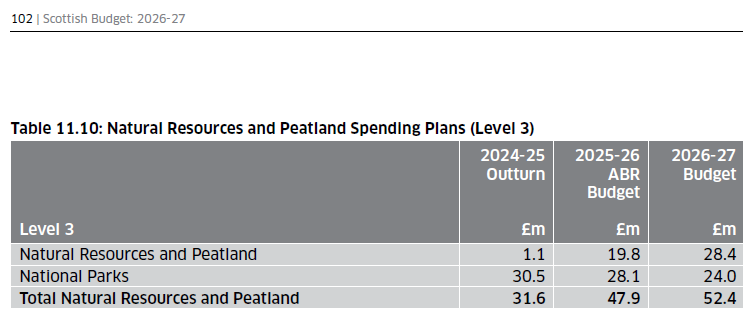
The Scottish Government’s budget for 2026/27 included significant cuts for both the Loch Lomond and Trossachs National Park Authority (LLTNPA) and the Cairngorms National Park Authority (CNPA) (see here for budget documents).
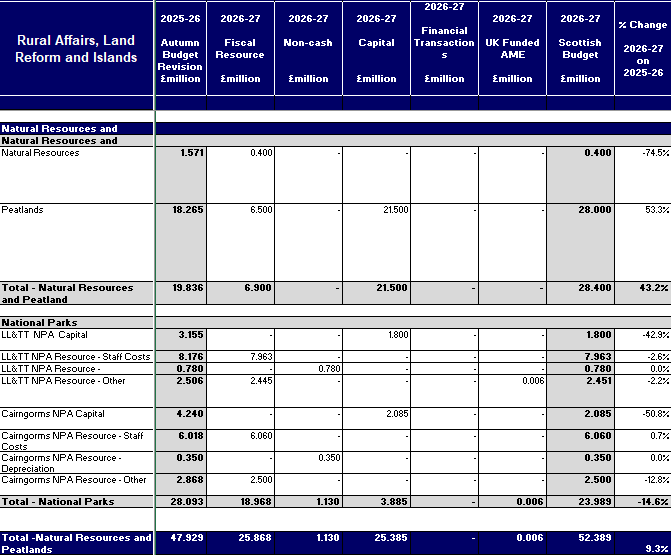
Over the course of two years the total budget for National Parks has been reduced by £6.5 million. £4 million of this is for next year and represents a cut of 14.6%.
Two years ago, before the Green MSP Lorna Slater was sacked as the responsible Minister, budget responsibility for National Parks lay with the then department for Transport, Net Zero and Just Transition. It was was then moved over to Rural Affairs, Land Reform and Islands under Mairi Gougeon and is now included in the same subsection of their budget as Natural Resources and Peatland (as shown above). .
The peatland budget, most of which is used to pay landowners to restore damage caused by the way they have managed the land, is being increased by over £8.5 million or 43.2% next year. The notes to the table states this inscrease is “to meet CCP [Climate Change Plan] emissions reduction targets”. Since the LLTNPA and CNPA are responsible for disbursing Peatland Action money in their areas, some of this increased budget with go through them and could offset some of the cuts in their direct funding.
What is going on?
These changes represent a further step in the trend of increased central Scottish Government control over National Parks, other non-department bodies and local authorities in Scotland. Instead of these bodies being allocated a budget and being able to decide how best to spend this, funds are ringfenced for certain purposes and in many cases directed through other organisations.
A significant proportion of the LLTNPA’s expenditure now comes through other bodies, like the Nature Restoration Fund and the Rural Tourism Infrastructure Fund (RTIF). For example the LLTNPA announced in December (see here) a £1.2m investment “to enhance visitor experience and restore nature”, much of which involved car-park related work at Tarbet and the Falls of Falloch funded by the RTIF through Visit Scotland.
This system of disbursing funds to rural Scotland disadvantages other areas because, unlike National Parks, local authorities and other organisations lack the staff resources to make bids to these specialist funds. But it also leaves National Park Boards, two thirds of which are made up of local councillors and directly elected representatives, almost completely powerless because they have no influence how budgets controlled by others are spent. This has given more and more power to officials and civil servants.
The outcomes of this top down control of budgets, where nobody on the ground is responsible for how money is spent, have not been good. A recent small example is the failed Scottish Government funded Viewing Tower at Inveruglas (see here). The amount of money that could be wasted by the £250 million the Scottish Government has pledged to invest in peatland restoration over ten years to reduce carbon emissions is likely to be far higher. The problem is not that restoring peatlands is a bad idea, its that if money is handed over to landowners to do this without any long-term control over how the land is managed, there is nothing to stop them continuing to manage land in ways that damage peat. For example, there is no point restoring peatland damaged by trampling and grazing unless deer and sheep numbers are reduced dramatically.
There are some indications that staff on the ground understand this and are trying their best, as in Glen Falloch (see here), also to address some of the underlying issues. It would be far more sensible to start by addressing these underlying issues, for example by requiring the deer population to be reduced to less than 2 per sq km, before spending any money on trying to restore damaged peatland.
A National Park Authority which had control over its own budgets could decide how best to spend their funds and could, for example, start employing stalkers to reduce the deer population or fund others like Forest and Land Scotland to do so. Such an approach would not only make any subsequent restoration work of peatland more likely to succeed, in some places peatland would start to recover naturally (saving money) and there would be other benefits, like woodland starting to expand through natural regeneration.
From centralisation to outsourcing
While there are major issues about HOW the Scottish Government is now allocating its resources and that they could be much better spent, they are at the same time being reduced. There is simply not enough money in the system and NDPBs like National Parks are generally a low priority for expenditure.
These financial circumstances partly explain the Scottish Government’s attempts at trying to attract private finance to pay for carbon offsetting and nature restoration. It hasn’t worked. The Scottish Government still pays for the vast majority of peatbog restoration and native tree planting in Scotland while speculators run riot. That is where the National Lottery Heritage Fund (NLHF) comes in.
In February 2024, the then First Minister Humza Yousaf said this (see here) when the Cairngorms National Park Authority (CNPA) was awarded £10.7m by the NLHF:
“Scotland’s national parks are more important than ever in helping us tackle the biodiversity and climate crises – and strengthening our rural communities.
“We [my emphasis] are proud to support the Cairngorms to become the UK’s first net zero national park.”
The “WE” indicates that Mr Yousaf made no distinction between the NLHF and the Scottish Government. Although the various governments in the UK have the power to issue policy directions to the NLHF, decisions are supposed to be made independently by its Trustees (appointed by the UK Government). The Scottish Government’s policy directions (see here), however, require the NLHF “to engage effectively with Scottish Ministers in development of policy and related funding programmes”. In other words they have a great deal of influence in how NLHF monies are spent.
In December (see here) I described how Heather Reid, current Convener of the LLTNPA, had been appointed as chair of the NHLF in Scotland by Keir Starmer (at a cost of £20,749 per annum). Dr Fiona McLean, one of the few nationally appointed members of the CNPA Board to be re-appointed when Lorna Slater was responsible Minister, is also a member of the NLHF Committee for Scotland.
Although the Cairngorms National Park is larger and more important for nature than the Loch Lomond and Trossachs National Park, much of which is blighted by industrial forestry, it has historically been less well funded by the Scottish Government. The CNPA has, for years, made up the difference with lottery monies, most recently to the tune of £10.4 million in 2024 (see here). Last year the LLTNPA announced that they hoped to be “awarded”, along with their “partner” the RSPB, up to £10m from the NLHF for nature restoration work and they repeated this in mid-February (see here). With both National Park Authorities now represented on the Committee of the NLHF Scotland, along with Stuart Housden, the former Director of RSPB Scotland, that funding looks certain and the National Park board member appointments not a coincidence.
Both Dr Heather Reid (also Board Member NatureScot and Water Industry Commission for Scotland) and Dr Fiona McLean (also a Member of the Judicial Appointments Board for Scotland) are part of the Scottish quangocracy, safe pairs of hands whose primary allegiance is to the Scottish Government who appointed them..
The evidence suggests that the NLHF board appointments and the cuts to the CNPA and LLTNPA budgets are linked and part of a deliberate plan. The Scottish Government now appears to be working with the UK Government, who ultimately control the NLHF and appointments to its board, to replace a large proportion of government funding for our National Parks with lottery funding. That is not openly stated on the “Policy Directions” to the NLFH.
My suspicion is the Chief Executives of both National Parks and selected board members must be fully aware of this plan, although I also suspect most of their board members have been kept in the dark. Those with power would not want any board member to blow the whistle let alone any public consultation or discussion in the Scottish Parliament about whether what is happening is desirable or not.
Perhaps its time that the board of the national lottery in Scotland was appointed by lottery, with board members chosen at random like members of juries? It would be interesting to see what such a citizens board would do if asked to fund National Parks but of one thing I am confident, it would be a far more honest way to take decisions about how lottery money is spent.

Very good article. Funds like the National Lottery re very worthy in their aspirations, but groups like the NGOs and now the parks are very good at hoovering up the lion’s share of it, and that does not leave much for anyone else. We then end up with these high cost/ slick presentational/ low output projects, and once they have been funded once, they almost always need more funds to keep going. It is all happening in plain sight.
The lottery fund was set up for good causes. It was not set up to fund government quangoes. To use lottery funds for that purpose is an abuse.
But that is where we move. That is what the government are doing. And in doing so they are appointing executives from the National Park quangos onto the lottery fund boards who have influence on where funds go.
A conflict of interest and getting the stover into funds that were supposed to go to support good causes. But that sadly is the way of our rotten and corrupt political governance. Or maybe it’s to go to pay the compensation bill that is rumoured to be due to Flamingo Land now that their commercial property development proposal has been rejected.
Time for folks to ask questions. National Parks are supposed to be, like councils, statutory authorities and should be funded as that. But as we see here collusion, and vested interests, are very much in play.