The Woodland Carbon Code (WCC) describes itself (see here) as ‘the UK’s government-backed standard for creating new woodlands that generate high-integrity carbon credits’ and is managed by Scottish Forestry. The WCC is based on a number of key assumptions which are not explicitly stated:
- the first is that since trees take CO2 out of the atmosphere through photosynthesis, if there were more trees in the British Isles that would help offset the carbon emissions which are causing the world to heat up;
- the second is that extending tree cover for carbon offsetting purposes is best done by planting trees rather than through natural regeneration;
- the third is that planting trees requires private investment;
- the fourth is that this private investment is best secured through the creation of a market in which the creators of new woodland can sell carbon credits to those who wish to offset their carbon emissions;
- the fifth is that a significant proportion of the carbon trees absorb from the atmosphere remains locked up after they are harvested or die naturally.
Following Richard Evans post on The Carbon Illusion: Why “Net Zero” Is Not Environmental Neutrality this series of posts will take a critical at the WCC starting with the first assumption. If that assumption is wrong, the WCC and the market it is trying to create faces collapse.
Trees and soils as stores of organic carbon
Inorganic carbon, in the form of rocks like limestone, is estimated to contribute 38% of the total carbon stored in soils. The rest is made up of organic carbon. This is estimated to amount to about four times that stored in the earth’s plants, including trees (see here). The level of Soil Organic Carbon (SOC) varies considerably, from less than 1% in the world’s deserts to over 50% in peatland. The peatland which covers over 20% of Scotland (see here) is therefore a much more important means of storing carbon than trees. The Scottish Government’s allocation of £250 million over 10 years to restore damaged peatland is partial recognition of this fact although at the same time it continues to allow trees to be planted on peat less than 50cms deep.
It is not just soils officially classified as peatland which are important for storing organic carbon. Forest Research estimates that within Britain’s forests around 70% of the organic carbon is found in “forest soils” not the trees (see here). Of this forest SOC 11% is estimated comes from the first metre of ‘deep peat’ on which trees have been planted. The amount of SOC stored decreases from organic > organo-mineral > mineral soils.
Evidence from across the world (see here) now shows that where trees are planted on peatland, this releases SOC over time, whereas where trees are planted on mineral soils this results in an increase in SOC over time. If the intention of the WCC, therefore, is to help offset carbon emissions, it is crucial that trees are planted on soils with low organic content. The UK’s Climate Change Committee recognised this in its Seventh Carbon Budget published in February 2025 (see here) when it recommended that while Britain needs a lot more woodland:
‘Trees are only planted on mineral soils, with organo-mineral and organic soils excluded to protect biodiverse habitats and minimise soil carbon loss from planting disturbance.’
A couple of further pieces of research on the relationship between trees and soils, which have specific implications for the WCC, are worth highlighting.
Friggens et al in 2020 (see here), coming from a soils perspective, showed that planting downy birch and Scots pine on heather moorland – podzols rather than peat – resulted in no net increase in ecosystem CO2 in four experimental sites 12-39 years after planting. In one case there was a net decrease in carbon. They hypothesised that this release of SOC, equal to or more than the carbon absorbed by the trees, resulted from the impact that trees have on soil respiration processes.
Forest Research, coming from a trees perspective, found (see here) that while planting woodland on more mineral soils resulted in an initial rapid increase in SOC this tailored off and stabilised over time. The long-term potential of woodland to increase SOC, which comprises over two thirds of the carbon stored in forests, thus appears limited or, as the International Union for the Conservation of Nature put it (see here):
‘Forest planting and restocking on peat translocates carbon from a large soil carbon reservoir that is
secure over millennia under natural conditions (i.e. peat soils) to a more reactive store (i.e. wood) which,regardless of its end use, is more likely to be converted back to carbon dioxide within years to decades.’
What all this research shows is that if the WCC is to achieve its intended objectives, it should start with considering the soils not the trees.
The WCC calculator and soils
The WCC is underpinned by a calculator (for current version, 2.3 dated August 2025, see here). Its primary purpose is to measure the amount of CO2 absorbed by new woodland (Assumption 1) so that these ‘gains’ can be traded on the Woodland Carbon Market. This can be either in the form of Pending Issuance Units (PIUs) – a promise to deliver at a later date – or actual Carbon Units (each one represents a ton of CO2 removed from the atmosphere).
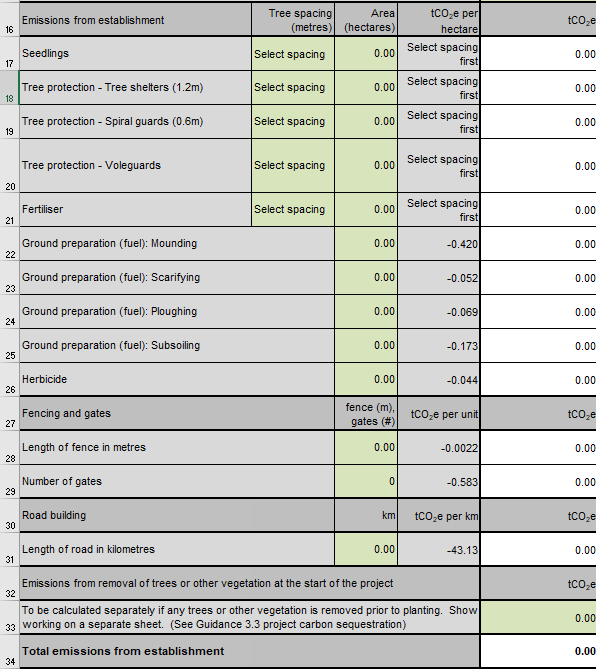
The WCC has from the start acknowledged that the activities involved in creating new woodland can cause carbon emissions. Allowances for this are incorporated into the calculator in Table 1 on ‘Emissions from establishment’;
and Table 3, Soil Carbon Emissions;
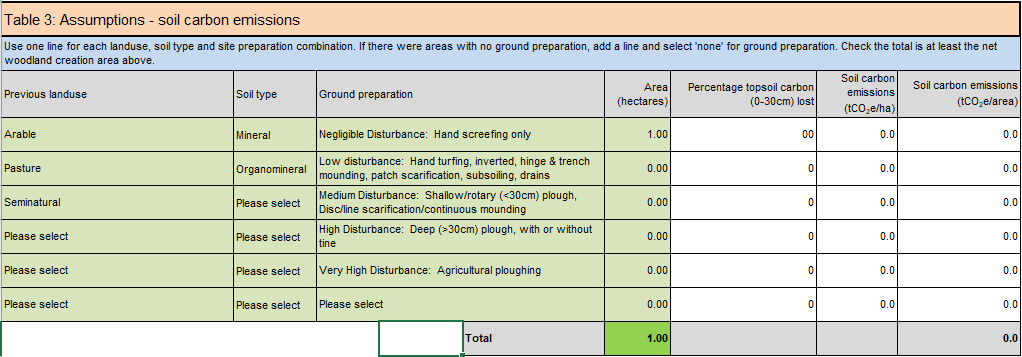
The assumptions built into these tables for establishment costs and soil carbon emissions account for why the WCC calculator typically predicts, as with BrewDog’s Lost Forest (see here), that new planted woodland starts to sequester CO2 after around 15-17 years and then starts to generate tradeable Carbon Units (rather than PIUs).
Several things have puzzled me about the WCC’s calculator’s assumptions here I want to highlight two issues. First it only gives two options for soil type: mineral and organo-mineral, with no option for peat or soils in-between. This is despite the fact under the UK Forestry Standard trees can still be planted in Scotland on peat (i.e an organic soil) less than 50cms deep.
The second is how it deals with SOC over time:
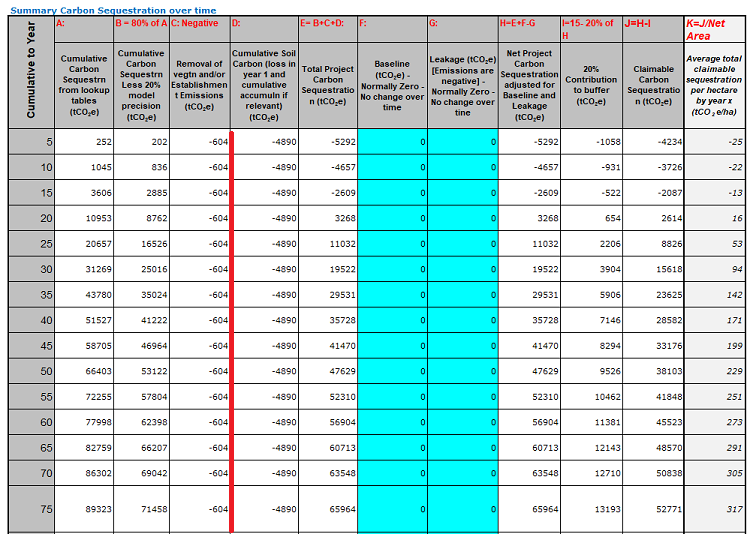
The WCC calculator for Baddoch Hill, like every other scheme I have looked at, accounts for any predicted loss of SOC from woodland establishment in Year 1. After that it treats SOC as remaining stable contrary to the research by Friggens et al which showed that SOC can continue to be emitted over long periods of time.
I did wonder if Scottish Forestry might have decided to incorporate some allowance for SOC emissions over time in Year 1, as reflected in the figure of -4890 tCO2 recorded in column D for Baddoch Hill. However, the predicted net increase in carbon sequestration for Baddoch Hill between 2020 and 2025 from 3268 to 11032 tCO2 looks extremely high given it was mainly planted with downy birch and Scots Pine and given the research by Friggens et al. I therefore decided to ask Scottish Forestry the scientific basis for the assumptions they had used in the WCC calculator.
Scottish Forestry’s assumptions on Soil Organic Carbon
My first email (see here) was an information request Dr Vicky West, who has led on the development of the WCC calculator for Scottish Forestry. She responded by saying ‘It’s detailed in this paper’ and gave me this link to a paper she had written on soil carbon and the WCC back in 2011.
The paper answers the question why the WCC calculator does not include an option for organic soils. Organic soils were defined in the paper as peat over 40cm deep in England (its now over 30cms) and over 50 cm deep in Scotland, i.e based on the peat depth where planting has been banned, and so are excluded by definition. The paper then treats peat less than 40/50cm deep as an organo-mineral soil even though it has a much higher SOC content than true organo-mineral soils. No scientific justification is given for this.
The paper also helps why the WCC calculator treats all SOC losses as occurring in Year 1:
‘On soils with an organic layer of 50 cm or less [i.e those that the WCC classes as organo-mineral], there are still likely to be some soil carbon losses due to disturbance for establishment and management purposes, but these are likely [my emphasis] to be smaller.’
Back in 2011 there might have been some excuse for Scottish Forestry not knowing that planting trees on peat releases SOC in organo-mineral soils over time but NOT given all the more recent research. Column D, Cumulative Soil Carbon, in the WCC’s Summary Carbon Sequestration Table is therefore not fit for purpose. It is also worth noting that it does not measure the potential gains in SOC from planting trees on mineral soils as demonstrated by Forest Research.
Given that Scottish Forestry uses the detailed soil classification system developed by the Forestry Commission to inform decisions about planting (see here), it seems very strange that they have reduced soils to just two categories, mineral and organo-mineral, for the purposes of measuring SOC in the WCC calculator. It is even stranger than these have never been updated..
The final section at the end of Dr West’s paper on Soil and the WCC on Future Developments stated that:
‘Ongoing research will help us better understand the changes to soil carbon due to woodland creation and management‘,
and
‘We will update the soil carbon methodology within 2 years using results of ongoing research. This will allow us to say with more certainty both the amount of soil carbon lost on woodland establishment as well as the rate of accumulation of soil carbon as the woodland grows and matures.’
I therefore decided to ask Dr West to clarify whether her paper or the assumptions on soil carbon used in the WCC calculator had ever been updated and also whether the research referred to had happened?
I did not receive a reply so after four weeks submitted a formal review of my information request to Dr West (see here), along with some further questions about what scientific evidence underpinned the selection of the options available in Table 3 and column D in the Carbon Sequestration table. It turned out Dr West was off sick, so I forwarded my information requests to the FOI section at Scottish Forestry. I received two responses.
The first, FOI Response-202600513888, confirms that the assumptions in the WCC calculator on SOC have not been updated since 2011 and that the research which was supposed to inform revisions on SOC within two years is still ongoing: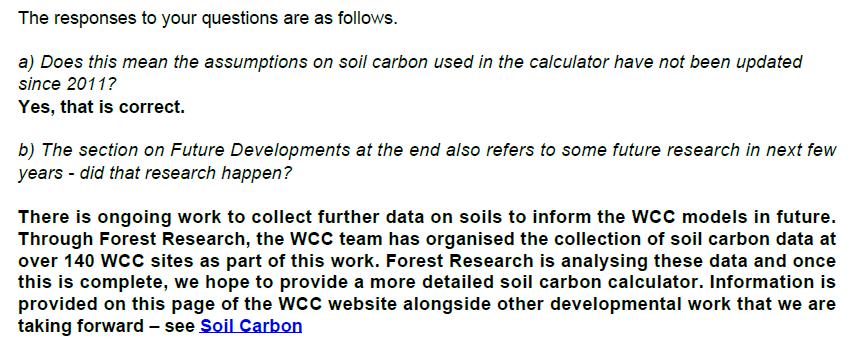
The second, FOI Response-202600510598, confirms that Dr West’s 2011 paper does not answer my questions about assumptions on SOC used in the calculator:
‘Upon reading the ten-page document you were sent [ie Dr West’s 2011 paper] I have determined that the information you sought [on the WCC calculator’s treatment of SOC] has not been provided’.
It then went on to state that Scottish Forestry does NOT hold the information that informed those assumptions:
‘I can confirm that as part of my review I commissioned new searches, which have resulted in the
information being sourced from external sources.’
While it is shocking enough that Scottish Forestry do not hold this information, they then declined to provide links to the external sources on SOC which have apparently been used to inform the assumptions in the calculator. Until those are made public and independently verified there is no reason for anyone to trust the WCC calculator.
Scottish Forestry, soil carbon and the integrity of the Woodland Carbon Code
In November last year at COP 30 in Rio de Janeiro the WCC received a Local Leaders Award from Bloomberg Philanthropies (see here):
‘Speaking about the award, Pat Snowdon, Head of Economics and Woodland Carbon Code at Scottish Forestry, said: “The Woodland Carbon Code is a powerful example of what can be achieved through collaboration. By bringing landowners, organisations and businesses together, we’re creating new woodlands which address climate change, restore nature and support local communities across the UK.’
It appears Bloomberg Philanthropies were completely unaware that the assumptions in the WCC calculator about carbon in soils does not appear to be based on any scientific evidence or that much tree planting on organic and organo-mineral soils is likely to be adding to the amounts of CO2 in the atmosphere and accelerating climate change further.
In February Dr Vicky West was nominated for an award from Confor, the body which represents the commercial forestry industry, in the ‘net zero innovation category’ (see here). The award went to Ayrshire-based land energy (see here) but how anyone can regard the WCC as innovative when it disregards and underplays the impact of planting trees on SOC is a question worth asking.
In March the WCC, i.e Scottish Forestry, announced (see here) that the code is the first government‑run carbon standard in the world ‘to enter full assessment’ by the Integrity Council for the Voluntary Carbon Market (one of whose funders is Bloomberg Philanthropies!). Commenting on this, Dr Pat Snowdon from Scottish Forestry stated:
‘This is a really important step for the Woodland Carbon Code and a clear recognition of our commitment to integrity, transparency and science-led standards. We are excited to progress to full assessment and to strengthen the UK’s leadership in high integrity nature markets.’
This post has demonstrated that Scottish Forestry and the WCC’s treatment of soils, a far more important store of carbon than trees, is far from transparent and is not science-led contrary to Dr Snowdon’s claims. As for integrity, the WCC’s promotion of trees rather than soils as a means of offsetting carbon emissions could be viewed as a means of helping Scottish Forestry to promote their own interests and meet their planting targets.
The idea of a calculator which works out the potential advantages and disadvantages of planting trees from a carbon perspective is not a bad one but needs to be firmly founded on soil carbon science. That is not Scottish Forestry’s area of expertise and, despite their claims to value collaboration, there is no indication that they have ever co-operated with soil scientists. The Scottish Government, which is ultimately responsible for the WCC, should therefore intervene and commission soil scientists to review and update the assumptions about SOC in the calculator.
The James Hutton Institute have done significant work on this, mapping the ‘Net Carbon Change from Afforestation in Scotland’ (see here). Their maps show the impact of planting different species on different soils over time:
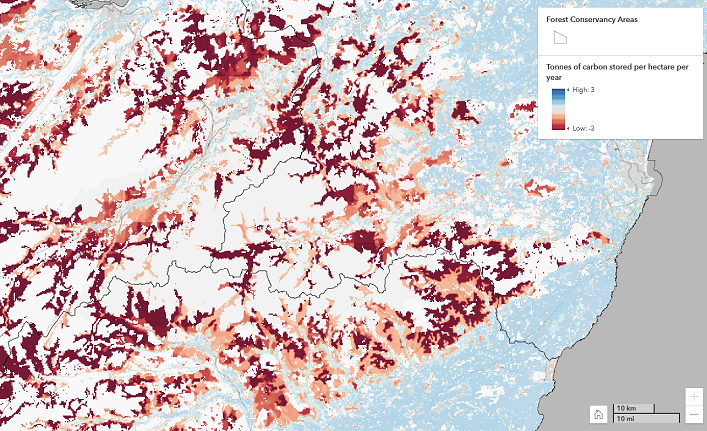
While the maps show the negative impact of planting species like Scots Pine on organic and organo-mineral soils decreases over time, they also show that even where there are net gains this takes significantly longer than is predicted by Scottish Forestry’s WCC calculator.
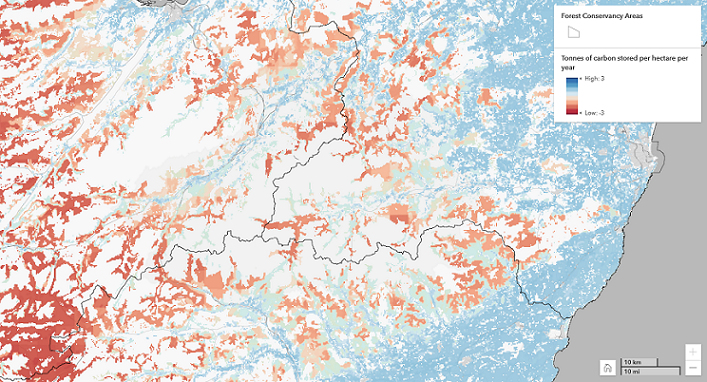
If the James Hutton Institute is correct – and unlike Scottish Forestry they are open about the research on which their calculations are based (see here) – then that has fundamental implications for the integrity of the WCC and the carbon market it is trying to create.

Our croft is on the edge of a large area of blanket bog. The croft which incorporatesa number of rocky outcrops and some higher areas was established in the late 19th century on marginal coastal land. This place has also seen extensive quantities of peat dug out to be removed for home heating. Deer and sheep could move across the area. Grazing by cattle had taken place over generations.
When we came here in 2002 we took a series of photos to show the state of this croft Then we erected a deer fence to enclose part of it around the house, approx 1 acre of garden ground. The transformation of this enclosed area since sheep were shut out has been quite remarkable.
In places where narrow drainage ditches had been cleared alongside the driveway, a thick screen of birch and rowan has spung from the ground. No seeding was necessary. The seed source for this woodland growth lay dormant, shielded by heather, wholly restricted by overgrazing.
But this was not all. Some Larch had taken roots on the higher outcrops well before our time. Now within the fence larch saplings emerge all over the place. Likewise Sitka. We have imported a number of other conifer saplings taken from forestry roadsides in local plantations, such as Scots Pine, Douglas fir. We also gather hazel nuts and acornswhich have been pushed into likely places. This has proved successful, provided the growth around any emerging seedlings is weeded.
24 years may not seem long. But I suspect this 1/4 century of quiet undisturbed nurture to be a much longer than many academics will ever watch any similar single space so diligently. The theory is one thing. What nature will do if left alone for decades is something else altogether.
Tom, what is ‘the theory is one thing’ supposed to mean? What theory are you referring to? Ehat you have reported is not in conflict with any theory
The subject of this thread concerns new science. It is conjecture..theory Micro measurements seek to describe this “theory”, as scientists attempt to determine the ways woodland carbon can be absorbed.. how much might become stored in woodlands…or what % might be lost again to the atmosphere through mechanical disturbance of natural cycles.
The calculations given in my 2011 New Paradigm document, refined in Appendix G in my ‘Illustrated Book of Peat’ (2021) show that 12 cm of peat store as much carbon/ha (82 tonnes) as the average total carbon stored in the wood (including roots and leaves) during the lifetime of a 60yr rotation of Sitka spruce of Yield Class 12 (81 tonnes). Do the calculatiions for yourself: the Appendix includes an Excel-based spreadsheet for calculating soil and woodland carbon.
Because tree roots dry and oxidise the soil, it does not make sense to plant on any trees on organic soils if climate change mitigation is the reason.
There is also the reduction in albedo from woodland compared to moorland, which will result in localised climate warming: an issue which no-one talks about.
Do you have a link for that 81 tonnes? I think you’re out by a factor of nearly 3 there- the spruce produces, 700 m3 of timber, which is ~504 tonnes wet, 227 tonnes dry weight, roughly 50% of dry timber is carbon – 113tonnes. But only roughly half of the the biomass is in the stem, so that’s 227 tonnes of carbon.
Hi Francis, could you give a source for the information you have reported too? Whatever happens to the stem, the other biomass from Sitka (branches, needles etc) surely biodegrades very quickly – unless it is preserved in peat! – so I am not sure why you think it appropriate to include it in a comparison with peaty soils?
There are two other things that stick out for me here: (1) An average volume of timber for that sort of stand would be nearer 400 tonnes than 500 tonnes, and possibly less, (2) It is open grown broadleaved trees with many branches were 50% of biomass is in the branches etc. It will be a LOT less in a conifer stand where there is probably only any significant branches/ live material in the top 1/3 or so of the tree for most of the stand, bar the edge trees. The figures James quotes tie in pretty well with FC research.
Francis, the figure is the average standing crop of carbon over the 60-year rotation cycle.
I have added a link where you can download Appendix G of my ‘Illustrated Book of Peat’ which includes the calculations used to get the 81 tonnes. You need to read the text as well, which gives various provisos. You can also download the Carbon Calculator itself as an Excel spreadsheet.
Go to the ‘CONTENTS’ section of the peat book at the bottom right of the web page, and if you click on ‘Appendix G’, it will download. The Excel spreadsheet is accessible below this.
The link is: https://www.fenton.scot/book%20-%20peat.htm
A great reveal of a document purporting to be based on scientific evidence which has not been updated to reflect latest research. However, yet again, PR has taken over and placed this document (Woodland Carbon Code) in the forefront of the movement to reduce carbon emissions but forming a quasi-scientific basis for the corrupt trading in carbon credits.
The problem is that too many people in positions of influence (e.g. senior executives in NatureScot) and in Government just skim the surface of these issues and hold only something which they can promote as being credible. Yet another Scottish Government failure which they will keep on pretending is a big (even international) success!
It is deep peat > 50 cms which covers 20% of the Highlands. When you start to consider shallow peat > 5 cms, which is the definition of a carbon rich soil, you probably have twice this area again. The tree planting plot I am aware of re Friggens et al had a peat depth of just 7 cms, and yet the birch trees produced an overall reduction in soil carbon, more than any gained in the trees. That site was not mounded or cultivated either, suggesting it is the trees themselves that trigger the C loss, not the cultivation work.
There is a local enthusiast from this region who takes time to recall “Acharacle in the past” . People have taken to sending him old photos of local scenes. Some images show local activities, poeple taking part, but also special views along lochs and glens.
These old images have been found among the belongings of family members who have passed.
Many antique photographs he shares will date right back to the end of the 19th century. Sometimes among them are old glass plate negatives from an even earlier generation ….now also shared.
The point is, these images are able to – almost inadvertently – tell us how these places actually looked. Places so familiar to us alive today show us how they were managed, by local highlanders through earlier centuries.
Today we hear scientists, wldlife specialists and ecologists, waxing lyrical about nature conservation across Scotland. They busily cite academic papers and engage in painstaking recording of minute detail to chart soil samples and so on. Opposing groups seek to justify tree planting, the erection of fences to conserve “tree crops” . Their activity now leads to modification of natural drainage systems and may also include blasting through impervious bed-rock, undisturbed since teh last ice age to destroy water ‘tables’ and drain bog pools, just to form new access roads for huge machines…..and wind turbines etc.
All these people would do well to study such informal antique images.
100 years ago this part of the western highlands had far fewer native trees on hillsides than have naturally re-established themselves now that pressure of local people trying to survive has reduced. ( and I am quite deliberately not mentioning the 1950’s hillside planting ..a blanket to 800ft contour.. a veritable calamity for so many hillsides …now so often an erosoion prone ‘warzone’ of clear-felled debris.)
The end of widespread sheep rearing, the carting of coal and timber to this region from far way, for home heating,oil and gas supplies and the electric grid have all reduced former widespread felling of small local trees for firewood, fencing and homes. Small trees left alone get bigger. Eventually they will self-seed again. It is happening now. The proof is all around. (As is rampant Ponticum !)
These antique photos do not mislead us, however inconvenient the evidence recorded by them might prove for those who now live wholly dependent on this age of constant ‘take’ from the National ‘grant money’ systems.
There is no doubt that there are thousands of ha of such naturally regenerated native woodland in Scotland. But in terms of carbon balance, if the regen is dominated by birch, then the outcome will be negative for many decades. The woods will have all sorts of other benefits, especially on a west coast croft, but the carbon benefit is not part of it…. regen or no. The mechanism is increased biilogical activity/ respiration from the carbon rich soils which much of this regen will inevitably be growing on.
You are correct Victor, Friggens et al 2020 explains that the C loss is due to soil priming as a result of tree root exudates feeding the expansion of mycorrhizal fungi and bacteria in peat that then increase nutrient cycling….this causes C loss. It is astonishing that all concerned with planting tree are wilfully ignorant of the latest science on trees and carbon budget in organic soils. This science is over 5 years old and the one reference I’ve seen was a paper which tried to place a financial gain estimate for wolves in Scotland calculated by the reduction in red dark and the consequential increase in trees. The author misled his readers claiming that the huge C loss mentioned in Friggens et al 2020 was due to planting soil disturbance. If he had read the paper correctly he will have seen that they used slot planting to avoid that very issue. There is another paper that show that natural regeneration also significantly reduces SOC.
Well done for pushing over the Cabon Offset house of cards.
It has been begging for it for a decade, but you did the graft.
I am willing to bet that Woodland Carbon Offsets in the UK have increased emissions, not reduced them.
One of largest vendors sells them with this pitch; ” customers expect businesses to address climate concerns. EcoPoint is an affordable way to reduce the impact of your vehicles CO2 emissions”. I guess Affordable = cheaper than changing to EVs.
https://allstarecopoint.co.uk/benefits/
Great to see these lines of enquiry Nick. 2 queries from me . 1 Does the Hutton study include emissions from current land use ? 2. Will your examination also look at the impact of carbon traded on future woodland management? Essentially, if we are creating 2 parallel ownership regimes ..one for woodland and one for carbon will they conflict? . Can the woodland owner actually cut down the trees if the carbon has been sold to another party.
I think that in theory the burden of managing the land to preserve the carbon passes to a new owner. But I cannot see how anyone can believe that will work in practice. As we all know land owners are hard to track down and even harder to hold to account. Sure you can fine a shell company in the Seychelles if they cut down the trees or just let deer do the job. But will said company have any tangible assets other than the land? Further, will the future inhabitants of the area or of Scotland, or Trump if he invades us, be bound by these fairytale documents?
At a recent gathering to celebrate 60 years of Ecological Science graduates at Edinburgh University we had a presentation from Dr Lisa Wingate, former graduate, and now Research Director at INRAE (France’s National Research Institute for Agriculture, Food and the Environment).
Her keynote was on Arbuscular mycorrhizal fungi (AMF) and their influence on how plants move carbon into soil and how long that carbon stays there. AMF are fungi that colonize the roots of most land plants. They receive photosynthetically fixed carbon from their host plants and using enzymes (biological catalysts ), in return, help plants acquire nutrients such as phosphorus and nitrogen. This carbon transfer makes them major players in the soil carbon cycle.
I have to admit that the chemistry was mostly beyond beyond my distant ecological degree, so I hope I picked it up correctly.
She explained that the enzymes in AMF are central to ecosystem processes because they mediate numerous reactions that are essential in biogeochemical cycles. Her research team had concluded from their extensive literature review that enzymes determine the sensitivity of soil carbon to warming, but that the microbial community and enzymatic (protein stucture) traits that mediate this effect will change over time.
Warming temperature may increase enzyme activity but shifts in microbial community composition and growth efficiency may mediate the effect of warming in the long term.
Although increasing enzyme activities may accelerate labile (easily altered) carbon decomposition over months to years, Dr Wingate’s review highlighted that this initial stage can be followed by the following phases:
(a) a reduction in soil carbon loss, due to changing carbon use efficiency among communities or substrate depletion, which together can decrease microbial biomass and enzyme activity and
(b) an acceleration of soil carbon loss, due to shifts in microbial community structure and greater allocation to oxidative enzymes for recalcitrant carbon degradation.
In essence soil carbon fluxes are complex and we don’t yet know enough about them, as our climate changes. Moving forward – right tree in the right place with the right AMF and enzymes ( still uncertain) seems to be the message for woodland cover. There could be tricky times ahead anyway for soil carbon stability.
Studies that bridge scales in time and space are required to assess if there will be an attenuation or acceleration of soil carbon loss through changes in enzyme activities in the very long term ( decades and centuries).
Don’t think I will be investing in carbon credits involving soil anytime soon!
https://besjournals.onlinelibrary.wiley.com/doi/10.1111/1365-2435.14027