[NB This post was updated and corrected at 18.50 on 19th July. I wrongly reported the local resident as having seen smoke at 11am on Weds 15th about 45 mins before the Scottish Fire and Rescue Service were alerted to the fire when he had seen smoke in that area the day before. It was completely my mistake and my apologies to him].]
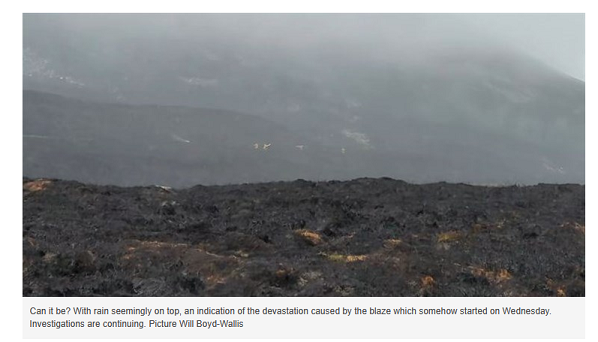
As the Strathy put it (see here), ‘heavenly help arrives in Strath Nethy after days of fire’. 4.11mm of rain was recorded as falling at Cairn Gorm on Saturday, enough it appears to put out the fire in the remote areas of Strath Nethy where it had spread after crossing into Glen More (as I described here).
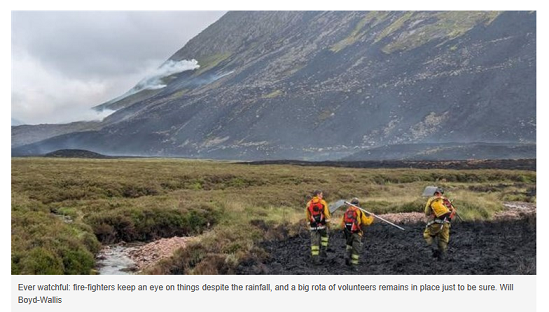
If 4.11mm of rain was enough to extinguish the fire, it suggests that it would not have required that much water to have extinguished it in its early stages:
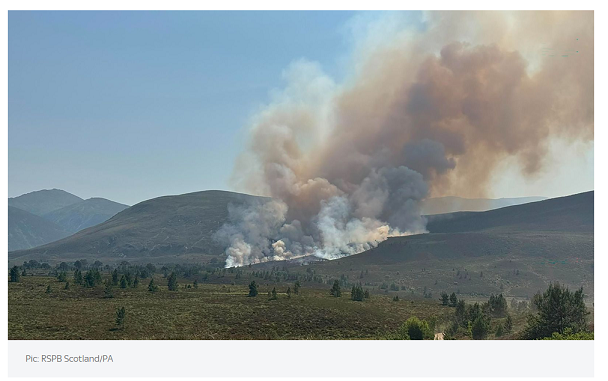
One wonders many helicopter water carries from Lochan Uaine, just over a kilometre away, would have been needed to contain and extinguish the wildfire at this stage on its first day? When helicopters were eventually deployed, around two days later, Lochan Uaine at the Pass of Ryvoan was used to source the water that was used to contain its spread into the Caledonian Pinewood. (Lochan a’ Gharbh-choire is located even closer to the area in the photo but I don’t know if it is deep enough for helicopters to source water).
During the early stages of the wildfire the RSPB, who own the land in Strath Nethy, made calls for helicopter help. None arrived, with the Scotsman reporting (see here) an RSPB spokesperson as saying:
“We have no helicopter support, as we believe they are all deployed to England and Wales fighting wildfires down there.
“This is critical and we need it urgently to bring the fire under control.”
Another article in the Scotsman reported (see here) that:
‘Initially, they [the RSPB] were told adequate assistance had been deployed [i.e no helicopters were needed].
Scottish justice secretary Neil Gray said on Thursday afternoon that the fire was “contained” [this was before helicopters were deployed] and that the Scottish Government would be reviewing the situation should anything change.’
Clearly, adequate assistance hadn’t been deployed. That failure allowed the wildfire to spread and grow in size making it far far harder to extinguish. The eventual arrival of helicopters on Friday provides confirmation of that.
After my last post, in which I reported that the Scottish Fire and Rescue Service (SFRS) had been alerted to the fire at 11.47 on Wednesday 15th, I was contacted by a local resident who thought they had seen smoke in the sky around 11am on Tuesday 14th. Although wondering if he imagined it, that deserves to be investigated by the SFRS.
That prompted the thought that, while it does not yet appear to have been made public how long the fire had been burning when reported to SFRS on the 15th or when the smoke or flames were first seen, every minute could have made a difference. As the resident helpfully remarked, the lesson is, if you see smoke, report it.
Now imagine that the SFRS had 24 access to a helicopter, which could also carry water, and had used this to check the source of the smoke when first seen. SFRS could then have started to respond to this wildfire at the scene several hours earlier than they did and when it was much smaller. There appears to me a very strong case that if this wildfire had been responded to promptly and with the appropriate equipment, it could have been extinguished and most of its damaging impacts could have been avoided.
The consequences of cuts to the SFRS
As the wildfire was raging in Glen More, Katy Clark MSP was raising in the Scottish Parliament concerns about the latest round of cuts to the SFRS (see here). These cuts, and the requirement of managers to balance budgets, explain why the SFRS is so reluctant to deploy helicopters. They may also help explain why the Justice Secretary, Neil Gray, tried to claim the wildfire was under control, when it clearly wasn’t. The Scottish Government appears to be in denial that cuts in public services have consequences.
The delay in engaging helicopters, which were then need for many hours, to fight this fire may well have cost SFRS far more than if they had deployed helicopters immediately and put the wildfire out.
The wider costs of cuts in the SFRS’s budget to local communities and the environment are enormous. The Strathy and other local media are full of stories about the financial consequences of the fire, with many local businesses losing significant amounts of money in prime holiday season. Those losses will be far far more than the cost of SFRS having helicopters available to respond rapidly to wildfires.
As for the environment, the Cairngorms National Park Authority’s targets for net zero, woodland expansion and protection of designated sites would all appear to have gone up in smoke. Clearly, they need to start reviewing their Integrated Fire Management Plan now in the light of its failure to prevent the damage caused by this fire. Central to that should be quantifying what public resources are needed to prevent such disasters occurring in future. All the volunteers who fought against insuperable odds to limit the damage deserve no less.
Update
A reader has made me aware of an eyewitness account of the start of the fire by a hillwalker which appeared on WalkHighland on Thursday – (see here). It is essential reading for anyone interested in wildfires and how to prevent them. It shows attempts were made to report the smoke as soon as it was spotted, asks where the helicopters were and comments how the first vehicles to get to the scene of the fire had no water to fight it.

I read that the helicopters cost £5000 per hour for each one. That’s £10k per hr or £240,000 per day! If they had been deployed at the earliest opportunity how much could have been saved both in cost AND habitat/ wildlife? As fires, wild or otherwise, appear to be an ever increasing danger then maybe the SFRS should have it’s own fleet of helicopters rather than paying private enterprise at overinflated rates!
you are assuming cost of helicopter would be met by sfrs. is this correct? some landowners have insurance to cover such costs.
As I stated in the previous post, the CNPA’s Integrated Fire Management Plan suggests landowners should consider taking out insurance to cover the cost of helicopters and my view on that is its unreasonable to expect landowners to cover the costs of insurance for fires they are not responsible for starting. There are lots of other issues with private insurance too, once SFRS are notified of the fire they need to be able to contact the landowner, the landowner needs to decide if they are going to use the insurance and my need to check with the insurance company first, the helicopter company needs to be contacted etc etc. all of which would lead to delays. A public response service if properly funded would be far more effective and cheaper.
The Fire was mostly on FLS (publicly owned) land and the government doesn’t insure.
To claim against the RSPB’s insurance you would have to prove delict based on the neighbour principle- that the RSPB allowed a dangerous level of fuel buildup, this directly caused the fire, the harm was foreseeable and thereby they failed in a duty of care to a standard expected of a reasonable landowner.
When I worked on Deeside, we were part of the South Grampian Forest Fire Protection Group, attended by SFRS. At our annual meetings, we did a debrief of incidents in the previous year, but one important function was always to update helicopter permissions…. who was covered and who who was able to authorize. If there was a fire, then SFRS knew what the situation was. So, there are ways of doing these things. It is possible though that things are changing. The scale of the Dava fires last year and the coverage given to this fire will mean that people’s perception of risk has increased, and that will put pressure on the whole insurance thing. I am told that people are now more reluctant to declare too quickly if they are covered or not in case they end up as the ones paying for someone else. It is also that case that as premiums increase, the more people look at the value in paying them. I also know people who will not get involved in tree planting or regeneration projects now, simply because the risk is becoming too high in relation to fire. It is much safer and cheaper just to maintain an open landscape. When we had the big fire in the Forest of Birse in 2003, one of our conclusions was that if we wanted extra helicopter support, the best option was to have them fly across from Norway, where availability was much higher. It is very important to realize that all these discussions have been had before. The problem is that the urgency to deal with fire situations falls away very quickly once the immediate danger is over. I would say we were very lucky this time. The wind direction could have been much worse. We got rain at the right time. There was only one fire in Scotland, not multiple ones in different locations. We are not set up for all of this at present, and the politicians are not with it at all. That Neil Gray is a total disaster, and screws up everything he goes near. We need something better.
Is it not the case that helicopters were down in England where the wildfires had been ongoing days before RSPB Abernethy kicked off?
Not all privately owned helicopters or pilots in Scotland are geared up/trained for this sort of work.
Hopefully the facts will come out.
Let us hope that the RSPB get a licence to muir burn, in season next year to create firebreaks where no provision has been made for years.
Well, I agree that Neil Gray does not inspire confidence( that’s my bid for understatement of the year)
to your point about delay: estate staff can be authorised by landowner/employer to call for helicopter support, so no need for the delay you describe.
to your point about landowner paying for damage caused by third party: fair point, but then why should taxpayer pay if insurance is possible?
so, a worthwhile debate, and ross kemp from sle makes good case elsewhere (scotsman). perhaps if landowner/manager has done what s/he can to mitigate/avoid damage- patrolling, resilient bbq pits, firebreaks etc- then insurance would be reduced? this would be similar to other property insurance- smoke detectors, window locks, etc reduce premiums.
As a landowner you can’t mitigate -provide BBQ pits – not allowed – firebreaks prevented by SSI restrictions + you are compelled to allow dangerous fuel build up by ‘leave it to nature’ (deadwood) conservation policies and aggressive deer cull of your neighbours- meanwhile, surrounded by NGOs and FLS – you are the only estate with any expertise in controlling fire and yet maligned for muirburn whilst your neighbours create a dangerous situation on your march for which they take no responsibility .
Tosca, I dont know about the specific land management constraints you refer to: expect it’s different for every landholding depending on designations, agreements,etc.
However, WRT bbq pits, individual landowners can give permission to groups/tenants/etc to have a fire/bbq. So mitigation in the form of robust/resilient facilities could be made available.
Everyone attending that fire needs to invoice for their time, including a hire fee for all equipment used, and any breakages and repair bills covered. Then we will see the actual cost.
Interesting discussion on when the fire started. I saw the fire clearly from Broomhill around 13.30 on Wednesday 15 July. (I checked the timing from my car log). At that time the fire was alarmingly big – akin in size to an out of control muirburn. My assessment was that the wildfire was as big or bigger than the RSPB picture in the blog of the fire in its early stages photographed from near Ryvoan bothy. Unfortunately I didn’t take any photos then.
If SFRS and the Scottish Government are to learn anything from this fire it is that we need to have helicopter or even firefighting aeroplanes available a very short notice throughout the high risk season and get these aircraft on the scene as soon as possible. The first reaction by SFRS to such fires needs to be to deploy these aircraft, not wait a day and think about it. There’s something for Neil Gray to think about!
Presumably the Minister was given advice from the Fire Service that the Fire was contained which allowed him to make his statement. I can’t imagine he was in a position to know otherwise since he isn’t a firefighter nor was he present at the site? It’s not believable that he made any statement without receiving advice?
We really need to look into firefighting drones too. These can have 100kg or more load capacity and an hours endurance before a battery change is required. Much lower cost than a helicopter and could be stored in vulnerable areas for fast deployment.
This article from last year is well worth a read: https://countrysquire.co.uk/2025/07/07/wildfires-in-moray-lessons-learned/?shem=rimspwouoe&fbclid=IwY2xjawTKD4NleHRuA2FlbQIxMQBzcnRjBmFwcF9pZBAyMjIwMzkxNzg4MjAwODkyAAEe1Ch8HmAeBC43yRHDq9sNWZD-WBxVgPovufGvW7X4s6AudV6bjxZOmvq20Zo_aem_dcjsPngAKo5SbKIHhM-2Cg
What an excellent apologist you are for misunderstood country squires and the VED system.
Is this not another example of where this country needs a permanent professional “ranger” service. A group who are kept fully trained to oversee, manage and act as a nucleus of workers who can be brought in to situations when the interests of the Public are under threat. I can think of air crashes, major rail disasters, big floods , bridge collapse etc).. Is the only way this sort of thing can be dealt with today involves ‘pass the parcel’ of blame and chance of ultimate accountability from Scotgov ministries to land owners, to fire chiefs to local officials and the public. Never a decision maker who takes charge?
A system once meant that a natural disaster could lead to instant release funds from a national contingency reserve. Has it now become so essential to first micromanage the financial response of so many Quango interests and satisfy every irrelevant “committee” first.
Here’s a list of what I mean. In no particular order…..Satisfy SEPA, Appease Mountaineering groups. Relieve Land owner worries, co-ordinate with Police, summon SFRS, allocate the ambulance Service, involve RSPB, and other wildlife conservation groups. Each concerned that money ( not from ‘their pot’ ) will be found to absolve those making the hard choices.
What wild fire risk requires is a fearless individual right at the top of the system who will TAKE CHARGE . ( some might say this is the first Minister’s role in the Scottish situation ????) Someone who can say . “CUT the incessant chatter and buck passing. Stop the waffle now – get it done”
There should be a flight of water carrying aircraft kept regionally for this. and there should be RAF crews or RAF reserve pilots kept fully certificated, able to operate them as can be seen fighting fires in so many other countries.
Must it take a fire sweeping through..say… Aviemore, Tomintoul , Braemar or Granton on Spey to initiate some long duration,costly, public enquiry so such obvious ” lessons can be learned?
Ah, aye indeed Tom, right with you there and if you’re familiar with my posts herein and on Facebookl( before I was banned) you’ll know I have argued in similar vein for some years. However, we are up against, not so much a brick wall as a shape shifting bureaucratic ‘jellyfish’ of procrastination, prevarication and obfuscation. Loud as the protests were from Labour, the SNP and the Libdems when Thatcher first set up the Quangos and the promise of a ‘bonfire’ of such, should they have political power, no such thing has happened. Instead, they put in their own placemen and used the Quangos as a kind of ‘buffer state’ against direct public opprobrium directed to Ministers of state; a kind of ‘Wisnae Me in Disnaeworkland’. And, so it continues, with the NGO-Quangocracy just as much as part of the private landed hegemony that stifles democratic land reform and the creation of a National Wildlife SERVICE/National Parks SERVICE for a normal country. Should the possibilities in your last paragraph be manifested the we’ll be told that it gets rid of the worthless scrub and creates more grouse habitat. So what if a few ‘pehsints’ get incinerated?
Glad to see this morning that the BBC Scotland has raised the serious under resourcing issue surrounding airborne firefighting equipment for use to fight upland wildfires in an article. It is interesting and appears well researched.
https://www.bbc.co.uk/news/articles/cy8enzjdz0qo
https://x.com/i/status/2079899559912718593
https://x.com/i/status/2080738035701100789
Nethy Bridge is being evacuated. Is this a first?