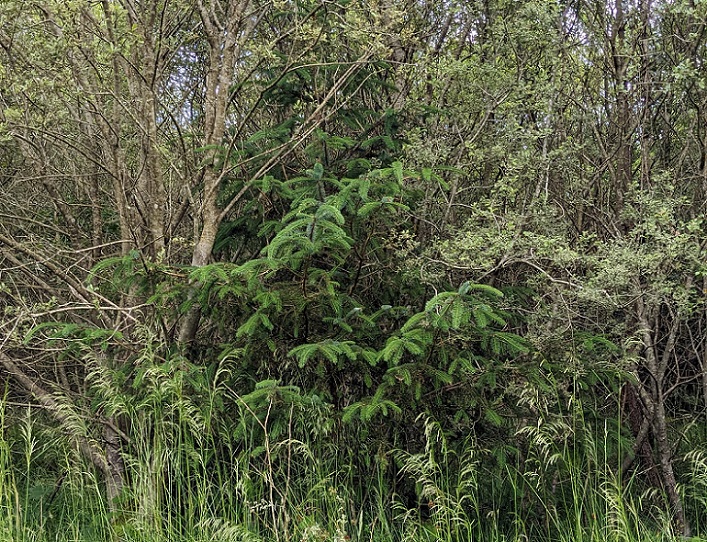
At the end of June I went for a walk over Conic Hill, starting from Milton of Buchanan and then back along the main road from Balmaha. The first part of the route, which I have followed several times before, takes the West Highland Way through the western edge of Garadhban forest, owned by Scottish Ministers and managed by Forest and Land Scotland (FLS).
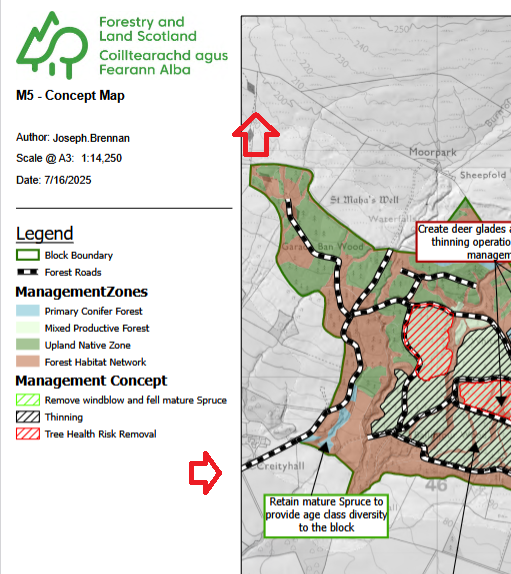
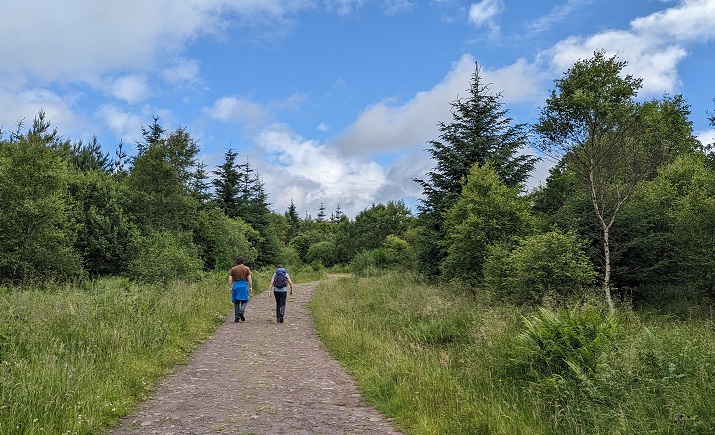
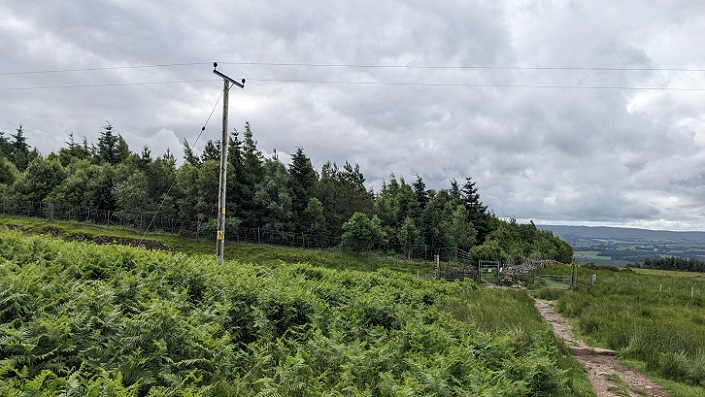
It was my first visit since FLS consulted on a draft Land Management Plan (LMP) for Garadhban forest last year (see here). FLS’ intention is to manage most of the forest as a mixture of conifers and broadleaves, using Low Intervention Silvicultural Systems (LISS) and natural regeneration rather than planting, but reserving the western compartments of the forest for native woodland. The north west corner of the forest, known as Garadh Ban wood, was planted with native trees around 15 years ago:
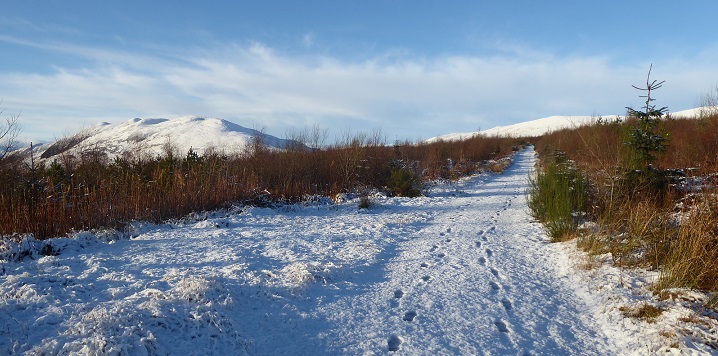
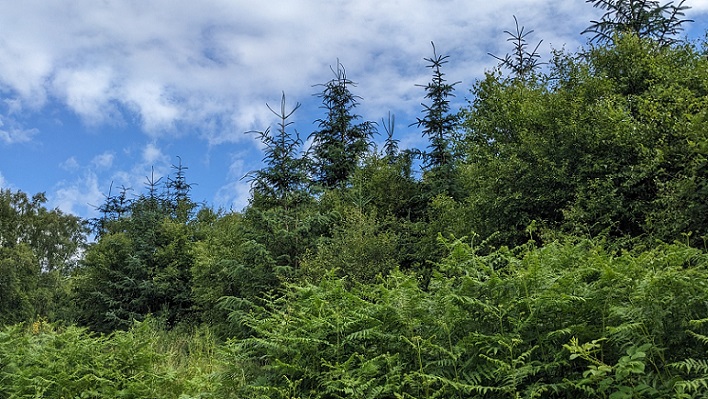
Since I first started looking at the native woodland on the western edge of Garadhban, the number of native Sitka appear to have steadily increased. As they grow faster, many of the Sitka are now significantly taller than the native trees and threaten to out-compete them
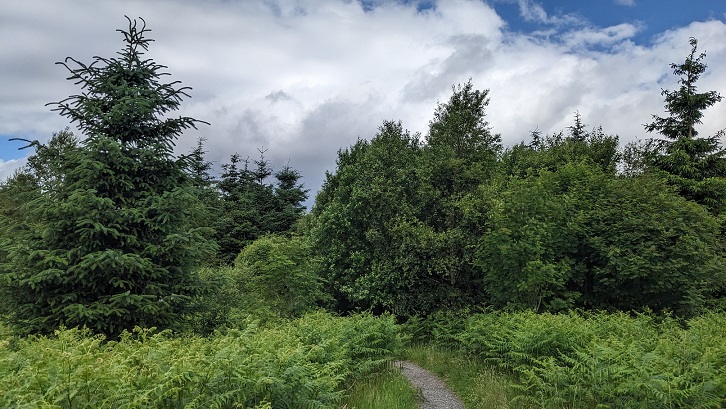
While Scots Pine is the mostly widely distributed conifer on earth, the absence of other large conifers from Scotland made our native woodland unique. Scotland’s native woodland lacks the dark closed canopy conifer forests found elsewhere in the northern hemisphere. Where Sitka is invading native woodland, however, as at Garadh Ban wood, it threatens to change that character entirely and could eventually out-compete and kill off most of the native trees.
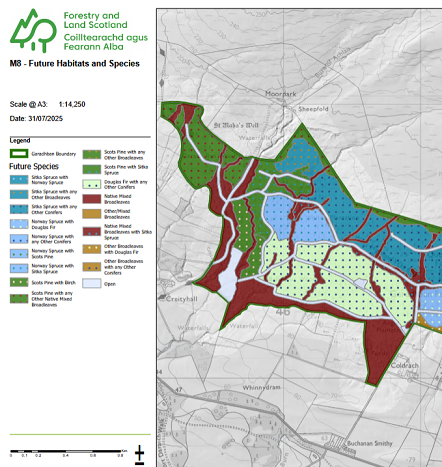
That eventuality, the likelihood of which appears to be increasing at Garadhban year by year, is clearly contrary to the intentions of LMP which depicts the whole area I walked through as native woodland. There is no mention of this issue, let along what FLS plans to do about it, in the draft LMP which is still to be approved by Scottish Forestry although there is reference to an ‘ingress of Sitka’ in a broadleaved area on the eastern side of Garadhban that is due to be thinned (coupe 61601 on the thinning map).
Sitka don’t produce seed until they are about 20-25 years old and the problem on the western edges of Garadhban appears to have been made worse by FLS’ decision to retain a strip of mature Sitka (light blue on top map) along the southern part of the native woodland to provide more structural diversity to the forest. Each time these trees seed, the native woodland to the west faces an invasion of Sitka.
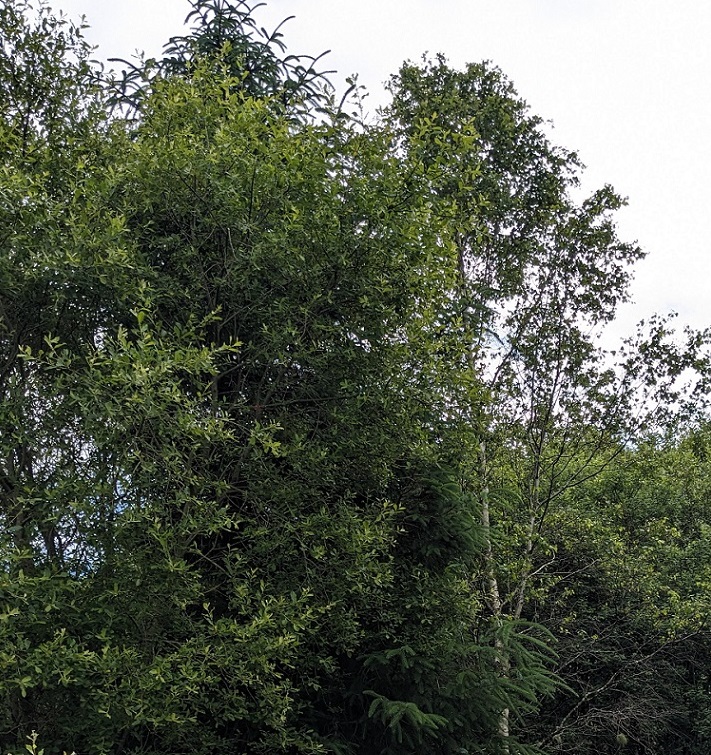
While it is easy enough to remove Sitka seedlings from open moorland (see here), when Sitka invades densely planted native woodland it’s another matter: the young Sitka, among all the other vegetation growth are much harder to detect and then, as the native woodland grows, extracting them becomes more and more difficult. Leave it to long, as FLS have done at Garadhban, and the landowner either faces considerable expense or losing the native woodland they had intended to create.
The failure of FLS’ draft LMP to describe how Sitka (and other non-native conifers such as Western Hemlock) are invading the area reserved for native woodland at Garadhban let alone what they plan to do about this suggests it has been a desk top exercise. The approach to Sitka contrasts with its proposals to remove the remaining 14.9 ha of larch in the forest (3% of the total) ‘in an effort to slow the spread of Phytopthera Ramorum’. Why is FLS doing this, even though ‘there are no active plant health concerns’ in the LMP area, and not making any effort to slow the spread of Sitka?
Part of the explanation is that Sitka, despite being non-native and highly invasive, is not classified by the Scottish Government as an Invasive Non-native Species. This has allowed foresters to absolve themselves of responsibility for what is happening on the ground (see here) and explains this statement from FLS’ LMP:
A.6.10 Invasive Species
There are no known areas of non-native invasive species in the woodland block; however, there is a significant amount of Rhododendron Ponticum ~800m south of the block boundary which has the potential to seed into the block
Meantime Phytopthera Ramorum, an invasive disease which spreads through the air, is classed as a threat to plant health even though it is clear now that removal of larch won’t stop its spread.
FLS’s draft LMP fails also to say anything about the risks that other landowners face from ‘Sitka ingress’. This is likely to become a major problem for the Montrose estate because, as the plan reveals:
‘A.6.6 Adjacent Land Use
To the north and west, Garadhban borders land of Montrose Estate which has recently excluded grazing from the area with a view to potential woodland establishment’.
Reduce grazing levels and Sitka, one of the least palatable of tree species found in the British Isles, spreads.
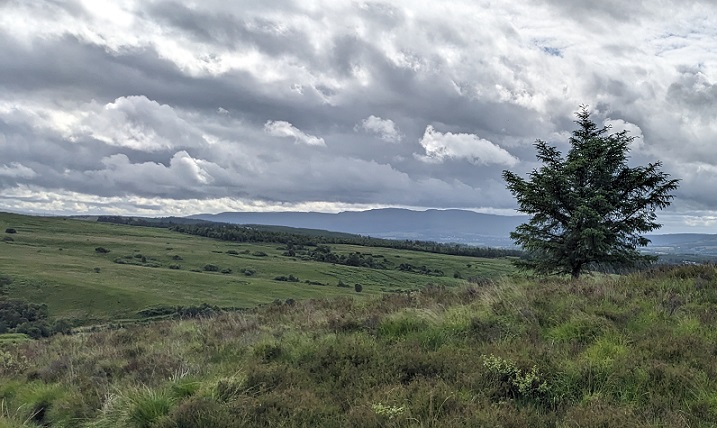
Sitka have been in the process of colonising Conic Hill, part of which is a Site of Special Scientific Interest, for over a decade. Its special flora, some of which is associated with the Serpentite conglomerate from the Highland boundary fault, were thought to being damaged by overgrazing but the reduction in sheep numbers appears to have opened the door to a new threat, Sitka.
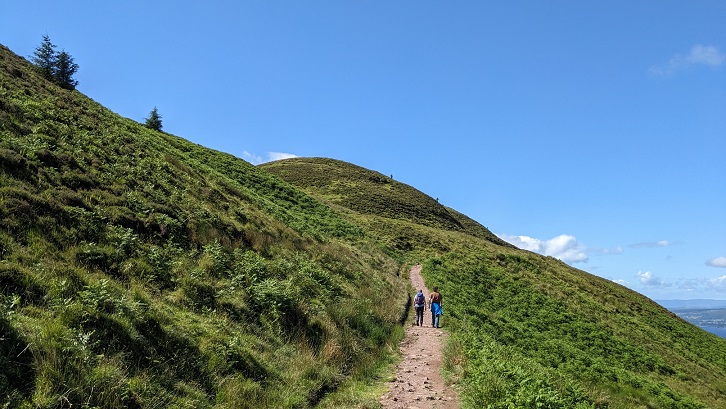
FLS’ LMP recognises the special landscape character of east Loch Lomond where it is attempting to enable the oakwoods, which were originally planted, to recover from being over-planted and surrounded by conifers and to develop into a more natural Atlantic rain forest. It claims, however that as Garadhban lies:
‘3km from the loch shore at the boundary’s nearest point and far below the closest ridgeline of Conic Hill – forestry in the LMP area is unlikely to negatively impact the special landscape qualities of the national park.’
The Sitka on Conic Hill could owe their origins FLS’ plantations at Balmaha, the Garadhban Forest or the Loch Ard Forest to the north-east, other smaller plantations locally or a mixture of those nearby sources. That uncertainty has allowed FLS to avoid taking any responsibility in its LMP for the Sitka which is spreading out from its large landholdings into east Loch Lomond.
Discussion
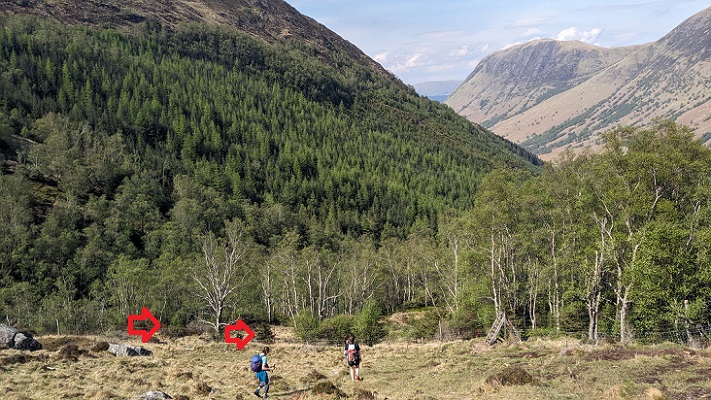
The ostensible policy position of the Scottish Government and the regulator, Scottish Forestry, is they wish to promote more native woodland. Hence the forestry grants for planting native trees and hence the requirements that commercial conifer plantations, when first planted and when re-stocked, include a proportion of native trees. There is no point, however, in FLS or any other forester planting new native woodland or mixed forests – as at Garadhban – if that woodland is then overrun by Sitka and ceases to be native or mixed woodland. The invasion of Sitka at Garadhban (and other native woodland schemes) therefore represents a massive policy failure.
Jim Knight, author of a Forest for the Future (see here), who commented on my post on the Sitka invasion of Glen Falloch (see here), believes it is too late to stop its spread and we should adopt a different model of mixed forests, with natural regeneration replacing planting and the trees then managed differently.
Driven by the impact of wind-throw, which has in the past regularly toppled uniform single species blocks of conifers, FLS appears halfway to that model for Garadhban. Its LMP shows no less than 17 different combinations of species for different blocks within the forest. For example: Sitka spruce and Scots Pine; native mixed broadleaves with Sitka spruce; Norway spruce with Douglas fir; other broadleaves with Douglas fir.
The challenge is that unless FLS selectively fells the faster growing conifers, Sitka spruce, Norway spruce and Douglas fir, most of the blocks will become monocultures again. While the LMP does contain proposals for selective thinning, these appear driven more by the need to reduce windthrow rather than a commitment to the model of continuous cover forestry that Jim advocates or is practised on the continent.
While continuous cover forestry or LISS, comprising a mix of native and non-native species, would represent a significant improvement on plantation forestry, it still leaves the question of what to do with invasive Sitka? Where should they be accepted as a component part of new woodland and where not? As a starting point, we not only need to protect the integrity of the Caledonian Pinewood remnants and other special areas of native woodland against Sitka and other non-native species, we also need to protect peatland.
To deliver this, we need to develop and map Sitka free zones, as with the buffer zones Scottish Forestry (SF) has drawn around the 84 sites on the Caledonian Pinewood Inventory. SF should be developing similar policy requirements for all planted native woodland, otherwise there is no point in it continuing to pay to plant it or requiring others to do so.
The Scottish Government and SF also need to develop mechanisms to make the forestry industry responsible for preventing the ingress of Sitka into all Sitka free zones and removing them where ingress or invasion occurs. That would not be that expensive if the problem was dealt with promptly. A single person with a chainsaw could probably cut down most of the invasive Sitka on Conic Hill in a day. Allow Sitka to develop among native woodland, however, or their seed rain to get established on moorland and its another matter.
Sitka is the dominant tree in the Loch Lomond and Trossachs National Park. The National Park Authority (LLTNPA) could be playing a key role in developing Sitka free zones – how about all land above 500m in addition to those previously suggested (see here)? – and bringing landowners together to address the problem before its becomes too great. Another sign of the LLTNPA’s failure as a National Park is it appears to have no policy on Sitka: it is not mentioned once in the current National Park Partnership Plan 2024-29 which sets the framework for all it does; its Trees and Woodland Strategy 2019-39 has plenty on clearing invasive rhododendron but nothing on Sitka; and there is no mention of Sitka in its vision for Future Nature (see here).
Unfortunately, the senior management and the board of the LLTNPA are completely blinkered and do what they are told by civil servants rather than think for themselves. Imagine what they could have achieved for nature if, instead of employing rangers to police the camping byelaws, which they are proposing to renew just now and describe as pioneering (see here), they had employed them to remove Sitka instead? That might have actually made a difference for nature,
[I intend to follow up this post with another on the impact of invasive Sitka on attempts to restore native woodland along the shore of east Loch Lomond part of which is already supposed to be a Sitka free zone].

Yes — sitka invasion is as menacing as you indicate. A problem with it invading native pine is that sitka, a species of relatively dense forests, is highly shade tolerant -and thus can invade the willow stands you photoed. In contrast, scots pine, as a pioneer species specializing in colonising open ground is not. Hence, in the longer term, sitka would dominate scots pine stands and indeed stands of broadleaves. I recall how, in Glenmore when they started to plant sitka there – of all places in a National Forest Park- there was a famous tree – The Glenmore Birch – which all agreed was absolutely distinct – indeed unique-genetically from its growth and form. They planted sitka all around it and it shaded the birch out and it died.
Re uprooting seedling sitka by hand. I was walking along the ridge between Glen Kindie and Glen Buchat in Strathdon last Sunday. There were young sitka everywhere almost 1000 feet above the nearest seed sources. I found I could pull out a few by hand but many were deeply rooted and could not be moved. The only effective method I can think of – forgive me if this causes offense to some – would be a quirt of Roundup!
If you clip Sitka close to ground level with pocket secateurs then that will do the job. I don’t think Sitka can sprout very well.
I know Garadhban well. The eastern end has suffered very badly from windthrow in recent years (since harvesting began) and will present a significant challenge to managers. If my memory is correct Coupe 61601, which you mention, was harvested many years ago and has regenerated naturally with a mixture of sitka, birch, rowan and a few oak (some broadleaves may have been planted but not in the coordinated way they have been in the block immediately to the east and south of Coupe 61508). It’s actually developed into quite a nice diverse piece of habitat with a variety of woodland bird life, insects such as butterflies, damsel and dragonflies, hares, red squirrels and pine martens. The most southerly part of Coupe 61601 is primarily birch and particularly rich in birds. It’s interesting to see on the thinning map that the gaps between the patches of colour are the parts most affected by windthrow. Are they being abandoned?
I have seen adders, slow worms and lizards in the past, and someone local was warning about adders recently on social media. Ditches are filled with frogspawn in spring. Post harvesting large ponds were created which have developed into significant habitats. So personally I would suggest that throughout Garadhban native species are just about holding their own, although there are some specific areas which are still very dense conifers and others which used to be very good for smooth newts which have been destroyed. The wildlife has changed over the years in response to forest operations.
To the north of Garadhban the impact of the reduction in grazing is very apparent, although I think some cattle have recently been introduced. The whole moorland out towards Ben Ochainaich is scattered with young sitka. In many ways it’s a far more depressing sight than the ongoing tussle between sitka and natives taking place within the plantation.
The U Boat forestry developed after WWI and WW2 was not about rebuilding a forest it was about planting cellulose factories. In that limited capacity and context it worked, but our natural environment is still being trapped between the grouse industry, the sheep industry, the forest industry and the electricity industry; in some respects it’s an industrial wasteland or perhaps more accurately a wasted land. It certainly requires rehabilitation. In that process I’m very sympathetic to the views of Jim Knight including his views on the tree and shrub species we could use. We cannot restore the virginity of a multiply gang-banged rape victim (ie our upland environment) but we could restore ecological function and dignity. Hand picking or spot weedkilling using glyphosate to kill Sitka saplings is flatulence against thunder, urinating against a Force 10 and baling out the Titanic with a teaspoon
I attended one of the drop in sessions during the consultation. It was very useful to hear the perspective of the professional foresters, one of whom was the recreation manager for the QEFP; I came away with the impression that they are struggling to fulfil a very clear vision. Struggling because their vision of a healthy, diverse place providing a home for wildlife, a source of recreation and sanctuary for people and a viable crop of trees (which was roughly the old Forestry Commission’s remit in the recent past) is completely hamstrung by two things: the current policy of FLS, which is solely to maximise commercial return, and a total lack of investment. They were just as depressed as everyone else.
Aye, the problem is a strategic failure at government level, both Westminster and Holyrood.
One of the biggest problems is that the current forestry system practised by FLS and the private sector sees no place for a forester with his/her boots on the ground and who is located near a forest long enough to see what is going on and propose practical steps (‘a stitch in time saves nine’) in their forest.
Management decisions are taken remotely and as Anne Currie above mentions, decisions are based on Spreadsheet financial calculations (which are normally way out by the way), but give the high heid yins, the richt answer from their top down perspective!
another nail hit firmly on the head, well said, Douglas
When NWC schemes or LTFPs appear for consultation respondents should include a comment that the proposed mitigations against environmental impact need to take into consideration the long term impact of sitka seeding onto the grounds within the scheme marked as necessary for the mitigations to be valid. If there is not a management plan for internal sitka seeding in the operational plan then all land left for mitigation eventually gets seeded and the mitigation is therefore invalid. Scottish Forestry cannot conclude that there will be no adverse environmental impact if the mitigations are not protected. Who has seen a clear fell site with lovely patches of open ground with preserved habitats, peat and water dependent ecosystems? Even grouse leks are obliterated over time.