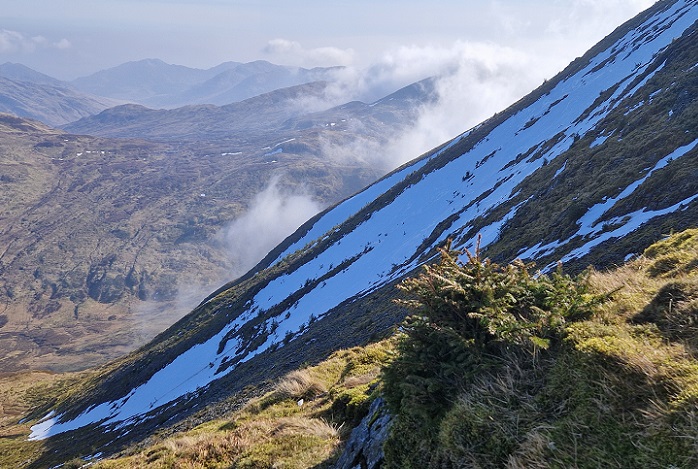
The person who sent parkswatch this photo was taken aback by the number of Sitka spruce they saw below the summit of Ben Vorlich, the Munro south of Loch Earn. Last month, while climbing on Beinn Dothaidh, near Bridge of Orchy, I passed a Sitka sapling on a ledge at over 900m (sorry no photo). It was 2km and over 500m uphill from the nearest seed source.
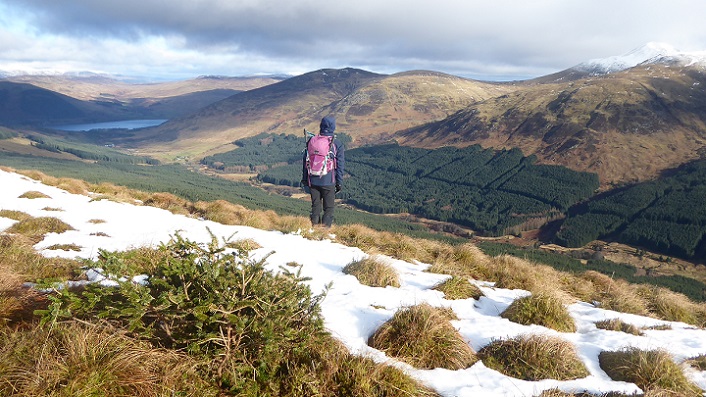
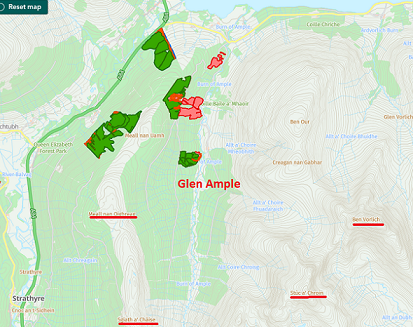
The seeds on the north face of Ben Vorlich had probably been blown up and over from Glen Ample, a minimum distance of 2.5km. If they had been carried on the prevailing wind from the south west, they might have come from further up the glen below the west flank of Stuc a Chroin or even further afield from Strathyre.
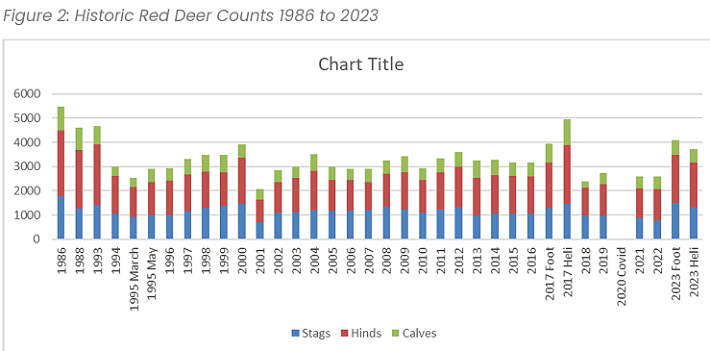
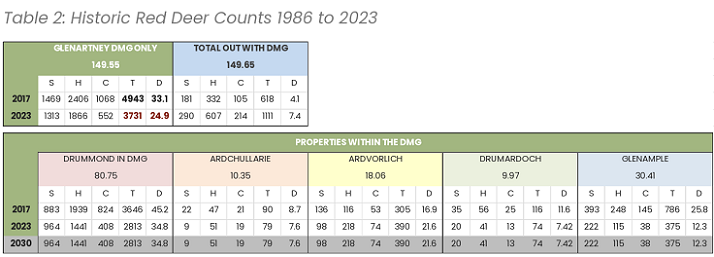
Deer numbers in the Glenartney Deer Management Group, which includes the Ardvorlich and Glen Ample Estates, are some of the highest in Scotland despite this area being part of the Loch Lomond and Trossachs National Park. The Glenartney Deer Management Plan 2024-2030 (see here) reported that “Red deer numbers counted in 2023 show an overall decrease in numbers from a density of 33.1 deer per km2 to 24.9 deer per km2″ in 2017”. The data actually shows that after a significant drop from 2018 to 2022 deer numbers increased again:
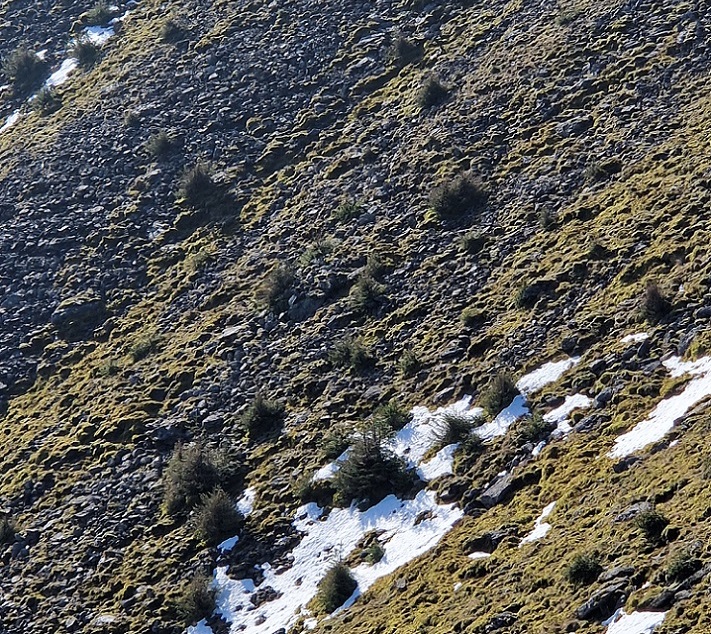
While deer numbers were not evenly distributed across the Glenartney Deer Management Group deer density on the Ardvorlich Estate at 21.6 per sq km was more than enough to prevent any natural regeneration of Sitka spruce which is the least palatable of trees:
My informant said they had seen no self-seeding Sitka on the lower ground – an observation which fits with the very high deer numbers – and suggested that the steep nature of the ground, together with snow lie over the winter, could explain why they have become established below the summit of Ben Vorlich.
The timing of that colonisation will have been determined by the age of the Sitka plantations in Glen Ample. Sitka normally start to produce seed when around 25 years old and then do so every 4 – 8 years (see here). In upland settings they are now being harvested after approximately 35-40 years. As a consequence many plantations only produce seed on 2-4 occasions before being felled. When they do, however, this can be in enormous quantities.
It appears likely therefore that the trees on the north face of Ben Vorlich are a consequence of one or two Sitka seed years, in which seed from the plantations in Glen Ample were carried up and over the hill into Glen Vorlich. Of those that then took root, most were then eaten but those on the steeper north face of Ben Vorlich survived.
The Ardchullarie and Glen Ample Sitka plantations
Four years ago I walked along the ridge between Sgiath a Chaise and Meall nan Oighreagh from Ardchullarie in Strathyre before returning along Glen Ample. I commented then on the new forestry tracks on the Ardchullarie estate (see here) (where deer numbers are far lower (see above) than in Glen Ample). What I observed illustrates further the factors that determine whether or not Sitka plantations start to regenerate naturally and spread across the landscape.
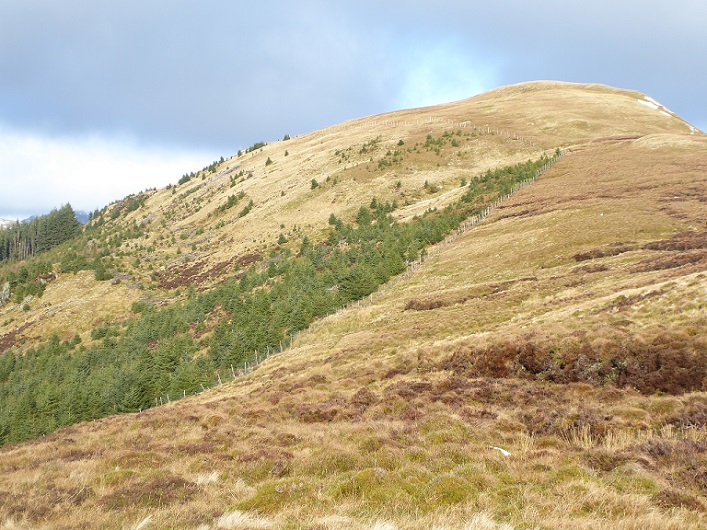
On the Ardchullarie (western) side of the ridge below Sgiath a’ Chlaise the deer fence was well above the top of the plantation. Protected from grazing, there had been extensive natural regeneration of Sitka within the open space at the top of the enclosure. Outside the deer fence, Sitka were absent, a consequence of the levels of grazing in this area which meant any seed that sprouted got eaten.
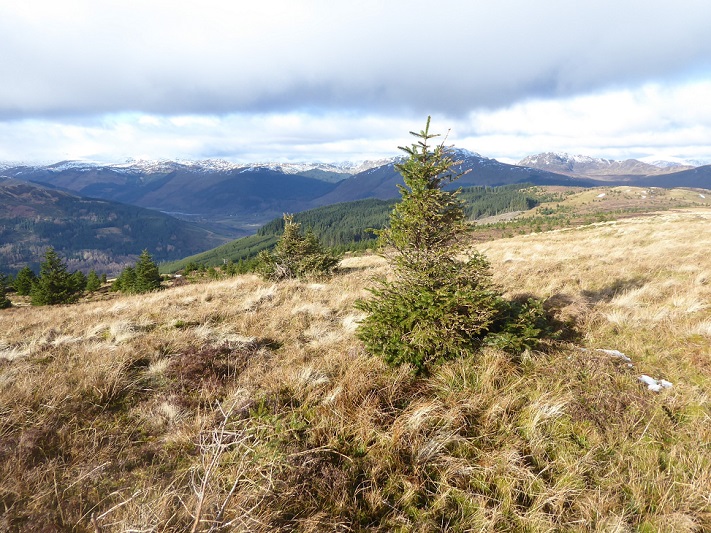
Further north along the ridge a few Sitka had become established outside the enclosure and showed signs of being very heavily browsed. Why one Sitka gets established in locations like this, close to a seed source, whereas most are browsed to death is probably partly a matter of chance. Once established, however, Sitka can survive amidst high deer populations because as they grow their palatibility to deer and susceptibility to being browsed reduces further.
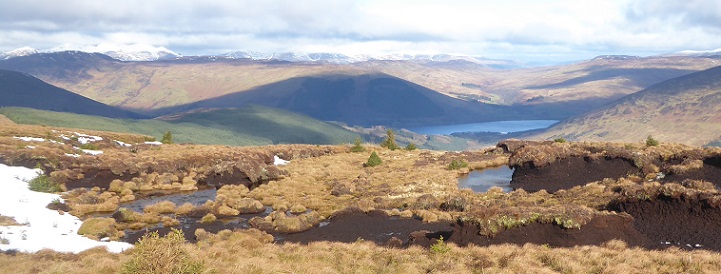
Just why more self-seeded Sitka had become established in an area of eroding peat bog was not obvious. While bog vegetation is generally, like Sitka, less palatable to deer, which might deter them from visiting this area to find food, the eroded haggs are almost certainly partly a consequence of trampling by deer.
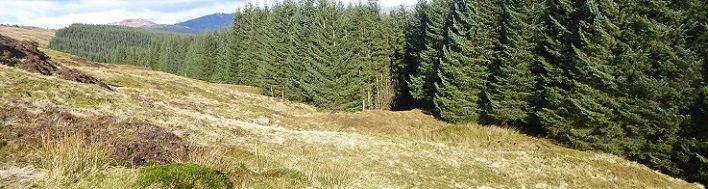
Descending into Glen Ample, the Sitka plantation presented a clean edge, with almost no signs of natural regeneration present, unlike that ridge directly above. That may have been partly a consequence of the age of this plantation. Such “clean edges”, which have such a significant landscape impact, are a common feature of Sitka plantations across Scotland. The explanation probably lies in grazing pressure generally being greater on the lower, more sheltered, ground added to which the cover provided by the trees makes the areas around the forest edge most likely to be browsed.
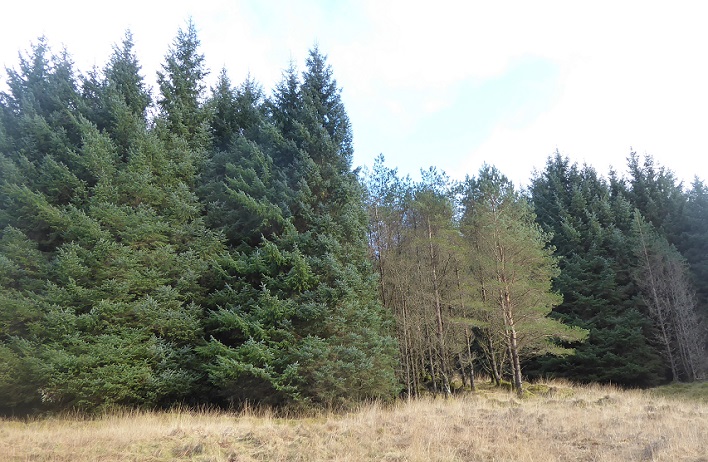
Along the bottom of Glen Ample there had been some attempts to soften the clean edges to the Sitka plantations by adding other trees. It has made little difference, just adding small blocks of other species, none of which have been able to regenerate naturally due to high grazing levels. While Scots Pine natural regeneration might have got a head start on the Sitka if grazing levels were lower, there are far too few of them compared to the Sitka to make much difference.
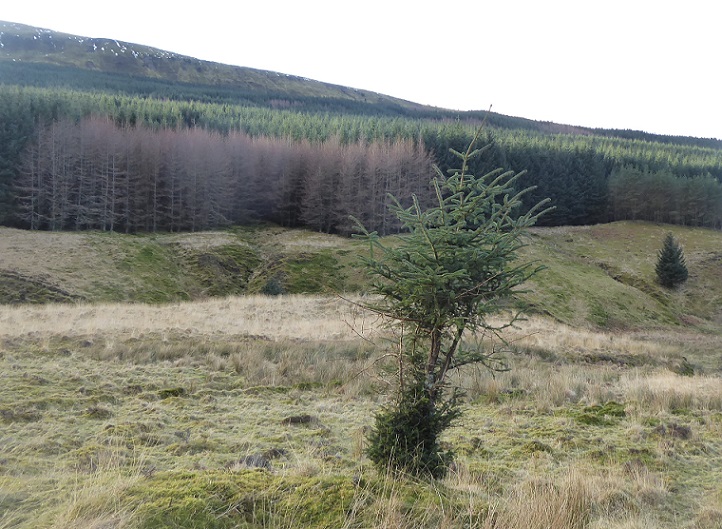
Weirdly shaped Sitka are now a common sight across Scotland. In this case the barer area around the middle of the trunk reflects a period of increased grazing, while the clump of new growth below suggests that that grazing pressure then reduced for a time. Such trees help demonstrate how grazing pressure varies over time.
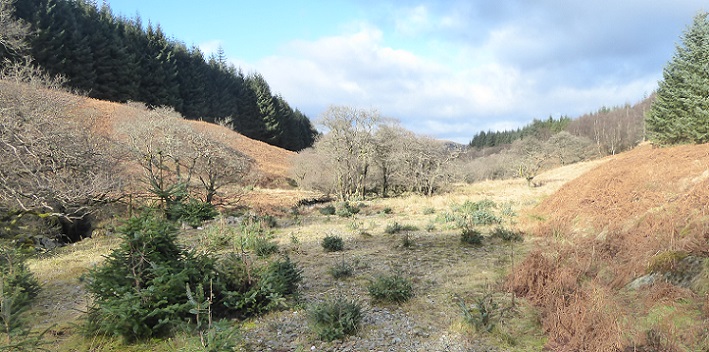
A stony section by the river provided the best example I saw of what happens when the rain of Sitka seeds starts to get established. Its starts to take over what was a semi-natural habitat. Of all our native deciduous trees, alder is the least palatable to deer which explains its survival along many river banks and this new Sitka-Alder upland vegetation community.
Sitka, natural regeneration and nature restoration
The expansion of Sitka Spruce out from commercial forestry plantations in Scotland was, until relatively recently, limited by two factors. The first was its short commercial life cycle and the limited occasions plantations would produce seed before felling. The second was the high number of sheep and deer in the uplands which resulted in the seedling of this, the most unpalatable of species, being more often or not eaten as soon as they poked up above the surrounding vegetation.
Those general limitations on Sitka expansion are now changing quite dramatically. First, increasing numbers of Sitka that have managed to get established, despite the high deer population, are now of seed bearing age. Instead of producing two or three cycles of seed, like commercial forestry populations at present, they could now potentially do so for hundreds of years. Second the reduction in the deer population, essential to enable nature to recover, is also lifting the main constraint on Sitka expansion.
Invasive Sitka Spruce now poses the greatest threat to the natural environment of any non-native species in Scotland, occupying an area estimated to be twice the size of Fife, but is exempt from controls on other INNS (Invasive Non-Native Species) (see here). Our public authorities and the Scottish Government still appear to have their heads in the sand and are doing nothing to address this threat.
The red and dark green areas in the map above show where Scottish Forestry has been paying the Glen Ample estate in the last few years to re-stock part of the Sitka plantation after felling with native trees. This avoids the real problem:which is that if deer numbers reduce sufficiently in Glen Ample to enable the small areas of planted trees to develop into native woodland, Sitka will also be facilitated to expand over an area many times as large. Scottish Forestry’s top priority therefore should be to use its regulatory and grant-making powers to remove invasive Sitka rather than trying to diversity existing plantations by paying for planting. (If grazing levels are low enough, native trees will re-establish naturally with out any need to plant).
The Loch Lomond and Trossachs National Park Authority (LLTNPA), which has failed to reduce the very high numbers of deer in the Glenartney Deer Management Group area since its inception, is almost as bad. There is no mention of Sitka on its INNS webpage (see here) although the “Future Nature” paper to the March LLTNPA Board meeting (see here) shows that it now acknowledges the problem and has started to tinker around the edges:
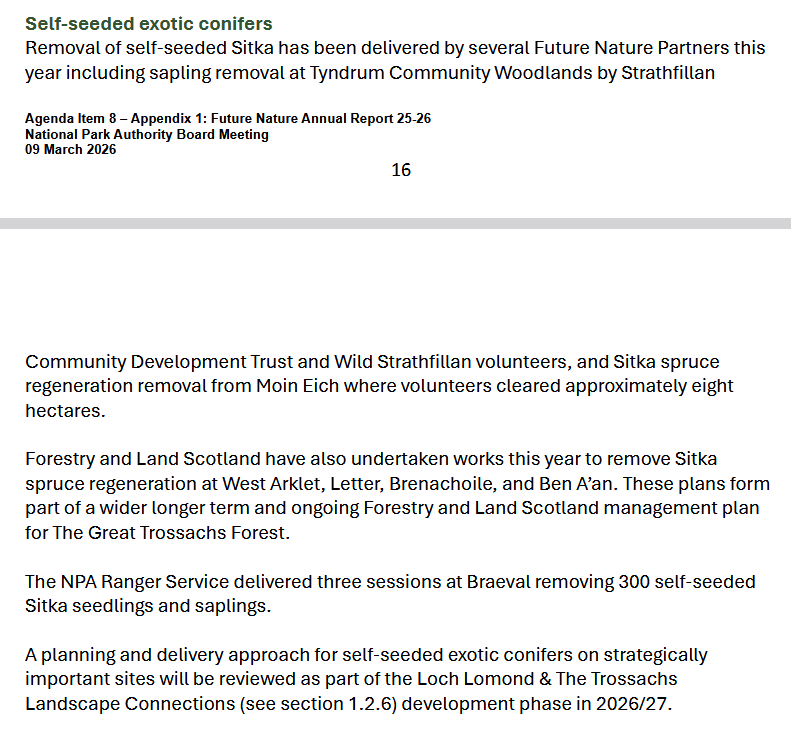
The LLTNPA, however, has failed to acknowledge the extent of the Sitka problem in the National Park let alone consider how it could be addressed. Professor Chris Spray, the board member who leads on nature restoration, commented at the meeting that the application to the National Lottery to fund work around the North of Loch Lomond is just what the LLTNPA should be doing, trying to restore nature at scale. What he omitted to say is the total area involved in the project only covers a small proportion of the National Park much of which is blanketed with commercial Sitka plantations owned and managed by Scottish Ministers.
A few “Projects”, however large, and the use of volunteers are not going to address the problem of invasive Sitka.

There was a sitka spruce seedling found near the summit of Ben Nevis last year. ie The highest altitude tree or shrub in the UK is a sitka spruce……. !! . Scots Pine spreads long distances if seed falls on to frozen snow, and then get blown along by the wind, much further than the wind alone can move it. I have seen areas of sitka regeneration where the pattern of spread might suggest something similar.
The Scottish Government and more especially its NGO-Quangocrats does not do strategic, holistic and integrated, as evinced by the very structural set up of the so-called ‘national’ parks and management of native biodiversity.
It is only such an integrated and holistic strategy that will either address the liability of Sitka Spruce or even turn that liability into an asset. What we will get instead is more prevarication, procrastination and gaslighting.
This is a bit anecdotal but I think it must be the steepness of the slope on the north side of Ben Vorlich which reduces grazing. I was less than 2 kilometres away on the adjacent hill Meall na Fearna back in August and stood for about 10 minutes as a herd of red deer passed me. It was like being in the Serengeti. I estimated more than 500 in the herd. Unsurprisingly the peat bogs in that area are badly eroded.
Self seeded Sitka is a massive problem on the Isle of Mull. At the community owned Ardura Forest , Doir a Chuilinn, volunteers spend more time removing this than all our other activities put together! It’s a thankless task.
The final two paragraphs and Ronald’s comments could prompt another article on their own. The Scottish Government are not alone in providing a masterclass in misdirection. Look at the tens of millions we are investing in nature restoration projects over here and not the hundreds of millions that we are investing through agricultural and forestry support over there creating much greater systematic problems than any project could correct or balance out. I have removed sitka from small woodlands as well as from open hill slopes and it is back breaking and time consuming work to do it properly. It was caused entirely by the decisions neighbouring landowners and unless the system of support is radically overhauled to reflect the principle of the polluter pays then things will only get worse. It also seems to be the case that some non native species are more acceptable than others (sitka and pheasants) depending on their ability to make a (sometimes subsidised) profit. Those that introduce them should be made to pay for the wider environmental costs of their decisions.
We are still suffering from U -Boat forestry mentality. It is no coincidence that the Forestry Commission was set up in 1919 the year after WW1 ended, a war which we nearly lost because the U-Boats rendered us just a few weeks away from not only running out of food, but also timber imports. Imports required because, unlike Germany, we did not have an integral strategic reserve of forest and instead we just asset stripped forested countries of the Empire.
We’ll never, under the current demand regime, anyway, have a totally self-sufficient forest reserve and although the priorities of timber demand have changed our demand for timber products exceeds the capacity to supply from home grown sources. All we can do is maximize forest production under other restrictions of land use demand; housing, industrialization, lowland arable production, upland pastoralism and upland sporting estates. Though no matter how much timber we produce, we will never be self-sufficient, that which we can and indeed do produce has the potential to save billions in import costs. The big question is the environmental price we are willing to pay for reducing these costs.
We are not currently creating a Sitka forest, just a giant cellulose factory with a variety of environmental and social downsides, not only via private Sitka forest, but also via state-owned forestry and, in regard to the latter, making the polluter pay isn’t going to be very practical, unless we expect the Government writes out fines to itself. We need a totally different paradigm.
Sitka makes a lot of money for a few people, and I do mean a few people. For the rest of us (the masses) it is a pest in every imaginable way. It is about time the Scottish Government listened to the rest of us….. because it is our money they are using to subsidise the millionaires and dis-spoiling our countryside
Well, could we really have expected any other outcome from a non-national park masquerading as a ferrago impersonating a mirage, which had, at its inception/misconception, the largest single land use comprising a forestry system based predominantly on exotic conifers?