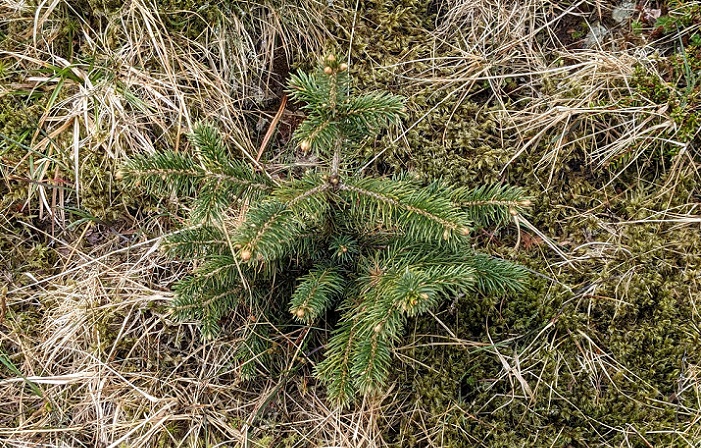
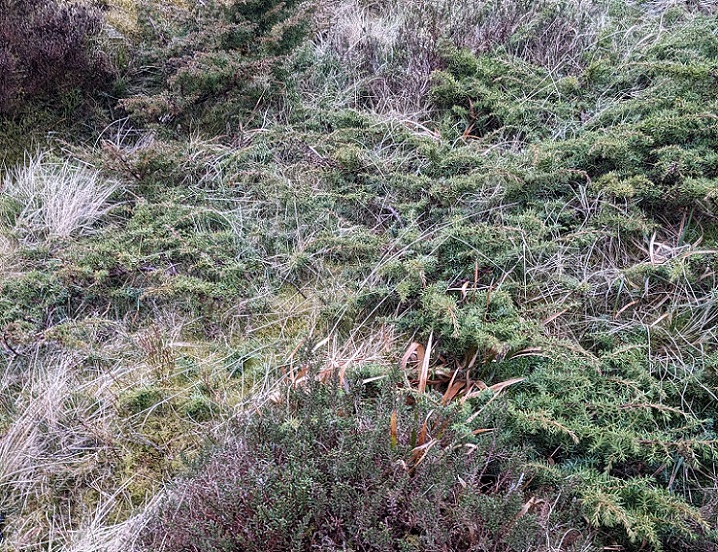
 On Saturday I walked up White Coomb in the Borders through the Carrifran Wildwood, the native wood creation project that puts others to shame. Descending from Firthhope Rig I was quite surprised to find this Sitka sapling at about 750m in altitude.
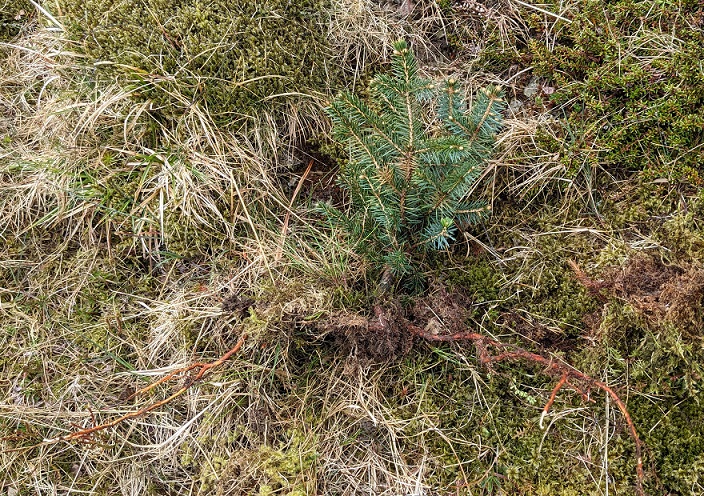
Usually once Sitka have reached this size they are very difficult to uproot by hand. The mossy ground and shallow soil helps explain why this one came away after a few seconds pulling. As an invasive non-native species my understanding is Sitka are not covered by Section 13 of the Wildlife and Countryside Act 1981 (see here) which makes it an offence for anyone to uproot a wild plant without the landowner’s permission.
Unfortunately, there appears to be no clear guidance on this, with the result that some people may be deterred from trying to pull up invasive species through fear they may be committing a criminal offence. Rhododendron like Sitka can only be uprooted when very small but I have seen increasing evidence by the sides of paths of others doing what I do and weeding out both species where they can. That is something Scotland’s National Parks could be promoting.
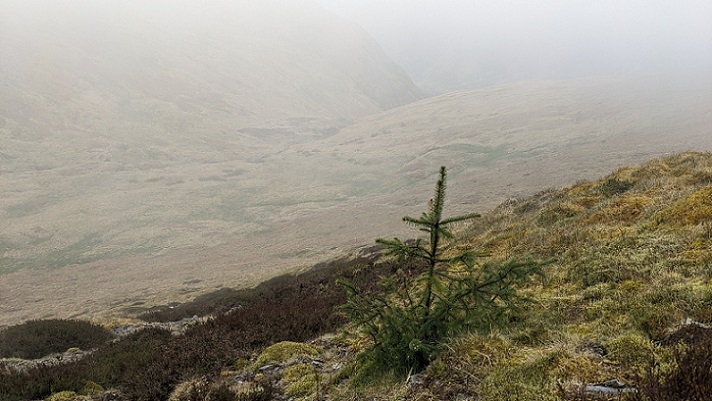
Thirty metres further on was a taller Sitka sapling which successfully withstood my efforts to uproot it. The length of the leading shoot shows how quickly Sitka, once its roots are established, grows. It prompted the thought that perhaps I should add a pruning saw to my hill walking kit list.
While it might have taken a couple of minutes for me to cut down this Sitka sapling, the cost to the Borders Forest Trust (BFT), who own Carrifran, of doing so would be significant: travel to from Carrifran and a three to four hour walk up and down.
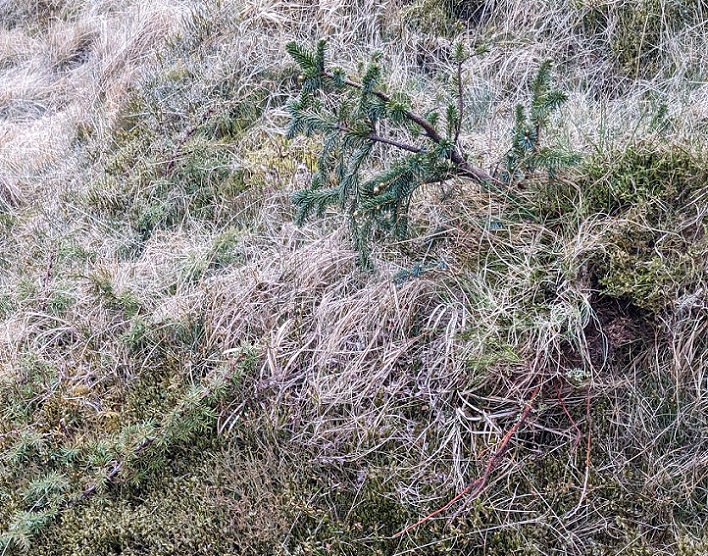
I uprooted two further small Sitka in the next 40m before noticing that there was prostrate juniper adjacent to the second. The location of these juniper was well above the area along the Firth Hope burn which the BFT originally planned to plant (see here). They may well have regenerated naturally but, being slower to grow than Sitka, risked being out-competed.
The BFT has just been awarded funding to assess the impact of its montane scrub restoration project at Carrifran (see here). I hope that research also looks at the growing threat of the Wildwood being colonised by Sitka as a result of the reduction in grazing pressure.
There are widely differing estimates of how far Sitka seeds disperse, from a distance of 100m or so to several kilometres. For example, the GB non-native species secretariat says this (see here):
‘The winged seeds are dispersed by the wind. The US Forest Service quotes dispersal distances up to 0.8 km. Similar observations have been made in Norway where Sitka Spruce can spread up to 0.9 km away from plantations (Nygaard & Øyen, 2017) whereas in many parts of Britain small trees have been observed up to 2 km from the source of the seed (Ison & Braithwaite, 2009).’
In this case the nearest seed source is the Polmoodie plantation in Moffatdale owned by the Gresham House, now Scotland’s second largest landowner:
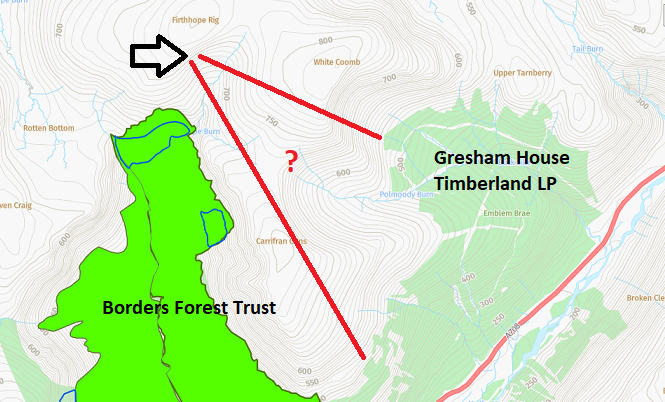
If the Sitka seeds had blown from the nearest part of Gresham’s plantation, south east of White Coomb, they would have been carried c2km as the crow flies but also blown 300m uphill, then over the summit plateau and then either high across Firth Hope or down to the burn and up the other side. Alternative origins for seeds from the Polmoodie plantation would have involved longer dispersal routes. And if blown up Carrifran they would have had to be 30 foot or so above ground level to avoid being caught by all the native trees there (I just saw one Sitka sapling in the main area planted by the BFT).
What this illustrates is that once airborne in in suitable wind Sitka seeds can potentially be carried miles and miles. It shows the power of nature but also why Sitka are becoming such a problem in Scotland.
The need for proper controls over invasive Sitka
Sitka are increasingly being recognised as a highly invasive species which threatens native habitats, including peatland estimated to be equivalent to twice the size of Fife (see here), many of Scotland’s surviving remnants of Caledonian Pine Forest and semi-natural habitats more generally. In that respect Carrifran is part of the Moffat Hills Site of Special Scientific Interest (SSSI) which surrounds Gresham’s Polmoodie plantation on the north side. No mention of the threat of invasive Sitka.is made in NatureScot’s Site Management Statement for the SSSI which has not been updated since 2010 (see here). That suggests that 15 years ago Sitka were not regarded as a threat to this site. They clearly now are.
The key questions that need to be addressed are how do we prevent this threat and who should pay for the removal of invasive Sitka?
Both the UK and the Scottish Governments developed a framework for managing non-native invasive species on the back of requirements introduced by the EU. The release of invasive species was
prohibited through the Wildlife and Natural Environment (Scotland) Act 2011 but exemptions made for trees because of the importance of the forestry industry to the Scottish economy:
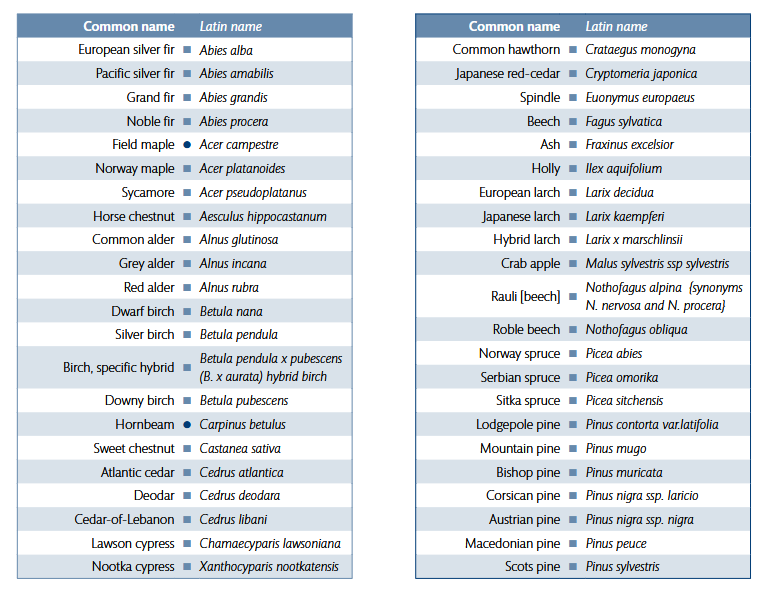
Although facilitating the dispersal of non-native trees is not a criminal offence, government recognised it was nevertheless an issue. In 2015 the then Forestry Commission for Scotland consequently issued guidance on ‘Managing Invasive and non-invasive forestry species’ (see here). This recommended (rather than required):
‘that forest management plans submitted to us for approval have a clear objective to manage invasive spread. Good forest management practices can then deal with the invasive potential of a species in a proportionate and sustainable way, whether it is native or not, or exempt or not.’
The conflation of native with non-native species and treating both as invasive helped to disguise the primary threat, Sitka. This policy confusion appears to have been designed to placate the commercial forestry industry as it increasingly moved towards planting Sitka.
The Guidance continues:
‘In forest plans, the top priority should be prevention, then rapid response, and then control and containment’ and refers readers to four of the UK Forestry Standard Biodiversity Guidelines:
- Plan for the control of invasive species where feasible by developing barriers to their dispersal; ensure newly created elements in habitat networks do not facilitate dispersal (BG39) [now BG29]
- Consider how forest operations, such as felling and thinning, might promote the spread of invasive species and take action to control them beforehand (BG40) [now BG 30].
- Where non-native species are invasive and pose problems, control or remove them where this is feasible; take action early while populations are still small (BG37) [now BG27]
- Participate in collaborative actions to control invasive species (BG38) [now BG 28]
These four guidelines are to all extent and purposes meaningless because, like so much else in the UK Forestry Standard, they require no action on ground. They contain no provisions for commercial forestry managers, like Greshams, to remove invasive Sitka when its starts to colonise land owned by others, as is happening at Carrifran, and no provisions for reimbursing neighbouring landowners for a problem that is not of their making. The UK Forestry Standard, updated in 2024 and approved by Scottish Ministers, is completely unfit for purpose when it comes to preventing the spread of Sitka.
Part of the way the commercial forestry industry has avoided taking responsibility for this problem is by arguing that where Sitka starts colonising semi-natural habitats, it is impossible to tell where it has originated and therefore who should be responsible for removing it. It was partly to get round this issue that eighteen months ago, James Fenton proposed a levy on ALL plantation owners which would be used to fund Sitka control teams (see here). In my view that is worth more public discussion but needs to be combined with a number of other reforms.
The first of these should be a legal requirement on all plantation owners to notify Scottish Forestry and neighbouring landowners when potentially invasive non-native trees start to produce seed. In the case of Sitka, which does not seed until around 25 years old and which will then produce 3-4 seed crops before felling, it would enable neighbouring landowners to identify with a much greater degree of certainty the likely seed source.
The second reform should be a legal requirement on plantation owners to fund surveys of the surrounding land, whether by drone or on foot, with the agreement of neighbouring landowners, and to share the results with Scottish Forestry. These surveys should take place five years after the Sitka have produced seed, by which time any saplings are easier to spot, and every five years thereafter.
Such reforms would lay the basis for a far more effective response to the problem of invasive Sitka, whether that was funded through a levy on the whole industry or on a case by case basis. If Greshams, for example, had had to notify the BFT when their Polmoodie plantation had produced seed and then had then had to survey Carrifran after five years, it would help establish beyond reasonable doubt whether the Sitka seedings on Firthhope Rig were their responsibility. That would then make it much easier for landowners like BFT to claim for the costs of removing them.
The commercial forestry industry, as represented by Confor, will do everything in their power to avoid taking responsibility for the problem. When quizzed at the Scottish Parliament rural affairs Committee about solutions to the problem, all they were prepared to offer was that at some point in the future it may be possible to genetically modify Sitka so they don’t produce seed. That will do nothing to address the problem that many self-seeded Sitka are now old enough to be producing their own seed.
Meantime, hillwalkers can do their bit for conservation and help reduce the financial liabilities of the commercial forestry industry by pulling up young Sitka saplings where they are invading neighbouring habitats. And for those who want to make a difference volunteering, time would be far better spent uprooting and pruning invasive Sitka rather than planting native trees in plastic tree tubes.

Good article that lays out the problem and the lack of a satisfactory solution. You are right to say current policy which conflates native with non-native species and treating both as invasive helps disguise the primary threat, Sitka. Sadly this is true of virtually every forest policy in this country. The ‘Sitka problem’ is always disguised – trees are great for recreation (yes but not Sitka), trees create valuable wildlife habitat (true but never Sitka) etc etc. Forestry research is very keen never to look at ‘species’ or ‘silviculture’ when they look at public benefits of forestry and for very obvious reasons.
Congratulations on this excellent post, Nick. As a long-time Steward of Carrifran Wildwood, and with wider interests in native woodland regeneration in other parts of Scotland, I hope that the suggestions you make may be implemented by the appropriate authorities. Meanwhile, I will happily join you, and other likeminded people, in uprooting invasive Sitka where I come across it.
I posted on this matter when you raised it some time ago.
I agree with everything you say, except regarding the time it takes Sitka Spruce to mature. You mention they do not seed until around 25 years old. I too have read that. However, I have observed 2-metre-high Sitka Spruce in the Pentland Hills and in the Highlands and Islands, each encircled by smaller trees; a “mother tree” surrounded by her “blood.” While I do not know how old a 2-metre Sitka is, it is less than 25 years. Sitka Spruce can seed and so spread at a much younger age than is often said.
Too little too late Nick Kempe, like Sika Deer the lack of action has created a huge costly problem. Nature Scot very much asleep at the wheel.
Our near neighbours keep telling me about their fantastic Scots Pine tree in the drive, which is actually a Lodge Pole, as are all the other “Scots Pine” they have. Being rewilders they know better. I would hesitate encouraging folk to pull up trees randomly, they might end up in a Sitka scheme and do much damage. Although it is my intention to ‘do something’ about the Sitka Spruce roadside behind our house and to the North side, all from the SS planted in our garden by the previous owners of the site which was a caravan park. Possibly Highland Regions flail will come one day.
On Rona where I retired from, I spotted a Lodge Pole on the North East side of the Island, 24 years ago, thankfully the stags did not like it, they trashed it and it died but it was not alone. Sitka were hidden away in odd corners but also thriving in numbers on the new road of 2002.
The nearest forest with both species is at Tote/Old Man of Storr, ex Commission and another small ex Commission plantation south of that, 5 miles away as the crow flies.
The distances mentioned are nonsense, the proof is there. The prevailing wind in this area is, South/South West.
There are plantations East of Rona on the Applecross peninsula but further away with LP and SS.
Recently on road trip on Skye I was dismayed to see Sitka Spruce in numbers off the road to Glen Brittle, I am sure you are acquaint with the area? Many of mixed age, some substantial trees and as you say costly for a chainsaw operator who would be needed to remove them as they were spread well apart over rough ground. Who pays?
What are Nature Scot saying about this? What are the NNS Project officers doing?
Thanks Bill, yes I saw Glen Brittle is being destroyed by Sitka last year – its taken me far too long to start writing about it! Roadsides though are next on my list!
Not only Sitka spruce, but self-seeding Lodgepole pine is a problem in some areas (e.g. Flow Country), larch (I have seen a sapling near the top of Liathach in Torridon; also on Mar Lodge crags), Lawson’s cypress (e.g. Kerrysdale), various firs, Norway spruce, and, of course, Scots pine (provenance often unknown).
And sometimes the conifers seed out from private gardens.
The head of steam on the issue needs to continue to increase the pressure until it boils over: but there is no cheap solution.
Unless there is a strategic landscape scale policy regarding Sitka Spruce we are left with trying to bale out the Titanic with a tea spoon or farting against thunder.
Wow, it turns out Sitka can grow to that height. I totally agree that climbers could help out a little by weeding to preserve the Carrifran’s native vegetation.