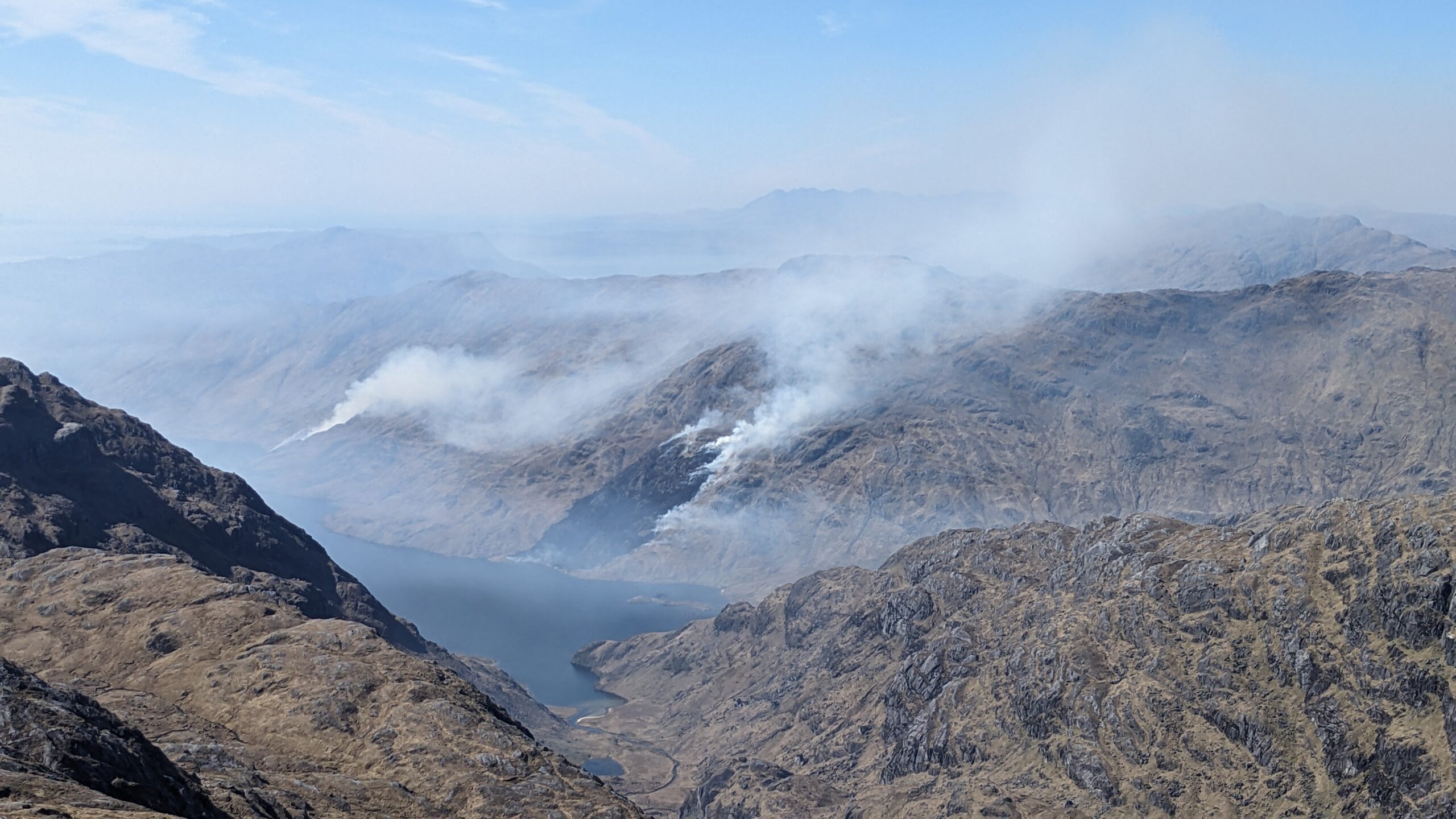
 Following my first post (see here) on the muirburn on the North Morar estate on 25th April, after the end of the muirburn season, a reader prompted me to check whether the Scottish Government had been providing public monies to the landowners. On checking the DEFRA Rural Payments database, I wrote a further post showing the Scottish Government’s Rural Payments division had ‘awarded’ the North Morar estate £33,782.55 in the year until 15th October 2024 (see here).
The DEFRA website, however, is closing for good in May 2027, 2024 was the last year it reported payments for Scotland and, despite stating the UK Government remains committed to ‘full transparency in the use of public funds’ (see here) it says nothing about how the information will be published in future. As a consequence on 7th May I made two information requests to the Rural Payments and Division at the Scottish Government.
The Scottish Government’s plans for publishing rural payments in future
I received a response to my first request the very next day:
‘We can confirm the Scottish Government remains committed to full transparency in the use of public
funds [note the wording matches that on the Defra website], including the publication of details about all payments made under the Common Agricultural Policy (CAP) legacy schemes still in operation in Scotland.
Following the decision of the UK Government Defra to close their website for publishing CAP
beneficiary data on a UK basis, we have introduced and passed the Rural Support (Simplification and
Improvement) (Data Publication) (Scotland) Regulations 2025 (the “2025 Regulations”) that came into
force on 1 January 2026 to make our own arrangements for Scotland.
The 2025 Regulations will enable the CAP beneficiary data for Scotland to be published by 30 June
each year for the preceding financial year and to remain available on the Scottish Government website for two years from the date of their initial publication”.
Far from delivering ‘full transparency’, the new regulations (see here) appear to replicate the DEFRA scheme. As a consequence information about payments made to rural landowners will still only remain public for two years. This means the total amount that the Scottish Government has awarded over the years to estates like North Morar will remain hidden from the public and will still only be possible to establish through generally time consuming and lengthy information requests (see below). Making the rural payments history public would also improve transparency about changes in land-use. For example, it would help show when the North Morar estate, which is recorded in the Registers of Scotland as the North Morar Deer Forest, and appears once to have been managed as a stalking estate, first took up farming.
Unfortunately, the response from SGRPID does not reveal where the rural payments data for Scotland,which is due to be made public by the end of the month, will be published. It also remains to be seen whether the Scottish Goverment’s rural payments data base is any more user-friendly than DEFRA’s. One of the major limitations of the DEFRA database was that to find out whether a payment had been made for an area of land, you needed to know the name of the beneficiary or their postcode. Searching postcodes is like looking for a needle in a haystack – the recipients of the rural payments to the North Morar Estate in 2024 have a postcode in Gloucestershire, GL56! – while establishing the names of recipients often requires guesswork. Unless the new SGRPID database is linked to geographical information systems and enables the public to do map searches for payments, much of the little information that is published will continue to remain hidden from the public.
Rural payments and muirburn in North Morar
On 4th June I received a slightly laboured response (see here) to my second information request of 7th May which I had sent to the local office of the Scottish Government’s Rural Payment and Enforcement division in Portree. This started by stating:
‘A search of our system has identified that a beneficiary in the name North Morar Estates received Basic Payment Scheme, Greening, Less Favoured Area Support and Scottish Upland Sheep Support
scheme payments in respect of the 2025 scheme year. The 2026 Single Application Form window
closed on 15 May 2026 and these applications have not yet been processed’.
The amounts of the 2025 payments to the North Morar estate was not provided, presumably because the information will be published at the end of June. The headings given for the payments are slightly different to those published by DEFRA in 2024. The new heading of ‘Scottish Upland Sheep Support’ is significant given that much muirburn in the west of Scotland appears to be carried out to improve sheep grazing.
I had also asked in my information request about payments to the two other main landholdings on North Morar:
‘No payments have been made to beneficiaries in the name of Nevis Estate or Bracora Crofters Ltd.
There may be some beneficiaries within the area shown on the map provided that have received
payments in respect of the 2025 scheme year. CAP beneficiary data for Scotland can be found on
the Defra, UK – CAP Payments Search website and searched by beneficiary name, town or postcode.’
This shows just how difficult it was to find out from the DEFRA database what rural payments had been made for a specific area unless you knew the name of the beneficiary. It suggests, however, that some of the crofters who manage the intensively burned land on the western part of the land north of Loch Morar may also be receiving rural payments .
The information response then helpfully describes the current system of rural payments and muirburn:
‘Beneficiaries of support scheme payments are subject to Cross Compliance requirements and must meet the Cross Compliance rules to receive their full[my emphasis] payments.’
Under ‘GAEC 6 [Good Agricultural and Environment Conditions] Maintenance of Organic Matter’ claimants must comply with the requirements of the muirburn code. The following would be considered to be a breach of the requirements:
* leaving a fire unattended
* being unable to control a fire or having not made provision for its proper control
* causing damage to any woodland’.
In Morar there have been multiple instances of unattended and uncontrolled fires which have caused damage to trees and woodland although there appears to be no evidence publicly available about who started them and whether the people responsible were in receipt of rural payments.
Additionally, under ‘SMR 2 Conservation of Wild Birds’ claimants must not carry out any activities which are likely to result in the disturbance of birds or the deterioration of habitats affecting birds, including carrying out muirburn outside the burning season (standard muirburn season runs from 1 October to 15 April inclusive, extended to 30 April with landowner permission).’
Given this regulatory framework and the evidence I provided about the fires on 25th April, the Rural Payments and Enforcement Division has now agreed:
‘to investigate if there is evidence of any potential cross compliance breach(es) and take the appropriate action’.
The letter says nothing about whether I, as the member of the public who reported this potential breach of the regulations, will be informed of the outcome of the investigation. It is worth noting too that:
- having taken a month to decide whether to investigate, the chance of the investigation being able to determine who was responsible, which was never high, is now likely to be negligible;
- even if the beneficiaries of the North Morar estate admit they were ultimately responsible for the two fires, they are only likely to lose a proportion of the payment.
Enforcement of the Muirburn Code needs to get real
The response from the Scottish Government’s Rural Payments and Enforcement division startd me wondering about how many other large fires on crofting land in the West they have investigated since the Muirburn Code first came into existence. Given the size of some of the fires on North Morar, staff based at Portree should have been able to see the smoke outside their office windows. I will now ask.
Establishing who is responsible for unlawful muirburn, however, is likely to be even more difficult than finding those responsible for the illegal killing of raptors (see here). To start a fire, all a member of estate staff or tenant needs is a can of petrol and a lighter, items that are not controlled unlike the guns, traps and poisons used to kill raptors.
The provisions of the Wildlife Management and Muirburn (Scotland) Act 2024 (Clause 12(2)(b) make it an offence, punishable by a £5000 fine, for a person to ’cause or permit another person to make muirburn’ contrary to the provisions of the muirburn licensing scheme when it is introduced. The loophole this creates is similar as for raptor persecution, how can anyone prove that a landowner has permitted the offence to take place.
The weakness of the legislation makes it even more important that the Scottish Government’s Rural Payments Division uses cross compliance and its enforcement powers to end the uncontrolled use of muirburn to manage land on the west of Scotland. Part of what is needed is active monitoring – it is now easy to track fires through the EFFIS or FIRNS satellite databases – along with a rapid investigation of any that appear to have taken place outwith the provisions of the Muirburn Code.
Where there is reasonable cause to believe a fire was deliberate and contrary to the Muirburn Code, as in the case of those I reported for the North Morar estate, there is a strong case that the Scottish Government should then just suspend payments to the landowner concerned and put the onus on them to show they had not caused or permitted the fire. Certain landowning interests would no doubt complain, claiming it was unfair that landowners should lose money for fires that might have been started by the public, but the receipt of rural payments is not a right and never should be.

Many years ago a friend of mine who was at the time the village cop in Lesmahagow charged a landowner or his staff with illegal muirburn. I can’t remember any details but I was just wondering if anyone else has been charged these last 3 decades as it seems to be a practice that is regulated only in theory.
Meanwhile in the Cairgorms you can’t use a portable barbecue during the summer.
paid for pyromania, that’ll stop the worthless scrub right enough!