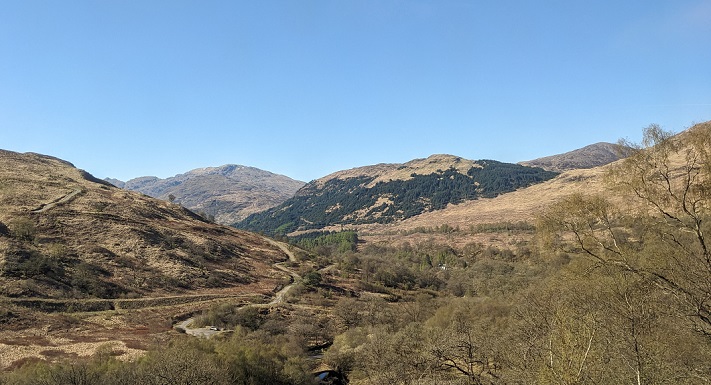
Looking West down Glen Falloch to Garabal Hill from the West Highland Line May 2026. Glen Falloch, the location of a large part of the Loch Lomond and Trossachs National Park Authority (LLTNPA)’s lottery funded nature restoration project, is bookended by Sitka plantations.
To the west, at the north end of Loch Lomond, are the plantations that clothe Garabal Hill. They form part of the Garabal estate bought by Simon and Gemma Hartwright in 2019. Garabal Hill is a geological Site of Special Scientific Interest, known as the place where the theory of the fractional distillation of magma chambers was first developed, and because of this one of the few areas highlighted by the LLTNPA in their Trees and Woodland Strategy as not being suitable for forestry (see here).
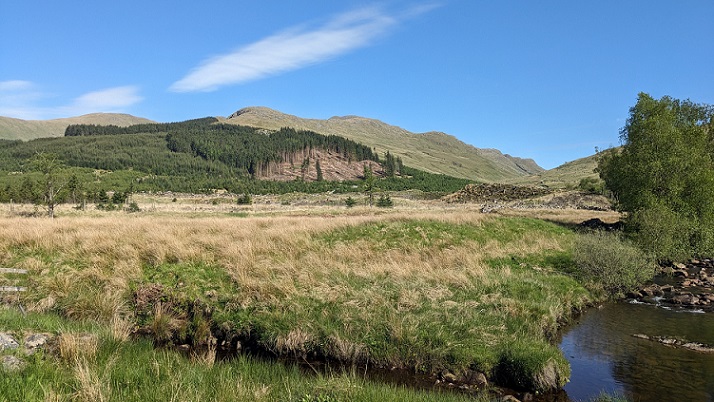
To the east are the plantations which run along the eastern side of Upper Glen Falloch. These are owned by Scottish Ministers and managed by Forest and Land Scotland (FLS).
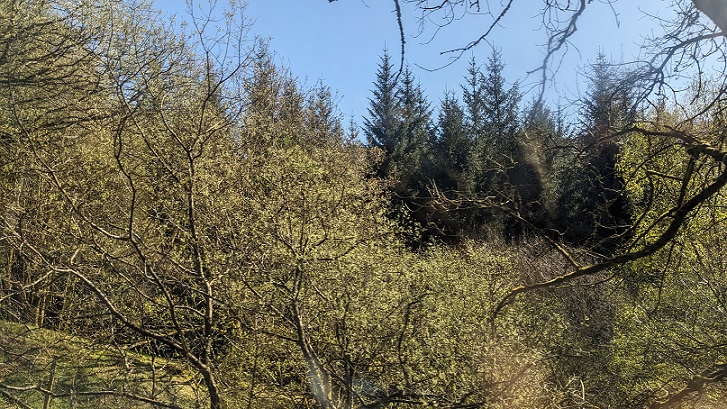
The evidence shows that Sitka seed has been blowing along Glen Falloch from both ends for many years but to date has only become established in areas protected from grazing. These include a strip of land between the West Highland Line and the A82 where extensive natural regeneration of both native trees and sitka has taken place.
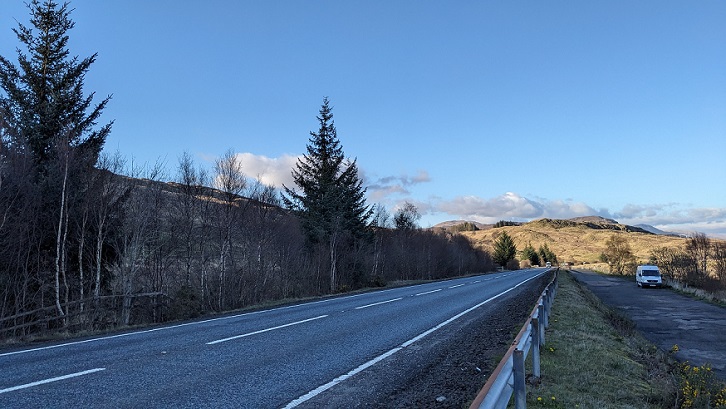
They also include the verges along the A82 which are protected from grazing by fencing and, on one side, by the West Highland Line.
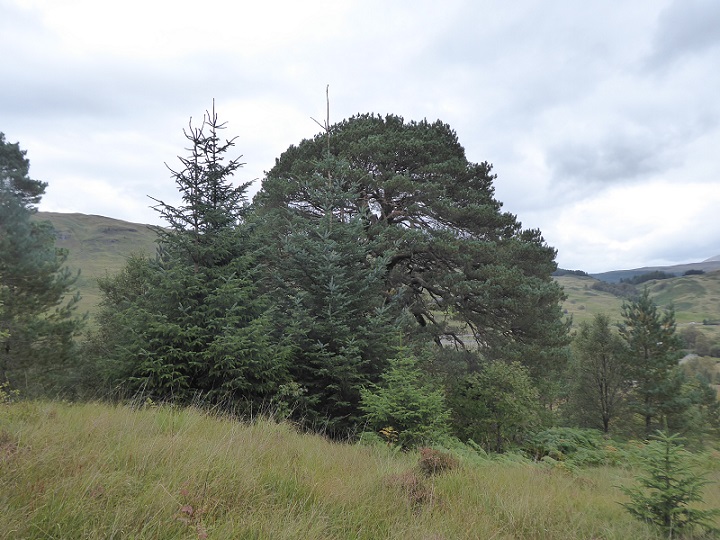
On the south side of the River Falloch Sitka had also colonised the fragment of Caledonian pinewood that was fenced to save it from being grazed to death by sheep and deer (see here). Sitka are the species of tree least palatable of tree species to herbivores so it has been the long history of heavy grazing on the open ground outside these areas which explains the lack of Sitka elsewhere in the glen.
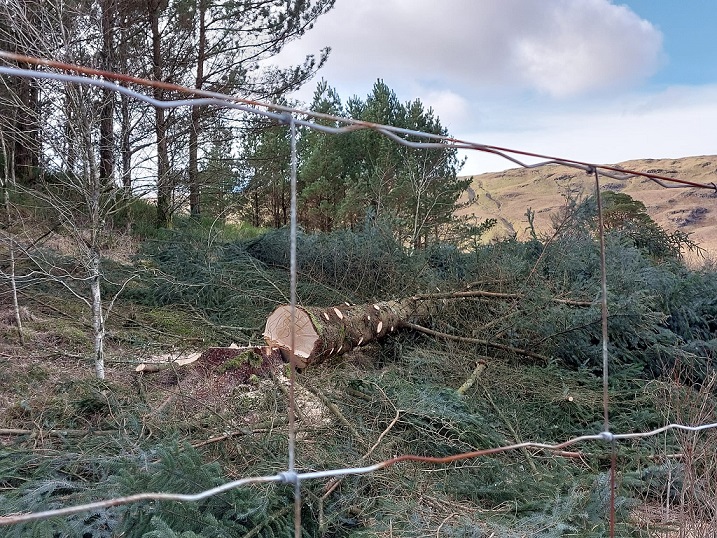
Early in 2025 a reader informed me that most of the invasive Sitka inside the Glen Falloch Caledonian pinewood enclosure had been felled. Whoever was responsible, this was the right thing to do because invasive Sitka and Rhododendron now pose one of the biggest threats, second only to overgrazing, to the survival of the Caledonian pinewoods .
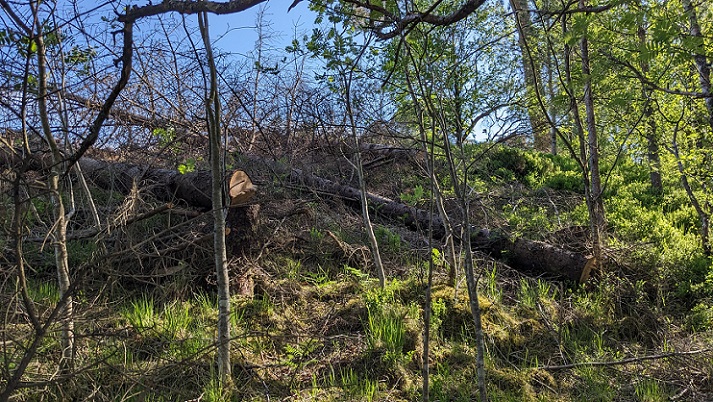
Last week I visited the eastern end of the enclosure and the removal of the Sitka appeared to have been done sensitively, with the trees felled in a direction so as to protect as many native trees as possible.
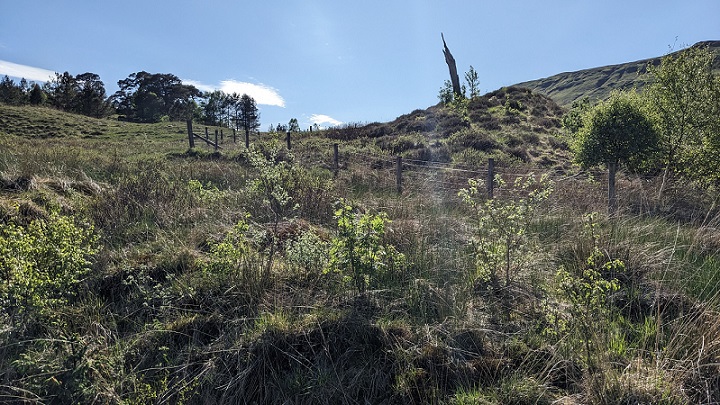
The Glen Falloch estate has, to its credit and in preparation for the lottery funded nature restoration project, been reducing deer numbers recently. Deer density is now reported to be around 4 per sq km, about double the density that would enable extensive natural regeneration but low enough for trees to get established in areas that deer are less likely to frequent. This probably explains the natural regeneration in the photo which is just next to the hydro track that is well used by hillwalkers.
The lower deer numbers, however, also mean that the self-seeded Sitka on open ground are far less likely to be eaten and have created conditions where Sitka is now likely to spread rapidly.
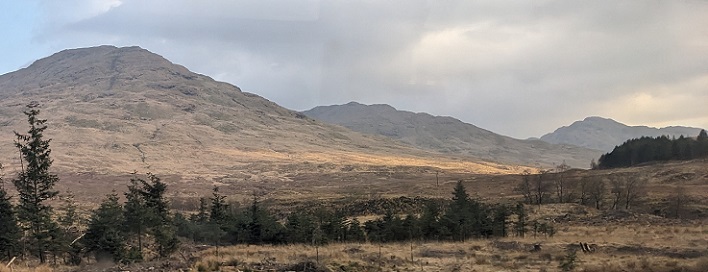
FLS’ plantation used to extend almost to the banks of the River Falloch before felling operations commenced. While the lower boggier area has not been replanted, self-seeded Sitka have become established there, helped by fencing. Now deer numbers are down, the risk to the rest of Glen Falloch, outside the boggiest areas where it is difficult for any tree to get established, should be obvious .
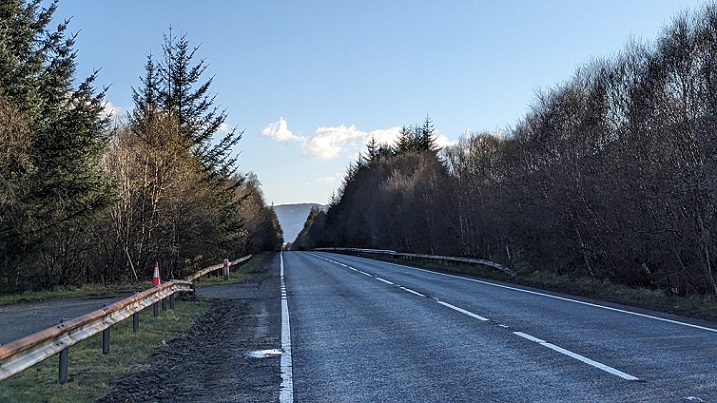
Further threats of invasive Sitka in Glen Falloch come from the two columns of maturing Sitka which line the A82. While they are to the north of the proposed Regeneration area and separated from it by the River Falloch, Sitka seed can be carried in the wind over mountains (see here) and across water.
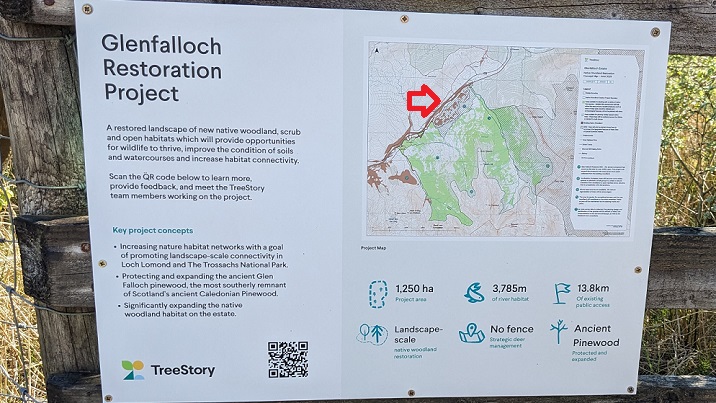
Glenfalloch’, as used in TreesStory’s information board, refers to the estate, not to Glen Falloch itself. The ‘Restoration Project is another native tree planting project, this time funded by the National Lottery rather than Scottish Forestry. It appears to have been designed with little or no consideration of the potential for natural regeneration, either by native species of tree or Sitka.
At least the plan is to plant without fencing – see bottom left of photo – which does so much damage to wildlife (see here). If this is to work livestock will need to be controlled and deer numbers reduced to less than two per square km,otherwise a large proportion of the trees will be eaten and the lottery funding wasted. At a density of two deer per sq km, however, the Caledonian pinewood fragment would start to regenerate beyond the current enclosure and the oak woods lower down the glen would also start to expand naturally, begging the question, why plant? To do so would be a waste of lottery money while at that deer density Sitka are likely to colonise the ground among the planted trees very rapidly.
It would be far better if, instead of awarding lots of money to plant trees, the National Lottery asked the LLTNPA to start acting like a National Park and come up with an alternative plan. Such a plan should adopt a similar starting point, the removal of livestock and reducing deer density, initially to 2 per square kilometre, and then whatever density is required to enable the Caledonian pinewood and oakwood to regenerate. The other main element of the plan, however, should be tackling the threat Sitka pose to the naturally regenerating native woodland and bogs in Glen Falloch.
Addressing that threat would require the LLTNPA to challenge Forest and Land Scotland, Simon and Gemma Harthill as the owners of the Garabal estate and Transport Scotland. The LLTNPA should be insisting FLS remove the invasive Sitka at the east end of Glen Falloch, as has been done within the pinewood enclosure, once every five years. This would prevent Sitka getting established there. The LLTNPA should also be asking the Harthills to contribute a proportion of the proceeds from felling the Sitka on Garabal hill to pay for the costs of removing self-seeded Sitka from the western part of the glen. And finally the LLTNPA should be calling on Transport Scotland to fell all the Sitka along the A82 (and other trunk roads in the National Park) as a matter of urgency. (My observations from travelling along the West Highland Line tree times in recent weeks are there are far fewer Sitka along the railway, perhaps because Network Rail tend to cut back all vegetation every few years).
Glen Falloch does not lack seed source, the usual excuse given for planting native trees. Rather the problem, now that the Glenfalloch estate is reducing deer numbers, is the abundant local seed source for Sitka. If the National Lottery were to tell the LLTNPA that their nature restoration project should focus on keeping deer numbers down and removing Sitka, rather than planting native trees, that would represent a significant step forward for nature conservation in Scotland.
Unfortunately, there appears little chance of that happening without Scottish Government intervention given that Dr Heather Reid, the Convener of the LLTNPA, is also currently chair of the National Lottery board for Scotland (see here).

Ah, the circulating nomenklatura of the NGO-Quango-Thwartocracy once more raises its multiple Medusa-like crania in the last paragraph.
We knew that the prospective ‘national’ park had, even before it was so constituted, had as its single greatest land use, a forestry system based on exotic conifers, so quelle surprise then!
The best way for a national park to act like like national park is actually to BE a national park. Whatever else this strategic landscape farce is, it’s NOT a national park
The Sitka Problem: flatulence against thunder and baling out the Titanic with a teaspoon.
Just so.
I enjoyed reading and agree with your article. LLTNP should be working closer with Scottish Forestry to build management of Sitka rain into New Woodland Creation Schemes and Long Term Forest Planning within the National Park. The environmental impact of Sitka rain should be addressed within the EIA screening process during planning application for a NWC scheme. Later, when the pattern of Sitka Escapees clearly shows a link to a plantation, then it should be a precondition of granting any LTFP that the Sitka escapees are dealt with on an ongoing basis. This change in approach by SF, with the encouragement of the NP could easily be implemented and enforced.
Alternatively we can just accept that Sitka spruce (and Norway spruce and larch and ….etc.) are all now part of our future native ecosystem. Natural regeneration is indeed ‘of the place’ a definition of native. Sitka is after all part of the same broad ‘boreal forest’ ecosystem as our ‘Scots’ pine which actually grows across a huge part of Eurasia. The future will be different from the past but these additional species bring new opportunities for people and wildlife.
Trying to police nature by constantly weeding out ‘non native species’ is a recipe for madness as the process will never end!