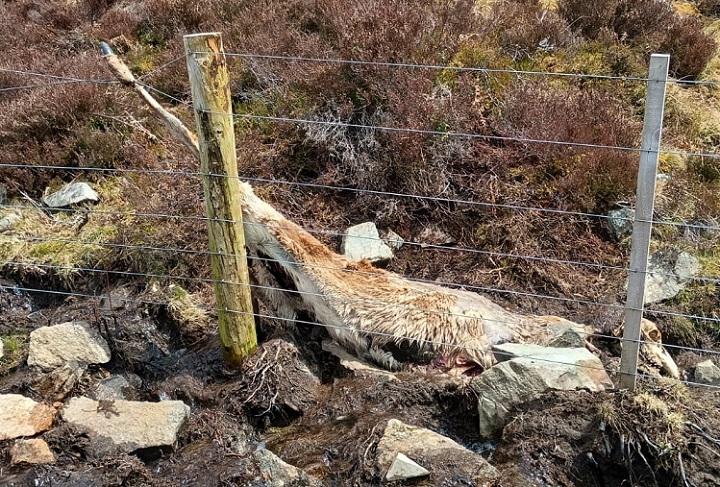
Fit adult red deer normally jump over stock fences such as this with ease but accidents happen and become more likely over the winter months as they weaken through lack of food.
Part 3 of the recently passed Natural Environment (Scotland) Act 2026 starts by setting out the aims and purposes of deer management. Two of these concern their welfare (see here):
‘(iii) to ensure the effective and humane control of deer,
(v) to keep under review all matters relating to deer, including their welfare‘
Unfortunately the Act contained no new provisions to reduce the impact of fencing on deer or other wildlife, including capercaillie (see here). As well as the deaths and injuries they cause directly, fences impact on the movements of mammals and the chicks of ground nesting birds. Some fences, as above, pose a hazard to be crossed or passed through but others present an impenetrable barrier. Such barriers divide territories, block “natural” movements through the landscape and, by excluding animals from certain areas, serve to concentrate their population elsewhere. In the case of red deer this has considerable environmental impacts.
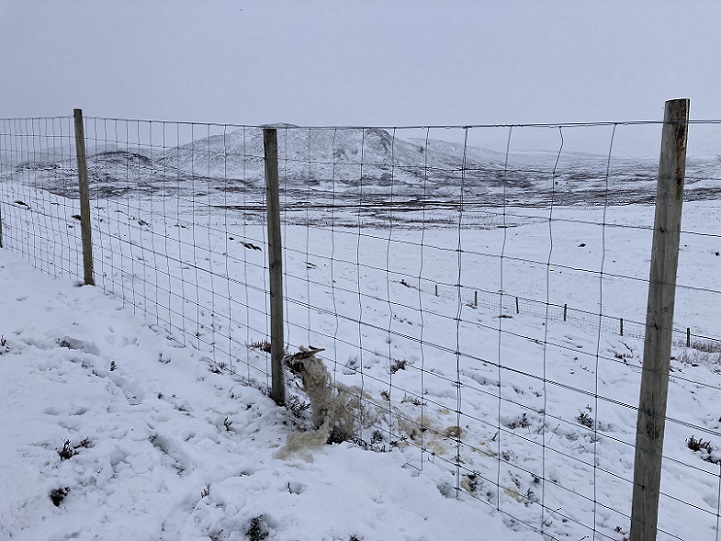
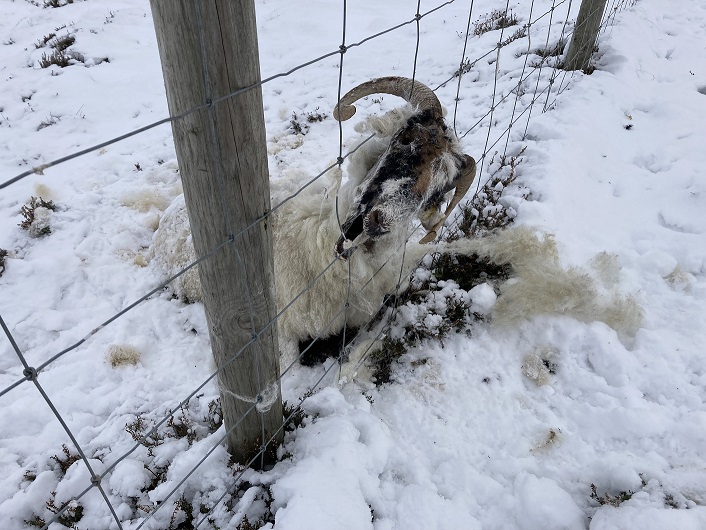
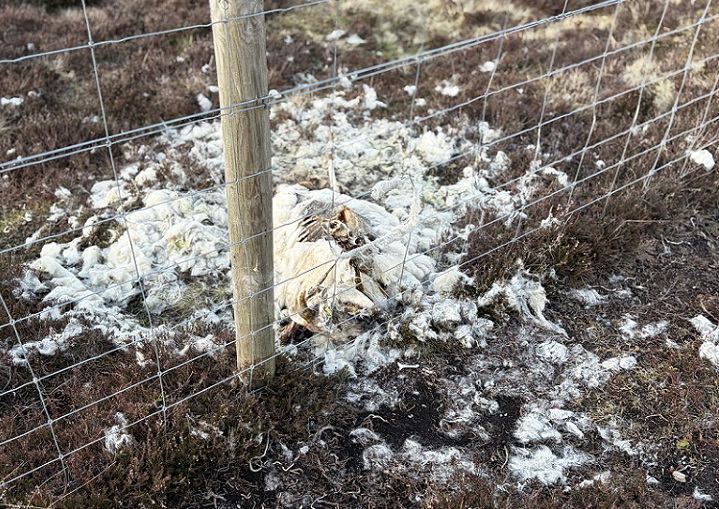
Fencing has similar impacts on livestock. This sheep was quite possibly trying to reach lower ground in the snowy conditions and, like the deer in the top photo, is likely to have suffered a cruel death.
A research overview back in 2018 (see here), which described some of the impact of fences on wildlife, suggested that there could be as much as 10 miles of fence (of all types) for every mile of road in the world. Recently, the Ferret reported (see here) that between between 2018/19 and 2024/25 Scottish Forestry had subsidised 2,284 miles of fence in Scotland and the cost of such fencing between 2016 and 2025 was £48.8m.
In addition to Scottish Forestry funded deer fences are:
- the unsubsidised deer fences erected by commercial forestry interests;
- the deer fences erected by Forest and Land Scotland;
- the deer fences being erected in the name of nature conservation;
- the unsubsidised deer fences being erected by sporting estates landowners;
- the deer fences being erected to reduce car accidents;
- the deer fences erected by home owners to protect their gardens from deer.
The deer fences that have been erected on the Pitmain and Glenbanchor Estate over the last decade do not appear to have been funded by Scottish Forestry. They provide examples of deer fences erected for private forestry or sporting purposes and also, in the case of the enclosures in Glen Banchor, those erected in the name of nature conservation (see here).
Where deer fences are privately funded, they are not subject to the limited controls required under the Forestry Grants Scheme, such as marking to reduce the risks of black grouse and capercaillie flying into them. Whether privately or publicly funded, there is no requirement for landowners to assess the wider impact of deer fences on either wildlife or livestock.
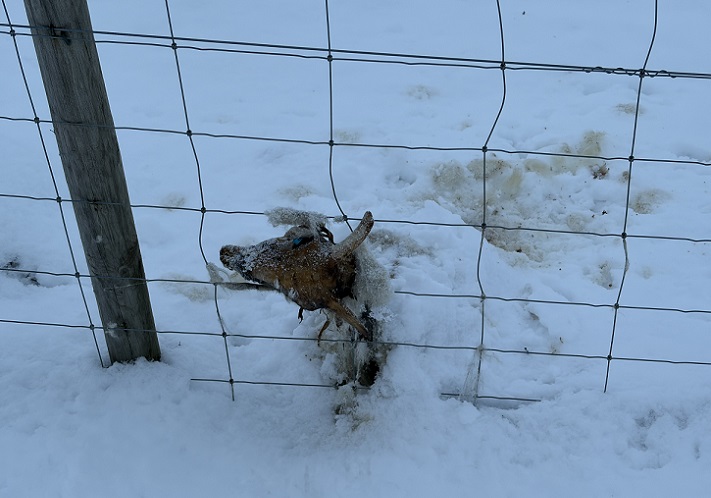
Fewer mammals than birds probably die through collisions/entanglements with fences but, when they do in Scotland, their remains are less easily removed by predators and scavangers and the evidence tends to survive longer. Notwithstanding these differences the scale of the carnage receives very little attention in Scotland compared to other countries. Ron Summers, who was involved in the pioneering research into the impact of deer fences on capercaillie – up to one 1.8 capercaillie deaths per km per year – and I described some of the issues and how other countries control fencing in an article in British Wildlife (see here).
In other parts of Europe the deaths and injuries caused to livestock and wildlife by fences is far less of an issue because fixed wire fencing, particularly in upland areas, is avoided. Walking the 650 km long GR5 through the French Alps in 2023 I saw not a single deer fence (see here) and it was the same last year walking through the Italian Alps (see here). This is because the deer population is controlled through hunting and with the help of wolves so forests and woodland regenerate naturally without any need for deer fencing. And in areas grazed by livestock, movements of sheep and cattle are controlled through mobile electric fences, which is hardly used in Scotland but has little impact on wildlife.
Where livestock fencing is used in more lowland areas in Europe, there is widespread awareness and concern about its impact. For example, in Norway the use of barbed wire is banned. More recently there has been concern in Germany about the impact of the fixed electric fencing now being used to keep out wolves: this prompted research that surprising shows such fencing is surprisingly permeable to most other mammals (see here – there are some good photos illustrating the conclusions).
Why is Scotland so far behind the rest of the Europe?
In Scotland the use of fencing is for all extent and purposes unregulated. Scottish Forestry does not even insist that deer fences within the average 11km dispersal distance of a capercaillie lek are marked. Meanwhile all the Cairngorms National Park Authority’s Capercaillie Emergency Plan commits to doing isto remove c156km of deer fencing within 1-5 km of a lek by 2030. This pathetic target is despite modelling by the Game and Wildlife Countryside Trust which suggests that if the killer deer fencing was removed, the risk of capercaillie becoming extinct in Scotland within 50 years would fall from 95% to just 3%.
The impact of deer and stock fencing on other wildlife and livestock in Scotland has been subject to almost no research and kept from public view. It appears no-one in authority has any interest in either monitoring the total length of this fencing or its impacts. As a consequence it is not possible to estimate the total wildlife carnage or the welfare costs to livestock in Scotland. If every photo of an animal or bird killed by a fence was published, however, most of the general public would likely be shocked. Instead of raising public awareness of the issues or promoting good practice from other parts of the world (see here for an example from the USA), our two National Park Authorities have ignored their statutory duty to protect wildlife.
The underlying problem is the power of landowners in Scotland. The owners of the Pitmain and Glenbanchor estate can more or less do what they want on their land without any regard to the impacts on wildlife or livestock. The exceptions to this animal free for all, the rules around the illegal persecution of raptors and the use of traps, have only come about as a result of decades of research and public pressure. So far they have been almost completely ineffective. After a goshawk nest was found destroyed near Loch Gynack on the Pitmain and Glenbanchor Estate in June 2024, a fascinating episode of Highland Cops showed how lawyers acting for the estate forbid staff to talk to the police (see here).
An estate that deliberately interferes with the process of investigating wildlife crime seem unlikely to care about the carnage being caused by its fencing.
What needs to happen?
It is time that the Scottish Government and our public authorities recognised, like countries across much of the rest of Europe, that the use of fencing has major implications for both wildlife and livestock. The solutions are relatively simple:
- reducing red deer numbers to a level where fencing is no longer required to protect woodland would address many of the issues;
- requiring land-managers to conduct an Environmental Impact Assessment where fences are still proposed as part of a forestry scheme would mean the forestry industry could no longer ignore the problem;
- bringing all other deer fences and stock fences in upland areas under the Prior Notification system would empower planning authorities and the public to comment on the implications for wildlife (and the freedom to roam);
- making it a requirement of all forestry and agricultural grants that redundant fencing is removed would clear the countryside of historic hazards;
- starting to collect data on the extent of deer fencing in Scotland and funding research into its impact on wildlife and livestock would enable an overview of the problems and enable government to track progress addressing them.
Beyond these proposals there is a strong case for making landowners vicariously liable for the deaths and injuries to wildlife caused by killer fences just as they are supposed to be for raptor persecution. I will consider that further in respect to the Pitmain and Glenbanchor Estate in a further post.

Spot on Nick.
Thank you for highlighting this important issue for Scotland. They are also a very significant impediment to access as you have noted in other blogs.
I endorse your observations on fencing in the Alps. The lack of fixed fences is one of the pleasures of walking in Alpine areas. Over the course of many visits to the Alps I have only encountered one area with fixed wire fencing and this came as a distinct surprise.
So many things to disagree with in this article, but to take just three: (1) A deer can easily simply misjudge a fence when it is jumping, especially if the ground is a different height on either side, or uneven, or if it has been walking along the fence and decides to hop over from a standing start. Getting caught says very little about its condition or welfare. Good luck with trying to prove that one! (2) Every farmer knows how sheep like to wander fencelines and reach through to try and eat something on the other side, even when they are up to their knees in grass where they are. Horned sheep are easily caught, which is why farmers look their sheep every 1-2 days, and pay particular attention to field boundaries. (3) It does not matter whether woodland fences are FGS funded or not, any fence aimed at woodland creation > 2 ha on the more sensitive sites requires EIA determination, and in theory at least, this provides a safeguard. In practice… that is different. When an electrified deer fence was proposed for Schiehallion last year, extending up to 3000ft plus, it got waived through, and the impacts on ptarmigan, sheep or deer did not enter the thinking at all. What that required was proper implementation of guidelines and legislation that already exist.
Agree with you here Victor, I have a collection of photos of deer caught not only by fences but all the detritus left lying about from empty five gallon drums, buckets, netting, baler twine to fox snares. Not to mention drownings.
Human impact has little concern for animals and often is very cruel………..
Well said Nick. Why are we still kowtowing to landowners who care nothing for the environment or the suffering of wild animals? CNP’s shameful pandering sycophancy to the large landowners is outrageous and shames this country and the National Park movement. National Parks should be progressive – leading the way towards sustainable management. Instead we get grovelling acceptance of medieval sporting laws.
The irony is that, as we were discussing recently, as animals do not eat Sitka Spruce, it is not necessary to fence Sitka plantations.
A total of 437 collisions involving 13 bird species were recorded. Red grouse (Lagopus lagopus scoticus) formed 42% of all collisions, with black grouse (Tetrao tetrix) 29% and capercaillie (T. urogallus) 20%. Allowing for corpse removal by scavengers, an estimated 70% of red grouse and 29% of black grouse collisions were fatal. (David Baines, Mark Andrew, 2003.)
However, the same paper notes that marking fences with wooden droppers or orange netting has been shown to reduce collisions. Trials showed that marking reduced capercaillie collisions by 64% and black grouse by 91%.
Not polluting the landscape with fences and markers would save huge numbers of birds.
Interesting that Norway bans barbed wire. Do they have problems with containing stock as a result, or is the almost universal practice of topping stock fences with barbed wire actually necessary? When you think about it it is difficult to see how it could be effective without causing serious injuries to livestock if it was really what was keeping them in.
It seems to be universally employed regardless of the use of the field and forms a major barrier to the theoretical right of access in Scotland.
should we be trying to fence wildlife OUT or domestic stock IN?
The barbed wire is to deter people jumping over the fence. It certainly does not deter cattle or deer – both good jumpers with thick hides. It helps create a hostile environment for humans – just what some landowners and farmers want. Its a pity the Association of Deer Management Groups and their apologists were not more effective in getting deer numbers down then their would be no need for fencing.
They could always use thorny scrub species as stock proof hedging – which can act as nurseries for trees.
Just for context, in my forestry/stalking career I have made a habit of photographing deer caught, as I say, by the hand of man. Yes for sure I have plenty pictures of deer caught in fences.
But I also have plenty pictures of deer caught by timber stacks, metal deer gates , stock and pedestrian gates, drowned. I have had deer with buckets, creels, rope, fox snares, plus more attached to them. All having to be dealt with.
I have shot three legged deer on many occasions in my life. Bullets in them, air rifle pellets buried in the haunches.
So just hold on Nick, blame private landowners if you like but the obstacles in our land for deer are Immeasurable.
We are the problem, not the deer……………..
Hi Bill, you are right about the wider point – a long time ago I helped free a stag (my mate was a lot braver than me) whose antlers were caught in washed up fishing nets on Harris Bay on Rum (a National Nature Reserve). Still, the Alpine countries do not have the same problem of deer being caught in forestry fences because they don’t use fences. That is one less hazard for wild animals.
The Norwegians and Alpine countries generally use less wired fencing because this kind of fencing doesn’t suit much off their terrain, (more wooded, rocky etc). They would if they could. Also their farming culture and climate, snow and avalanche makes fences almost impossible in many areas, and they house their animals indoors for 6 months of the year. Consequently they pay much more for their meat (often of inferior quality as it is fed in sheds for half the year), have fewer livestock farmers (over a 1,000 Norwegian farmer have quit in the last decade), and suffer extensive issues with wolves which don’t respect UK style fences, so more electric fences are used (much more expensive).
I know the article is designed to ‘stir the pot and debate’ but it and some of the comments are misleading or wrong and it concludes with the most ridiculous suggestion of vicarious liability for landowners for animals caught in fences which is just plain daft as it could a. never work (how could anything be proved) and b. also misses the rather important point that livestock farmers do not set out with any intention to harm animals in fences, (so the analogy with protecting birds of prey is completely inappropriate and to be frank insulting). In fact stock fences serve a very good purpose as they support the UK system of rotational farming, and different stock practices on neighbouring farms. We have 6 different neighbours on our small livestock farm, all with different grazing practices, breeding times and strategies.
We have been big investors in the use of ‘no fence’ collars on our larger bits of open ground to support the right grazing in the right places. However there are limitations to ‘no fence’ which means it is not good enough yet to support fence removal, and no good if your neighbour farms sheep. So stock fencing supports good rotational livestock farming supporting the growth of wildflower habitats and margins by allowing rotation, and ground to rest. The use of barbed wire on the top strand is to stop cattle in particular from simply walking through the fence… if they see something lusher on the other side where ground is recovering, a normal fence will not stop them. The barbed strand discourages them and is used globally.
Whilst agreeing 100% with previous articles around removal of deer fence or marking it, and supporting that old fence and wire must be removed, this article was otherwise completely misleading on stock fencing and showed a deep misunderstanding of the fabulous Scottish livestock farmers who care deeply for their animals, and who strive every day to produce some of the finest meat products, renowned across the globe for the quality of meat and diversity of animals and breeds.
Colin. Intersting comments but not sure i agree with some of your claims. Fencing does work but is suited to farming in lowlands where livestock is managed intensively and fences and stock can be monitored daily. Neither applies to Scottish hill sheep. Norway is losing farmers but so is Scotland and it has nothing to do with wolves. It’s a succesional issue and also falling margins. And finally, kai are good jumpers ….barbed wire or no .