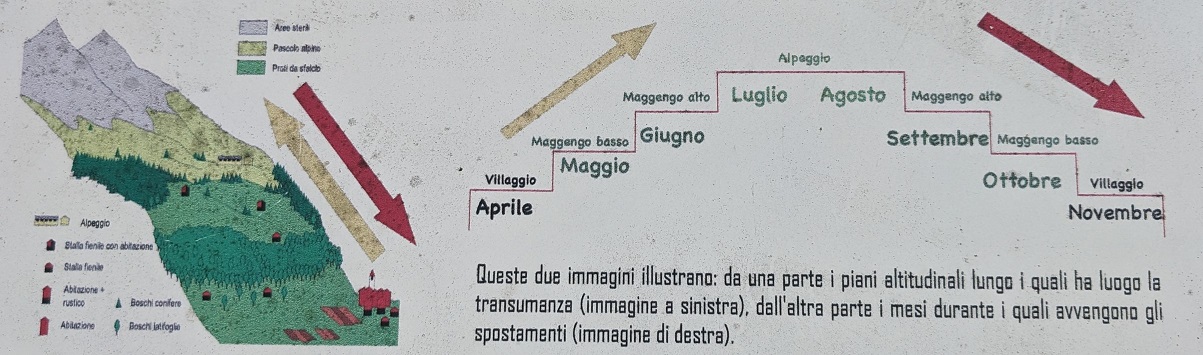
Traditional systems of transhumance, where people move their livestock up hill in summer and then back down in winter, are still fairly widely practised in the Italian Alps, in contrast to Scotland where the summer migration to the shielings ended when large flocks of sheep replaced people. In some ways walking the Grande Traversata delle Alpi (GTA) was like going back 200 years, although the quality of the rural and agriculture related buildings in Italy (which I will consider in a further post) was far superior to anything that has survived from Scotland at the time.
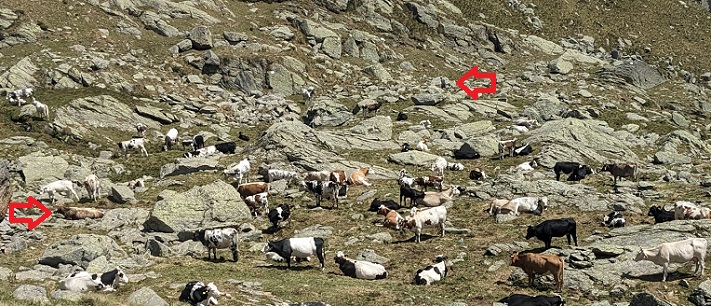
What struck me most from an ecological perspective was how ALL the grazing livestock I saw in three and half weeks of walking were being actively managed, a contrast to Scotland where normal practice is that sheep are let out onto the hill and allowed to wander where they will.
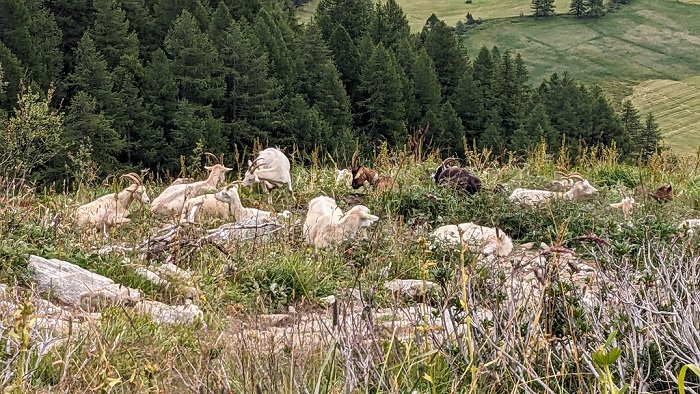
Some of this management was by people – cowherds, goatherds and shepherds – actively herding livestock and using dogs to direct the animals where to graze.
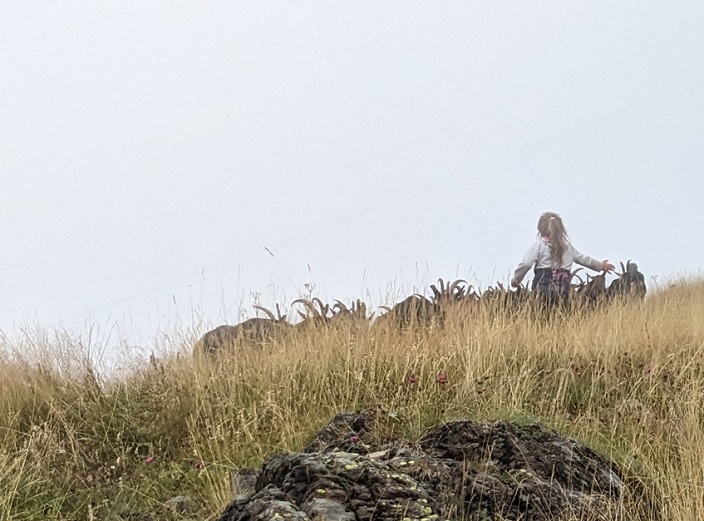
Herding animals enables forests to regenerate naturally without fences or planting.
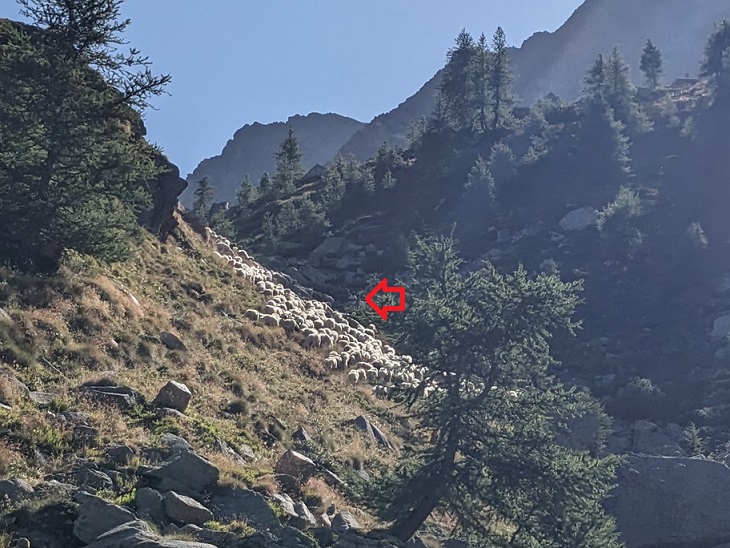
Livestock graze as they go and the vegetation on the routes used to take them up and down between the main pastures (alpes) was noticeably different to that on the surrounding land. Regular use of the route in the photo above has created a grassy swathe down the otherwise wooded valley.
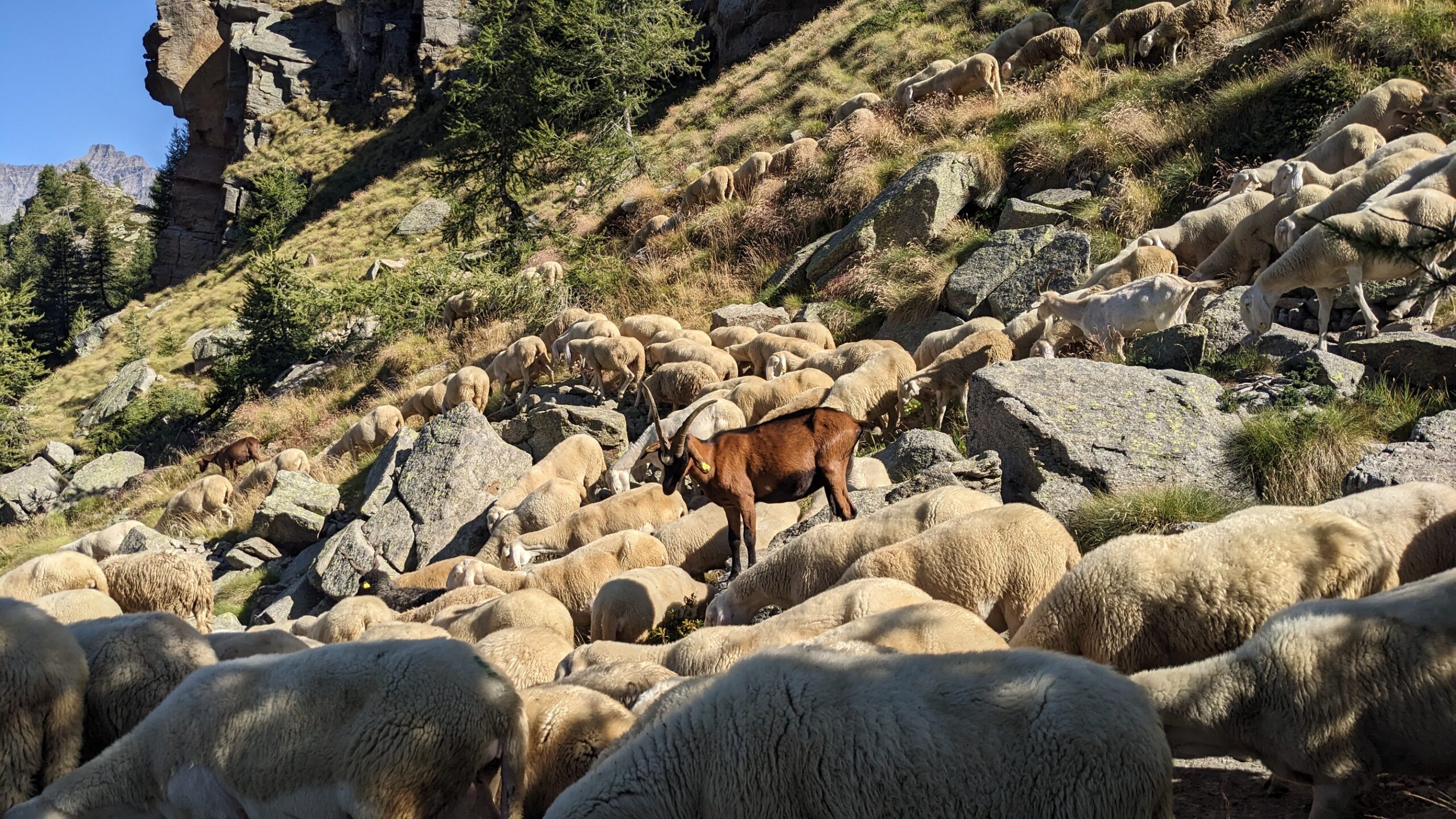 In this case the shepherd had five dogs helping him to direct the herd. Keeping the herds compact helps prevent predation by wolves. These are tough jobs, which require those doing them to spend significant periods of time in the mountains away from others, and are not well paid – which may help explain why an African was able to get work as the shepherd. Such employment, which enables more people to work on the land, basically does not exist in Scotland.
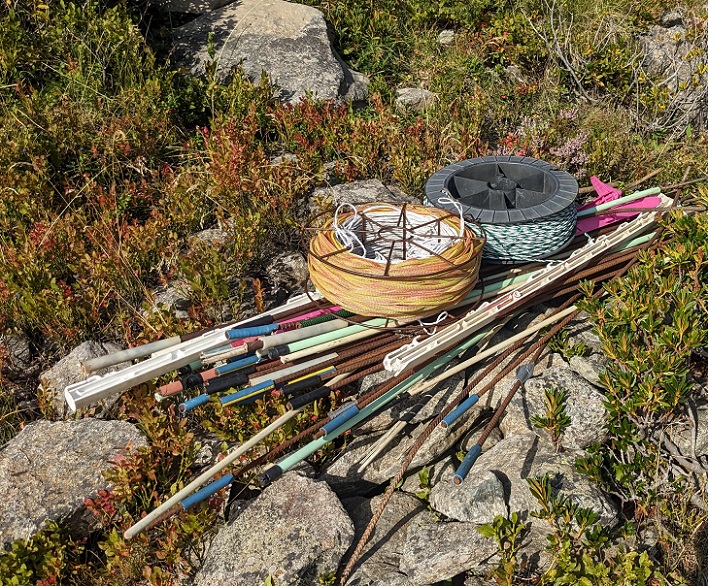
Fencing was the other main means used to manage where livestock grazed but I saw not a single deer fence and hardly a stock fence on my walk, a massive contrast to Scotland. Instead, the people managing livestock made extensive use of electric fencing. This is moved up and down the mountains with the herds and used dynamically to direct where grazing occurs and to what extent:
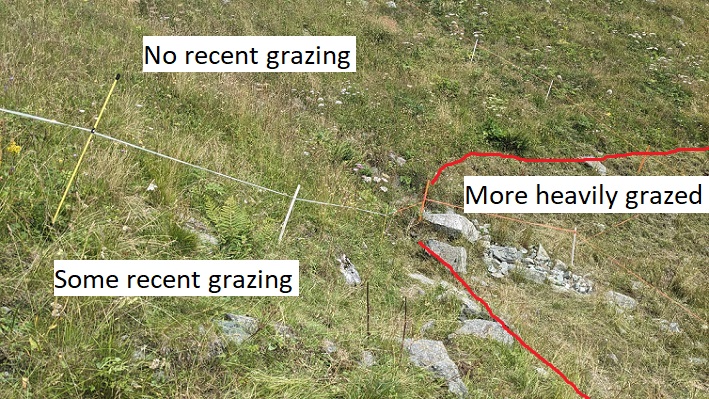
It is also used to protect forests:
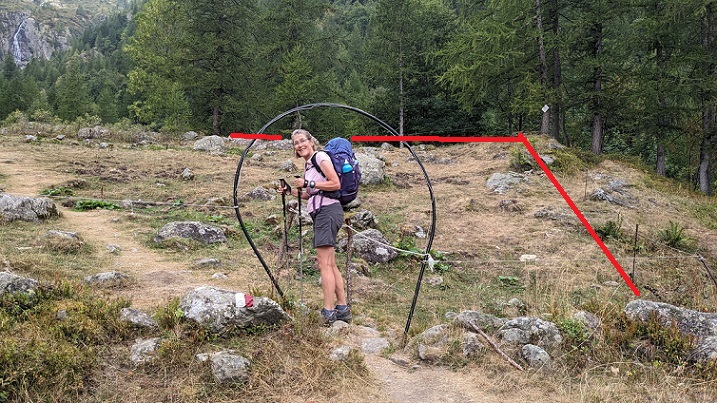
The contrast with Scotland is again significant. Instead of fixed fences, which are expensive to install, have a significant impact on wildlife but require very little management, temporary electric fences are easy to install, appear to have little impact on wildlife but require frequent management:
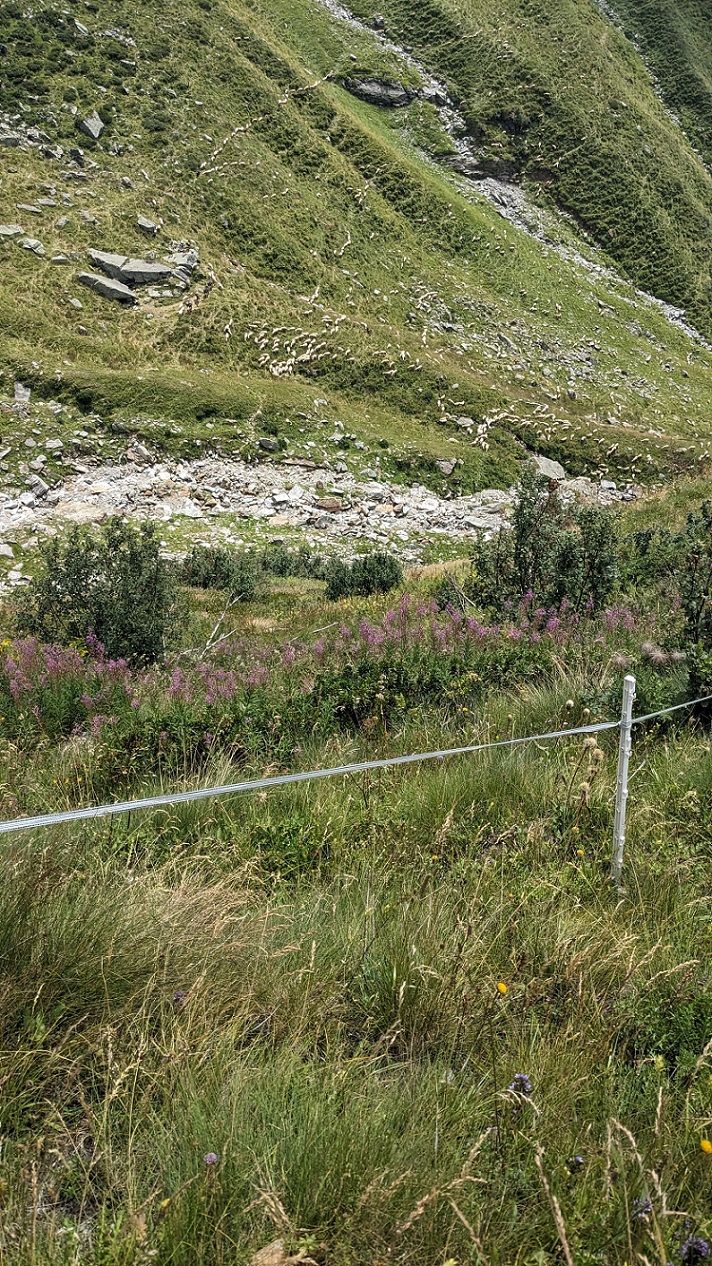
The impact of grazing by livestock was in some areas as great as anything I have seen in Scotland but, unlike Scotland, where that heavy grazing occurs is limited by the controls I have outlined and also means the land can be given a rest.
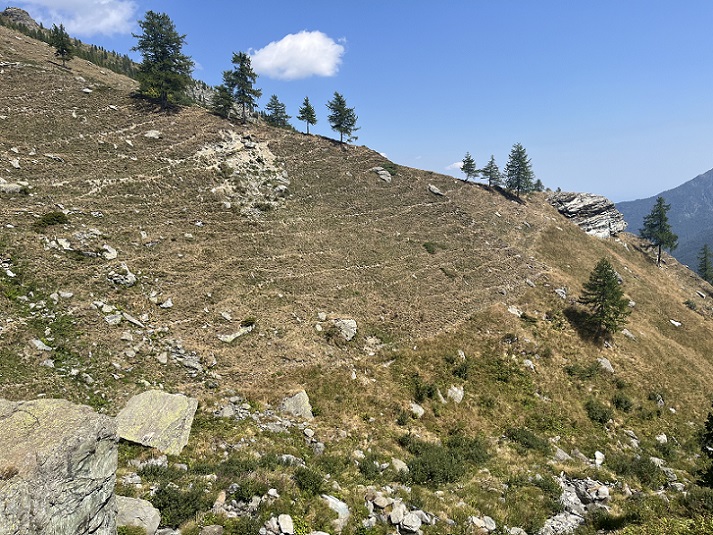
Once livestock has been moved into a different area, the electric fences are also removed:.
Looking at the photo above and the photos in my previous post (see here), it should be obvious that while heat and drought caused by global warming poses a serious threat to pastoralism in the alps, the most heavily grazed areas are also those most severely affected by heat and lack of water.
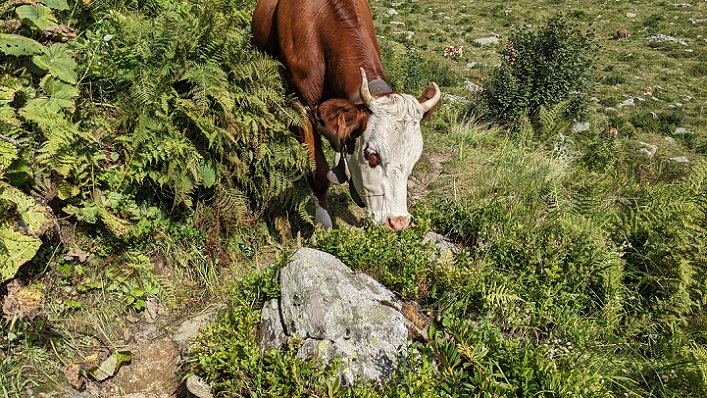
One way I saw this being managed was livestock being moved into areas of montane scrub, which retains water and stays greener far longer than the main pastures. Such habitat is so rare in Scotland that at home I would probably regard such grazing as ecological vandalism. But in the instances I saw in Italy the grazing within the montane scrub was also being actively managed, with electric fences used to control where the cattle browsed. I would have liked to understand more about how it works and its impact.
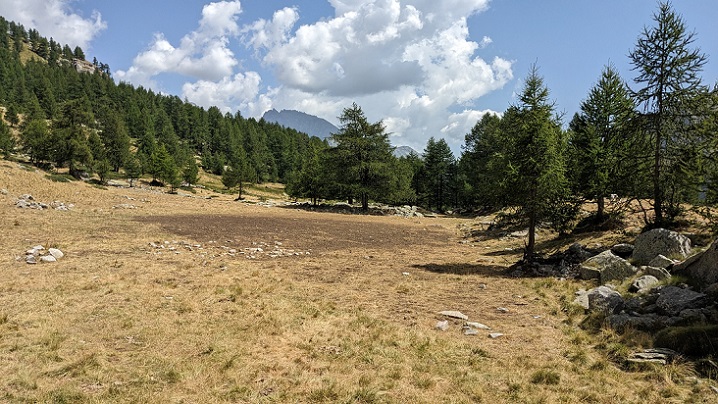
Electric fencing is also used to contain herds of animals at night which, together with the use of guard dogs, provides protection against wolves.
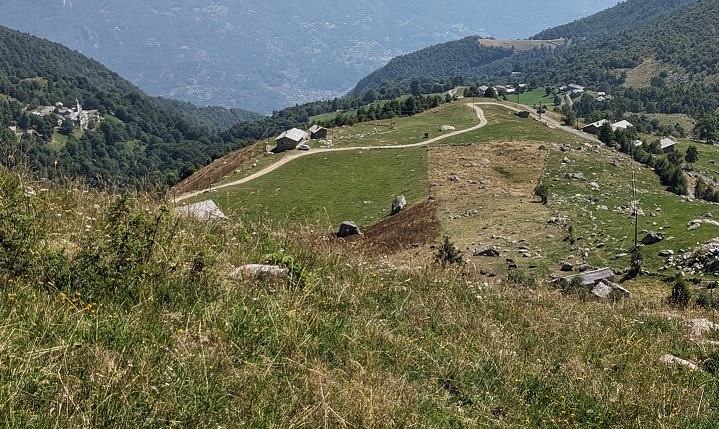
The impact and effect of this active approach to grazing management can be seen at the landscape scale. In Scotland, the patchwork above would only be possible with extensive use of stock fencing but we walked through the area and there was not a fence in sight.
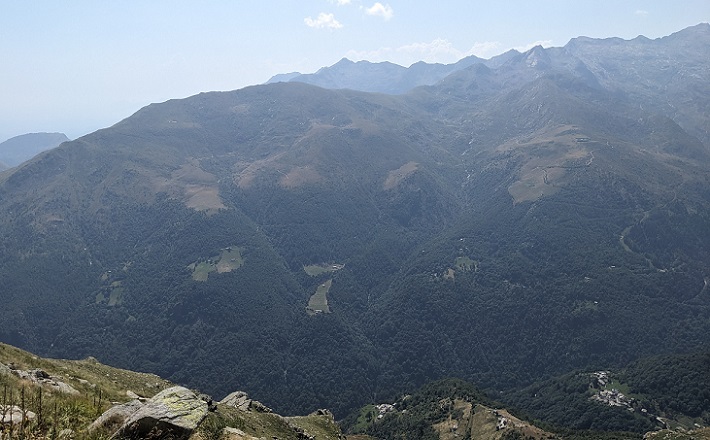
Incidentally, directing grazing to specific areas can also have other benefits, like reducing the rate of water run-off/number of landslides (all the steeper slopes in the photo are covered with trees, another contrast with Scotland) and reducing the risks posed avalanches.
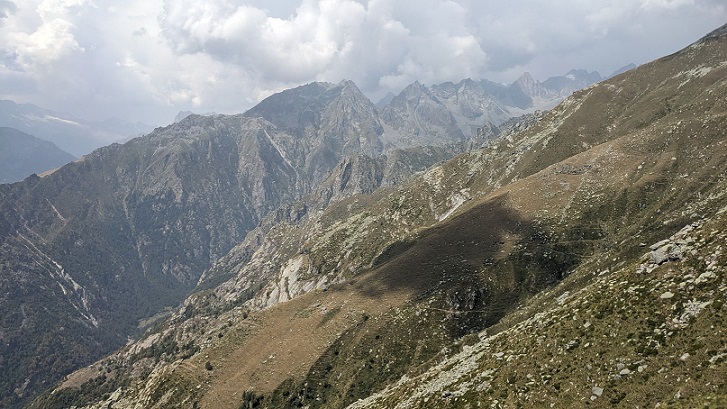
While the ridge in the photo above is steep and will shed water quickly, the exposed ridge is far less likely to accumulate snow in winter than the valley/gully this side of it. While snow-lie affects what can grow in such places, the more vegetation there is in such places the more it helps anchor the snow.
Discussion
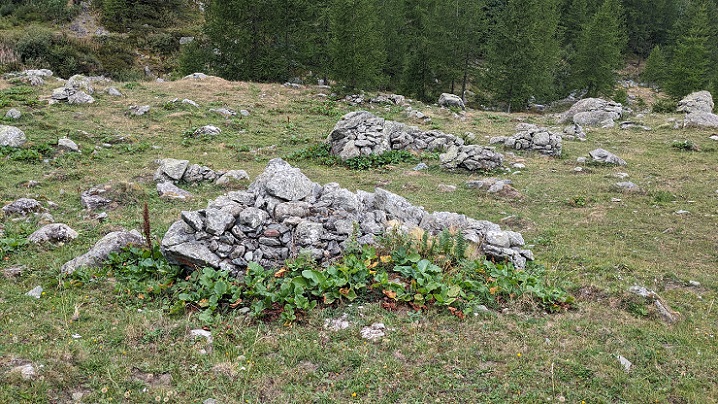
Walking along the GTA and knowing little about the history of land-use in the Italian Alps, it was tempting to believe this grazing management system had existed since time immemorial and there were indeed visible links to the past. The areas most used for grazing did not exist because of factors like soil, topography etc but because of human endeavour over many centuries.
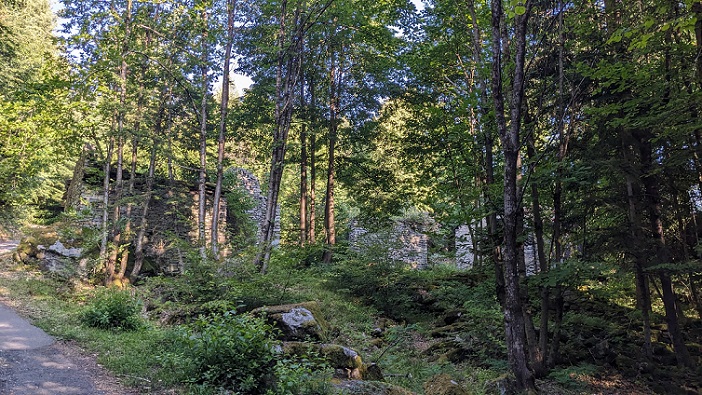
It was also evident that many areas that has been grazed in the past and their accompanying agricultural settlements had been abandoned, with ruined buildings everywhere and many places still known as “alpes” covered with trees. While I knew there had been a general agricultural retreat from across mountain areas in Europe, which had resulted in expansion of the forests, what I did not appreciate was until I started reading up about it was that I was witnessing something of a revival in managed grazing. Nor that in the Italian alps that this was being pioneered in Piedmont, the region through which I was walking.
The history, in brief, is that rural depopulation after World War II resulted in the traditional management of grazing by herding being replaced by what academics call “Continuous Grazing Systems”, i.e where livestock are let out onto the hill and allowed to feed where they wish – as happens in Scotland. That had an adverse impact on the mix of vegetation communities across mountainsides as, where given the choice, livestock browse selectively and would travel significant distances to eat their preferred plants. But it also made them vulnerable to wolves which were recolonising the Alps.
The consequence has been a renewed focus on “Rotational Grazing Management” systems, similar to traditional practices but with increased attention to pastoral productivity. Italian regions are semi-autonomous, a bit like Scotland, and Piedmont has pioneered the use of Grazing Management Plans (see here). Unfortunately I did not know about this on my walk and do not speak nearly enough Italian to have asked the people involved how it works. I suspect, however, those plans account for much of what I saw.
Managing grazing in the way I witnessed costs money but a significant proportion of that appears to have come from payments for measures to prevent wolf predation. The evidence is clear, so long as the wolf population is not too large – i.e there are wild animals for them to eat – herding livestock and protecting those herds with dogs in a system actively minded by people is an effective means of preventing livestock predation (see here). It is unprotected flocks that get predated. This has resulted in the use of EU agricultural funds to pay for the introduction of preventive measures such as guard dogs, electric fencing to contain herds and “shepherding”. Hence the grazing management I saw on my walk.
Whether the agricultural subsidies that are now being provided to support managed grazing are sufficient to provide those involved with a decent standard of living and maintain the practices I witnessed is, of course, a key question. There is, however, no reason why Scotland should not consider introducing similar measures in Scotland to change how livestock grazing is managed here and reduce its adverse impacts. Our National Parks, which were created not just to protect nature but to manage the land more sustainably, would be an ideal place to start. What chance of the Cairngorms National Park Authority funding a delegation of farmers from Strathspey to visit the Italian Alps and take a look at how they manage livestock there and how this is funded?

Yes, there is lot to be learnt here, but a few points on this: effective rotational animal farming requires either very large farms or very large commons. It’s not that hill farmers in Scotland do not move their animals between pastures, it’s that the overall land on which this happens within a farm is not big enough for it to be effective — the biggest obstacle to environmental restoration in Scotland is the nature of land owenership, and as long a bulk of the land is held by a small number of land owners (and in this regard it matters little if they are billionaires or rewilding NGOs), we will not move forward. If Scottish farming is to de-intesify, then the crofts have to come back in large numbers, and the commons with them. Second, countries where traditional mountain shepherding methods are deployed have also problems with packs of ferral sheep dogs, which, unlike the wolf, have absolutely no fear of humans (I had the pleasure of being acosted by a pack of those while hiking with a group of friends in Romania in the 1980s, and it was absolutely terrifying, run into them in parts of the French alps more recently as well). Thirdly, this type of farming requires infrastructure in the mountains, not least somewhere for the shepherds to stay in up in the hills during the summer months — huts and access tracks, I can already hear the complaints about spoiling the wilderness illusion if this was happenign in the Cairngorms.
Hi Tomas, this is very interesting and helpful. Some of those concerned about the size of landholding and the power of landowners in Scotland see the answer as breaking them up whereas in many places it would be better to convert most of that landholding into “commons”. That, as you say, might enable land with generally poor soils to be managed far more sustainably. I agree the dogs are generally more dangerous than the wolves even when non-feral – two years ago I was staying in a farm refuge on the GR5 where one of dogs bit a child’s face – but in the parts of Italy I was they were using different breeds which seemed better trained (not the patou you see in France) and at no point did I feel frightened. Third, yes you need huts but, as I will show, in Italy most of the herding is done without tracks and vehicles
That’s an interesting read, Nick.
But weren’t you meant to be on holiday:)
I am afraid I cannot help looking and thinking about what I am seeing wherever I go!
In his magisterial ‘The People Are Not There: The Transformation of Badenoch 1800 – 1863’ (2022), David Taylor writes that when sporting tenancies began to be created in Badenoch in the early 19th Century, one of the first things sporting tenants sought to do was to end traditional patterns of transhumance, which they saw as disruptive of their recreational shooting. Since they were able to pay far more money for sporting tenancies than local people could afford to pay for agricultural tenancies, they inevitably got their way.
We live in Scotland and bought a smallholding in the alps. The only reason we were successful in buying the property was because we didn’t object to access across the land or for the meadows to continue being grazed by the local dairy herds. Up in the mountains you see various properties scattered around the hillsides. The surrounding land usually belongs to each property but as you stated, there are no fences, gates, and certainly no deer fencing. Livestock are moved around and rotated often across large areas of land. Walkers roam, farmers will drive their vehicles respectfully across your land and not think twice about it if they’re chasing down an escapee goat….and that is absolutely fine. British peoples obsession with boundary lines (not just the big land owners, but look at every garden dispute you ever heard about with individuals wrangling over the precise two centimetres where the fence must be placed) Im afraid blaming the big landowners is an easy target because they seem greedy and entitled…actually I think its a much bigger, culturally imbedded problem that probably comes from being a pretty small island nation that is obsessed with privacy and individualism. Most of the farmers up here are also part of huge families that have worked the land for generations, they all know each other, share equipment/grazing/resources like water etc and go to church together….it’s just an entirely different way of being that I think we have largely lost in (most, not all) Scotland. The electric fencing and herding you describe is also really hard graft for the families here. They are all out driving their cows and sheep from barn to land at the crack of dawn each day, keeping an eye on them during the day and then back again at night time to bring them back to a barn or home meadow somewhere. The families that move the herds are usually parents and kids, many dogs, and various neighbours. It’s really hard work and everyone just mucks in because it’s what they’ve grown up doing.