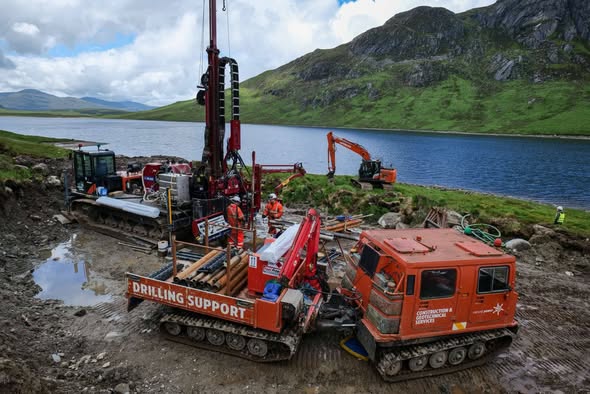
Just before she resigned as First Minister in March 2023 Nicola Sturgeon’s Scottish Government pushed through the Scottish Parliament what were described as “radical” changes in planning policy. This included giving the green light to any renewable developments, of whatever scale, that would help to meet UK renewable energy targets, emphasising that Scotland’s 42 Wild Land Areas were now open for such radical change.
Step forward every developer of wind farms and pump storage hydro schemes, from multinational conglomerate to corporate cowboy. At a stroke Sturgeon destroyed the work of her predecessor, Alex Salmond, who balanced the landscape impacts of renewable energy developments with the introduction of Wild Land Area (WLA) notifications to safeguard the best of Scotland’s natural beauty from such industrial scale development. Salmond’s WLA initiative had put Scotland at the forefront of European efforts to protect wild places and wilderness values across the continent; all squandered by Sturgeon’s love affair with corporate interests and their UK government allies.
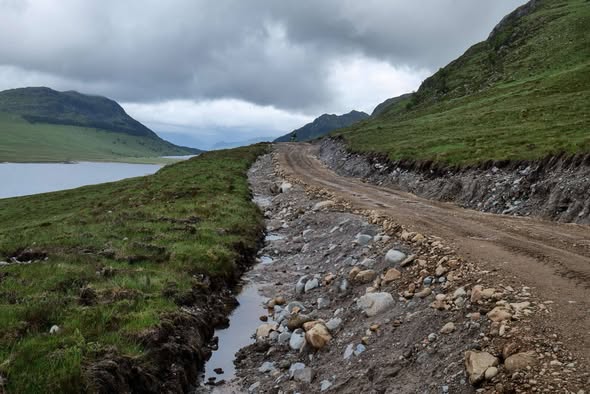
The latest example of Sturgeon’s folly, and an indelible stain on her diminishing credibility and reputation, is the recent announcement by the UK energy regulator, Ofgem, of provisional approval for the Lochan na h-Earba pump storage scheme between Dalwhinnie and Spean Bridge. This will have a massive impact on the Rannoch – Nevis – Mamores – Alder WLA (see here for map and description). Despite being described as the most massive hydro scheme to be built in the last 40 years in the UK, the project was never subject to public inquiry where lawyers could have tested the validity of the developer’s claims against the undoubted damage to Scotland’s natural beauty. The Earba scheme is one of three granted provisional approval by Ofgem, but is far worse than the others two, above Loch Ness and Loch Lochy, neither of which will impact any WLAs.
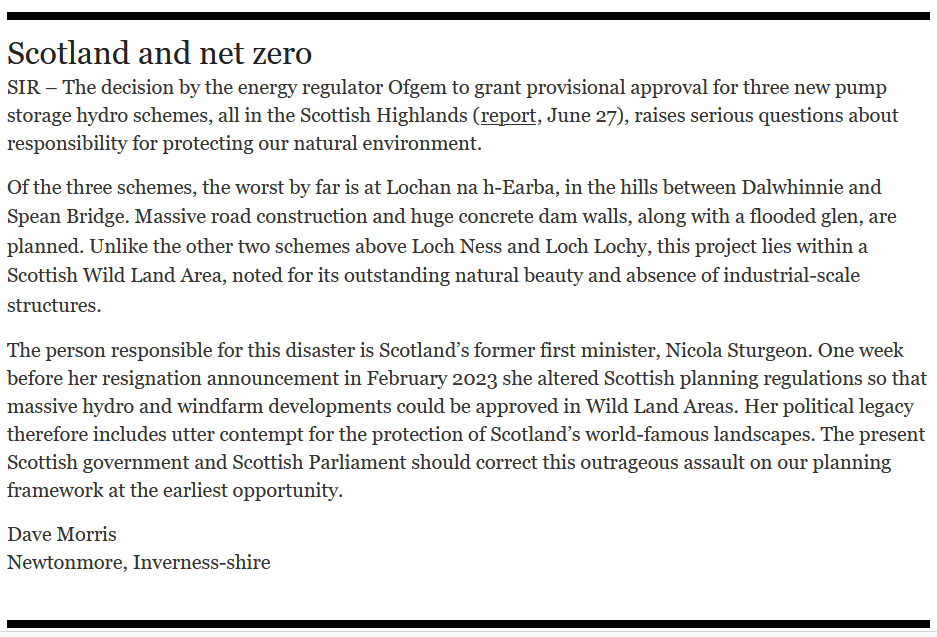
My recent letter, published by the Daily Telegraph in response to the Ofgem announcement, summarises the problem. The original article (see here) stated that even from the representative body for such developments in the UK have concerns about these prospective hydro developments. It reported Kate Gilmartin, from the British Hydropower Association, as saying:
“These schemes are major civil engineering projects, and it would be wrong to pretend they have no impact. They must be assessed rigorously……. The test should be: Is the impact understood, minimised, mitigated and outweighed by the long-term public benefit?”
It is obvious that alternative pump storage schemes can be developed above Loch Ness and Loch Lochy without the serious damage proposed for the WLA where Earba is located. And without setting a precedent for further damage to any one of Scotland’s other WLAs through misguided renewables developments.
Two conclusions can be drawn from the Earba fiasco:
Firstly, the Scottish Government and Parliament must amend the planning rules, asap, to prevent large scale renewables developments taking place in WLAs and avoid future mistakes like Earba.
Secondly, if Earba goes ahead throughout the construction phase, over several years, there will repeated publicity to demonstrate the adverse impact of Ofgem decisions on Scotland’s wild places. There could be no better evidence, for anyone who loves the outdoors and its natural beauty, why an independent Scotland, freed from the control of corporate interests and UK organisations, is the best way forward.
The Laggan Community Council Facebook Page has a useful summary of what is happening at Lochan na h-Earba and further photographs (see here).

You are spot on here Dave. There are rumours circling around Sturgeon on many fronts but selling out Scotland’s wild places is one of her biggest outrages partly driven by her dramatic turn toward a pro Westminster la key circa 2017 no doubt, but also because she despised rural life and nature, preferring her wee Glaesga clique
If anything an underestimate of the potential visual amenity and ecological damage, even worse than outlined in my August 2018 article on the impacts of hydro-development https://parkswatchscotland.co.uk/2018/08/23/the-hidden-horrors-of-hydro/.
I see no evidence that an independent Scotland would steer clear of such abominations, for the simple reason that, without the SNP government and its ECU henchmen, we would not have had a disgusting proposal like Earba being approved in the first place. No point in blaming Ofgem for Scotland’s outrageous lack of a democratic planning policy. The Scottish government is the real culprit and Swinney is no better than his predecessor. Neither of them has any interest whatsoever in ‘rural Scotland’; both are more than happy to extend the sacrifice zone Highland-wide. I am sick to the back teeth of making pilgrimages to our finest mountain landscapes to say goodbye. Don’t anyone try to kid me that Scotland’s a great place to live – it’s rapidly turning into an industrial wasteland.
Aye, Jane, traduced, suborned and infiltrated would appear to sum up the current SNP position
Well said Jane. As an Irishman with a deep love for Scotland and its previously wild and unsullied landscapes, I have been left gobsmacked by the thundering disgrace that is the wild west unfettered gold rush permitted in previously pristine lands. No land reform to return land to the Scots and vast estates raking in millions from ” renewables” funding this stripping of the natural world.
You’ve certainly woke up the Nat washers, I’m surprised you passed some of these comments.
An independent Scotland doesn’t need all the new hydro schemes it’s England that needs the power and OFGEM call the shots. If they want our power then will enforce every sneaky law as possible to ensure they get it. Admittedly Holyrood could and should put up a fight but in the current devolution restrictions t I’m afraid what Westminster wants it gets.
Well, Keith, as a past member of the SNP and of the Land Commission set up by Alex Salmond, I can vouch for the lack of interest of both the SNP and Greens at Holyrood in freshwater biodiversity issues. You’re correct in pointing out that energy is reserved to Westminster, but local planning is devolved and the SNP have used this to prevent new nuclear power stations. This proposed development has the blessing of the SNP hierarchy regardless of the environmental downside.
The developers, Gilkes Energy, have their HQ in Cumbria, and it is inconceivable that they could get away with anything remotely like this on their own doorstep in, say, the Lake District. Yet Scotland is seen as a soft touch and its natural heritage expendable. I wonder how many people believe that concerns for climate change and energy self-sufficiency, rather than financial greed, are driving this project.
Aye, John, it’s the old ‘wasteland ripe for development mentality’
Sadly, Scotland is destined to be one big power generation and battery complex providing electricity to mother England.
It matters not a jot how extensive the wind turbines, power lines, pump storage schemes, battery Parks there are. Or how many haul and access roads are scoured into the environment. Scotland is a resource to be exploited.
As for Sturgeon she has just been facilitating her political and corporate masters bidding. And no wonder she’s now hanging out in London.
There used to be a quip that Scotland found oil and got poorer. All these years on the same sentiment recurs with regard to the extraction of electrical power.
And don’t get me started about the burgeoning environmental toxic battery fish farms.
Oh and how many of us have considered Sturgeon’s plans to create National Parks all over Scotland.
And how many folks realise that National Parks as a government quango take over the planning role.
Freed of pesky local government with elected councilors, a plethora of National Parks provides a serious weapon to counter democratic public objection to commercial development.
Shades of LLTNP and Flamingo Land conflicts of public interest with commercial developer interests..Or am I missing something?
Indeed Willie, I would refer you to my article on hydro impacts in the August 2018 archive on this site and also the April 2016 one, the first covering aspects of hydro effects on loch ecology and the second the failure of our so-called ‘national’ parks and a possible alternative. Sturgeon and her colleagues cannot, or rather just will not, engage with the basic concept of a national park being owned by the nation and managed by a national parks SERVICE. A bit odd for a party in large part founded on the need for land reform.
The original sin lies in the way Wild Land Areas were introduced. They are an excellent idea but, because they never had a basis in legislation, when push comes to shove the Scottish Government (and planning authorities) have only ever needed to ‘take them into account’ rather than be bound by them. I assume that this weakness in their introduction was quite deliberate by the Government so that it did not need to be bound by the designation in the future, if it so chose. That’s exactly what happened with the introduction of NPF4. It was clear that the Scottish Government had already made up its mind to exclude energy infrastructure projects from the guidance on restrictions on Wild Land Areas before the public consultation on NPF4.
What I find surprising about this scheme, of which the detailed plans were available well in advance, was that the mountaineering and hill-walking fraternity, and conservation & other bodies generally, made no effort to object to the scheme. I did, on behalf of the Scottish Wild Land Group, because there can be nothing more damaging to the remaining wild land in Scotland than a scheme such as this: converting two lochs into a reservoir, a high altitude dam in a corrie in the heart of a large area of wild land, hill tracks everywhere…
It is too late to complain now but, if anything is to be learnt, it is that coordinated action is needed to prevent the continued attrition of wild land.
Mountaineering Scotland expressed grave concerns but stopped short of an outright objection. At least they later founds the guts to object to Fearna. The JMT did object to Earba, a last gasp effort by members of staff who were already on their way out the door. You wouldn’t get the JMT objecting to anything significant now. Some hill goers, me included, studied the planning docs and submitted lengthy objections to Earba, but you might as well piss into violin, as the French saying goes, for all that heed the ECU pays to objectors. Unfortunately, there are many concerned members of the public who daren’t voice opposition to ‘green’ energy schemes, and so we never build a head of steam; when I consider the slander and vilification directed at those of us who object on public forums, it’s perhaps not surprising.
Aye Jane, there is a fervency approaching religiosity on both sides of the argument. I haven’t been innocent of venality myself, but for our freshwater biodiversity this is an irreversible existential issue. Native biodiversity integrity in this environment is a bit death, pregnancy and virginity; it’s not possible to be a wee bit of any of the three, but the politicians will still procrastinate over what shade of policy grey they will propound.
There is of course a great deal more going on than just a desperate despoiling of the natural heritage of Scotland. There is no capital to spend on major road rail and other infrastructure improvements which if carried out would enhance the lives of outlying communities and cut transport costs for regional business.
But massive flows of venture capital are there to drive new “private” access roads into pristine glens,to allow massive cranes to deploy fresh turbines and bulldoze whole hillsides away. Capital also to blast new dry-dock facilities ( Kishorn) for construction and ultimate decommissioning of structures built thousands of miles away, for use at sea. Capital for creation of new breakwaters marshalling areas and docksides( Aberdeen south, Arderseir, Invergordon, Dundee, and elsewhere) to let ships unload steel structures transported to this once able industrial nation, by vast ships voyaging around the globe.
But no Budget money is available to be allocated to widen or strengthen rural arterial routes along which to fetch transformers, steel tower sections and wind turbine blades.
The Political/planning disconnect here is massive. And once all these new windmills are in use, after 20 -30 years, the job of dismantling them all comes around. The mess left behind will only get worse. Pump storage earthworks may endure longer..but who really can tell?
I commented elsewhere that what we are seeing is ‘short-termism’ writ large, where global financiers are barging past ethical questions or morality concerns. Greed has become justifiable. Short term profiteers running AMOK. Arguably, the last time such wilful coastal destruction occurred was during the building of 1000 miles of Atlantic wall defences in WW2. Some structures built then may indeed last for 1000 years.
Actually (and this is going a bit off topic ) there us money to spend on infrastructure, it’s just that it’s all being spent on the A9 rather than the next tier of trunk roads which actually support rural communities
After COP26 in Glasgow, Nicola Sturgeon charged Liz Lloyd with driving forward Climate Change policy. Great environmental damage is being done as a result.
Well, Graeme what alternatives would you suggest? Say, happy AMOC shutdown-day?
I’m not against having an ambitious Climate Change policy. I’m very critical of the cack-handed way the Scottish Government has approached the challenge, including ill-judged changes to planning policy such as this, and the contracting important parts of climate and environment policy out to city financiers and land speculators.
your point on city financiers and land speculators is well made as their connection with land monopoly in Scotland is not obscure! http://www.slrg.scot
well, said, Tom
Nah! This is all whistling in the wind, Sturgeon and Co. are clueless middlemen, the power and control is coming from the top down. Really, it’s just like Stalin said, “Social democracy is the moderate wing of fascism.” Who bankrolls fascism, the merger of the State and corporations? Finance and industrial capital. Finance capital is running a money for nothing debt and rent racket which is absolutely unproductive. As the UK is an imperialist country all the productive investment in manufacturing and industry has been offshored since the 1970’s, to rake in super-profits from emerging markets in developing countries. The UK is run to meet the subsistence needs of the ruling class. The proof of the pudding is in the eating, refuse and that’s a declaration of war and it’s launch missiles and bombs away. Of course, the Western Left call it “socialism.” Bollocks! The Western Left are anti-communist Nazis, fascists and Zionists. Ask China, they know what’s going on!
Aye, fine Jamie Graham, all we need is a wee red book and all will be well. Those who are not for us are against us, blah de blah, blah etc. However Uncle Joe was right when he opined that ‘no oligarchy ever gives up its power voluntarily’ and let’s face it he knew a thing or two about running an oligarchy or a gulag here and there. What shade of totalitarianism does the ecosystem need?
Pumped hydro is, in general, a waste of good land these days, the storage capacities, even for these mega projects, are too small in the large scheme of things. PSH is mainly suitable for covering small fluctuations in *consumption* for the short time it takes to spin up a gas power station, but the fundamental problem with renewables, and specifically with wind, is fluctuation in *generation* on a much greater scale; building ever bigger reservoirs doesn’t address that.
Earba estimates 40GWh of storage, about a week of Scottish consumption at present levels, but we can expect consumption to double on the back of ongoing electrification very quickly even just from EV adoption. Heat dome conditions can last for several weeks, and strategic energy reserves should be around the 40 day mark — we would need at least 10 of PSHs on the Earba scale in the medium run if that was to be the solution to the unreliable wind generation.
Of course, the need for large scale storage arises principally out of Scotland’s rejection of nuclear energy, a couple of Hinkley/Sizewell C sized power stations would cover more than our entire national needs at present, while the existing renewables already provide around the same as our national annual consumption, so we would be well secure for energy for a while. Without nuclear we will see more of this madness, or end up having to build more gas power stations — the simple truth is that there are no good solutions to climate change, and at present in Scotland pretty much everything is a worse option than nuclear.
But folk are deluding themselves if they think this would not be happening without the SNP; sure, the SNP (and even more so the Greens) have jumped on the CO2 reduction bandwagon with an incredible degree of naivety, completely lacking understanding of the parallel biodiversity crisis, but Scotland’s land has been exploited on a large scale this way for centuries because the nature of our land ownership makes that possible and easy. Without radical land reform, this will continue to happen regardless which lot are in charge, there is just too much money to be made.
I remain to be convinced that sharing out land ownership more equitably would automatically be to the benefit of our landscapes and environment. I suspect it would simply amount to having a lot of individuals chasing the same money that currently only a few have the resources to pursue; if the manner of thinking is no different – i.e. financial gain before everything else, including conservation – then there’s no real change.