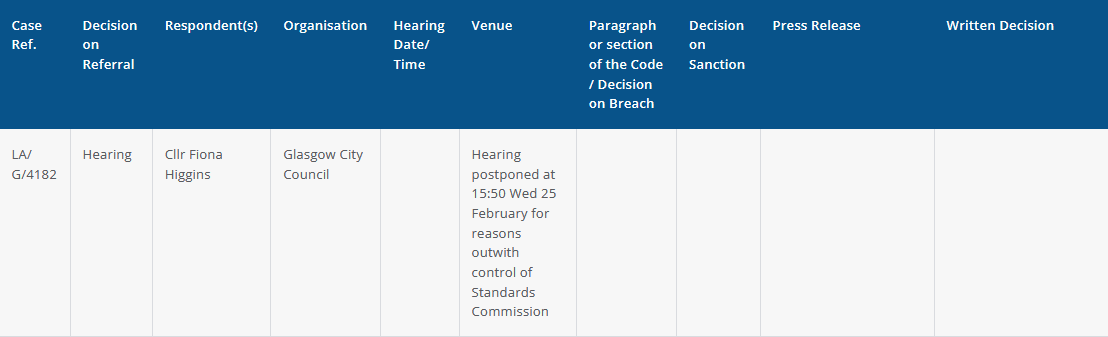
I had set aside last Wednesday morning to attend the Standards Commission for Scotland (SCS) hearing into Councillor Fiona Higgins, who like Sid Perrie (see here) the local elected National Park board member for Balloch, has been investigated by the Ethical Standards Commissioner for trying to raise concerns about officials. I was tipped off on Tuesday evening the Hearing had been postponed but not the reasons why. On checking the SCS website, it suggested the postponement was due to “reasons outwith control of Standards Commission”. This told the public little except that the SCS was claiming the delay was not its responsibility.
Two days later the reason for postponement was covered in the Herald (see here). The article reported that the SCS had refused to consider certain evidence which Fiona Higgins lawyers had attempted to submit on her behalf and, threatened with an interdict:
“Solicitors acting for the Standards Commission agreed last night (25th February), upon sight of our [i.e Fiona Higgins’ solicitors] petition, that it would not be necessary to interdict them from proceeding with the hearing today and they agreed that the hearing would no longer be proceeding on February 26 (today).”
Faced with the prospect of legal action, the SCS voluntarily agreed to postpone the hearing. Far from the postponement being due to matters outwith the SCS’ control, if the report in the Herald is to be believed, it was the consequence of matters absolutely within their control:
‘A statement released on behalf of Higgins reads: “Following upon a decision of the Standards Commission for Scotland to refuse to receive productions deemed by Cllr Higgins’ legal representatives to be relevant and material to her response to the allegations she faces, PBW law served proceedings for Judicial Review. This included a crave for interdict and interim interdict.’
The SCS did exactly the same in the Sid Perrie case. They told Alannah Maurer and myself, who were trying to represent Sid Perrie’s interests while he was off sick, that while we were free to submit any evidence we wished, they would decide what was “relevant and material” to the hearing:
“Yes, you can submit a document containing submissions you would like to make. If the Panel consider them relevant, the document will be added to the productions.” (Email from Lorna Johnston, Executive Director of SCS 13th January).
Later on 13th January, Alannah and I attended a pre-hearing meeting with Morag Ferguson, the chair of the panel, and Lorna Johnston, the Executive Director of SCS. Morag Ferguson told us that SCS’s only interest was interested in whether the six emails Sid Perrie had sent raising concerns about the Flamingo Land planning process met the rules in the Code of Conduct for Public Life, not in the wider context which might show whether they were justified.
Our original intention, while Sid was off sick, was to make submissions based around the evidence I had presented in my series of posts about how democracy in the National Park is being destroyed (see here), (here), (here), and (here). However, the SCS had already refused our request to call as a witness Heather Reid, the Convener of the Loch Lomond and Trossachs National Park Authority (LLTNPA) who had made the complaint against Sid and a member of staff. This was BEFORE we had submitted any information, because under SCS procedures witness requests need to be submitted and agreed weeks before the deadline for evidence, and without asking why we thought Sid would want to question those witnesses.
We decided therefore it was pointless spending lots of time preparing evidence, since it appeared the SCS would almost certainly refuse to consider this, and instead sought to adjourn the hearing on health grounds, since ONLY Sid could talk to why he phrased his emails as he did. SCS refused that too and without giving Sid time to obtain further information, required under SCS procedures, from his doctor.
The script that Morag Ferguson read out Hearing held in Sid’s absence on 10th February (see here) provides confirmation in writing that the SCS would have refused to consider any evidence we tried to submit on behalf of Sid:
“I would also note the Panel is only making a determination on whether the Respondent’s conduct, in sending the emails in question, amounted to a breach of the Code. The Panel has no remit whatsoever to make any determination regarding the planning application to which these related, any actions or decisions taken or made by the Park Authority, or the conduct of its employees or any other Board members.”
Relevant facts. such as that Heather Reid passed on Sid’s first email raising serious concerns about senior members of staff to those members of staff within nine minutes of receiving it, are currently being automatically ruled out of consideration by the Standards Commission. Unfortunately Sid and a significant number of other elected representatives subject to complaints for questioning officials, have either not had lawyers or not had the resources to pay to challenge SCS in the courts.
Large amounts of public money will no now doubt be spent trying to defend what should be indefensible. I am hopeful that the outcome of Fiona Higgins’ judicial review will be of considerable significance, not just for her own case, but also, as I hope I have illustrated here, for all the other cases where the SCS has failed to consider the wider reasons why elected representatives have challenged officials in public. Whether successful or not, what has happened to Fiona Higgins, Sid Perrie and other elected representatives needs to trigger much wider reforms of the Code of Conduct in Public Life (see here), the SCS and the power of bureaucracy in Scotland.
Robin McAlpine has now written another interesting blog, arising from the Fiona Higgins case, on the wider issues setting the SCS cases within the context of “iron law of oligarchy” (see here).

Robin’s article is salutary. As he says there, this covering up of mistakes and subsequently accusing those who raise the alarm is not confined to public bodies. Charities like JMT fall foul of the same descent into secrecy and centralised control.
What this detailed commentary appears to bring into absolutely sharp focus is how the Standards Commission and a Code of Conduct is being used to punish and silence elected representatives from asking questions.
In the case of the Flamingo Land development there is a clear question that all was not right between the commercial developer, the Scottish Enterprise and the National Park Authority. Documents are now emerging that indicate very much that thing may not have been right. But the commercial details of the relationships between Flamingo Land are a commercial secret. And now of course the elected representative who asked questions about the contract the relationships between the LLATNP, Scottish Enterprise has been suspended from office.
This and in other cases has the potential to be a national scandal with legislation being used to cover up wrongdoing. Administrative, strategic, and financial wrongdoing is something that the public must be protected against. Openness and the ability to ask questions is the disinfectant that keeps things clean.
There is everything to concern citizens about the Sid Perrie case.