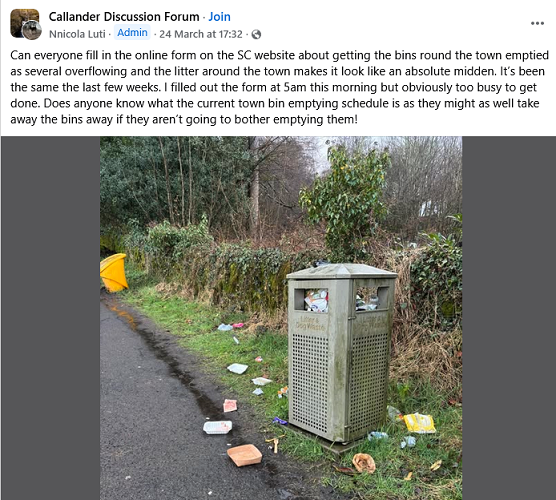
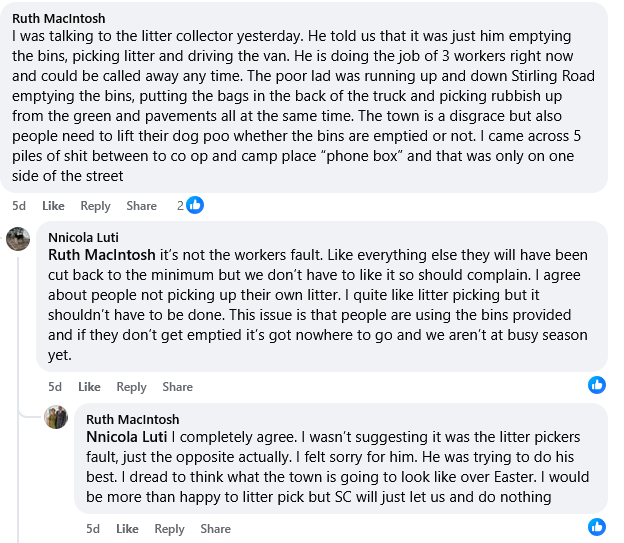
 Last week this post appeared on the Facebook Callander Discussion Forum about overflowing litter bins in the town (see here). The comments which followed helped explain the reasons why the bins had not been emptied and what is likely to happen when the tourist season takes off:
These problems are not new. After fairly extensive community consultation the Loch Lomond and Trossachs National Park Authority (LLTNPA) helped produce Callander’s Local Place Plan 2022-32 (see here). It had this to say about litter under the section on Public Services:
“Rural communities like Callander have shouldered the brunt of cuts in public service budgets. Were it not for our local volunteer groups organising litter picks, woodland maintenance and planting baskets and floral displays this would be a far shabbier town.
Dog fouling and litter remain two of the community’s major concerns due to the associated health risks and because they impact negatively on our landscape and on visitors’ perceptions of the town [All the underlining is my emphasis].
The recent changes to bin collections mean that residents are having to use the recycling centre at Lagrannoch more frequently. Ours is the only household waste recycling centre within the National
Park and neighbouring communities come here to avoid going all the way to Stirling.
The Callander facility only opens for a total of 16 hours per week and last entry on weekdays is at 7.30 p.m. This makes it hard for people who commute long distances for work to access recycling services.”
Callander’s Local Place Plan proposed simple solutions to these problems:
iii. Bins and hygiene
Stirling Council should provide more litter bins along our paths and in recreational spaces, and empty them more often. Stirling Council and LLTTNP should provide practical support for community groups in raising public awareness of responsible dog ownership.
v. Recycling centre
If the current schedule for bin collections is to continue, extended weekday opening hours at our recycling centre should be considered
Judging by the Facebook post, Stirling Council’s provision and emptying of litter bins has got worse. Meantime the Callander recycling centre, which is not open access but requires users to book beforehand, still appears to be open for only 16 hours a week (see here).
As for the LLTNPA, its Litter Strategy 2020-23 (see here) has not been renewed, a similar fate to many of its other plans and strategies. The current National Park Partnership Plan 2024-29 (see here), which was supposed to incorporate earlier plans, contains only two references to litter. The first is a brief reference to the contribution that marine litter makes to water pollution. The second expresses the pious hope that if people connected to nature more they might take their litter home. Just they the LLTNPA think people will do this after travelling through a midden is unclear.
Meanwhile the LLTNPA has shifted its attention and resources away from the provision of infrastructure to support visitors in the wider countryside, including litter provision, to focus on the sites it owns.
After Balloch, Callander is the second most important tourist village in the National Park. The LLTNPA website (see here) describes the village as an “iconic place with outstanding landscapes, habitats and communities. We work to ensure a sustainable future for this special place.” So overflowing litter bins are what makes Callander sustainable and a special place?
While communities and visitors suffer, the people who should be leading the National Park are wringing their hands and appear completely powerless as this comment on the FB post illustrates:
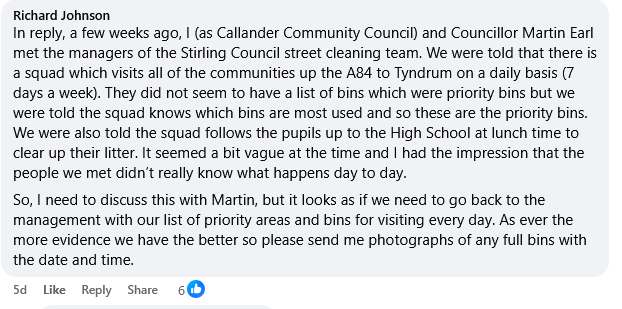
What Richard Johnson didn’t say is that both he and Cllr Martin Earl also sit on the board of the LLTNPA. So why are they not publicly calling on the LLTNPA to work with Stirling Council to ensure the necessary resources are invested in litter bin provision and collection?
The LLTNPA continues to be in denial that its strategy of trying to get people to take their litter home does not work and that litter binsdo make a real difference. Its Joint Response Visitor Management Plan(see here), presented to its board meeting on 9th March, contains just one reference to litter and that in a section on communication:
“Development of a comprehensive set of key messages which can be utilised when required around emerging / priority issues, such as high fire risk, planning ahead, parking and traffic congestion, water safety and litter across appropriate NPA communications channels”
What this appears to mean is the LLTNPA may occasionally lecture the public about litter over the spring and summer but plans to do nothing practical to address the actual problems. The plan offers no hope for local communities in places like Callander.
What the LLTNPA should be doing is shown by how the amount of litter in the laybys along the A82 south of Tarbert reduced when bins were provided. For many years Argyll and Bute Council had refused to provide bins in these laybys, even though its bin lorries regularly drive up and down the A82 to collect domestic refuse. After the Friends of Loch Lomond and Trossachs (FOLLAT) obtained Covid-recovery funding to provide bins, the amount of litter reduced considerably (see here). However, neither Argyll and Bute Council nor the LLTNPA have done anything subsequently to incorporate this provision into public services, the original funding has long gone and its been left it to volunteers and local businesses to try and keep the service going.
FOLLAT’s post on the situation (see here): last September is completely damning:
“For obvious reasons, the busy and beautiful A82 corridor along the shores of Loch Lomond has always been a priority for us and while the bins we maintain in some of the laybys closer to the loch are quite effective in managing litter, such is the pressure of numbers and the irresponsibility of some people, it is a constant battle helping to keep these areas looking their best.

It was noticeable that the laybys to the north of Arnburn, where we have bins, were much less polluted than those to the south, where there are none. The three laybys near Arden are in a disgusting state with decades of stinking rubbish including abundant evidence of toileting having built up within a few metres of the roadside. Despite years of asking, neither the National Park nor Argyll and Bute Council say they will help our efforts in any meaningful way, although in fairness we have recently received a small award from the Argyl and Bute Supporting Communities Fund which we are grateful for. With local business sponsorship and donations meeting an annual servicing cost exceeding £20,000, over 20 tonnes of rubbish passes through the bins each year. It is clear more are needed. A massive thanks to all of the businesses who continue support our Bonnie Banks Bin Scheme.
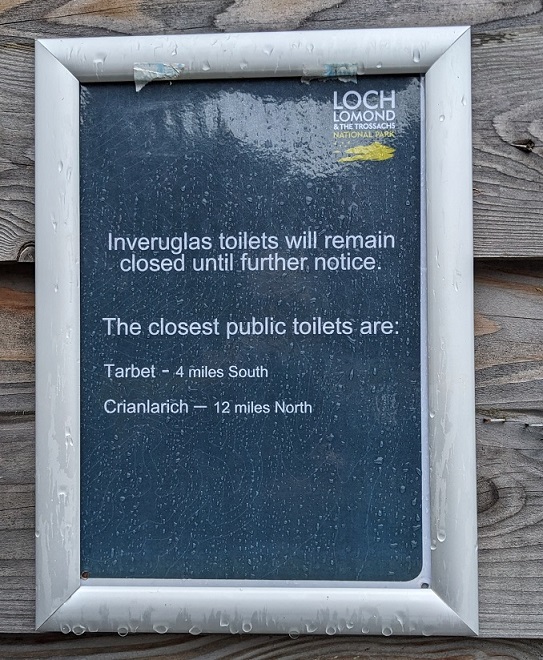
As we have repeatedly pointed out, there is also a crying need for some kind of Aire type facility suitable for large heavy lorries so their drivers can pull off, park safely and access toilet facilities. As it is, the A82’s Loch Lomond laybys must constitute the longest and most disgusting open air toilet in the country. The National Park has just spent around £2million upgrading facilities at Tarbet, yet not one extra toilet was added to the meagre facilities there…………………………
No one at any level of government seems to be listening or seems to care.”
It would be far cheaper and better use of money to incorporate provision of litter bins and collections in laybys into mainstream council provision than to pay contractors to make special visits. Yet instead of making this case and acting on it, both Argyll and Bute Council and the LLTNPA have preferred to shunt responsibility for dealing with the litter problem onto someone else. The same negative forces appear to be at play in Callander. Its not surprising so many areas in the National Park are, rather than a place of beauty, disgusting.

How many “eco” flags and awards does that school have? It should be a condition of getting and keeping them that the pupils don’t litter, but it happens everywhere. The school takes no interest in anything that happens outside the gates.
Anyone whose job involves driving knows all about peeing in laybys. With a truck it’s worse, there are few places to pull off at all let alone with a toilet facility. The much maligned out of town supermarket is a godsend, free parking without height barriers or weight restrictions and clean free toilets, something many councils seem to be incapable of providing.
No councillor wants to be pictured in the paper opening a new toilet.
Welcome to Scotland a land inhabited by Morons who throw their rubbish out of their on credit motors.
Oh what a lovely place.
Litter collection seems always to be one of the first casualties of cutbacks. This suggests that budget holders view it as somethinig of a ‘luxury’ service which is expendable in times of shortage.
This is the exact opposite of the reality for those of us who pay taxes and actually live in a place. Litter picking is a vital, crucial service directly related to the amenity enjoyment of our public spaces. Without litter picking the whole area becomes tarnished with a depressed, unhealthy, poverty-stricken veneer. It is deeply upsetting and disgusting to see our beautiful countryside strewn with waste.
It seems like our local authorities have essentially given up on litter. Much of it is years old and rapidly turning into micro-platics filtering into the soils and bodies of our fauna (including ourselves). If the authorities have given up on something so basic and fundamental we begin to ask; “What are you actually for?” “Why do we pay you?”.
Why should litter-picking be sacrificed before any one in authority will contemplate cutting down on corporate staffing in the various ‘performance’, ‘strategy’ and other non-jobs?