Last Wednesday I published a short post (see here) informing readers that Dave Morris, Gordon Bulloch and I were giving evidence that morning to the Scottish Parliament’s Public Audit Committee (PAC) on the funicular railway at Cairn Gorm. The short notice and whether you were available to watch at the time didn’t matter as anyone who wishes can watch us on Scottish Parliament TV see what happened and reach their own conclusions (see here – we are on at 11am).
If you prefer you can read the official record of the session, which is due to be published today, or you can read the minutes which were published the day after the meeting to find out what was decided in both public and private session. In the case of the PAC last Wednesday, the minute records that under Item 6, which was held in private session (see here), “The Committee considered the evidence heard at agenda item 3 [i.e where we spoke] and agreed to draft a report.” The minute may be brief but it is very helpful – it indicates that the PAC is not looking for more evidence about the funicular but now believes it is in a position to end its “mini-inquiry”.
The contrast between how the Scottish Parliament and the Loch Lomond and Trossachs National Park Authority (LLTNPA) operate is striking. While the LLTNPA have since Covid broadcast board meetings, they remove the recordings from the internet as soon as the meeting is over. This means only those who were able to view it at the time – a handful of people at most – know who said what or what happened. The draft minutes of meetings are then not published until a week before the next meeting. Since the main board meets quarterly, this means almost no member of the public can find out what happened until 12 weeks later. News releases highlighting decisions made by the Board are rare and done for show, for example when the LLTNPA announced the board decision to reject the Flamingo Land planning application (see here).
Although there were no journalists present at the PAC last Wednesday, in the afternoon Radio Scotland featured a report of the session which included a film clip of the evidence Gordon gave. When the PAC publishes the findings of their inquiry into the funicular, if the BBC wanted to feature further clips from the evidence sessions, it would be easy for them to do so. The way the Scottish Parliament operates facilitates journalism. Contrast that with the LLTNPA where no footage is available of the Board Meeting which rejected the Flamingo Land planning application on flimsy grounds (see here).
I have now made three separate Freedom of Information requests for recordings of LLTNPA board meetings and a subsequent one to the Ethical Standards Commission. It’s important that people understand what is going on, the implications for democracy and the need for reform.
The LLTNPA’s response to FOI requests for recordings of board meetings
My first request was made on 10th June 2024. I wrote to Dr Heather Reid, the Convener of the LLTNPA, requesting a copy of the “recording of the Board meeting today before it is discarded”. I had been caught up in other matters and only started viewing the meeting as Dr Reid was trying to silence Sid Perrie, the locally elected member for Balloch, from expressing concerns. I was concerned by what I witnessed but wanted to view the exchanges which had led up to it, hence my information request.
A nameless person (or was it AI?) from “Information Management” refused my request claiming the contents of the recording constituted personal data under the Data Protection Act and that they had not asked the permission of board members to make this “personal” information public. Contrast that with the Scottish Parliament where no-one asked the three of us for permission before broadcasting the evidence we gave last Wednesday. If it is lawful for the Scottish Parliament to make available their recordings without the permission of individuals concerned, that must also be the case for the LLTNPA. Indeed, the LLTNPA has been live-streaming its meetings without ever asking permission from its board members, the issue is that it does not wish to make those recordings publicly available afterwards as a matter of public record.
I requested a review and Douglas Smith, the LLTNPA’s corporate performance manager, responded on 2nd August 2024 FOI 2024-024 REVIEW Response confirming the Park’s refusal to release the information. He argued that since the participants at the board meeting had not consented to the recording, providing a copy would “contravene a data protection principle – namely that of lawfulness, fairness and transparency”. This is like something out of Animal Farm, covering up something makes it more transparent!
Because what I most wanted was the part of the recording that covered the exchanges between Sid Perrie and Heather Reid, I decided to try playing the LLTNPA at their own game and asked both of them for their permission to release the information:
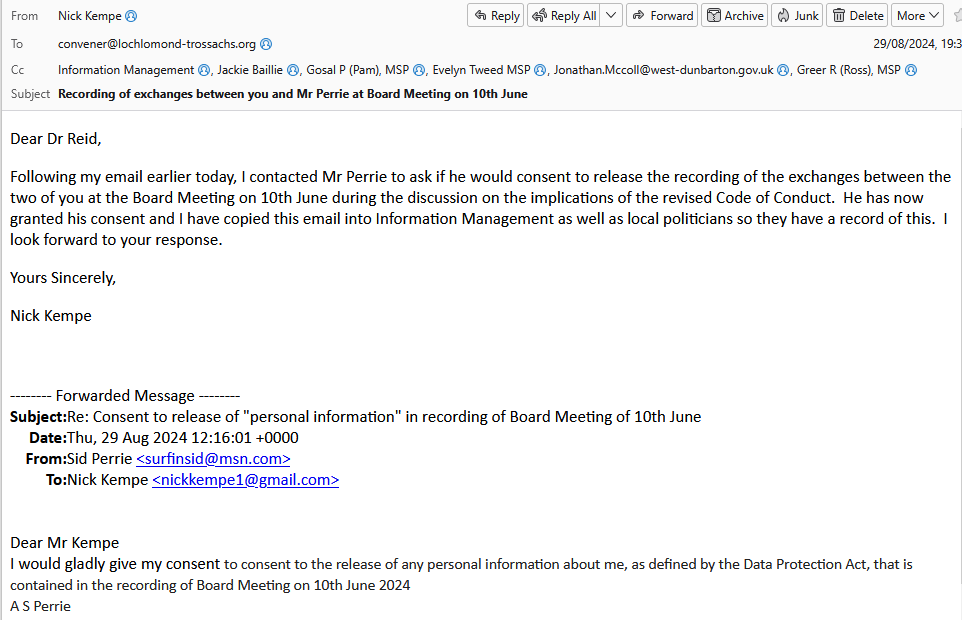
As you can see Sid Perrie agreed, he has never tried to cover up anything he has done or said, but Dr Reid failed to reply. She never does. Perhaps the staff who control her emails never showed her my request? Or perhaps Dr Reid was too busy preparing the complaint she submitted to the Ethical Standards Commission on 30th August? This was about the six emails Sid Perrie had sent her between 26th and 28th August about the Flamingo Land Planning Application (see here).
Unfortunately I then got caught up look at the decision to refuse the Flamingo Land application and others things and failed to appeal to the Scottish Information Commissioner in time.
My second request was made a year later and was or the recording of the board meeting of 9th June 2025. This time I resolved to see the process through. My request was refused for similar reasons as the previous year FOI 2025-022 Response:
“as the video recording contains the personal information of multiple individuals who have not consented to their data being processed in this way (i.e. they have not consented to a permanent recording of their names, images and voices being made permanently available in video format), we believe disclosure would contravene the data protection principle that information must be processed lawfully, fairly and transparently”.
In asking the LLTNPA to review this decision FOI 2025-022 Review Request 11-7-25 I pointed out that in England the “Openness of Local Government Regulations 2014″ allow any member of the public to record and broadcast public meetings in England” and quoted the following statement from a House of Commons briefing:
“Council meetings are public meetings. Elected representatives and council officers acting in the public sphere should expect to be held to account for their comments and votes in such meetings. The rules require councils to provide reasonable facilities for any member of the public to report on meetings. Councils should thus allow the filming of councillors and officers at meetings that are open to the public.
The Data Protection Act does not prohibit such overt filming of public meetings.“
While permitting the public to film meetings is more limited than requiring public authorities to do so, in terms of data protection law the issues would appear to be the same. The position in England suggests no permission is required from participants in public meetings for recordings of them to be made widely available.
The LLTNPA’s response on 8th August Review Response – FOI-2025-022 ignored this evidence and argued that opinions expressed in the course of performing a public duty are personal data and therefore they would have to redact the recording before releasing it (even though they had previously invited me to view it in their offices!). No attempt was made to explain why LLTNPA board members are so different from MSPs (or indeed councillors in local authorities many of whose meetings are broadcast).
Note too the claim, which was soon to be contradicted, that “these recordings are used to assist with the production of meeting minutes and are routinely destroyed upon completion of this task”.
My third request was the recording of the next board meeting which took place on 15th September. I received a short response FOI 2025-037 Response from a nameless bureaucrat on 1st October :
“The National Park Authority does not hold a video (or audio) recording of the Board meeting which took place on 15 September 2025.
As you will be aware as a result of the similar information requests you reference in the above request, the National Park Authority’s Board meetings have generally been broadcast live over the internet in recent years and a copy of the recording kept for a short period of time for the purpose of assisting the minute-taker with the production of the meeting minutes (which are subsequently published on our website).
The provider we use to live-broadcast meetings has changed following the expiration of our contract and meetings are no longer recorded by default.”
This appears to a deliberate attempt to pre-empt the Scottish Information Commissioner and prevent the LLTNPA having to publish recordings of board meetings in future. So much for the LLTNPA’s Code of Conduct for Board Members which states:
“Openness
I have a duty to be as open as possible about my decisions and actions, giving reasons for my decisions and restricting information only when the wider public interest clearly demands”
In my view, if board members and senior staff are not prepared to be recorded when performing a public function they should not be in post.
I submitted my appeal to the LLTNPA’s refusal of my second information request to the Information Commissioner on 31st December. It will be interesting to see how they respond.
The recording of the June 2024 Board Meeting and the Ethical Standards Commission
As regular readers will know I have been trying to support Sid Perrie, the locally elected member for Balloch, in the complaint made against him by Heather Reid (link above and here, here and here) and decided to try and get the Ethical Standards Commission (ESC) to consider the way he had been treated. I therefore submitted a complaint about the way Heather Reid had appeared to shut down Sid at the June 2024 Board Meeting, on the anniversary of the meeting – the last date for doing so. (Complaints to the ESC are supposed to be submitted within a year although they have allowed the LLTNPA’s Chief Executive Gordon Watson to submit (another) late complaint against Mr Perrie).
I will come back to the ESC’s findings about my complaint, which they did not uphold, in a further post. As part of their investigation, however, the LLTNPA provided them with a recording of the board meeting of 24th June 2024. It is interesting how they had kept a copy after claiming recordings were only kept for minuting purposes or until any request for the information had run its course – mine had run out several months previously when I missed the deadline to appeal. That provided a second opportunity.
While the ESC decided against my complaint, the content of their report contained some important information, for example that “during the meeting, the Respondent [i.e Dr Reid] interrupted and spoke over Mr Perrie on several occasions” on a couple of occasions “with a raised voice and a sharp tone”. Having, as I explained above, missed most of these exchanges, the information was very helpful but I wanted other people to be able to judge whether the ESC was right to conclude Dr Reid’s behaviour was justified. I therefore asked them for a copy of the recording.
Comment: This seems extraordinary. How can what was said at a meeting the LLTNPA was required by law to hold in public be claimed to be confidential?
Meeting recordings and the Standards Commission
Last week Alannah Maurer and myself met the Standards Commission for a pre-meeting in the case of Sid Perrie which is scheduled to be heard on 10th February. Sid is off sick with stress as a result of the way he has been treated by the LLTNPA and ESC.
We made a number of requests to the panel member present, Morag Ferguson, one of which was that any hearing into the case against Sid Perrie (we are currently seeking an adjournment on heath grounds) should be broadcast. While the Hearing Rules drawn up by Standards Commission allow them “to hold the Hearing online and livestream it” Ms Ferguson stated that they only broadcast online hearings and would not do so for hearings held in person. This allows the Standards Commission to tick a box and say the hearings, as provided for in the legislation, are held in public, while ensuring as few people as possible see how they operate.
So much for the transparency which the Standards Commission was set up to uphold.
Discussion
This post has explained at some length just how resistant the LLTNPA, and the bodies ostensibly responsible for ensuring they operate in an ethical manner, are to operating in a transparent manner. Much bureaucratic time and effort is spent by all these bodies preventing the public from seeing how they operate and make decisions. Generally it works, in my case I have been worn down too often.
In my view this poses a fundamental threat to democracy. Democracy is dependent on transparent decision-making and providing for this should really be quite simple. Now that technological developments have made recording and broadcasting of meetings cheap and easy, all decision-making meetings of public authorities should be recorded and, except where these are justifiably held in confidential session, broadcast with those recordings publicly available (as they are with the Scottish Parliament). That would ensure the facts are on record and help spread disinformation, whether from the public authorities concerned or the public.
The Nolan principles (see here), which were created after the cash for questions scandal in 1994, also put it quite simply in their fifth principle, Openness:
“Holders of public office should act and take decisions in an open and transparent manner. Information should not be withheld from the public unless there are clear and lawful reasons for so doing.”
The LLTNPA and ESC have basically been trying to use data protection law to undermine the Nolan Principles and undermine democracy. They need to be stopped. I hope the Information Commissioner will do so through the appeal process. The LLTNPA, however, is clearly trying to avoid the consequences of any decision by the Information Commission by ceasing to record board meetings. It should be a priority of the next Scottish Parliament therefore to legislate to require public authorities to adopt similar practices to those which govern how it operates: meetings should be recorded and broadcast, minutes issued promptly and other information, such as evidence submitted to consultations etc, also published promptly.

I know it’s not your main point but I was struck by your comment that “The draft minutes of meetings are then not published until a week before the next meeting. Since the main board meets quarterly, this means almost no member of the public can find out what happened until 12 weeks later.”
Try being a member of the John Muir Trust if you think this is tardy! Draft minutes are NOT published. The Board “summary” is approved at the following meeting (3 months later) and the approved summary is published …. weeks later. At the moment, we are still waiting for the minutes of the September 2025 board meeting that will have been approved in December 2025.
In contrast, our local community council minutes are publlished in draft within a week or two of the meeting and the approved version (if they differ) immediately after the following monthly meeting.
This post should be essential reading for anyone who aspires to be elected to the Scottish Parliament in May this year. We need a new intake of politicians who will clean out the cess pit of Scotland’s quangos. Most of them appear to have, as their highest priority, the need to redact as much information as possible that might possibly affect their reputation or to the rocking of any of the vested interest boats which lead the quango fleet. Back in 2000 Alan Blackshaw, a former senior civil servant and board member of a wide range of public and voluntary bodies, sent a 45 page page report to Scotland’s Auditor General which detailed his excruciating experience of dealing with Highlands and Island Enterprise and their subsidiary, Moray, Badenoch and Strathspey Enterprise. As a non-executive Director of MBSE Blackshaw had an insider’s view of the obstructive and incoherent process which HIE and its subsidiary engaged in while trying to justify the economic case for constructing the funicular railway in the Cairngorms. Blackshaw resigned from MBSE following the remarkable decision of the Chief Executive of HIE to leave his post and immediately joined Morrison Construction to whom HIE had recently awarded the contract to build the funicular. Blackshaw’s paper was subtitled “Are the Nolan Standards Working?”
The answer to that question was, and still is, “no”. The Public Audit Committee will report on the funicular saga to the Scottish Parliament before the next election. Let us hope that, at least as far as HIE is concerned, they will make recommendations which will inspire the next generation of politicians to start the cess pit clean up.
Which part of public service ethics was missing from the upbringing of any of those who have, since devolution, stood for elective roles in Scotland?
A fundamental part of public service employment was always to be found within the oath of office :….. “without fear or favour, in the common good”.
When? for what valid reason? has this essential ethic of democratic activity become superceded in Scotland by: ” In fear of ‘mis-steps’ being found out during a period receiving remuneration from the public purse”?
So much misbehaviour and self serving incompetance has been taking place for over two decades now , the failures become normalised; Some truths only dragged out months or yeaars later through intermidable “Learn lessons” official public enquiries. The code of secrecy within devolution management is become all pervasive.
Most reasonable people will notice that Scotland’s unelected public officials do not often offer themselves up for replacement. Total “decontamination” …a disconnect from the current mischievous ways ..will therefore never be permitted to occur.
In contrast, CNPA retain recordings of Board Meetings and Planning Committee meetings – they are available on U-Tube. This makes an even bigger farce of the stance taken by LLTNPA. My main criticism of the CNPA set up is that their new ‘slick’ AI contributed website is not easy to navigate and its search engine is very poor. I’ve found it easier to conduct a Google search to find something on the CNPA website and use the Google searched link to find the information.
To be fair, aspects of the Scottish Government are hardly a bastion of transparency either, with a number of well known issues handled like a banana republic. The quangos will likely take their lead from this.
Your question might have been better phrased the other way round, Nick, so as to give credit where it is due to the Scottish Government for its transparency, although I do take your point about some of the quangos, although not all – some of them, in my experience, try very hard to be as open as their remit allows.