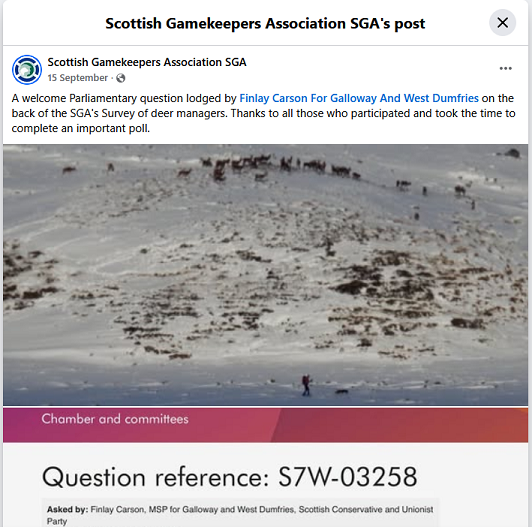
 The newly formed Rural Affairs Committee (RAC) of the Scottish Parliament are conducting what they describe as a short inquiry into Scotland’s access rights. The inquiry appears to have been prompted by claims from the Scottish Gamekeepers Association (SGA) that access rights are impeding their ability to cull deer, although it appears likely to consider tourist pressures on rural areas, such as the North Coast 500.
Background – timetable to date and involvement of SGA and deer management interests
1) 9th September 2026. The minute of the RAC meeting records that as a result of the discussion of their work programme, held in private: “The Committee agreed to undertake an inquiry into outdoor access and consider an approach paper at a future meeting.” No further information has been published about why they decided to do this
2) 10th September 2026. The SGA publish the results of an anonymous poll about the impact of access rights on deer stalking (see here).
3) 14th September 2026. Finlay Carson, the Tory MSP for Galloway and West Dumfries, submits a written question to the Scottish Government asking if they have any plans to review the “right to roam” – his terminology!
4) 15th September 2026. The SGA welcomes Finlay Carson’s parliamentary question (see post above)
5) 23rd September 2026. The minutes of the RAC meeting record that under Item 8, held in private:
“The Committee considered its work programme. The Committee discussed its approach to an upcoming inquiry on outdoor access in Scotland. The Committee agreed a scope for the inquiry; to issue a public call for views; to seek to undertake up to two visits to support the inquiry; to consider at a later date a proposal for community engagement work; and to two groups of witnesses to begin the inquiry, delegating authority to the Convener to sign off a final list of witnesses for those two meetings.”
6) 24th September 2026. The Scottish Parliament Petitions Committee refers a petition from Robin Pettigrew, asking for a review of the Scottish Outdoor Access Code to the RAC (see here). The Scottish Government had responded to the Petitions Committee on 3rd September setting out the current framework for managing access rights and saying they had no plans to change this (see here).
7) 25th September 2026. Gillian Martin, the Cabinet Secretary for Climate Action and Rural Affairs responds to Finlay Carson saying “The Scottish Government has no current plans to review the legislation relating to responsible non-motorised access rights or the associated guidance, the Scottish Outdoor Access Code (SOAC).”
8) 28th September 2026. The RAC opens a public consultation calling for views until 23rd November (see here).
9) 29th September 2026 SGA issue a news release saying they are delighted to hear the RAC is undertaking an inquiry in Scotland’s access rights and refer to Gillian Martin’s response to the Petitions Committee (see here).
10) 11th October 2026. The Association of Deer Management Groups (ADMG) welcomes the RAC inquiry:
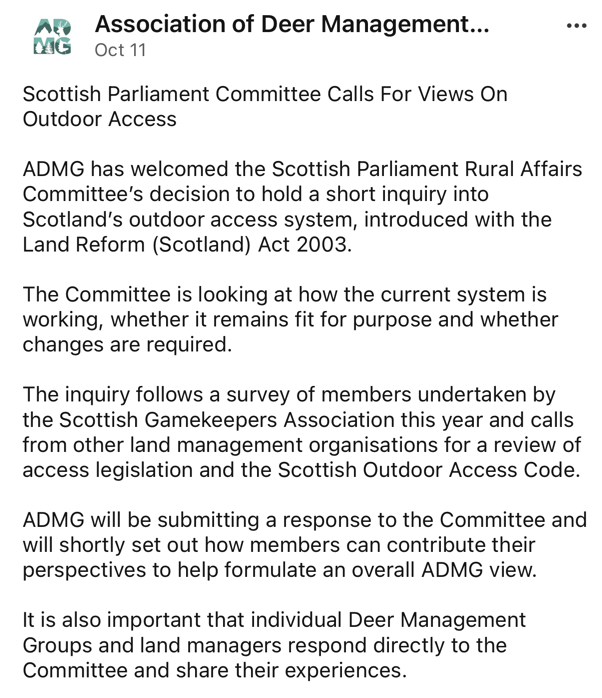
This history appears to confirm that the RAC inquiry follows calls from the SGA and other land-management organisations for a review of the access legislation and the Scottish Outdoor Access Code (SOAC).
Deer stalking and access rights
The SGA’s headline claim from their anonymous poll of deer managers and practitioners which received 132 responses, is that:
“Over 60% of Scotland’s deer managers say evolving Access issues are impacting their ability to fulfil deer management obligations, leading to elevated stress within the profession.”
The SGA are backing up this claim that access rights are affecting their ability to cull deer with further claims that “access conflicts”, such as “E-bike misuse in core deer habitats” and “a rise in professional dog walking and wild swimming, increased motorbike and drone use, 24/7 access with head torches, and social media influencers encouraging off-the-beaten-track photo opportunities and dawn camps”, have increased post-Covid. They also state that “the majority of respondents cited uncontrolled dogs as a major issue when carrying out deer control operations, scattering and even chasing deer that are now being displaced from hefted ground into woods where they cause more damage”.
How some of these alleged “access conflicts” such as “wild swimming” and “professional dog walkers”, who tend to operate on the fringe of settlements, impact on deer stalking is not explained. One wonders whether the SGA supplied the RAC with a copy of the photo from their FB post of 15th September (above), showing a large herd of deer standing on a hillside within shooting distance of a walker and their dog?
This spurious evidence reminded me of the occasion when Patrick Gordon Duff Pennington, chair of the then Deer Commission and the then Scottish Landowners Federation, showed a group of people representing access and environmental interests around his estate at Ardverikie prior to the Land Reform (Scotland) Act 2003. A herd of deer disappeared round the hillside as the group approached and Mr Gordon Duff Pennington started expostulating about how this provide a perfect demonstration of how the presence of people disturb red deer. Five minutes later, as the group were still discussing the issue, the deer walked back across the hillside.
The question of how deer may be affected by the presence of people is far more complex than the SGA suggests. Any competent deer stalker, however, who knows the ground will also know when and where people are likely to be and can arrange stalking around this. I first appreciated this over 25 five years ago when a young stalker who worked for the Ben Alder estate came to talk to a Mountaineering Council of Scotland meeting at Laggan. Since then I have met several stalkers who take pride in knowing where they can successfully and safely shoot deer when people are about.
Most of the time this is not that difficult, since people tend to follow certain routes or visit certain places “such as the off the beaten track photo opportunities and dawn camps” the SGA refer to. But even when people take routes or visit places that no stalker might anticipate, that may not be a problem. A few years ago Dave Morris and I decided to descend directly from the summit of Cranstackie, a Corbett in Sutherland, instead of returning along the main walkers route along the ridge to Beinn Spionnaidh and then back down to the road. A couple of hundred metres down we spotted three stationary figures on the slopes below, one with a rifle. I must admit my heart sank but we walked directly down to them and apologised if we had disturbed their stalk. The stalker, who had seen us on the ridge above, couldn’t have been nicer. He had seen us on the ridge above and gave us advice after we had offered to change our route down so that any deer we might disturb would be displaced towards them. We altered our course by a couple of hundred metres
This illustrates how with the right attitudes on the part of both land-managers and visitors, as promoted by the SOAC, there should not be any major conflict between access rights and the ability of stalkers to shoot deer.
What the SGA failed to mention when claiming stalkers were have difficulties fulfilling “deer management obligations” and feeling stressed as a consequence is that in 2023 the Scottish Government changed the law. The close season for male deer was abolished, making it possible to cull deer for 12 months not 3, three, while the use of thermal and sights to shoot deer at night was made legal under license. The changes should have made it much easier for SGA members to shoot deer than before Covid, including in places popular with visitors..
Blaming access rights for the failure of sporting estates to reduce deer numbers
Towards the end of their survey article the SGA also claims that “Deer are already being disturbed more, today, with natural capital developments, energy schemes, woodland creation, the siting of transmission and telecoms masts and peatland restoration programmes all creating displacement.“. Unlike public access, all these developments that “displace” deer are decided by the gamekeepers’ employers, the landowners and so cannot be blamed for their their failure to fulfil their “deer management obligations”.
The truth is that the reason the deer population in Scotland is so high is not because of disturbance by walkers or new types of land-use but because the owners of sporting estates want it that way and have resisted every attempt to reduce deer numbers over the last 30 years. This is well explained in Mike Daniel’s new book, Locked Antlers, which is essential reading for anyone interested in the issue. Mike points out that where sporting estate landowners have decided that deer are a problem, as on the grouse moors where they are thought to spread disease among grouse, they have been eliminated entirely. King Charles’ landholdings provide the perfect illustration of this with Delnadamph, managed for grouse, having no deer (see here) while parts of Balmoral have long had some of the highest numbers of deer in Scotland (see here).
There are, however, still deeply embedded cultural reasons, what Ron Greer would describe as the Victorian Edwardian Dystopia, behind how sporting estates owners manage their land and which Mike Daniels explores in his book, . Having resisted every attempt to reduce deer numbers to date, the provisions of the Natural Environment (Scotland) Act 2026 on deer control, were due to come into force in October. As Stuart Allison of the SGA Deer Group put it, the “Scottish Government has placed deer management at the heart of Net Zero, with 50 000 more deer needing to be managed annually.” This presented a new threat to the perceived right of landowners to manage their land as this wish. The stalking estate landowners and the SGA therefore needed a new excuse for not reducing the deer population that is doing so much damage to the natural environment. Hence the decision to try and blame access rights and hence the SGA survey.
Stalking estate landowners and the SGA also possibly had other reasons for wanting to reduce access rights. For example, while most landowners are not really bothered about people being on their land when they are not there, some still want exclusive use of the land for themselves and their paying guests when they stalk. Hence the longstanding access problems at the North Chesthill Estate in Glen Lyon (see here). Those gamekeepers still involved in wildlife persecution also have good reason not to want people on their land, it makes such persecution more difficult and increases the chance of being caught. This explains why grouse moor interests have for a long time been trying to limit public access to paths (see here).
Whatever the other motivations, the SGA and ADMG’s main purpose in pushing for an inquiry was, I believe, to put a halt to current government attempts to reduce deer numbers. From this perspective, it does not matter the Scottish Government has subsequently said it has no plans to review the access legislation or SOAC. This can now be used by stalking estate interests to argue to the RAC that they have been put in an impossible position, caught between people exercising their access rights and the requirement to increase deer culls. SGA and ADMG are now encouraging their members to respond to the RAC’s consultation to try and prove this point and undermine the new deer legislation (weak though it is).
It is important that all those who enjoy access rights and those representing them challenge the claims about the impact that access rights have had on deer control. One way is to expose the many dubious claims in the SGA survey. For example, how does the SGA’s claim that access rights are displacing deer into forests where they are harder to shoot fit with the fact that so much of Scotland is treeless, in part because of the way sporting estates manage the land? And how do stalkers employed by Forest and Land Scotland, which generally welcomes the public, manage to cull so many deer each year if access rights are such a problem?
The opportunity presented by the RAC Inquiry
Although the RAC inquiry may have been prompted by the SGA and land-managers, it appears that the RAC, convened by Green MSP Mark Ruskell, has decided to take a much wider view. It has agreed (see here) to undertake two visits and to two evidence sessions and then, “once the Call for views closes, the Committee will take stock before scheduling further evidence”.
The visits planned so far are to the start of the West Highland Way and the Loch Lomond & The Trossachs National Park and to the Pentlands Regional Park. The first provides the opportunity for MSPs on the RAC to consider how the Loch Lomond and Trossachs National Park Authority has failed to deliver the camping places it promised and how they are reviewing the camping byelaws (see here) & (here). The second provides an opportunity to discuss the need for proper investment in access infrastructure and countryside management (see here). The first introductory session, which takes place this Wednesday (see here), is with academics, the second with access authorities and “other relevant bodies responsible for access”. So far, stalking estate interests are nowhere to be seen.
In addition, none of the questions in the RAC’s call for views (see here) are about the impact of outdoor recreation on deer stalking. Instead there are three questions on responsible access by the public are matched by three questions on responsible management by land-managers:
“2. What role has the Scottish Outdoor Access Code played in developing a culture of responsible access?
3. What role have access authorities played in developing a culture of responsible access?
4. What are the key issues relating to irresponsible access?
5. What role has the Scottish Outdoor Access Code played in developing a culture of responsible management?
6. What role have access authorities played in developing a culture of responsible management?
7. What are the key issues relating to irresponsible management?”
Question 7 provides the opportunity to make the point that sporting estates need to stop blaming others for their own management failings and, more specifically to stop blaming access rights for their failure to reduce deer numbers.
The RAC survey is fairly comprehensive but also open-ended and the questions, such as whether Access Authorities are appropriately resourced or have sufficient powers to carry out their duties effectively, both pertinent and balanced. It therefore creates opportunities to raise with MSPs a large number of issues relating to the implementation of the Land Reform (Scotland) Act 2023 and the SOAC which have undermined its original intentions. World class in principle, in practice the implementation of the Act and SOAC is now undermining some of those principles while the implementation of its provisions is now distinctly second rate.
Examples I have covered on Parkswatch over the last couple of years are Historic and Environment’s continued closure of the Radical Rd within sight of the Scottish Parliament (see here), the Cairngorms National Park Authority’s unlawful Exclusion Zone after the Abernethy/Glenmore wildfire (see here), the inadequacy of core path plans (see here), the impact of deer deer fences on access rights (see here) and the reluctance of access authorities to remove unlawful signs (see here). There are many more. I would encourage readers who care about access rights to respond to the survey (direct link here) by the deadline of 23rd November.
