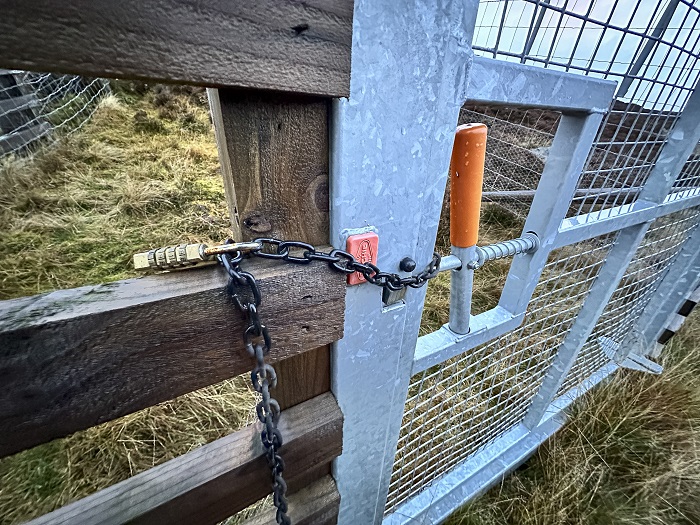
A few days after they had provided me with a copy of the contract for the Creag Bhalg woodland creation scheme near Kingussie (see here), Scottish Forestry responded to my complaint about the locked pedestrian gates there. After their Conservator for the Highlands and Islands, John Risby, had confirmed their contract with Balavil covered these gates, he went on to say:
‘We have contacted the estate to draw their attention to this and made clear that to comply with
the FGS contract conditions and the Land Reform (Scotland) Act 2003 and Scottish Outdoor
Access Code that these gates must be left unlocked to allow public access. We are awaiting
confirmation from the estate that this has been done and Scottish Forestry will check the gates
in due course. Should the estate fail to unlock the gates we would consider this a breach of the
FGS contract conditions’.
While this is no more than one should expect from a public authority, in the current climate where most public authorities are very slow to do anything to uphold access rights, this action is extremely welcome. Unlike the Cairngorms National Park Authority (CNPA) which wanted to view the locked gates before decided if they were an access problem or not, Scottish Forestry has used their authority and simply written to the estate telling them to remove the locks. Instead of spending time investigating what is an obvious breach of access rights, they have said they will visit afterwards to check the landowner has complied. In my view that is a sound and effective use of resources.
Mr Risby’s letter goes to say Scottish Forestry have informed the CNPA of what they are doing. I have written a follow up letter to the CNPA asking that when they visit the estate they take the opportunity to check all the gates in the perimeter fence around the Ceag Bhalg woodland (there appear to be 13 in total) and not just those I reported initially.
The wider issues with Scottish Forestry, deer fences and access
Last weekend Jamie Mann from the Ferret reported (see here) that between between 2018/19 and 2024/25 Scottish Forestry subsidised 2,284 miles of deer fence. If there was one gate per mile of deer fence, which is approximately what was agreed at Creag Bhalg and which I would argue is the absolute minimum required to protect the right to roam, that would be 2,284 gates. Although Scottish Forestry has in practice agreed to fewer gates in many schemes, how many of those gates are now locked and how many are in our two National Parks?
I had also raised with John Risby the question of whether the deer fence along the boundary the Balavil and Pitmain and Glenbanchor estate might not now be redundant because of the new deer fences being erected on the Pitmain side. His view is then Creag Bhalg fence is still needed to protect the trees from deer. I then realised Scottish Forestry probably only knows about the deer fences and gates it has funded or form part of forest plans it approves. While these include deer fences erected by Forest and Land Scotland, they don’t include:
- deer fences erected for conservation purposes (such as those in Glen Banchor see here);
- deer fences erected for sporting purposes, to protect game birds from deer and exclude predators; or
- all the deer fencing erected by home owners to protect their gardens from deer.
In the last few years the number and length of deer and stock fences on the Pitmain and Glenbanchor estate has increased significantly but most appear to have been funded by the estate. The combined impact of all the deer fencing in the area means that red deer have been increasingly excluded from the lower ground on the estate. It is s likely that no-one apart from estate staff will understand ther extent or impact of all this fencing and whether the deer fence with Balavil is still needed or not. I have responded to John Risby saying I will get back to him once I, with the help of others, have checked the position on the ground.
That task, however, should really be a job for the CNPA as the local access authority. In my view the CNPA should be mapping all the fences on estates like Pitmain and Glenbanchor, assessing their impact on access rights, and then identifying those that are redundant and could be removed. They should then be ensuring adequate access points are installed through the rest. The CNPA’s initial view is that redundant deer fences are none of their business whatever the impact on access rights but I am trying to initiate a dialogue with them about this with a view to persuading them to change their position.
From a wider Scotland-wide perspective there is a strong argument that deer fencing should now be brought under the Prior Notification scheme (like agricultural and forestry tracks). Currently deer fencing is a permitted development. Requiring landowners and managers to notify Planning Authorities before any fence was erected would enable them to assess the impact of new fencing on access rights and ensure sufficient gates were installed.

Good to see rapid action by Scottish Forestry to deal with this locked gate obstruction. And Nick is correct in saying that new deer fencing should be subject to a prior notification procedure. A huge deer fence is currently under construction, section by section, around the whole of the Monadhliath hill range and, as far as I know, none of it has been subject to any form of public consultation or local authority consideration. And, as regards stock fences, is it not time to question the use of barbed wire? In Norway, which has a thriving agriculture, the use of barbed wire was prohibited after the Second World War. Barbed wire was too much of a reminder for Norwegians of their occupation by Nazi Germany. Today Norwegian farmers manage their sheep, goats and cattle without any need for barbed wire. Surely it is time for Scotland to follow their example.
Aye, I have bad memories of coming across live sheep with lengths of barbed wire wrapped round their torsos. It’s nasty stuff
So lets just review what the CNPA have been up to:
Fencing access out of existence
Spending public money to boost salmon catch for lairds
Banning camp fires for the hoi polloi but allowing hundreds of hectares to be burned annually for the shoot
Spending public money to restore peatland without doing anything to prevent it being degraded again
What next? A CNPA sponsored grouse shoot?
Good response from John Risby and Scottish Forestry as funder and CNPA as access authority. It contrasts with Forestry and Land Scotland lack of action to address obstruction of an important Right of Way crossing National Forest Estate land not that far away..
Here General Wade’s Military Road has been a ROW since the 18th century and is of national importance. Once the main route to Inverness and closely connected to iconic sites like Culloden and Inverness Castle. Now well suited to modern recreational access needs.
The section from Moy to Inverness is marked with Scotways signs at either end. The nailed shut FLS gate in the deer fence was replaced jointly by the community and Highland Council with a new metal self closing one. But a short section of the old military road on FLS ground has long been obstructed by a missing bridge, ditches, water innundation and brash – despite on going communication. FLS – please take a lead from Scottish Forestry and remove these obstructions.
Ironically this section of the ROW is beside the current A9 dualling works. Closer to Inverness the ROW crosses private ground and is in poor condition – awkward gates, path surface, over grown with vegetation. Sort them and get a quick win, mostly off road and low cost, walking/cycling route along a heritage icon from Inverness to Aviemore. What is not to like?
Would be a shame if bolt cutters had to be part of your hill kit 😉
What, on top of the saw needed to cull rogue sitka saplings? It’s not a rucksack we need, it’s a trailer …