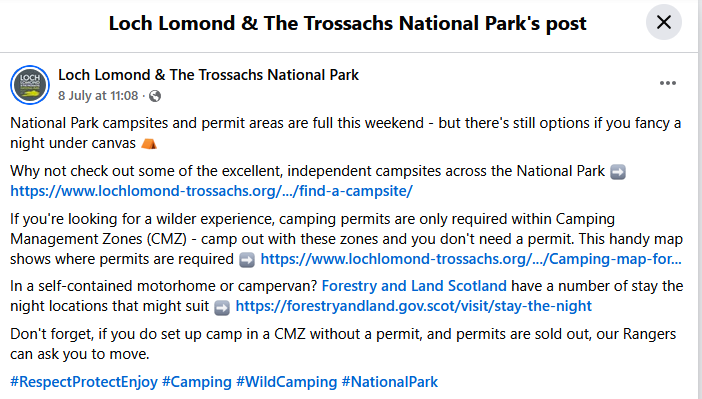
On 2nd July the Loch Lomond and Trossachs National Park Authority (LLTNPA) announced (see here) a 12 week public consultation on the camping byelaws which legally require to be reviewed every ten years. Six days later they announced (see here) that all the permit and camping places that had been created to enable the public to continue to enjoy camping by the loch shores under those byelaws were fully booked for the weekend. That was quite predictable, it happens every year when there is a good forecast but the LLTNPA has in 10 years failed to tackle the shortage of camping places in the National Park. Finding a place to camp wasn’t a problem before the LLTNPA removed access rights in the camping management zones
As I explained in March, Scottish Ministers delayed the implementation of the camping byelaws by a year to enable the LLTNPA to create 300 ‘new’ camping places, with the clear expectation that more would follow, but last year there were only 245 places for tents (see here). The LLTNPA’s consultation document (see here) fails to mention this Ministerial requirement and instead claims the number of camping places are outwith the scope of the review (see here);
This is not an accident. At the start of the year Sid Perrie, the locally elected member for Balloch who was subsequently suspended by the Scottish Standards Commission for Scotland for trying to expose the truth about the Flamingo Land application (see here), sent me slides about the review of the camping byelaws presented in a secret board session. They included this:
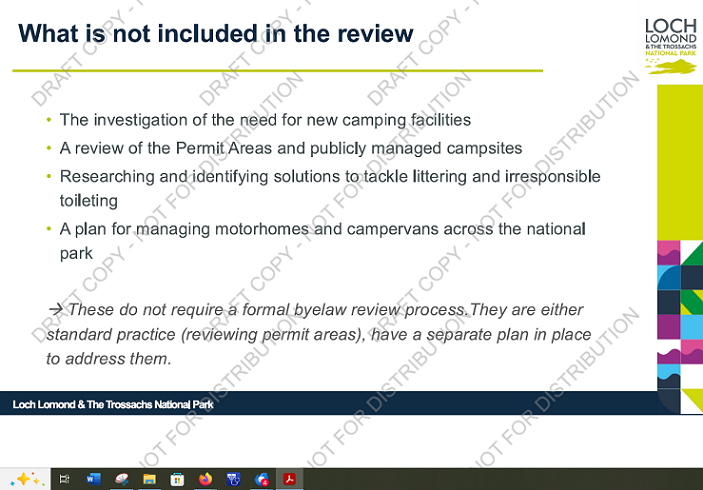
Sid told me that someone had raised the ministerial requirement to increase the number of camping places in this session but were effectively told “don’t be silly no one will remember that”. So here is another reminder of what Aileen McLeod said in her ministerial letter to then board convener Linda McKay:

Incidentally, I have driven up the west shore of Loch Lomond a number of times since March, most recently this week,and each time north of Tarbet there have been people camping along the shore where there are no permit places. It is welcome that the LLTNPA is clearly no longer enforcing the camping byelaws along a significant stretch of Loch Lomond – their main impact here was to victimise anglers and cycle tourers – but even the location of the management zones are, according to the LLTNPA, outwith the scope of the review.
Why then did the LLTNPA consult on what areas were to be included in the camping management zones originally? A case in point is that consultation resulted in the camping management zone along the west shore of Loch Lomond being extended to include the Beinn Ghlas campsite at Inverarnan at the owner’s request. This effectively forced West Highland Way walkers to camp there, so why are the public not being given another say on matters like that?.
The number of camping places, however, is so central to the impact that the camping byelaws have had on access rights that the LLTNPA cannot avoid it entirely. Hence their claim that:
“The number of camping spaces available has generally been able to meet demand from campers, except on very busy peak weekends. The permit areas and campsites have been considered full (over 90% occupancy) on average 20 nights per year.”
This completely misses the point. Most years the number of days most people want to get out and camp is very limited because of the weather – say about 20 days in the average year. What the 90% plus occupancy on those 20 days tells one therefore is that whenever there is demand for camping, the places where people can lawfully camp in the National Park are woefully short (a complete contrast to the Lake District National Park, for example). What happens then is that people who are concerned about being fined for camping in the National Park go elsewhere. Rather than chaning people’s behaviour, all the LLTNPA has done is displace problems, as far as they exist, elsewhere.
In the consultation the LLTNPA claims that there are high levels of satisfaction with the camping byelaws:
“Nearly 300,000 people have camped in permit areas since 2017, with satisfaction consistently above 90% and complaints down from 324 in 2017 to just 40 in 2025”
This claim is not compatible with its statement that “recorded instances of aggressive behaviour have more than doubled since 2021” and its proposal ‘to make it a specific offence to threaten, abuse or behave aggressively towards a National Park Officer”.
The LLTNPA claims this is “a trend reflected in many other public-facing roles across Scotland” without any critical reflection about its own practice or why there is now so much public anger about the way public authorities operate. The camping byelaws and the way the LLTNPA has been managing them are in my view are in large part responsible for this increase in aggression towards its staff. If people are camping in accordance with the advice in the Scottish Outdoor Access Code, which elsewhere in Scotland is quite lawful under access rights, its not surprising that if asked to move on for doing the same in the Loch Lomond and Trossachs National Park they get frustrated. All it takes is an officious ranger and an aggressive response is likely.
And, for those people out to confront authority anyway or committing crimes, it is not countryside rangers who should be addressing the problem but the police. Creating new powers for rangers rather than addressing the fundamental issues will only make the problems worse, not better. The explanation for the trend of increasing aggression towards public sector employees, which the LLTNPA blames for the problem, lies in the increasingly authoritarian ways in which they are being asked to act. Just as what has happened to my own profession, social work, the role of public sector employees is no longer to help people but to ration, control and punish. The LLTNPA is part of that problem and should not be allowed to escape responsibility for it.
The way to reduce aggression from campers is for the LLTNPA to stop managing their rangers like a quasi-police force and let them get back to the job that they used to do – but that would mean repealing the camping byelaws and the way the consultation is being manipulated shows they have no intention of doing that.

The point about Rangers being quasi police is no understatement.
That is exactly what they have become. Armed with cameras and other surveillance equipment they are empowered to progress fines.
How long before they are kitted out with personal protective equipment, tasers and the like. And yes, some of the Rangers are police.
Its not at all a pretty picture of what is supposed to be a national park. Quite the opposite.
But as the Sid Perrie story shows, something in the Kindom of Demark is rotten and will in due course be revealed.