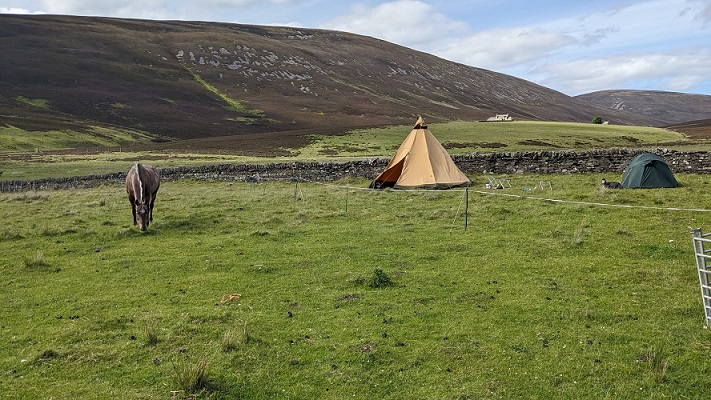
Walking back from Cook’s Cairn and Corryhabbie Hill in mid-June, I spotted shoeless hoof prints in Glen Suie and then a tepee and two horses in a field by the nearby estate bothy. I went over to have a look and got chatting to a woman minding the camp.
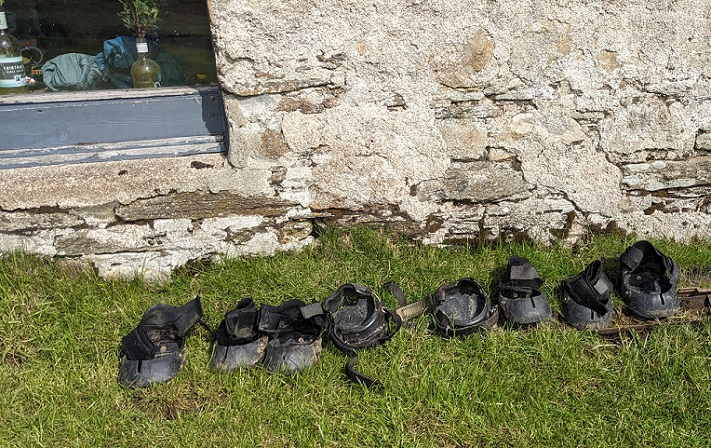
She was with two companions and helping to prospect a new route for a horse-trekking business. She told me the hoof prints were from a trip she had made two weeks previously through Glen Suie, which connects the Glenfiddich and Glenlivet estates, and then showed me the soft shoes used for the horses.
The trekking business offers people the opportunity to stay somewhere well away from any public road, in comfort and with all the gear carried by horses. From the camp, customers have the option to go off on a hill walk and the woman’s companions were checking those options out. While access rights cover access by horse and camping, the woman told me she always seeks permission for overnight camps from landowners – the horses need to be able to graze somewhere – who are almost always supportive. . It was a bit of an eye-opener for me not just about horse-riding and access rights in practice but how all aspects of a commercial trek are tested out beforehand. I am really impressed by the knowledge and professionalism
The woman then explained that her friend lived in the Cairngorms National Park and the business used to operate there but had been forced out by the fire byelaws which came into force this year (the upper part of Glen Livet lies outwith the National Park boundary).
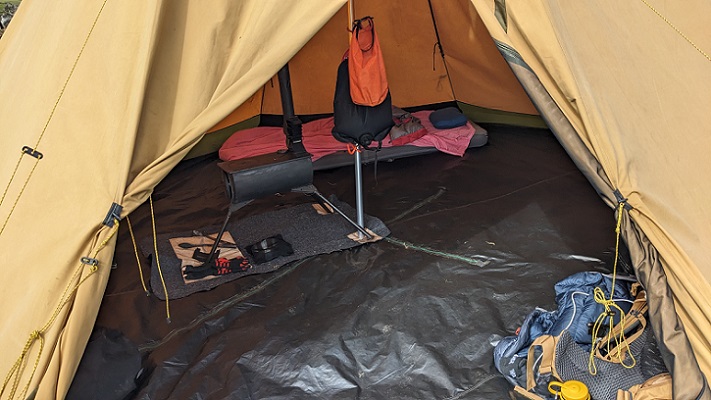
The Cairngorms National Park Authority’s fire byelaws ban not just campfires and barbecues from 1st April to 30th September but also wood burning stoves, such as the one this business uses to keep clients warm in the tepee, especially in the Spring and Autumn. Under the definitions used in the fire byelaws para 2e reads::
‘“Fireplace” means a structure (including wood burning stove) that is designed to contain a fire and is made of brick, stone, metal or any other material.’
Meantime paragraph 3 bans fires in fireplaces, as defined, except for bothies and other buildings which are exempt from the byelaws. The risks of outdoor stoves like this, if used properly, causing wildfires appears extremely low. The farmer clearly thought so too because he had brought in firewood for the group to use.
It was only then that it dawned on me who the woman was, Claire Alldritt. In 2022 Claire had taken her two horses on a 1000 mile ride across Scotland (see here). She had subsequently corresponded with me about access problems for horses in the National Park and sent me a short video she had make on the impact of Network Rail’s closure of the level crossing at Dalwhinnine on horse riders (see here). Riding into the Ben Alder area is now far more dangerous than it was before.
(Incidentally, there will be no chance to reverse this if the CNPA’s proposals to de-designate core path paths over private railway proposals, which are part of their current core path consultation (see here), are allowed to go ahead. What that consultation doesn’t say is the CNPA could have legally challenged Scottish Ministers ‘instruction’ but chose not to do so).
Claire then told me it was not just her friend’s horse trekking business which had been displaced by the fire byelaws but a kayak business too. The repercussions of breaking the fire byelaws for businesses and the landowners who grant them permission to stop off are potentially much greater than for individuals. Forced to operate elsewhere, they are faced with increased costs (e.g travel) and potentially to having to move home.
Besides local businesses, youth and other such groups will also be being displaced from the National Park. For anyone wanting to teach a group of young people how to light a fire safely in an appropriate place, there is nowhere to do so in the National Park, not even in grassy fields as shown in the top photos, or at times of very low fire risk. The fire byelaws are therefore displacing those – like leaders of trekking businesses and scout groups – who could teach others how to have a fire responsibility. The ban, being comprehensive, effectively destroys any opportunities for education within the National Park.
At the same time a significant proportion of those who don’t need to be seen to be ‘responsible, are unlikely to leave the National Park to have a fire, as I explained in my first post on the Glenmore fire (see here). All such people need to do is go out of sight, round the corner, where they are unlikely to get caught and fined. Where that happens it is likely to increase fire risks, instead of reducing them.
There has been almost no media coverage or public discussion about the displacement consequences of the fire byelaws or of byelaws in general. The Loch Lomond and Trossachs National Park Authority have always been in denial that their camping byelaws displaced people elsewhere. There is no mention of displacement in the current review of those byelaws (see here). and it was never properly considered by the CNPA in their fire byelaw consultation. Arguably, its the most important thing that needs to be considered before proposals for byelaws even get to the consultation stage.
This post has illustrated how byelaws force out just the sort of people and activities which any real National Park should be supporting. Conversely, where there are problems, these also tend to be displaced elsewhere. Displacement is almost never a good thing. A different approach is sorely needed and I will consider some possibilities, based on the thinking that lay behind the creation of access rights, in a future post.

Bans are rarely the best strategy…because it changes behaviour in ways that might not support the objectives. CNP might come to realise that the PR benefits of the ban will not be reflected in positive behaviour change.
Will asking people nicely not to light fires work? There’s a whole load of not nice people out there who don’t give a shit and who won’t change their behaviour unless they know there’s firm and visible policing with consequences to back it up.
We have a livebait ban that makes it clear that using live fish for bait is simply not on. It’s not perfect, but a least it’s no longer openly OK for people to move fish about. Such failures as there arem are due to inadequate policing and a complete lack of political engagement at Holyrood, even by the Greens. There’s a comity of inadequacy in both issues.
Honestly, they don’t need to light fires any more than anyone else. They may need to provide warmer bedding in the teepees, but it’s perfectly possible to stay warm while camping without a fire. It’s a bit of a ridiculous argument for not being able to operate in the Cairngorms park area.
Well, there may be case if it’s -20 and below in winter, but certainly not in this kind of summer
I have a similar set up, laavu and stove and was a bit shocked to find I was caught out as well. I don’t use the stove in the Summer but it is useful in the Spring.
Keeping the lum out of use and sight during daylight hours is probably the tactic should this be extended.
or just adhering to the no fires rule–simples. Spring is a high risk fire time. Do you think you should have an exemption and why?
Rules need to be rational – I will write more about this but currently, for example, the ‘rules’ allow muirburn, whether within or outwith the Cairngorms National Park, regardless of whether or not SFRS has issued a warning about fire risk.
Aye, the situation as at present is not rational. Are the rules there to protect a national asset or the interests of sectional vested interests?
It’s amazing how much heat a large candle can give off and one could be burned safely in a tent if placed in an open container–no sparks, no smoke, less weight, more room.