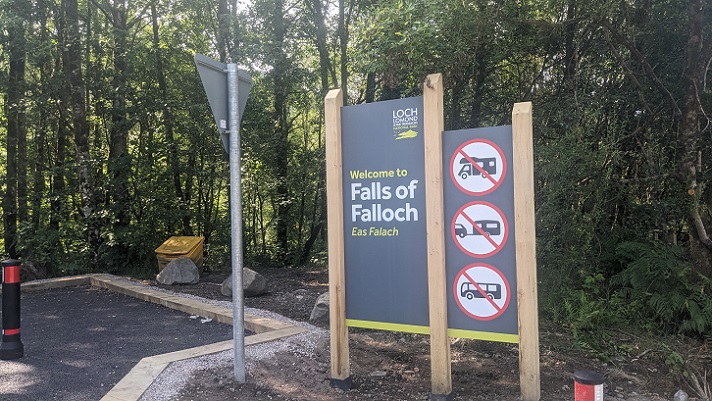
 Driving up the A82 in mid-July, before going to the Alps, I was surprised to see that the Loch Lomond and Trossachs National Park Authority (LLTNPA)’s works to ‘upgrade’ the Falls of Falloch car park, announced earlier this year and which I had blogged about in April (see here), were complete. Very few of the LLTNPA’s visitor management projects are completed on time but then, according to the planning documentation (see here), the Falls of Falloch project was originally scheduled for last year but delayed a year because of discussions with Transport Scotland about the junction onto the A82.
The car park ‘upgrade’ was not part of the LLTNPA “Place Programme” but funded through the Rural Tourism Infrastructure Fund which followed Covid. Its purpose, according to LLTNPA planning staff’s assessment of their colleagues proposal, was to “deliver significant improvements in road safety at the junction with the A82 which is in the public interest as well as reduce damage to tree roots and site biodiversity by better managing visitor footfall”.
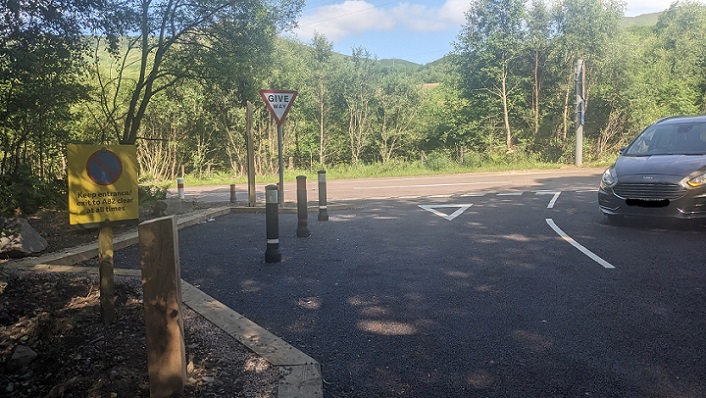
The junction to the Falls of Falloch car park has long been dangerous, it was hard to see and there was no filter lane for northbound traffic to turn right across southband traffic on what is the fastest section of the A82 between Tarbet and Crianlarich. The turning is now better sign posted and the entrance, which has been widened by 1.5m, is now more visible.
The design of the access road, however, means there is room for just two cars on either side before it narrows and is insufficiently wide for cars to enter and leave the car park at the same time. After we turned right into the entrance, we were unable to move further while the traffic jam caused by drivers trying to enter and leave the car park but this narrow road sorted itself it. Behind us another car was waiting on the A82 to turn right, and while they did so, northbound traffic piled up behind them. According to the planning report the original proposal included a “ghost [traffic] island” but this was removed “in favour of carriage way edge and give way markings”. Those marking don’t address the issue.
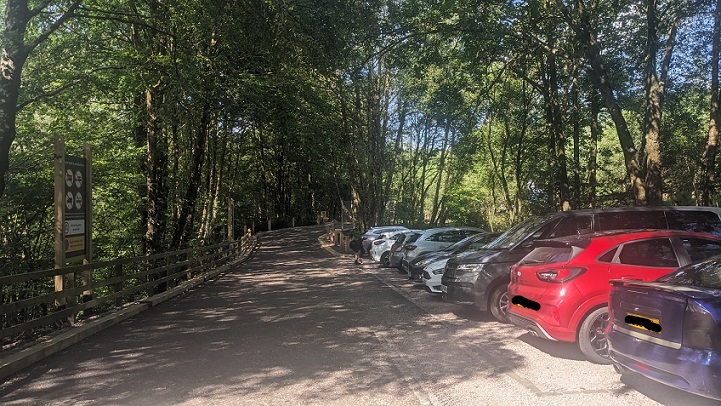
The new car park is supposed to provide nine spaces, including one disabled parking space. The parking area has been so constrained you can see why the LLTNPA has had to ban campervans and caravans. There is, however, also insufficient space to accommodate cars or to allow them to manoeuvre. As soon as two cars enter the the car park looking for a space but find none free, the who area becomes log jammed while people either wait for another vehicle to try and leave or themselves decide to try to turn around and leave the car park.
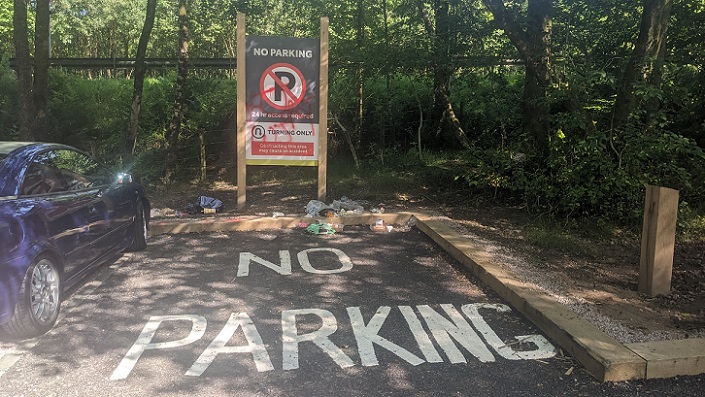
The problems are made worse by the very small area provided for turning at the end of the car park. Such a tight space might be suitable for a small private car park but not a busy public car park at an important visitor attraction. It did not take long for someone to express their displeasure at the quality of the provision.
The rubbish meanwhile is an inevitable consequence of the LLTNPA’s failure to provide bins. There is no toilet on the site either, although its quite predictable that visitors will need to go. A small composting toilet, such as I saw in Slovenia (see here), would have been the obvious solution. I pity its workforce who are then left clearing up the problems caused by their senior management.
The excuse given in the LLTNPA’s planning report (in effect they approved their own development) for the constrained car parking space is it needed to:
- Minimise the impacts of visitors on the existing sensitive woodland environment.
- Maximise opportunities to restore and enhance the site biodiversity.
There was very little justification for this. The Falls of Falloch car park and associated paths lie outside the woodlands in the glen which are designated as Sites of Special Scientific Interest and Special Areas of Conservation and the LLTNPA decided no Environmental Impact Assessment was required. There was thus no legal requirement to limit the size of the car park to avoid damaging trees, as they did, although there is a presumption in Scotland against removing native woodland. The area that would have been affected, however, is tiny and the LLTNPA is backing a large tree planting plan to “restore” nature just 2 km up the glen.
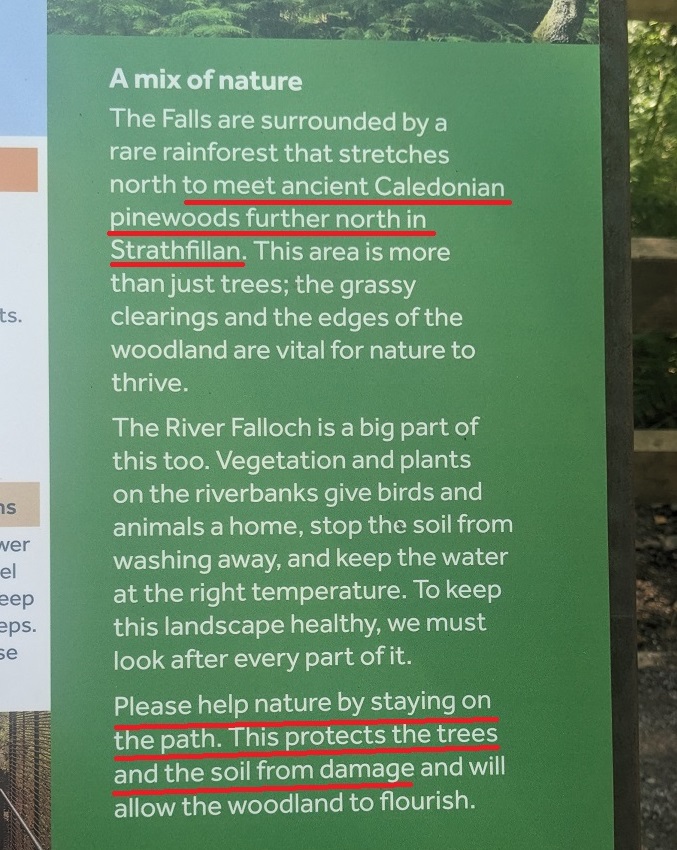
It is a major cause for concern that LLTNPA staff appear to believe what they describe as rainforest meets “ancient Caledonian pinewoods further north in Strathfillan”. The Caledonian pinewood remnant in Glen Falloch, the most southerly in Scotland, starts just beyond Derrydarroch. This is where the LLTNPA is backing TreeStory’s planting proposals which basically ignore Scottish Forestry’s advice on the importance of maintaining regeneration zones and buffer zones around the Caledonian pinewoods to enable them to expand naturally (see here). Given the extent of the proposed destruction further up the glen, the LLTNPA’s exhortations to people to keep to the path are just ridiculous.
If the LLTNPA had any interest in fulfilling its statutory duty to promote enjoyment of the National Park’s special qualities by the public it could have used Visit Scotland’s Rural Tourism Infrastructure Fund monies in very different ways. There is no doubt that the previous car park, sandwiched between the A82 and the River Falloch, was constrained for space and insufficient to meet demand. The solution to this problem was not to ban campervans and caravans but to create a new parking area or areas off the A82 (there are a number of suitable places within 500m including a section of the old A82) as an alternative to the double yellow lines that have been painted along this section of the road making it illegal for people to try and park elsewhere in the vicinity.
That, however, would have required the co-operation of Transport Scotland – who appear responsible for the decision not to widen the A82 by the car park to create a proper protected traffic island – and the Glen Falloch Estate.
Despite the claims in the LLTNPA’s planning report that one the aims of the development was to support “more sustainable ways of travel, both to and within the National Park”, the opportunity to create bus stops on either side of the A82, has been missed. In failing to do this, the LLTNPA has undermined their own National Park Partnership Plan and its own statement (see here) that:
“Part of the reason for the volume of cars is because large parts of the National Park can’t be reached any other way.This also means that access to the Park isn’t equal for everyone“.
It is also worth noting the LLTNPA’s excuse for not providing cycle parking facilities:
“Provision for cycle parking is not made however at present the site cannot be accessed safely by bicycle. This situation will be reviewed when future trunk road projects improve accessibility by bicycle.”
This is ridiculous, there is no ban on people cycling along the A82 and if the site cannot be safely accessed by bicycles, what does that say about safe access for cars?
The real agenda of the LLTNPA at the Falls of Falloch has been, as the planning application puts it, “to reduce visitor numbers at peak times”, however they travel. Hence the lack of any bus stop and the very small car park. The LLTNPA has deliberately constrained the number of people who can view one of the finest natural features in the National Park, cares not a hoot that tourists in campervans or with caravans can no longer enjoy the experience and appears to be relying on traffic chaos within the upgraded area to deter people from visiting “at peak times”.
The LLTNPA is a National Park that has long lost its way and is unaccountable to the public. The wonder is that Visit Scotland ever agreed to fund a facility that undermines rural tourism.
