Recently, while researching my post on the Loch Lomond and Trossachs National Park Authority (LLTNPA) local member elections (see here), I came across this revealing post on Linked In (see here):
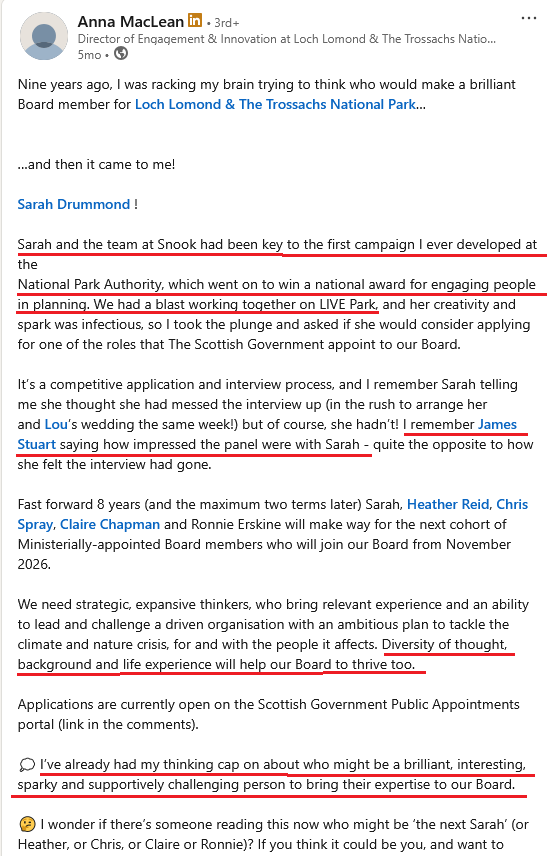
Having been writing for a number of years about how staff at the LLTNPA control board members (see here for example), I should have guessed that they involve themselves in who gets appointed.
It is also revealing is that Anna Maclean states that James Stuart, then Convener of the LLTNPA, fed back to staff about how Sarah Drummond performed at interview. That should have been none of staff’s business. One wonders whether Mr Stuart or other members of the interview panel also sounded out staff about candidates beforehand giving them further influence about who gets appointed?
‘Succession planning’, in which the leadership of an organisation chooses who will succeed them, is now commonplace. The Scottish Government’s Public Appointments system, however, is ostensibly supposed to promote equality and diversity on Non-Departmental Public Boards like the LLTNPA. Staff encouraging people who share their world view to apply to the board undermines that but from what Anna MacLean says – “I’ve already had my thinking cap on” – is still clearly going on
The dangers of staff ‘picking’ who they enjoy working with is well illustrated by the appointment of Sarah Drummond. Dr Drummond, as Anna Maclean states in her post, designed the consultation on the Main Issues Report underpinning the LLTNPA’s Local Development Plan (LDP). That consultation won the Overall Award at the Scottish Awards for Quality in Planning in 2015 for its innovative approach. The LLTNPA then secured another award in 2016 for the LDP itself (see here). The engagement on the Main Issues report and LDP resulted in just three objections to the proposal to allocate the Riverside Site at Balloch for Visitor Experience in 2016 (see here). Eight years later over 150,000 people had objected to the Flamingo Land planning application for that same site. With Sarah Drummond on the LLTNPA board, there was very little chance of it or senior staff like Anna MacLean ever reflecting on what was, judging by the numbers, the least effective planning consultation in Scottish history.
Unlike other senior staff, Ms MacLean has engaged with me in the fairly recent past and I have liked her for that but her post is an indication of the bubble the leadership at the LLTNPA inhabit. Neither she nor any of the board members linked into her post, which is still up five months later, can apparently can see anything wrong in officials encouraging people they like to join the board .
Anna Maclean’s statement that ‘Diversity of thought, background and life experience will help our board to thrive too’ is highly ironic given what has happened to Sid Perrie, the local member for Balloch. Sid, as regular readers will know, is neurodiverse and has now been suspended from the LLTNPA for six months (see here) for sending six strongly worded emails challenging the Flamingo Land planning process. One wonders how far Sarah Drummond’s involvement in the planning process which paved the way for the Flamingo Land planning application explains the lack of support from other board members for Sid?
One lesson is that when board members and staff get too close and are one ‘team’, as James Stuart liked to put it, the potential to hold officials to account publicly greatly reduces. Anna MacLean was right to say that the LLTNPA needs a different type of board member (see here), but she and other staff are not the people who will make that happen.
Senior staff have also indirectly been trying to influence who stands in the local elected member elections. They do this, as was recently reported (see here), by telling people who are considering whether to stand that their role is to represent the interests of the LLTNPA rather than the interests of local people who elected them. That puts many people off standing and is designed to prevent any more board members like Sid Perrie who were prepared to challenge what they do. Whether senior staff try to influence the elections directly, by encouraging certain people to stand, is a moot point but the evidence of Anna MacLean’s post – as Director responsible for communication she is only the messenger – suggests they would have no scruples in doing so.

I suspect that senior staf at the LLTNPA will see nothing wrong in recruiting sympathetic, ‘nice-to-work-with’ fellow professionals onto the Board that is supposed to scrutinise their own activity in the interests of the great unwashed public.
The concept of public service, accountability, transparency and meaningful representation from users of services seems to have entirely evaporated from some sections of civic office. Replaced by careerism, cosiness, marketing spin and a general aping of what these public servants imagine the world of ‘big-business’ looks and feels like.
For public servants who have gone down this rabbit-hole, the general public and the communities and environment where they live their lives have become an mere irritation. A barrier and problem that must be overcome to facilitate the deal-flow with developers that has become their primary concern. They are too busy cos-playing ‘important-executives’ to be bothered with uppity members of the public trying to preserve the natural environment. There’s money and status to be gained and ‘the public’ and ‘democracy ‘ are now a problem that needs to be bypassed.
This delusional way of working is very wrong. Aside from the moral, democratic and possibly legal arguments against it, they should not act like they are running a free-market commercial business for the simple reason that we as consumers, users, customers have no choice but to use what they offer. They are a statutory agency servicing a monopoly. There isn’t an alternative set of National Park authorities that we can choose if we don’t want National Park turned into a Theme Park. We, the public, are not in a ‘market’. We live here. No cooperation without representation.
1 Nick: don’t you dare apply! We need you on the outside.
2. Councils seem to operate in a similar way, even if staff don’t get to pick the councillors. Councillors are managed, kept in ignorance, and required to rubberstamp decisions taken by staff which they cannot understand. After a few years they give up because they can achieve nothing. They need training, independent researchers, to be listned to with respect, and have their ideas taken seriously.