 Last Friday, the day of the Scottish Parliamentary election count, the appeal by the locally elected member for Balloch, Sid Perrie, against the decision of the Standards Commission for Scotland (SCS) to suspend him from the Loch Lomond and Trossachs National Park Authority (LLTNPA) for six months for sending six emails (see here) was due to be held in Paisley Sheriff Court. Unlike the SCS, which refused to adjourn the hearing in February and found Sid guilty in absentia, the Sheriff Principal agreed to defer the appeal on health grounds. That is very welcome.
Almost immediately after that decision the SCS agreed to defer another hearing they had scheduled for June into a second complaint about Sid, this time by LLTNPA CEO Gordon Watson (see here for coverage in the Sunday Mail). When Sid is well enough to attend the appeal at the Sheriff Court, it will be interesting to see how SCS defend their decision to proceed with that case but not the second. The wider issue, however, is about how the SCS and the Code of Conduct for Public Life are being used by unelected officials and Scottish Government appointees to silence locally elected representatives, whether on National Park board or local authorities. The forthcoming local member elections to the LLTNPA provide a further insight into what is going on.
Arrangements for the 2026 local member elections to the LLTNPA
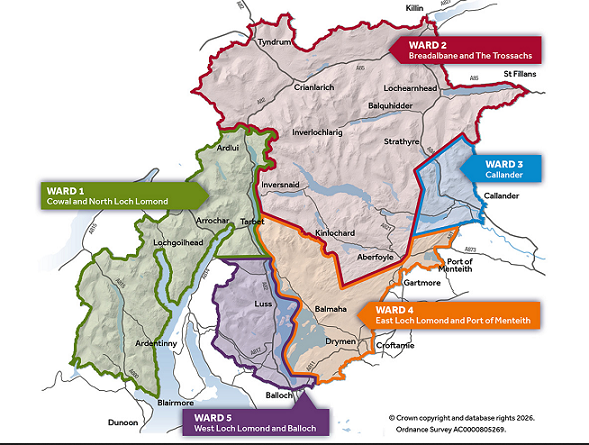
On Thursday (14th May) official notice of the LLTNPA Local Member elections will be published (see here). Anyone aged over 21 can put themselves forward as a candidate but people interested in doing so have three weeks, until Thursday 4th June, to gain nominations from 10 registered voters in the electoral ward in which they wish to stand.
Candidates are allowed to provide a 250 word statement which will be circulated along with ballot papers on 11th June. Ballot papers need to be returned by 4pm on Thursday 9th July and the vote, which is conducted on a first past the post basis, is then counted that evening.
The Natural Environment (Scotland) Act passed earlier this year included a section on National Parks but failed to reform the system for electing local members which I first argued was unfit for purpose eight years ago (see here). Among the issues are:
- 250 words is insufficient to enable any candidate to inform voters what candidates stand for;
- election expenses have not been uprated since the LLTNPA was created 23 years ago, are limited to £100 compared to £806 minimum for local authority elections and are insufficient to enable inform voters what candidates stand for;
- the first past the post voting system resulted in Bob Darracot being elected for the Cowal ward in 2018 wlth less than 17% of the vote on a 32.4% turnout (see here) i.e with the support of less than 5% of the total voters;
- a person needs to be 21 to stand for election to a National Park Authority but only 18 to stand as a local councillor.
Despite these serious issues neither the LLTNPA nor the Cairngorms National Park Authority boards have, to my knowledge, discussed the electoral system at a Board Meeting let alone made representations to the Scottish Government about the need for reform. Among other things this shows all the talk about the LLTNPA involving young people through their Youth Committee (see here) is hot air.
Just like four years ago there was nothing on the agenda of the LLTNPA Board Meeting in March about the elections. That is despite reducing turnout (from 32.5% to 31%), the falling proportion of women standing and the total number of candidates having reduced from 24 to 14 between 2018 and 2022 (see here). That is not an accident, the LLTNPA don’t want democracy to work better.
The LLTNPA’s approach to the 2026 local member elections
A short new section has appeared on the LLTNPA Board’s webpage publicising the dates of drop-in sessions for ‘interested candidates’ for the 2026 elections (see here). Those wishing to attend have to submit a registration form which allows officials to keep tabs on who might be standing. Three of the sessions are within 8 days of the deadline for nominations closing and one just two days before. This will make it extremely difficult for anyone who wants to find out more before deciding whether to stand to then obtain the necessary 10 signatures in time.
There is a link (see here) to another web page with more detail about becoming a candidate. This includes a couple of tokenistic references to local issues (‘access to affordable housing and joined-up transport’) while managing to be crass, confusing and controlling:
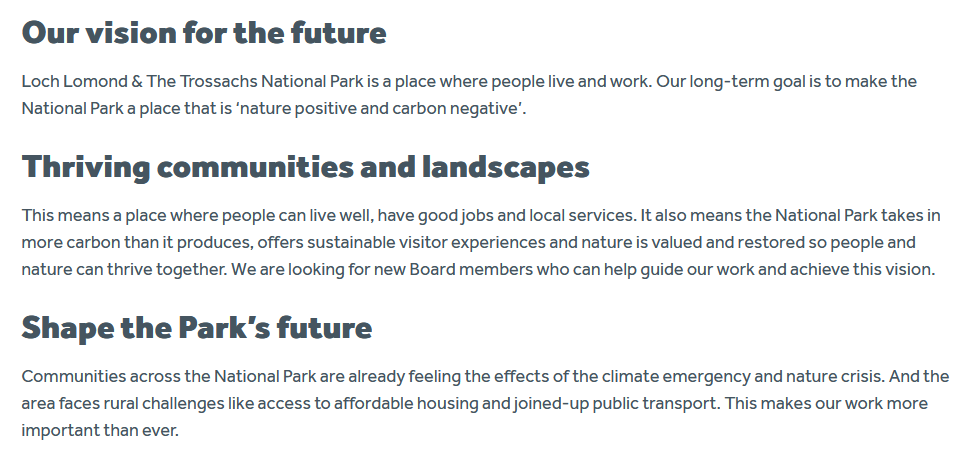 Crass: ‘Loch Lomond & The Trossachs National Park is a place where people live and work’, ‘this means a place where people can live well’ and ‘Communities across the National Park are already feeling the effects of the climate emergency and nature crisis’. Those crises have now been well documented for over 35 years.
Confusing: A vision for the future is not the same as a long term goal. And what does a National Park which takes in more carbon than it produces mean?
Controlling – ‘We are looking for new Board Members who can help guide our work and achieve this vision’.
As important as the vacuous vision is the misrepresentation of the role of locally elected members. National Park Authorities are different to other non-departmental public boards (quangos) because a third of their boards are democratically elected rather than being in the pocket of the Scottish Government. Officials have always had difficulties distinguishing the roles of elected and appointed members, hence the reference in the election blurb to ‘Five locally elected members (the focus of this recruitment)’:
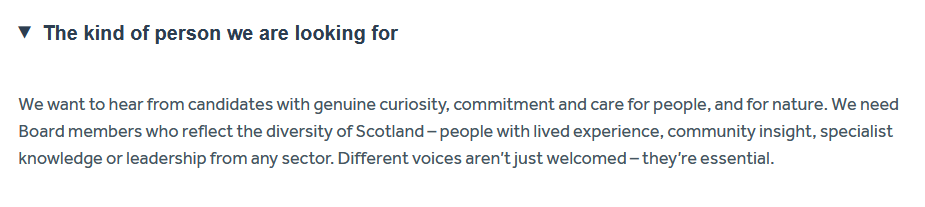
MSPs and local councillors are NOT recruited and no-one tells prospective candidates what type of elected representative the Scottish Parliament or a local authority is looking for – so what gives the LLTNPA the right to do so?
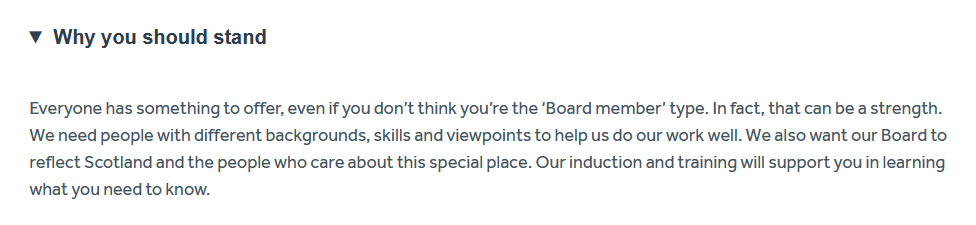
The claim that ‘everyone has something to offer, even if you don’t think you’re the ‘Board Member’ type’ and ‘that can be a strength’, should be judged by what happened to Sid Perrie. He stood out from the rest of the board by being neuro-diverse and speaking plainly as many working class people do, about what he thought on the Flamingo Land planning application and other matters. For that, he has been relentlessly bullied and suspended from the board.
The LLTNPA’s claim, however, also deliberately misrepresents the role of locally elected members. This should be to represent the needs and views of local people on the National Park board, exactly as Sid Perrie tried to do for Ward 5 (West Loch Lomond and Balloch). Instead, the LLTNPA blurb portrays the role of locally elected members as being to ‘reflect Scotland and the people who care about this special place’. Actually, its the role of the Scottish Ministerial appointments to fulfil that function.
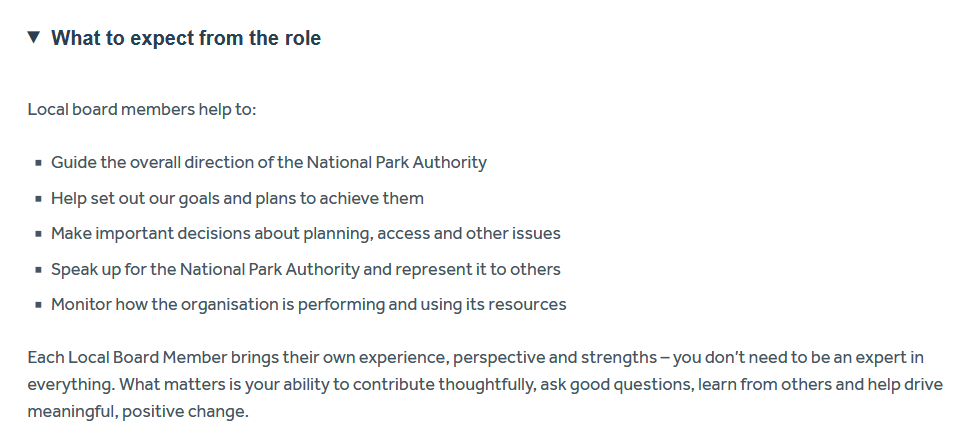
The LLTNPA then redefines the role of locally elected members as being to ‘Speak up for the National Park Authority and represent it to others’. This is the exact opposite of what locally elected members should be doing, i.e speaking up for local residents, representing their views to the LLTNPA, scrutinising what the Park does locally, ensuring strategies and plans reflect local needs and informing local people where this does not happen.
Discussion
This attempt by officials to change the role of locally elected members is new. Much the same words were being used eight years ago (see here). What is new is its now clear what lengths other board members and officials will go to silence locally elected members who try to speak out and how the Code of Conduct for those involved in Public Life has been weaponised to do this (see here).
Anyone wanting to change how the LLTNPA operates and who wishes to stand for election should therefore be aware of the considerable pressure exerted on board members to conform. This will start with the briefing sessions scheduled over the next few weeks and then, for those elected, with an induction process designed to persuade those elected that they are there to do the bidding of officials.
I hope people who want to change the LLTNPA will stand and say this in their 250 word election addresses but anyone doing so should be aware of the need for a wider support network, including among the public who elected them. Having supporters present at board meetings, for example, would have greatly helped Sid Perrie to feel less isolated. Developing such networks will be very challenging until all locally elected members have their own independent emails and phone numbers so they can be contacted by constituents like local authority councillors. Even better would be if the LLTNPA funded the costs of local surgeries.
Meantime, the ability of locally elected councillors and National Park board members will be helped if elected representatives like Cllr Fiona Higgins, who tried to expose attempts to cover-up education cuts in Glasgow, and Sid Perrie win their cases. The SCS employs lawyers to represent them at great public expense and Sid’s chances of success would, I believe, improve significantly with legal representation. If you haven’t contributed to Sid’s fundraiser (see here) please consider contributing if you can.
The position of locally elected members in parts of our National Parks is not helped by the rules which prevent MSPs representing people living outside the areas which elected them. By a quirk of the Holyrood election system, people living in Ward 5 have no SNP MSP they can ask to represent them. That is because once again Jackie Baillie won the West Dunbartonshire constituency and there are no SNP list MSPs in the West of Scotland. Whereas everyone in Scotland can, if they so wish, contact a Reform MSP, outside of Highland Region no-one living in a constituency which elected another party has any SNP list MSP despite the SNP being by far the largest party. The consequence of these rules is that no-one in Balloch has an SNP MSP they can ask to represent them on local matters, no SNP MSP has been allowed to get involved in Flamingo Land and Sid Perrie has had no SNP MSP he could go to for help. These rules have helped insulate Scottish Ministers from any internal party pressure to reform the LLTNPA and served to increase the power of officials further.

This piece raises so many alarm bells.
Sid Perrie was a local man, neurodiverse, a retried biology teacher with degrees in earth science and biology and a clutch of engineering certificates. Describing himself as a working class individual interested in representing his community, their rights and the environment, he has been pursued relentlessly by the National Park authority.
It is the behaviour of the National Park and their chief executives who are now on trial. Do they have something to hide, were they in the pocket of special interests, are they compromised. And how many hundreds and hundreds of thousands of pounds have they spent of taxpayers money pursuing Mr Perrie. When it comes to cover up and vendetta public bodies have effectively unlimited funds.
But you know what, and this is political, highly political, the Scottish Parliament is already looking in to abusive litigation process with a view to anti SLAPP legislation and protocols. For those in the know SLAPP is an acronym that stands for Strategic Litigation Against Public Participation. It is the big issue of the multi billion pound fish farming international conglomerate interdicting silence and freedom of movement because of an individual raising environmental concerns.
The Law Society of Scotland no less have expressed absolute support for the need to protect the small individual from the big beasts with the resources to brutalise the individual into silence. This is an issue that is not going to go away. The need for scrutiny and the ability to raise issues without the fear of being cowed into silence goes to the very heart of any so called democracy. It is a fight that needs to be won.
In the meantime, it would be fantastic that anyone who reads this piece might consider making a small donation or whatever they can afford to Sid Perrie’s fighting fund.
https://www.gofundme.com/f/sid-perrie-his-fight-for-balloch-and-loch-lomond-continues
Nick, I completely agree with your comments on the lack of democratic control of the LLTNP. Public officials do not like being under any control ,and this applies in the Park to local authorities (Argyll and Bute being one of the worst examples) and Transport Scotland seems equally untouchable (both the A83 and A82 in the Park). The reason for this note is your suggestion that Ward 5 is not represented because these is no list SNP for the area. In Jackie Baillie these constituents have one of the very best local MSPs and she has acted directly and publicly over Flamingo Land and over the A82. We would not have got anywhere in our fight to stop the ludicrous decision to keep the A82 down on the lochside without her help. The new parliament will mean a renewed fight.
Recently there have been any number of examples where local authority officers have been using assumed secrecy powers to show total “disregard” to the important ‘representation of the people’ role of locally elected councillors.
In one case full detail of the reasoning and accident statistic which were used to reach a (“bonkers” – my word – ) decision, have been constantly denied. This denial of background detail, is now said to be justified because the full time staff member who took the “traffic” decision on this matter has reported feeling intimidated.The officer is said to be Worried lest His/her identity be revealed. This has meant the matter cannot be independently assessed or subjected to full scrutiny, by those it most affects.
I refer to the matter of the “Bridge over the Atlantic”. Unwanted, unjustified traffic lights are currently being installed on either side of that 200 year old structure by Argyll and Bute Council. This despite huge local opposition. The local councillor at the centre of the issue who has used all means to try to obtain clarity, including FOI requests, has been cowed into effective silence under sanction of legal proceedings . Apparently today In Scotland an accusation, by those in position of central authority that an elected councillor has stepped beyond the limits implied for that locally elected role, entitles permanent council officers to do what they like?
This is surely not what Scotland’s newest data protection and privacy legislation was intended to achieve.
Last week, an elected LLTNP Board Member describeded thier dismay, at a well-attended public meeting, at being told by LLTNP officials, when first elected, that it is NOT their job to represent the interests of people from the ward that elected them, it is their job to represent the LLTNP to the people who elected them. Another Kafkaesque episode from Team Watson and Heather the Weather. Whilst Nick calls on good folk to stand for election, I would not recommend doing so, for the sake of your well-being.