After my post about how the Cairngorms National Park Authority (CNPA) no longer provides emails to board members on grounds of national security (see here) a reader sent me a link (see here) about board members on the Lake District National Park Authority (LDNPA). The LDNPA, like the CNPA, has a new website but seems to have managed to overcome the threats to national security and provides emails to board members. Not only that but it also gives the home addresses of board members and what appears to be their personal phone number. Check for yourself. There is one exception to this, the Independent Person, whose role I will consider below.
I last blogged about this three and a half years ago when James Stuart, the Convener of the Loch Lomond and Trossachs National Park Authority (LLTNPA), who had moved down to England, was also appointed to the LDNPA board (see here). I pointed out then that while Mr Stuart had refused to provide contact emails for board members on the LLTNPA he was quite happy to have one as an ordinary member of the LDNPA and had allowed them to publish his home address to boot. Instead of learning from down south (they are members of National Parks UK) CNPA board members have now, without a murmur of dissent, decided to follow the example of the truly dreadful LLTNPA and make it extremely difficult for the public to contact them directly..
The addresses given by the LDNPA board members reveal an interesting fact. All but one appears to live in Lancashire or Cumbria, i.e within or close to the Lake District. The one who doesn’t, a young woman called Juliet Bailey, was appointed by the UK Secretary of State and lives in Macclesfield. There is not one person on the board from further south or even from Yorkshire!
The Yorkshire Dales National Park Authority (YDNPA) does not give addresses for board members but down in Dartmoor the National Park Authority does. Those addresses (see here) show that, just with the LDNPA, the Secretary of State has appointed people who live locally. Contrast that with the LLTNPA where Sarah Drummond was re-appointed to the board even after moving to London. If in England they can recognise that people who live in or local to National Parks have all the skills and knowledge needed to represent the national interest, why can’t we do the same in Scotland?.
The contact details for board members published by National Park Authorities in England varies. Some provide addresses, most telephone numbers and but all provide email addresses. The Peak District NPA (see here) even has a facility for the public to download board member contact details as V-Cards. Interestingly, the YDNPA does not provide Park email addresses. Instead councillors use their local authority email addresses while all Secretary of State appointments provide personal email addresses (see here).
Regular readers will recall that Heather Reid, who succeeded James Stuart as the Convener of the LLTNPA, complained that Sid Perrie had committed very serious misconduct by copying the personal email addresses of board members (see here) to ‘variously Government Ministers, MSPs and the Community Council’ when trying to raise concerns about the Flamingo Land planning process. Dr Reid’s specific complaint about Sid Perrie, for which he has been suspended for six months by the Standards Commission for Scotland (see here), could never have succeeded in Yorkshire because those ‘personal’ emails are public anyway. It was also only possible because Scotland’s two National Park Authorities refuse to provide any means for the public or politicians to contact board members directly.
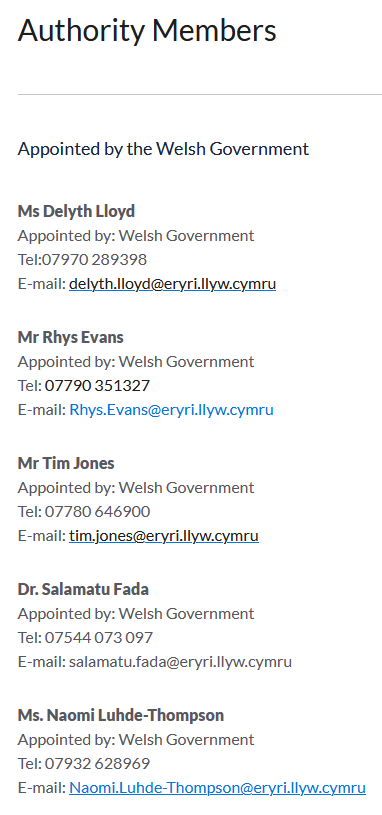 Practice in Wales, which has a devolved government like Scotland, is less radical than the National Parks in England. While both the Eryri (see left and here) and Pembrokeshire Coast (see here) National Park Authorities publish emails and phone numbers for board members, they don’t give addresses.
The Brecon Beacons, however, stands out for being like Scotland. You can only contact board members through staff (see here).
Last Thursday nominations for the LLTNPA local member elections opened (see here). The LLTNPA published a news release (see here) which stated ‘five positions are available’. Few people would describe elected representatives to local authorities or the Scottish Parliament as holding ‘positions’. Describing John Swinney as holding the position of MSP or First Minister sounds wrong and it is: he is elected and accountable to the people who elected him. But in Scotland’s National Parks its very different, once local members are elected they are deliberately cut off from their constituents by officials. That makes a mockery of the claims of those officials in the news release that ‘these elections an important and meaningful democratic opportunity’.
The news release goes on to state ‘The five locally elected members sit alongside six local authority nominees and six Scottish Government appointees, ensuring that local voices and lived experience help shape the strategic direction of the National Park.’ Neither the English nor the Welsh National Parks have directly elected local members – that is one thing that was supposed to make Scottish National Parks different – but in practice they appear to have far more local people on their boards so ALL board members have similar ‘lived experience’, whatever that is supposed to mean. And all those members – with the exception of the Brecon Beacons – are accessible to local people, unlike Scotland.
The Localism Act 2011 and Independent Persons
Much of the explanation for these differences between Scotland and England lies in the Localism Act of 2011. This devolved many powers to the local level, including for example planning powers, while Scotland took an opposite course. Keir Starmer’s UK Government is now reforming the planning system on the centralised Scottish model. The Localism Act, however, helps account for why UK Secretaries of State now look first to appoint people to National Park Boards who live within the vicinity.
Chapter 7 of the Act requires “relevant authorities’, which include councils and National Parks, to adopt Codes of Conduct which embed the Nolan Principles for public life. The requirement for a Code of Conduct is similar to Scotland (see here) but power over this is more devolved. It is the Local Government Association in England, rather than the Scottish Government endorsed by the Scottish Parliament, which produces the model code of contact for local authorities. This model code can then in turn be adapted further for local use, as the LDNPA has done (see here).
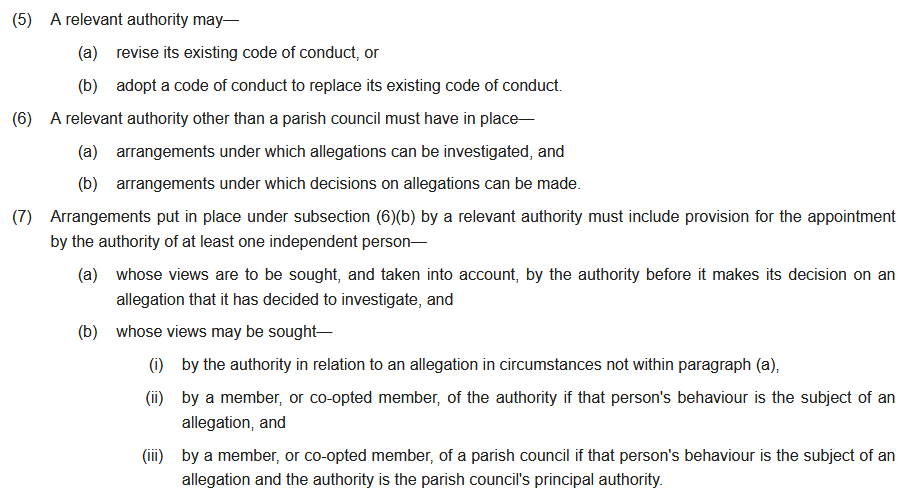
Another key difference between England and Scotland relates to how breaches of the Code of Conduct are investigated and determined. In Scotland, two centralised bodies accountable to the Scottish Parliament have been set up to fulfil these functions, the Ethical Standards Commission (which investigates) and the Scottish Standards Commission (which decides). In England Section 28 of the Localism Act (see here) devolves responsibility for the codes to the Relevant Authority but introduces a requirement for each to appoint at least one Independent Person to advise on the application of their processes and ensure they are not abused.
The Independent Person is the one board member for whom the LDNPA does not publish contact details:

While there are risks that an Independent Person, like other board members in Scotland, would simply do what they are told by officials, they could also potentially reform the rotten governance of our National Parks and help restore locally elected members to their rightful role. In Sid Perrie’s case, he had tried raising concerns about the Flamingo Land planning process with both James Stuart and Heather Reid without success (see here). When they refused to speak to him without staff present he could have gone straight to the Independent Person. Likewise when Heather Reid prevented Sid Perrie from raising his concerns at the June 2024 board meeting (see here) he could have asked the Independent Person to intervene. An Independent Person could have advised Sid on how best to raise his concerns and then intervened after Heather Reid had passed on his concerns about staff to those staff (see here).
Any Independent Person worth their salt would see that the the Nolan principles of openness, accountability and leadership in public life are meaningless unless board members can be contacted directly by the public. That may help explain the differences between England and Scotland. I have been unable to find any research about this or whether the Independent Persons scheme in England has helped people like Sid, whose request that every board member should be directly contactable by the public was also voted down by colleagues. Unfortunately in Scotland power is currently so centralised that if Independent Persons existed, they would almost certainly be wrapped up in bureaucracy and procedures which would prevent them from operating independently.
That is why we need a fundamental review of governance in our National Parks (and other public authorities) that starts from the bottom up. The experience from English National Parks and the Localism Act is important because it shows governance of Scotland’s National Parks could be far better than it is at present. It could also potentially be used by Sid in his appeal against the decision by the Standards Commission for Scotland to suspend him for six months but that would have far more chance of success if he had legal representation. Please therefore consider contributing to his crowdfunder (see here).

As usual, comes back down to not having a nationally owned national park, managed by a national park SERVICE to meet the criteria of a national set of criteria and accountable directly to a parliamentary Minister with a specific portfolio pertaining to it
A brilliant factual argument which could be hugely influential in overturning Sids kangaroo conviction and bring sunlight back to the way we manage our parks. This should be joyous transparent exercise, a source of pride and ,through nature, a font of mental well being for all : especially the poor and underprivileged.
With Flaimingo Land and Cairngorm Mountain we are loosing the plot a descending into a cesspool of secrecy ,bullying, political dirty tricks and corruption. For clarity, I don’t mean bribery or kickbacks, but undeclared disreputable agendas.
Sid was dangerous because he read Parkswatch.
An excellent post on a complex and difficult subject. The Scottish Government has created a centralised and controlling set of procedures covering our National Parks. Local democracy is the victim.
Another example of this centralised control is in the words describing the role of the CNPA Board from the website, which say, “The overall purpose of the Park Authority board individually and collectively is to provide leadership, direction, support and guidance to ensure the Park Authority delivers its functions effectively and efficiently, and in accordance with the aims, policies and priorities of the Scottish Ministers”. The key issue is the last part – in accordance with the aims, policies and priorities of the Scottish Ministers. Here is the centralised control of CNPA.
Frankly, our Scottish Minsters need to learn and understand what their aims, policies and priorities are from people who understand the issues in a National Park. The CNPA Board should be managing a centre of excellence in the National Park and providing advice to our Scottish Ministers to influence national policies and priorities. Scottish Ministers are the servants of the people, not the converse, but do Scottish Ministers understand this??
er, no, they palpably and purposefully do NOT understand this.
Totally agree with you, Ronald.