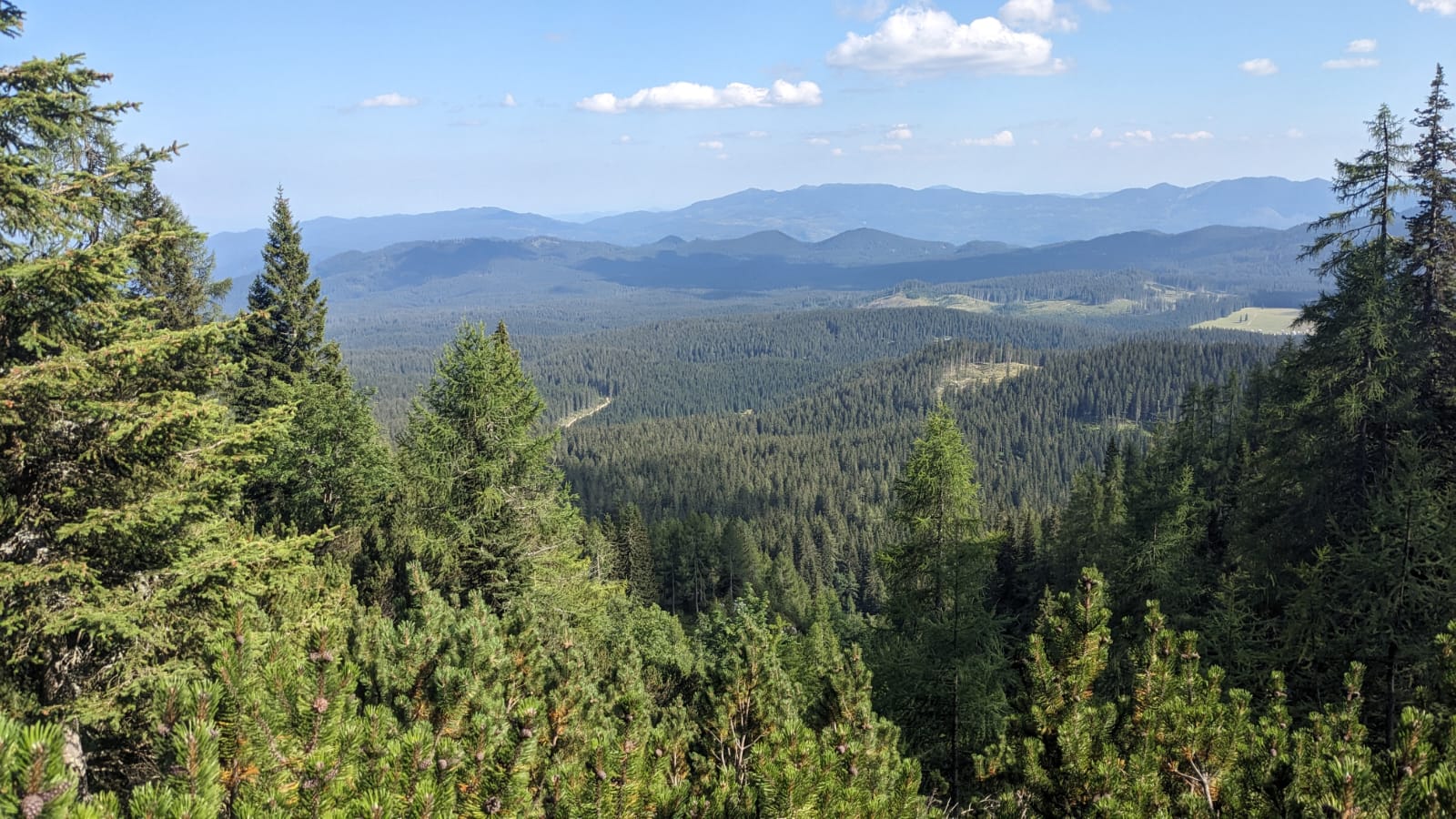
Walking up through the forest to our first hut below Debela Pec we had little idea if it’s extent until altitude started to stunt tree growth. Prompted by the Glenmore fire and Victor Clements post (see here) I wondered what would happen if a wildfire became established in a forest of this size and if it could be stopped?
In the past thr risks of wildfire in large forests like this – home to wolf and bear as well as capercaillie – was limited because of their natural characteristics. Trees trap moisture and wooded areas dry out more slowly than land without trees. Where vegetation is short, as can be seen in the photo, the differences are even more acute: parched grassland v green woodland.
The high proportion of deciduous trees, which are less flammable, particularly on the drier lower ground, offers further protection within the forest, while thunderstorms in the mountains help dampen the coniferous zone. The problem that is now affecting much of mainland Europe is that increased heat and long periods of drought are drying out many forests and overwhelming these natural defences against wildfire. In the the short term every tree that dies through lack of water adds to the dry fuel load.. This is making it ever harder to control wildfires once they become established in forests, as we are now seeing across Europe. That includes the wildfire that has recently broken out ion lower in the south west corner of Slovenia (see here)
Victor Clements’ post on the role of fire breaks after the Glenmore fire made many important points but unless those fire breaks can be kept wetter and greener than the surrounding woodland their effectiveness is likely to be limited. Although such breaks, as Victor pointed out, could facilitate access by fire fighters many existing breaks in commercial woodland in Scotland follow the lines of watercourses and are inaccessible to vehicles.
More specially, and contrary to the claims of grouse moor interests, using muirburn to reduce fuel load dries out the ground and promoted inflammable heather at the expense of greener vegetation, Prof Douglas MacMillan has shown how strips of muirburn appear to have done almost nothing to stop the spread of the Dava Moor wildfire (see here) while Andy Amphlett recently commented on how the public road also failed to stop the fire from spreading.
If the hotter and drier summers in Europe continue, the effectiveness of creating fire breaks within large forests may be limited and the very future of those forests at stake. Europe is facing an environmental crisis of massive proportions. While global warming is just as real in Scotland it’s impact is different. Our climate is still much cooler and wetter than much of continental Europe. That should make it possible for us to instigate nature based solutions to wildfire risk, which would not be possible in many other countries, such as rewetting the areas around woodland or using controlled grazing to create firebreaks as Victor suggested.
.

Well, it’s our fault not the forest’s and it’s up to us to mitigate our impacts. I note Andy Amphlett’s comment on even a public road with no vegetation on it failed to act as a firebreak, so I don’t see how a sheep grazed area would do any better. There is no place for exotic domestic stock in a national park which purports to put the primacy of nature first. There is however more credibility in using domestic cattle as a mimic for the Aurochs we exterminated. However a much better bet are beavers as exemplified in the photos I’ve sent you by email and hope you might integrate in a supplementary post
I have now shared this on Twitter/X with photos.