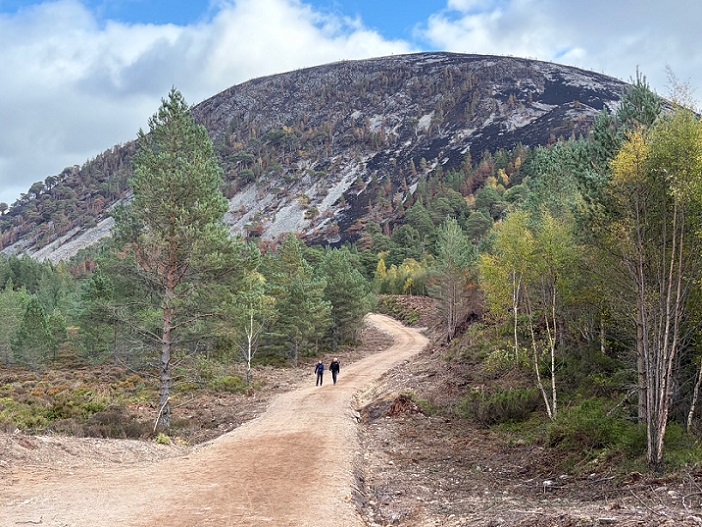
What has been the impact of the firebreaks in Glen More on the Caledonian pinewood?
By 30th July, Forest and Land Scotland (FLS) had created 6km of firebreaks in Glenmore (see here) as part of their efforts to contain and extinguish the Glenmore wildfire. As they put it:
“Immediate action was required and it was necessary to fell the trees without the planned care and due attention and diligence that is our usual practice. Many trees were just bulldozed to get them out of the way as quickly as possible.
To date it does not appear that maps of the new firebreaks have been published, although one was along the core path to the pass of Ryvoan. Most, if not all, will have been in the Glenmore Special Area of Conservation and Site of Scientific Interest (SSSI) and some will have damaged core areas of the Caledonian pinewood in Glen More.
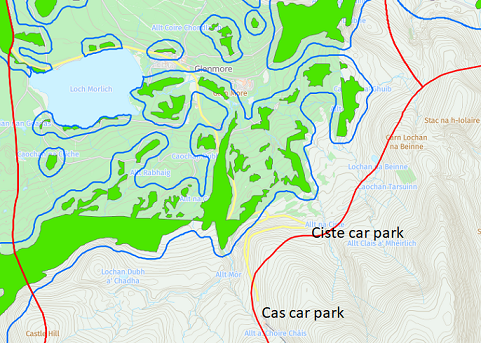
The Caledonian pinewood core areas are composed of Scots pine that are thought to be the ‘lineal descendants of those of early post-glacial times’ that have ‘regenerated naturally from
ancestors of like origin’ (Steven & Carlisle, 1959). They are very special indeed but their extent and worth is still being reduced by overgrazing, planting, invasion by non-native species and other land-management operations.
Until the wildfire, both the Cairngorms National Park Authority (CNPA) and NatureScot had been very resistant to any developments in the SAC/SSSI on the grounds that these would damage the Caledonian pinewood and harm associated species like the capercaillie. NatureScot’s list of Operations Requiring Consent for the SSSI (see here) includes:
“The destruction, displacement, removal or cutting of any plant or plant remains, including tree, shrub, herb, dead or decaying wood, moss, lichen, fungus, leaf-mould, turf etc.”.
That provides an almost perfect fit with what FLS said they did when the created the firebreaks!
Once the wildfire had been allowed to get out of control and turned into a major civil emergency there was clearly no time for FLS to seek consent through the usual means. The question, now, is why NatureScot’s most recent casework for the Glenmore SSSI is dated 2nd September 2025 (see here), i.e over a year ago, and why they appear to have done nothing to regularise the firebreak operations retrospectively, such as attaching conditions to the “restoration” work which took place along them once the fire was extinguished?
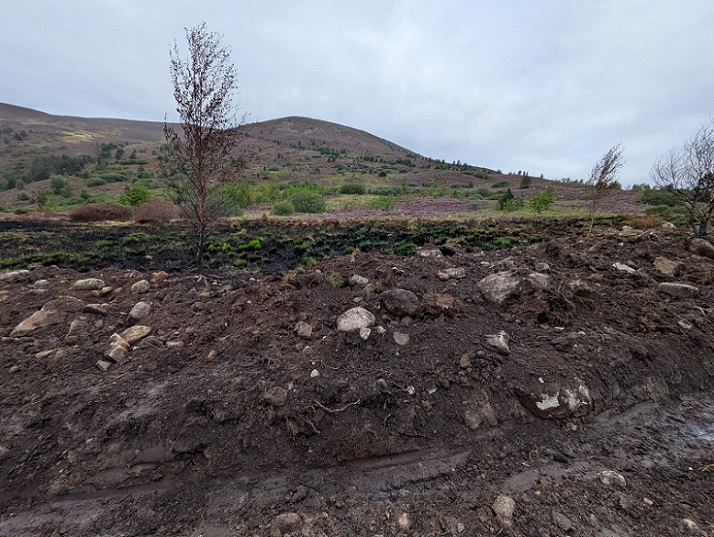
It is well past time that FLS published maps of the new firebreaks and reported on the extent to which they were effective in preventing the wildfire spreading. FLS also, however, along with NatureScot need to assess and report on the extent of the damage caused by creating them. That could then be compared to the impacts of the wildfire and, if both firebreaks and burned areas are monitored in future, would enable further comparisons to be made about how natural regeneration, including by non-native species, affects the two in future. Wildfire is a natural phenomenon from which the pinewoods in Glenmore and elsewhere have recovered in the past and it is possible that in the medium-term the creation of firebreaks could turn out to have the greater impact on the Caledonian pinewood and the species found within it than the wildfire which may have a regenerative effect..
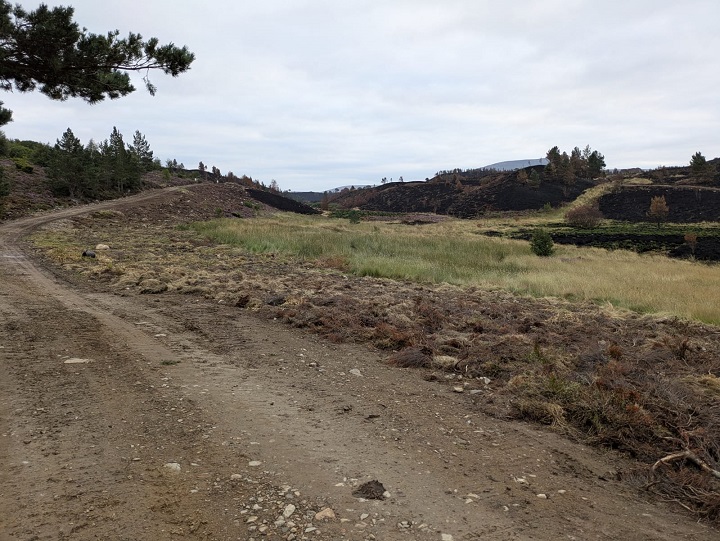
To date, however, our public authorities have given no indication that they are committed to reporting on the effectiveness and impacts of the firebreaks. This is another reason why a short independent inquiry is needed (see here). It also raises the suspicion that one the purposes of the CNPA’s unlawful Exclusion Zone (see here) may have been to prevent the public seeing the extent of the damage done to the pinewoods by the creation of the firebreaks until this had been covered up/”restored”.
The wider issue this raises is that before any public bodies decide firebreaks should be created in protected areas in future, whether to protect settlements or natural habitats, there needs to be a fundamental review of their effectiveness and impacts, followed by a debate on how firebreaks fit with both conservation principles and current approaches to conserving protected sites.
Compensating for the damage caused by the creation of new firebreaks
It is not clear at present how FLS hopes to manage the new firebreaks in future or what NatureScot might allow. One the one hand they could allow trees to regenerate naturally along them, enabling the pinewood to recover, on the other they could maintain them as firebreaks, chopping down trees as they become established. Whatever the case, the damage to semi-natural soil structures caused to natural and semi-natural soils by bulldozers is likely to be more long-lasting then the damage caused by the wildfire. NatureScot and the CNPA therefore need to require FLS to compensate for the areas of pinewood lost or damaged by fire fighting operations.
The best way for FLS to do this would be to accelerate some of their plans to restore the Glen More pinewood as set out in their Strathspey Land Management Plan 2021-31. These included proposals to remove non-native trees, such as Lodgepole pine and Sitka spruce, that had been planted in the Caledonian pinewood area:
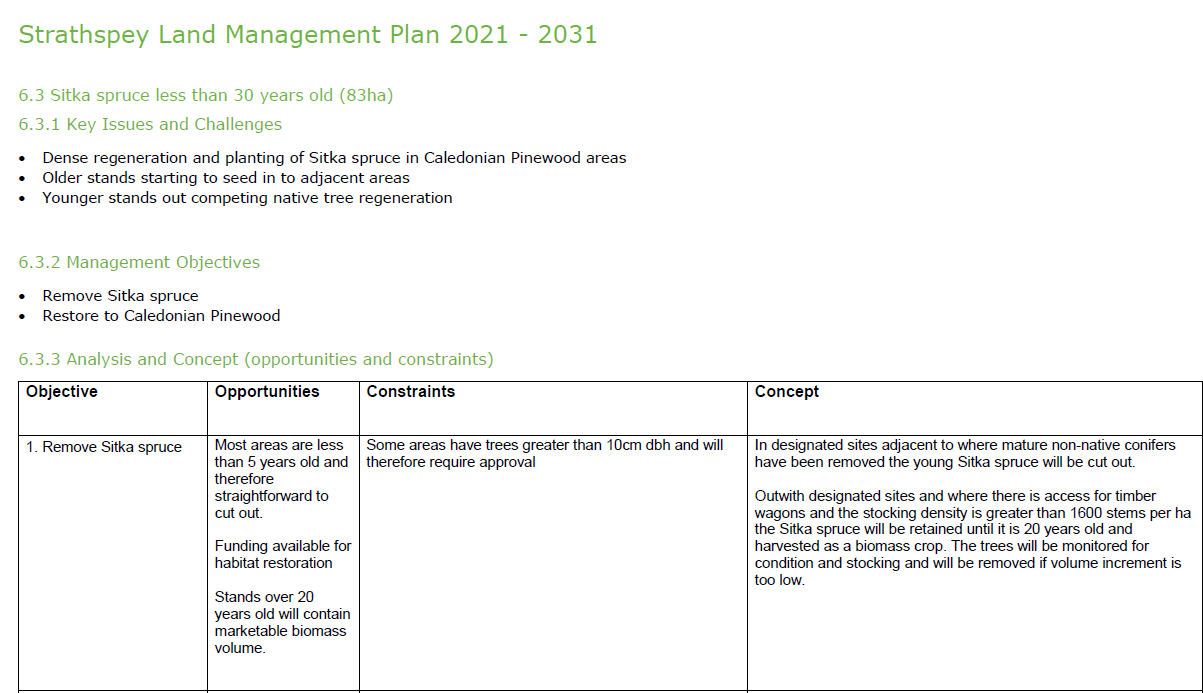
While some of these blocks of non-native trees described in the plan have now been removed, some remain. There is also extensive natural regeneration of non-native trees, both on plots where they have been felled and from mature trees scattered through the forest that have regenerated naturally in the past . The open and fertile areas created by the wild fire is likely to boost the natural regeneration of non-native as well as native trees, doing further harm to the pinewood. There is thus every reason for FLS to accelerate its programme to remove non-native trees from Glen More.
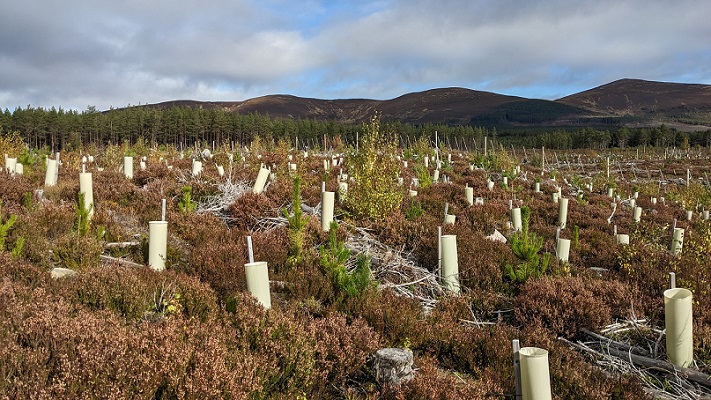
FLS, however, needs to avoid is repeating the mistakes it made in its disastrous experiment with Forest Research in the former McAlpine plantation at the west end of Loch Morlich. (see here). Planting native trees in cleared areas in straight lines, behind deer fences and in plastic tree tubes and then trying to boost tree growth through weedkiller, slug pellets and fertiliser is the wrong thing to do and causes further damage. Instead, where FLS removes non-native trees it planted in the past, it need to focus on restoring drainage channels created to promote tree growth, removing non-native trees for as long as they continue to regenerate.and keeping deer numbers down. Such actions would help compensate for the damage done to the pinewood by the construction of firebreaks and natural regeneration will then do the rest over time.
How should Scottish Government restoration monies be spent?
On 24th October the Scottish Government announced £1.3m of funding to “restore damaged habitats” including £150,100 for “nature restoration work” following the Glenmore/Abernethy wildfire (see here). This is a sop compared to the actual costs of fighting and responding to the wildfire and no details were given about who will receive the money and for what purposes. It may well end up getting used to plug holes that have arisen in budgets as a result of the wildfire.
The danger, however, is it gets used to plant trees so the Scottish Government and CNPA can claim to have done something to restore the damage caused by the wildfire. Our public agencies and most of our NGOs love tree planting because it is so visible. The CNPA and NatureScot need to rule that out now, as an operation that would damage the pinewood, and present the wildfire as an opportunity for nature to recover through natural processes as it has done in Glen More in the past (see here).
What would be good use of the £150k would be to increase deer stalking capacity to ensure that deer don’t destroy new natural regeneration in the areas affected by the wildfire, and weeding out non-native species which become established. That would probably require three additional people or c£150k a year for the next five years. That is five times what the Scottish Government has awarded.
