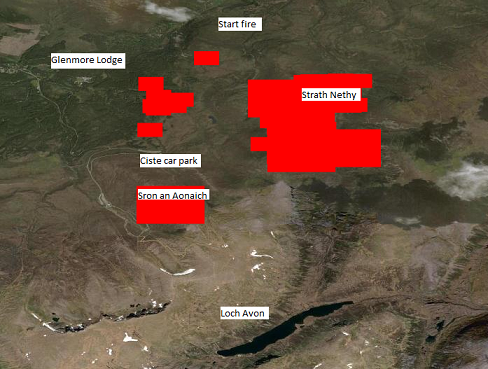
While efforts to contain the Glen More wildfire continue (see here) and have had some impact, it now appears likely only rain will extinguish it. In the last year the Cairngorms National Park Authority (CNPA) has approved fire byelaws, intended to reduce the likelihood of wildfires happening, and what was described as a ‘pioneering’ Integrated Fire Management Plan (IFMP) (see here) intended to improve the response to wildfires in the National Park.
This post argues the wildfire shows neither have worked and highlights some issues that need to be considered now, before the evidence disappears. It is not intended in any way to detract from the efforts that people on the ground have made to prevent wildfires or to fight this fire.
The cause of the fire and the CNPA’s fire byelaws
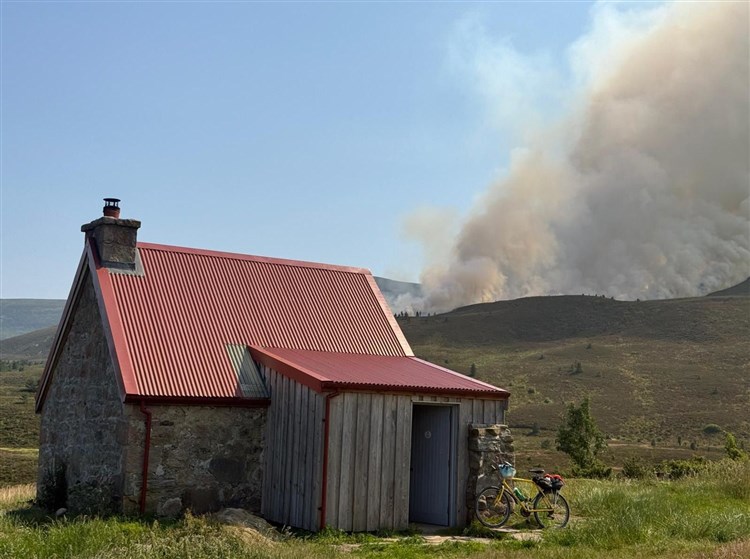
When the BBC (see here) and others started reporting a wildfire AT Ryvoan bothy, I immediately thought someone staying must have started the fire and started fearing the potential repercussions. In fact, as this photo and a video clip published by the BBC (see here) showed, the fire started almost a kilometre away by the track over to Strath Nethy.
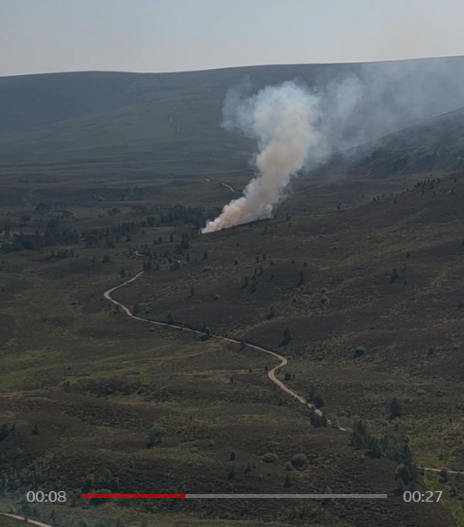
The Scottish Fire and Rescue Service (SFRS) were notified about the fire at 11.47 in the morning of Wednesday 15th July. The time and location suggest it is unlikely this wildfire was caused by either a campfire or a barbecue, both of which have been banned this year under the Cairngorms National Park’s Authority (CNPA)’s fire byelaws.
However, stranger things have happened than people lighting fires in out of the way places in the sweltering heat. With the CNPA’s announcement at the start of July (see here) that they were stepping up joint patrols with Police Scotland, including late at night, to enforce the fire byelaws it is possible that someone came out to Strath Nethy to light a fire or barbecue without being caught.
Whether that is the case or not needs to be investigated but points to the fundamental flaw in the fire byelaws. As the IFMP stated, “if the (fire) byelaw is approved then the Park Authority must ensure there is adequate resource, including training, to make its use effective”. The fire byelaws apply to the whole of the National Park for the period from 1st April to 30th September. That was always going to be far too big an area and far too long a period of time to police effectively whatever the propaganda about stepping up patrols. The CNPA should have learned from the amount of resources have been devoted, unsuccessfully, to trying to stop people from camping along the loch shores in the Loch Lomond and Trossachs National Park (a tiny area by comparison).
As importantly, to the extent that the CNPA does police the byelaws effectively, all that will happen is they displace fires and barbecues elsewhere. That is exactly what happened with the camping byelaws in the Loch Lomond and Trossachs National Park: Glen Etive, without any facilities, became a midden.
Such displacement adds to wildfire risks because, as we are seeing with the current wildfire, responding to them in remote places like Strath Nethy is far more difficult than doing so by the road in places like Glen More……….
……..but I digress

Muirburn, a more common cause of wildfires in the National Park than campfires, can safely be ruled out as causing this wildfire since it started on the the RSPB’s Abernethy estate and the RSPB don’t do muirburn.
The proximity of the start of the wildfire to the track, however, does suggest its cause was not natural and was in some way people-related, a cigarette possibly or an empty drinks bottle flung into the heather.
The point is that if we are to learn from this fire, the authorities need to establish the cause. The last thing we need in response to this wildfire is more ill-informed debate or calls for immediate action that results, for example, an extension of the CNPA’s byelaws to fires in bothies.
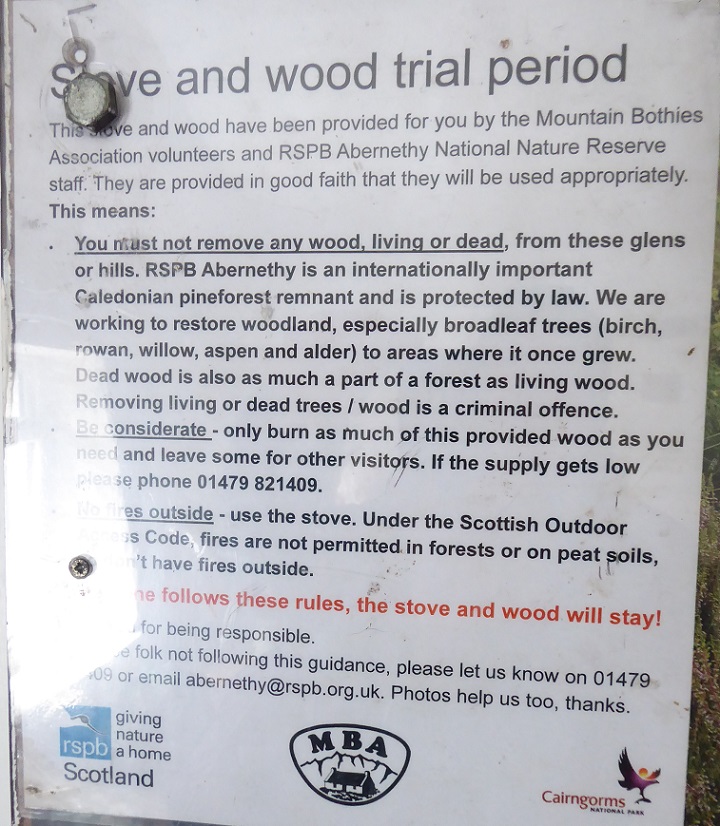
Some media reports altered what was stated in SFRS’ news release (see here), from the fire starting NEAR Ryvoan bothy – the best known landmark in the area – to reporting that the fire had started AT Ryvoan bothy. Such misinformation has already set hares running on social media.
All that is certain at this stage is that the CNPA’s fire byelaws, which were heralded as a means of mitigating fire risk (see here), haven’t prevented what has turned into the largest and most significant wildfire within the National Park since it was created. That deserves public consideration.
Will SFRS report on the cause of this wildfire unlike Dava Moor?
Unfortunately, since their provision of information on the causes of wildfires to the CNPA in 2024, the SFRS appears to have deliberately stopped keeping information on the cause of wildfires. A case in point are the two fires on Dava Moor which took place last year and were billed as Scotland’s first ever mega fire. Eyewitness reports at the time suggested the cause of the first fire, which started within the boundary of the Cairngorms National Park, was a flare. Despite the BBC reporting in July 2025 that the SFRS and Police Scotland had initiated an investigation into the causes of the fire (see here), nothing was reported publicly. It has then taken a number of FOI responses, first reported in the Scotsman (see here), for SFRS to admit – with lots of caveats – that the first fire was caused by a flare thrown from a helicopter.
I had not seen any information about the causes of the second fire, which started in the vicinity of Loch Allan on Saturday 28th June and which the BBC also reported was being investigated (see here), so I submitted an FOI response to SFRS. They replied on 22nd October 2025 (see here) and I have not written about that until now, Their response states:
‘Fire investigation did not attend this incident, therefore the IRS [Incident Reporting System] is the only information held. The SFRS hold not additional information’.
It does seem extraordinary that Fire investigation was not asked to try and establish one of the two causes of the first mega fire in Scotland. The incident report itself (see here) described the likely cause of the fire as accidental and lacks any useful information:
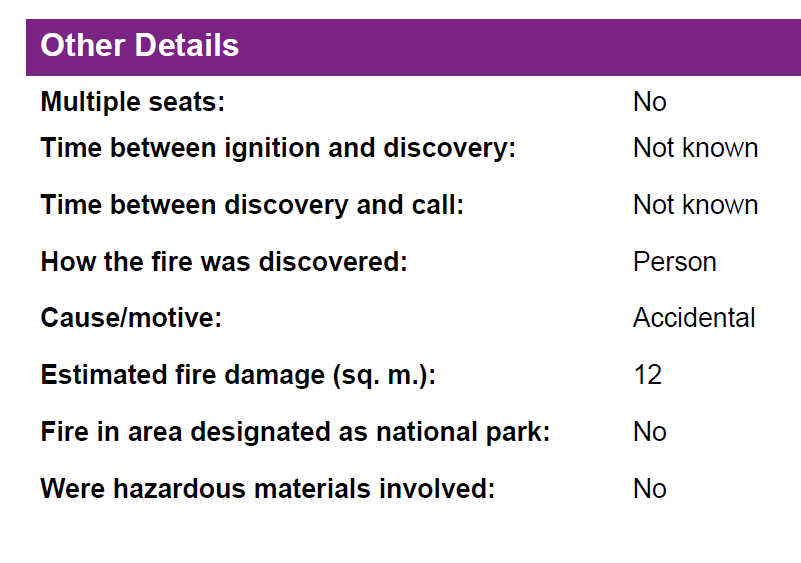 The estimate of fire damage recorded on the IRS, 12 square metres, appears ridiculous although the notes at the end of the IRS do qualify this: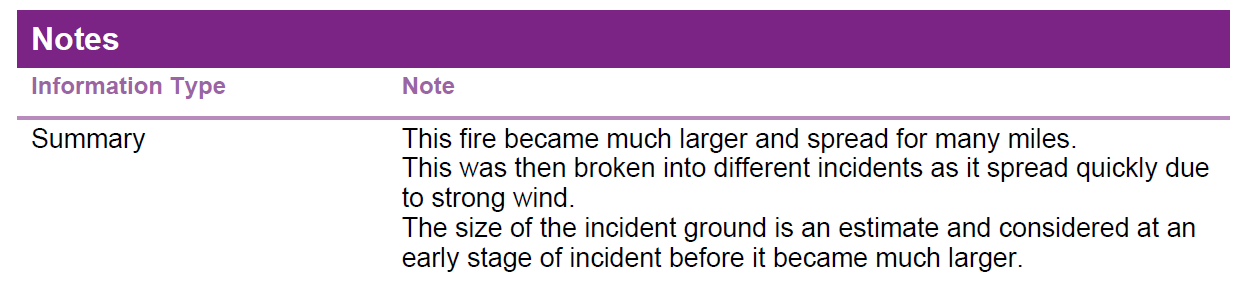
If the SFRS had time to record the fire when it was only 12 square metres in extent, it begs the question why they were not able to put it out. I prefer to believe that the 12 square metres recorded on the IRS is nonsense and that by the time SFRS crews reached the fire it was totally out of control.
Whatever the explanation for the absence of information, it is quite clear that the SFRS is failing to record the causes of fires. Th leaders of fire fighting teams always used to take notes and I am fairly certain they will have a good idea of what started the fire: the issue appears to be that SFRS’ management do not want this information to be recorded on the IRS and as long as they remain in private hands they lie outwith the scope of Freedom of Information requests.
The likely explanation for this secrecy is SFRS’ management wish to avoid being dragged into potential insurance claims and all the expense that involves. Scotland’s natural environment should be worth far more than that.
The Cabinet Secretary now responsible for SFRS, the justice secretary Neil Gray, whom the media has reported has been meeting their senior management about this wildfire, should insist that they now start investigating and recording the cause or potential causes of all wildfires starting with this one.
Mr Gray might also usefully ask the following question.
Could this wildfire have been contained?
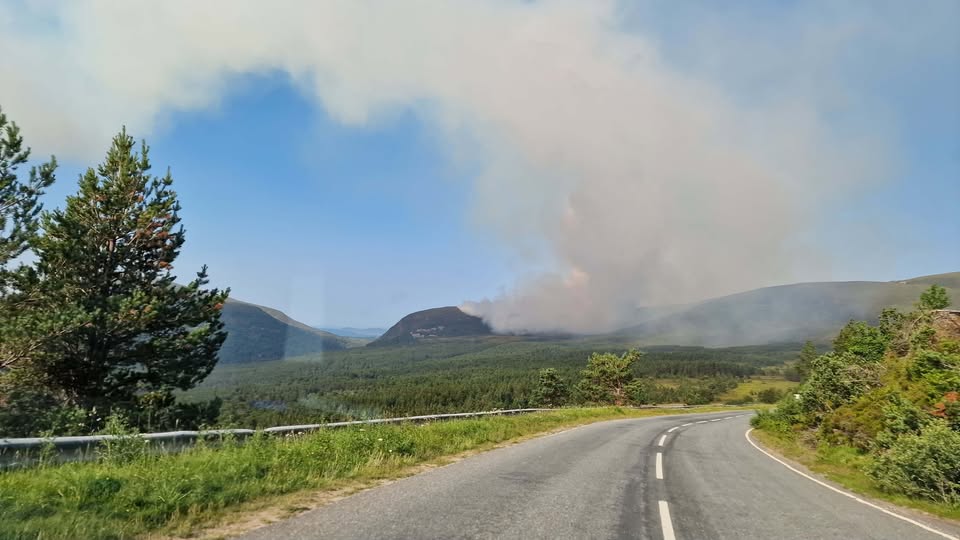
The evidence from photos and satellite data provided by NASA FIRNS and EFFIS (the European Fire Information system) suggests that the front of the fire expanded significantly once it had crossed over from Strath Nethy into the Glen More catchment.
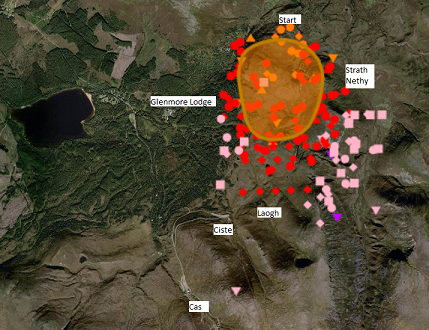
It appear the wildfire primarily burned through moorland at first – heather dries out very rapidly in a hot spell – but by Thursday it appears to have spread down into the main Caledonian pine forest in Glen More and by Friday (back) down into Strath Nethy. These developments made it much harder, if not impossible, to extinquish this wildfire. Forest fires are more dangerous and difficult to control while getting people and fire fighting equipment into very remote and trackless areas like the upper parts of Strath Nethy poses enormous challenges.
In its initial news release on the fire on Wednesday, SFRS reported they were deploying six appliances, one specialist wildfire unit and there was no mention of helicopters (see here). By Friday it was deploying ‘Nine fire appliances, two specialist wildfire units’ as well as two helicopters (see here). Added to that resource were estate staff, including gamekeepers from neighbouring estates, as provided for in the IFMP.
The gamekeepers have been reported to have been trying to create fire breaks, which may explain some of the isolated areas of fires recorded by NASA:
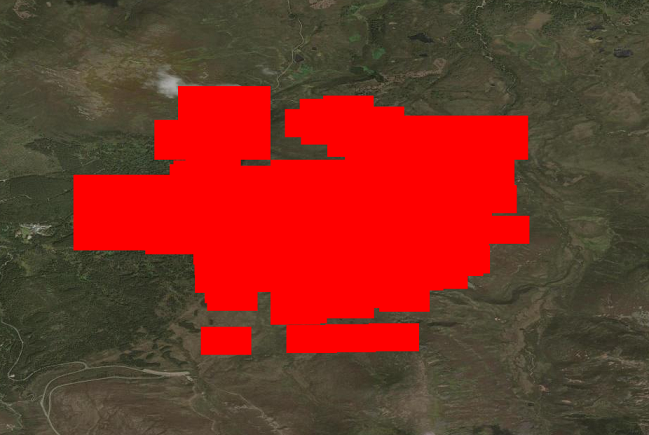
If that is the case, later data from NASA suggests the long fire break on the bottom right did not prevent the wildfire spreading south and east into Strath Nethy.
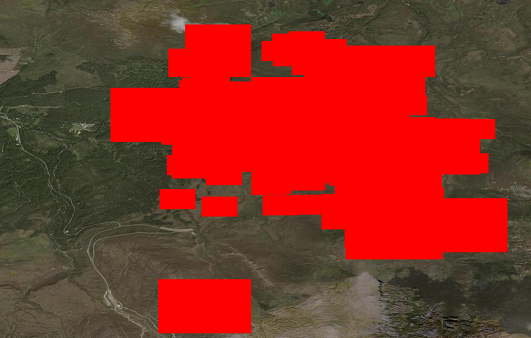
This is not to criticise people who were doing their best but it would be good to know why. Was it that some of the firebreaks didn’t work? Or was it that more were needed and there were not sufficient skilled people on the ground to do this?
The fundamental question, however, is not the efforts of volunteers but whether SFRS could have prevented the wildfire from entering the Glen More catchment if they had deployed more units and helicopters within hours of being notified of the wildfire?
Given the physical difficulties of accessing the area by vehicle or on foot and transporting water to fight the fire, it seems to me the crucial issue is whether helicopters – which many local people and the RSPB were calling for – could have stopped the fire in its tracks before its front spread out? And, if not two helicopters, how many?
The CNPA’s IFMP contains no concrete proposals for the deployment of helicopters, despite acknowledging that “wildfires may develop quite rapidly and there is limited time to refer to a
prescriptive plan” and shunts responsibility for paying for helicopters onto individual landowners:
“The use of helicopters, including the authority to request helicopter assistance and adequate insurance to pay for helicopter costs, are all important issues to consider.”
While it is quite reasonable that the IFMP expects landowners to put out fires for which they are responsible (including muirburn that gets out of control), it does not appear to me reasonable to expect landowners to pay for all the costs of extinguishing fires created by someone else (including neighbouring landowners). That should be a public function.
The CNPA’s IFMP states in relation to estate management plans that “the crucial issue here is the resources available to fight wildfires and the speed they can be mobilised” without mentioning the Scottish Fire and Rescue Service. Actually, the crucial issue is the resources available to SFRS and it appears it is this which accounts for why the CNPA’s IFMP has failed at its first major test.
Apart from looking at the causes of this wildfire therefore, it would be in the public interest for the SFRS to produce a report tracking its course with a focus on whether it could have been stopped before it spread out. Once they have done that Mr Gray should be a better position to determine what resources the SFRS needs to fight wildfires effectively.
The wider consequences of the wildfire
This wildfire has had significant consequences for among other things people’s health (smoke inhalation and closure of the most popular area in the National Park where people go to be healthy), the local economy (closure of local businesses) and conservation (the Caledonian pine forest, capercaillie, peat etc). I intend to write further about this but if we are to understand those consequences and learn from them, that also needs to be informed by facts and research.
If the CNPA is serious about conservation, for example, it should get together with others such as Forest Research (the research arm of UK state forestry), undertake comprehensive surveys of the damage done by the fire over the next few weeks and then commit to monitoring what happens over the next decade.
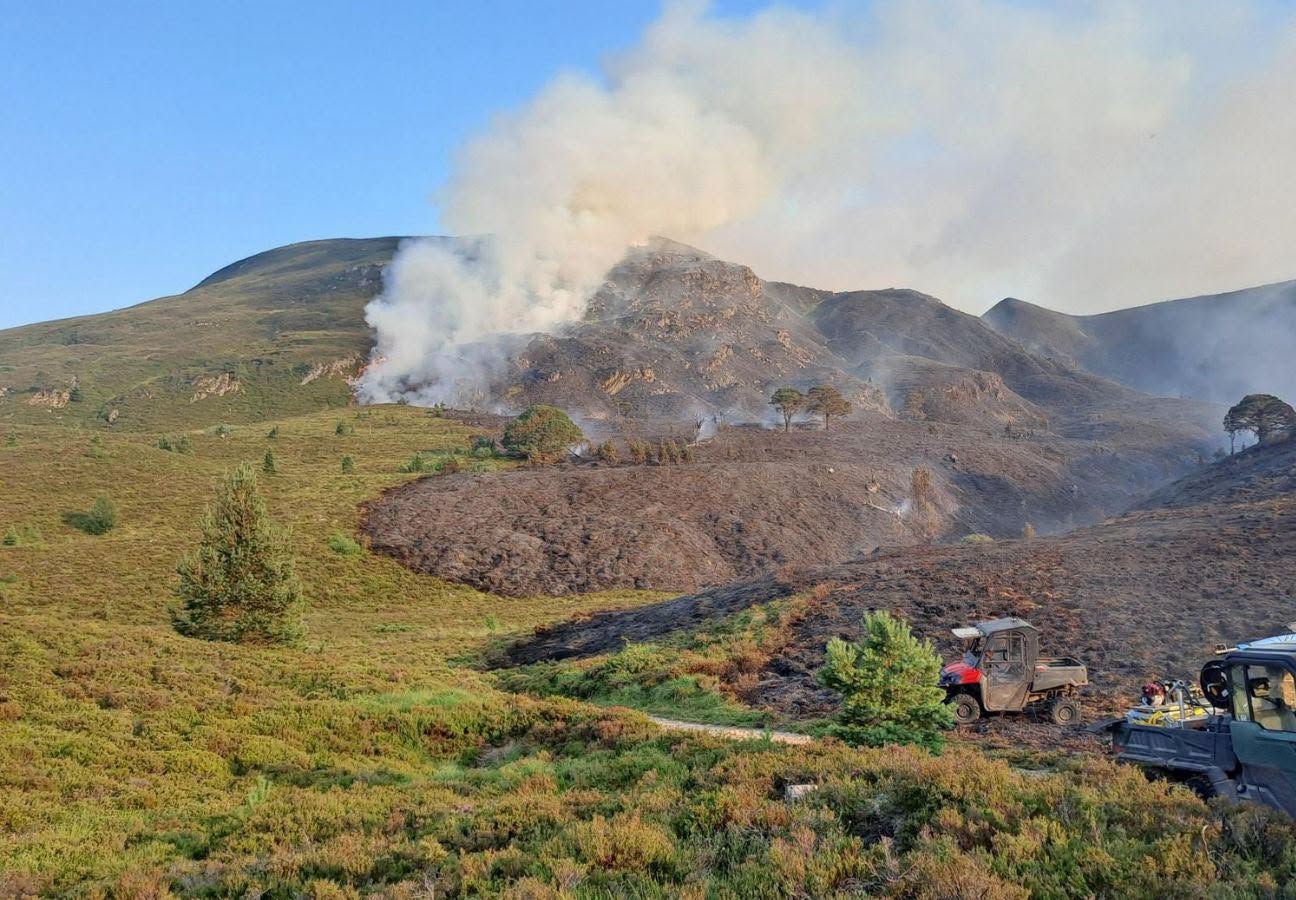
While some of the initial photos looked shocking, nature could yet surprise us. Fire has long played an important role in the regeneration of the Caledonian pinewoods. If this fire had taken place in one of the woods on the Caledonian Pine Inventory that consist of a few straggling mature trees, with the land round about overgrazed, it could have spelled the end. But the area affected by this fire has very low deer numbers and represents one of the best examples of woodland natural regeneration in Scotland, the reason why planting Coire na Ciste was such a terrible idea (see here).
With the Caledonian pinewood steadily expanding up the hill, as long as the fire has not destroyed too many of mature Scots pine it may have created conditions where they can regenerate far more quickly than previously. If so, that would not mean the destruction was a good thing, only that there may be hope yet. We need to learn from how nature responds to disasters..

We had a massive hot wildfire in the Forest of Birse in 2003 on an area with spreading pine regeneration. It was c 100 ha or so. Almost all the pines were taken out, but the area regenerated thick and fast, much denser than they were before. You can still see the line of the fire. On one side is Scots Pine, 5-10,000 per ha or more. On the other, scatted 30 year old pine growing in long heather, not a single additional tree since the fire. The deer density is obviously the same throughout. I might have a photo somewhere.
Most interesting Victor, both in terms of the deer densities not being reduced , what regenerated and where. Your post only mentions Scots Pine. What happened in respect of birch, willow and rowan? Photos would be very useful.
Excellent article, well informed and concise. Thank you.
Are you sure the damage reported was 12 square meters as not 12 square miles?
Indeed. Almost certainly a typo. 12 sq Kms would be 1200 ha or 300 acres, a better reflection of what actually happened.
Thanks for raising this and, yes, typos are easy to make so I can’t be sure. But the notes at the end of the record, which are included in the post, state that the fire became much larger and spread for many miles. That note would make little sense if the original report was 12 square miles when the estimates of the total amount of land burned by the two fires was c11,827 hectares (Scottish Land and Estate’s estimate) or c45.6 square miles. The important point here, however, is the official records kept by SFRS are sometimes, as in this case, of very poor quality, but even if the correct figures had been used they tell you almost nothing about the causes of the fire or what could be learned from it. It is that which I am arguing needs to change
……. or 3000 acres…… see how easy a typo is to make……
Aye Nick, the great semi-circumpolar Taiga forest is in large part fire structured and it’s not surprising that our western extension of it is quite naturally fire influenced, and would be, even if humans had never got here. We are however talking about multi-decadal, centurial and even millennial scale intervals between purely natural, true wildfires. This is a galactic scale difference from both the anthropogenic annual fires of the Balmorality Victorian-Edwardian Dystopia burning regime of the landed hegemony with its propaganda about ground-nesting birds and the Moronic Tourist Conflagrations of recent years.
Further your comment about the potential for regeneration on the bared, free from competition post inferno soil conditions is highly pertinent and one wonders if this will apply to other small seeded pioneer species such as birch and willow.
I agree there is all the difference in the world between occasional wildfires, which have in the past played a role in assisting pinewoods to the regenerate, and regular burning. We need to wait and see what happens on the burned area but a second wildfire in the same area would likely destroy much of the regeneration potential
Well, when we’ve got annual rotational burning that’s highly probable.
Compliments on another well researched and reasoned commentary, unlike the sensationalism of the social media.
Great article Nick. Raises important questions about the science supporting fire policy in the CNP. Recent analysis we did suggests that the main cause of wildfire in the CNP is not actually campers, but sporting estates. We found that only 9% of wildfire burns were likely caused by campers, whereas 71% were most likely caused by ‘muirburn gone wrong’.
The reason for the secrecy and lack of transparency, of course, does not lie with science, but in the realm of Park politics of which landowners seem to be in complete control of these days.
Regarding fire and regeneration I can go back to the 1980s and debates about the role of fire (in central and eastern Highlands) in the regeneration of pinewoods. At the Black Wood of Rannoch, poor regeneration rates of the ancient woodlands were thought to be due to the very thick understory of Calluna and the local forester wanted to try controlled burning to encourage it. He lost that argument due to the perceived risks. Not sure what the situation is now but at least one of your readers probably does.
Aye Douglas, comes back down to the land monopoly situation that neither the SNP, Labour or Greens will face up to, let alone do anything about and indeed seem to have been suborned by. A national park that is not owned by the nation is just an oxymoron. It is reached through Strath Chicanery and Glen Gerrymander. Just turn left at Castle McGrovel.
It’s telling that those with most to lose were unanimous in opposing the introduction of this Bye Law- the Landowners – private landowners & charitable & NGOs.
the NGO-Quangocracy are as much part of the land monopoly racket as the big private owners
I walked from Braemar to Loch Morlich on Monday and Tuesday having camped beside the shelter at Fords of Avon. The heat at the Fords at around 0830 was quite intense and the ground was very dry. What streams that existed were very low.
The only spot where wild camping was possible close to the fire is at the bridge crossing the stream at the bottom of the path coming off the hill where it joins the Land Rover Track heading towards Ryvoan/Green Loch. The area around the bridge is flat grass. Presumably, if that area is the source of the fire it will be possible to be clear once the investigators get to work. Any other site (say, in the midst of the vegetation on the hillside would suggest an alternative reason. The whole area was plastered with recent signs warning against lighting fires with a £500 penalty for culprits.
Hi Richard, thanks very much for this, it concurs with my memory which is that there are very few places along the section of track where the fire started where anyone could camp. As you say it should be quite possible for SFRS to establish if the fire started at the one camping spot you saw………………..
Aye, Richard, ‘culprits’ is a good choice of word, because these fires are quite simply caused by people. We only have a fire management problem because we have a people management problem. There are only 3 options; more education, more punishment and less people.
What about the torching of Radical Road in the centre of Edinburgh? How many fires have there been under HES’s care?
Back when I was doing my PhD on peatland restoration at Manchester Uni in early noughties, I had a lot of involvement with the Moors for the Future partnership (still going I think) who were spending a considerable amount of time on education and patrols in the Edale and Bleaklow areas, regarding cigarettes. They would patrol with plastic bags and anyone spotted with one, would be told to extinguish it and put in it their collection bags, and then given a brief talk on why to not smoke on peatlands. In such a populated area where many of the visitors aren’t your traditional mountain-sport folk, so not well-informed about codes of practice, this was an attempt to fill a gap and I think it has been largely successful, although needs modernising and revisiting for Gen Z after the current wildfires and people setting of firework!?!.
I think the CNP needs a similar approach and has simply been caught napping, regarding the types of visitor to the park these days, which much like the Peak District, isn’t just outdoor-sport folk but those just out to enjoy the scenery and who won’t be as clued up on wildfire issues. I don’t think it would be difficult to train and pay some staff to reside in the Car Parks, bus and rail station to engage with the public after all everyone has to access the park from somewhere and its harder to ignore an actual human being, than a Facebook or TikTok post.
“The proximity of the start of the wildfire to the track, however, does suggest its cause was not natural”
You cannot make that assumption.
A fire starting next to a track is consistent with an anthropogenic cause. But so also is a fire which starts 500m from a track. Or a kilometre. Or two kilometres. Tracks will see the most footfall but people wander all over the Cairngorms.
A fire starting next to a track is also consistent with a natural cause. As is a fire starting 500m away, 1km, etc.
That’s really all we can say. We’ll probably never *know* what caused the fire and we must be careful not to raise mere speculation to the level of reasoned deduction. The wrong kind of people may draw all the wrong conclusions and propose draconian measures which ultimately don’t help because they don’t actually address the real causes.
We’ve already seen this to some extent with the new fire regulations. Blanket bans which (as you have mentioned) are impossible to enforce are a kind of beaurocratic stupidity. If you think people are the problem then you must make an effort to educate them in the ways that fires start (tinder, kindling, fuel). No-one is doing this.
By using the word suggests I was trying to avoid assumptions. I disagree with you however that the location of the fire is an irrelevant consideration when it comes to it’s cause. If this fire had started at the bothy that would have greatly increased the likelihood a bothy user started it. The fact it didn’t made this a very unlikely cause and having checked I am now 99.9% certain of that. While SFRS haven’t yet investigated the cause they should at least try to establish the cause, narrow down the range of possible causes (eg if there is evidence it wasn’t a bothy user or broken glass they should say so) or clearly state they cannot say anything useful.
When CPNA were considering regulation I contributed that I was involved in MBA maintenance in NW Scotland, and occasionally I did find ‘fire pits’ with a ring of stones, within walking distance [ I would then hurl into the bog ]
This may not be relevant, but it is possible that good weather itself encourages outdoor living, and the good old camp fire is part of this.