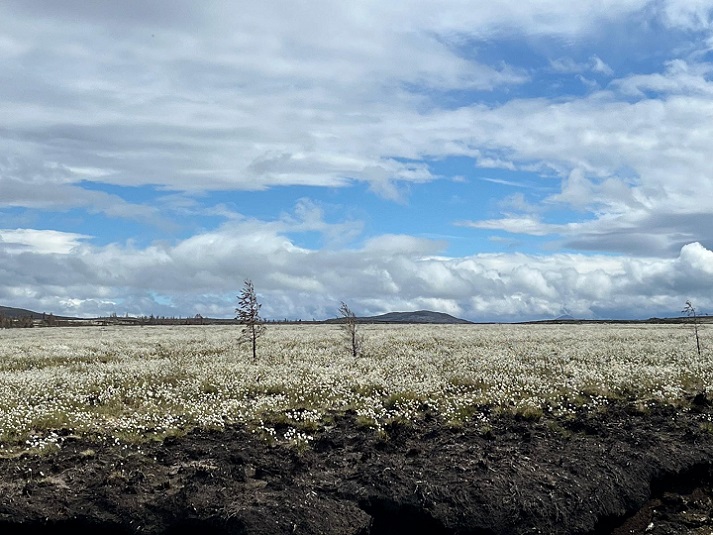
Eleven months after the largest wildfire ever recorded in the British Isles burned large parts of Dava Moor, hare’s tail cotton grass has expanded to cover much of the exposed peat. Out of destruction a scene of beauty!
Carbon emissions from peatland are estimated to add c3.5% to the UK total. Bare peat, some of which is a consequence of natural processes and some of how the land is managed, is held to be responsible for most of these emissions. When exposed to the air, the surface of peat dries out, oxidizes and decomposes, releasing CO2 into the atmosphere. It is therefore the focus of much peatland restoration work, as this UK Parliament research briefing explains see here), with the Scottish Government allocating £250m over ten years to re-wet and cover up areas of exposed peat.
While this official narrative ignores the impact that planting trees has on carbon emissions from peatland (see here), the photo shows that cotton grasses can do the job of covering up bare peat for free. This post takes a look at the implications for peatland restoration.
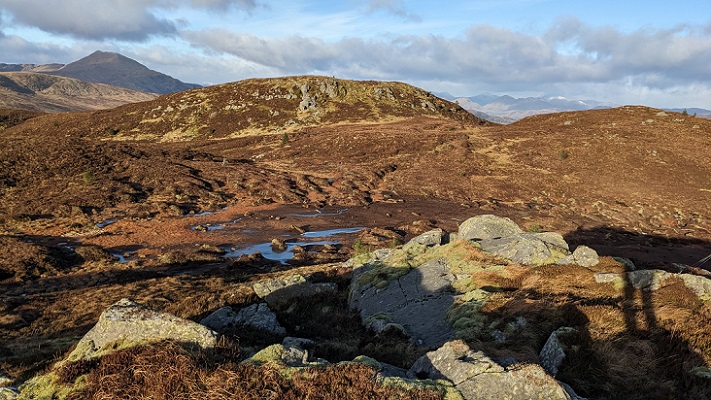
In January, I went to look at the Royal Scottish Forestry Society’s peatland restoration project at Cashel (see here), overseen by the Loch Lomond and Trossachs National Park Authority (LLTNPA).
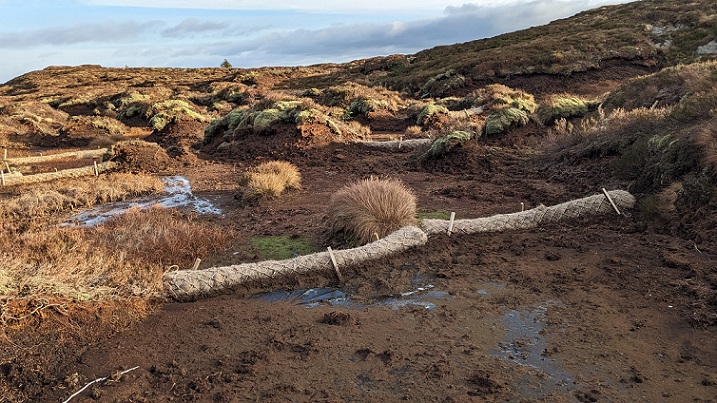
Despite extensive engineering, the re-establishment of vegetation over the areas of bare peat so far appears to have been limited and far slower than Dava moor. I could not tell if the flat vegetated area on the left of the photo pre-dated the engineering or was a consequence of it. The animal tracks, however, told a tale.
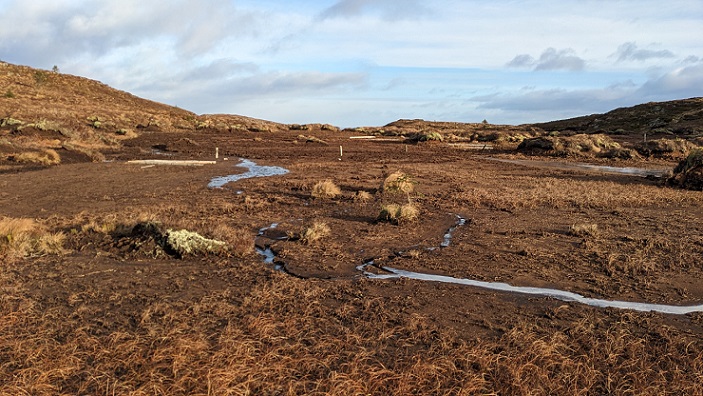
Although watercourses do erode peatland, this is a natural process and the area affected is usually limited to their banks. The broad expanse of bare peat on the this col suggests most of the erosion has other causes and that is most likely to be grazing and trampling by animals.
Erosion of bare peat by rain, wind and frost heave often wipes out hoof prints or boot prints, but there were enough tracks across the peat to indicate the number of grazing animals remains high. That could explains why cotton grasses are taking far longer to become established on Beinn Bhreac than Dava Moor. (It is also possible the ash from the fire pump primed the explosion of cotton grass there).
Last year NatureScot issued new guidance (see here) on the potential impact of herbivores pm peatand, describing deer density of over 10 per square km as high risk and 5-10 deer per sq km as medium risk:
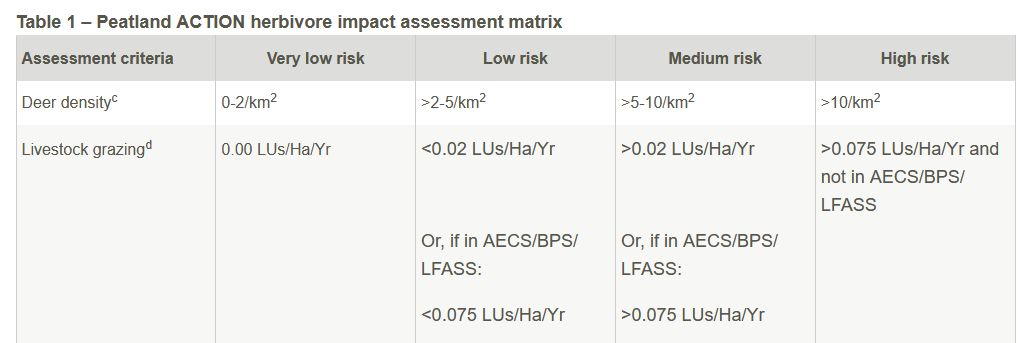
I can no longer find the documentation for Beinn Bhreac on the UK Land Carbon registry but last year it reported deer density of 13 per square km, far too high for the peatland restoration to work. NatureScot no longer funds restoration projects where deer numbers are above 10 per square km but it is likely that many earlier projects funded without consideration of the impact of grazing herbivores will fail. Further evidence is needed to establish what proportion of peatland restoration projects where deer density is 5-10 per sq km and are currently classified as being ‘medium risk’ are likely to fail.
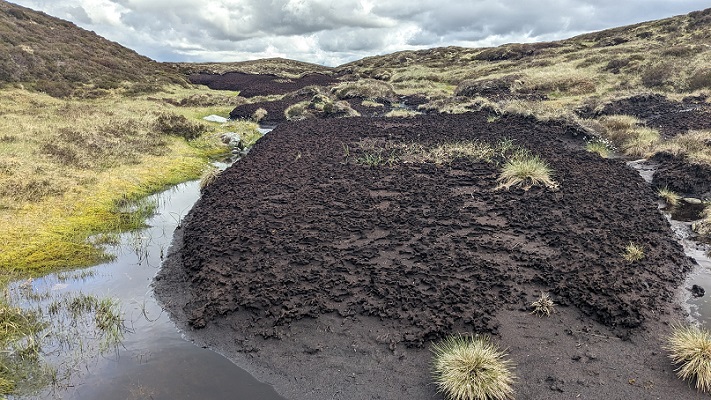
The day after Anne MacIntyre had shown me the Dava moor photo, I jogged up Glen Feshie and then over to Leathad an Taobhain above the Minigaig pass. Before the final ascent, I was somewhat surprised to come across an area of bare peat because the Allt Lorgaidh peatland restoration project, which I had passed, was not far away. Perhaps driving diggers another 1.5km, much of it off-track, was judged likely to cause more damage than good?
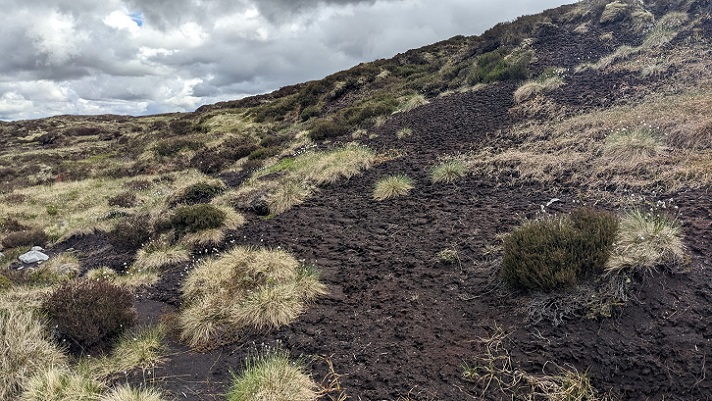
This land is part of the Glenfeshie Estate where 25 years ago deer numbers were very high. That may have helped cause the erosion initially but deer numbers are now extremely low and well below 2 per sq km. Unless deer come to this area to wallow, they don’t explain the continued areas of bare peat.
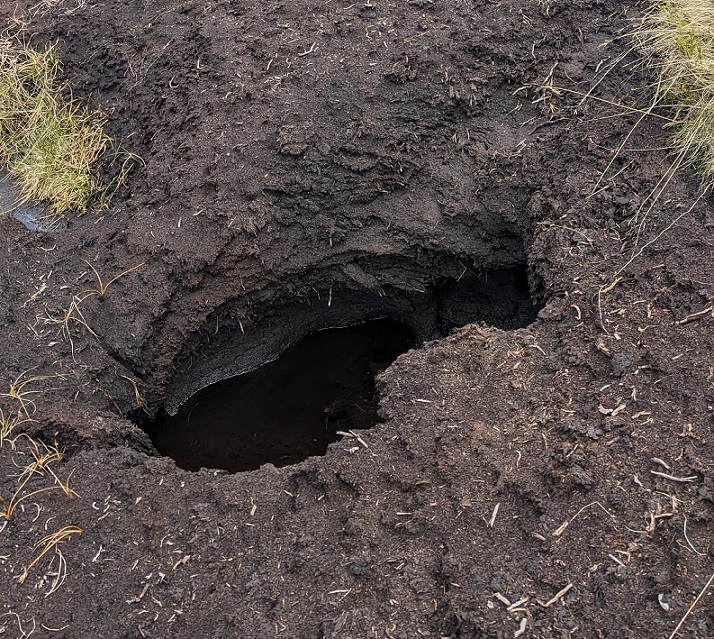
Looking round the site, I could see none of the usual signs of deer, grazed vegetation, droppings or hoof prints. I was left pondering the role of plants and more specifically why cotton grasses sometimes quickly colonise areas of bare peat, as at Dava moor, and sometimes don’t.
The importance of cotton grasses is recognised by the International Union for the Conservation of Nature (IUCN) UK peatland programme (see here):
‘cottongrasses are one of the plants that are used to help restore areas degraded by erosion. Cottongrasses are effective nurse crops, stabilising the bare peat and facilitating the growth of other species, such as Sphagnum’.
Although cotton grasses quickly reduce the amount of CO2 released by exposed peat, the IUCN explains (link above) how they also act as ‘methane chimneys’. The overall impact of cotton grasses on greenhouse gasses is therefore complex but from a carbon and nature perspective they play a very important role in helping create the conditions for other peat-forming species.
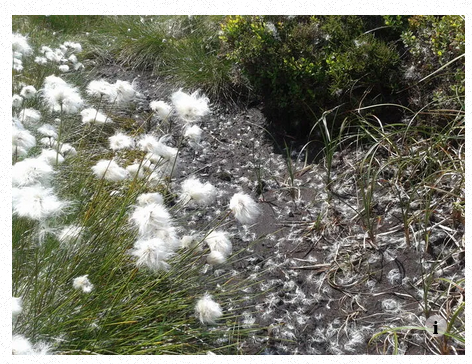
The IUCN briefing explains how ‘common cottongrass is usually one of the first species to naturally recolonise eroded blanket bogs, establishing in the more stable, sheltered areas of the damaged peatland’. Cotton grasses, however, reproduce not just by seed by also through creeping rhizomes which helps explain why so much of Dava moor is now a sea of white (see here).
The survival of the cotton grass rhizomes suggest that some of fire on Dava moor did not burn deep into the peat and may not have released as much carbon as some recently published research has claimed (see here).
Hare’s tail cotton grass, Eriophorum vaginatum, is generally unpalatable (apart from its flower heads in Spring) and its tufted form is quite resistant to fire. Partly because of that it is very common in peatland which is overgrazed or burned regularly and plays a key role in two peatland vegetation communities: the first (M19) with heather, Calluna vulgaris; the second (M20) alone.
Where there is ‘injudicious management; injudicious because the end result of intensive grazing and repeated burning’ (The Illustrated Guide to British Upland Vegetation P192) the mixed M19 vegetation community is replaced by cotton grass alone (M20). This process, however, can be reversed but research has shown (cited in Guide above) that it takes around 13 years for heather to recover and M19 to become re-established. The colonisation of other species, like spaghnum mosses, is likely to take even longer so, however beautiful the cotton grass on Dava moor, no one should be in doubt that this was a damaged landscape which has been further damaged by the fires last year.
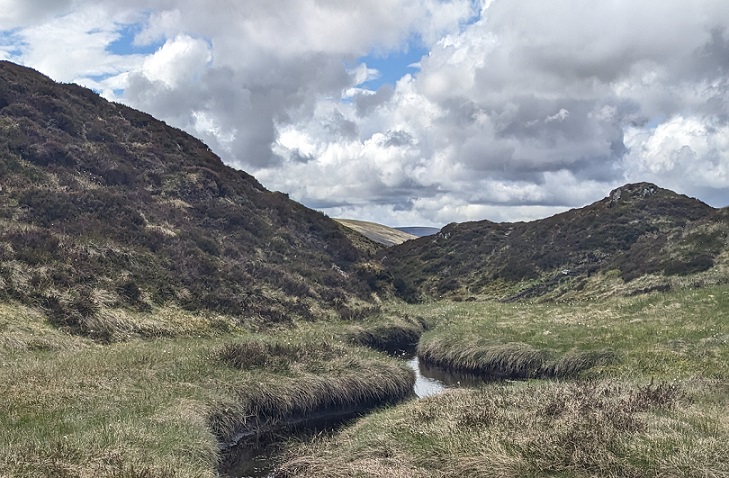
I have been left trying to work out why hare’s tail cotton grass has barely colonised the bare peat below Leathad an Taobhain, in an area where it is mixed up with heather. This doesn’t appear to be because the peat has dried out too much since, as you can see from the photos, some tufts of hare’s tail cotton grass have become established. It seems more likely the sparseness of the cotton grass has limited the regeneration through rhizomes, while the amount of seed produced by each plant may also have been further limited by the altitude (750m).
It would need an expert ecologist and possibly more research on the role of cotton grasses in colonising bare vegetation to establish the answer This, together with the impact of deer trampling and grazing, is something Peatland Action should be doing. What the photos of Dava moor in bloom should tell NatureScot and the Scottish Government is that they should not be trying to restore areas of bare peat where nature will do the job for us. Instead of trying to ‘restore’ every area of bare peat, so long as deer density is below c10 per square km as it is at present, peatland restoration needs to become far more focussed.
I will consider what might be learned from the Allt Lorgaidh scheme, which I visited five years ago and again this week, in a further post.

Some before and after pics of Glen Feshie here.
https://www.nationalgalleries.org/art-and-artists/features/exploring-environmental-change-cairngorms-patricia-macdonald
Great illustration of the amazing changes in Glen Feshie