Our National Park Authorities are unique among Scotland non-department public bodies (NDPDs) in that their boards are not wholly appointed by Scottish Ministers but some members are directly elected and others appointed by local authorities. That three-way division of power in theory makes Scotland’s two National Park Authorities accountable not just to the Scottish Government but to local councils and local communities.
The power of locally elected members has been partly undermined by a voting system which is not fit for purpose (see here for example). Xander McDade, who was Convener of the Cairngorms National Park Authority (CNPA) from September 2018 to July 2023, made significant efforts to address this by encouraging more people to put themselves forward for election and more people to vote (see here for example). He and other board members at the time clearly thought local democracy was important. This was reflected in the CNPA’s response to the Scottish Government’s suggestion in their consultation on new legislation for National Parks that Scottish Ministers should appoint the Convener and Deputy Convener of the Board (see here):
’22. The Park Authority Board believes that it is important that the Convener and Deputy Convener remain elected by the Board given that some of the powers the Park Authority exercises would normally be exercised by democratically elected councillors [e.g. as planning and access authorities] and without local accountability a democratic deficit could be created.
23. The Park Authority Board believes the Board mix of appointment methods is beneficial. In particular, the Board feels the role of directly elected members is important and needs to be kept.’
While seeing off the Scottish Government proposals to increase their power, Xander McDade had only limited success in making local member elections more democratic as shown by the CNPA’s 2023 local member election results (see here). Since then it has been downhill for local democracy, starting in the CNPA. This started with the secret elections to pick Xander McDade’s successor (see here) – if you don’t know who your local rep voted for you cannot hold them to account – and has continued since then as this post illustrates.
Hiding locally elected members from view
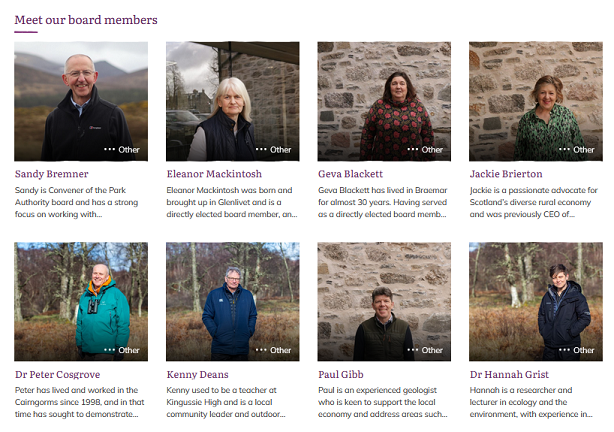
The three way division of power on the CNPA Board is not equally balanced. There are seven ministerial appointments, seven local councillors but just five locally elected members. Before the CNPA revamped their website last year, using Artificial Stupidity, locally elected board members were clearly listed. This made it easy to find out who represented a particular area and for residents of the National Park their local representative on the board.
The new website has lots of photos but board members are, apart from the Convener and Deputy, listed in alphabetical order and there is no obvious distinction between them. In only two cases, Eleanor Mackintosh and John Kirk, is it possible to tell from scanning the information that they are locally elected members. Even then you would only have a rough idea of which areas they represent, since the maps showing their ward boundaries appear to have disappeared from the website.
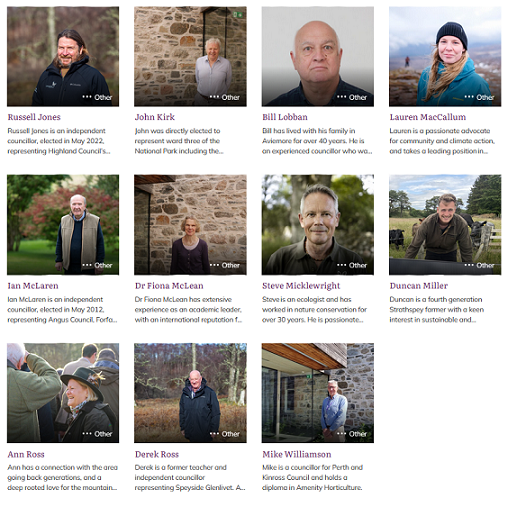 You can work out the roles of some other board members from the presenting text and discount them from being locally elected. But who would guess for example that Paul Gibb, a geologist, was the locally elected member for large swathes of Deeside, Angus and parts of Perth and Kinross (see here) rather than a Scottish Government appointment selected for his expertise in rocks? The result is some people might have to search through most of the background entries before finding who represents a particular area. Contrast this with most local authorities where if you go to councillors and enter your postcode you can find out who represents you.
Isolating locally elected members from their constituents and the general public
The issue is not just that locally elected members on the Cairngorms National Park Authority are hidden from view, it is also that they can no longer be contacted directly. The CNPA used to show up the Loch Lomond and Trossachs National Park Authority (LLTNPA) because it provided email addresses for ALL board members. The ability of the public to communicate confidentially with their local elected representatives, at whatever level of government, is an important democratic safeguard.
Sometime in 2024 or 2025 the public email addresses for CNPA board members disappeared. Last September, I contacted the Convener of the CNPA Sandy Bremner (who still has a public email like the Convener of the LLTNPA0 to query this. The substance of his reply was:
‘The Park Authority was advised as part of cyber security risk assessment to remove staff and Board email addresses from the public website, and to move to generic email addresses to reduce the risk to the organisation. The email address for contacting the Board is ctb@cairngorms.co.uk and I can assure you that if an email is sent in, asking to be distributed to the Board, that the Clerks will contact me as Convener directly without recourse to other staff. Equally, any emails to specific Board members will be directed straight to the relevant members by the Clerks with myself also informed as Convener.’
I thanked Sandy Bremner for his honesty but his response did nothing to answer my fundamental concerns. To illustrate why this is wrong, as soon as Heather Reid, the Convener of the LLTNPA forwarded Sid Perrie’s email to board members raising concerns about the Chief Executive, Gordon Watson, to a member of staff it was forwarded to Mr Watson (see here).
After several further emails, in December I asked Sandy Bremner if Board Members had been consulted on these changes and if any had challenged this cyber security advice. I was told:
‘The Park Authority’s Board members are all fully aware of the organisational approaches to email contacts. All Board members have been operating with this system for some time now, which was implemented following a discussion with the Board. There has been no adverse feedback from any members since our current approach was implemented. This matter has not been raised as an issue at our board effectiveness evaluations in 2024 or 2025, nor in any of my annual one-to-one discussions with members.’
It appears not a single one of the currently locally elected board members on the CNPA thought they should be contactable by the public in their capacity as board members. If that is correct, it is shocking. That is even worse than the LLTNPA where at least the locally elected member for Balloch, Sid Perrie – now suspended – argued unsuccessfully that locally elected members should have their own emails. Just why the seven councillors on the board, whose local authorities provide them with public email addresses AND phone numbers, have not objected is unclear. Surely the same levels of accessibility should apply to locally elected board members as councillors?
The fact that local authorities continue to provide emails to councillors (and the Scottish Parliament for that matter to MSPs) shows the cyber security excuse for removing individual board emails is complete bunkum. As one of the reports into the cyber attack on SEPA in 2020 recommended (see here), the way to reduce organisational risks is training of staff and ‘enhanced network segmentation controls’. The CNPA could, had it wished, created a standalone set of email accounts for board members to communicate with the public. Instead, it has deliberately instigated a system where all communications now go through a member of staff. That puts staff in control, just like in the LLTNPA.
How the Community Panel is further subverting the role of locally elected board members
A significant part of the funding for the CNPA now comes through the National Lottery (see here). Part of their contribution to the £42m Cairngorms 2030 programme (see here) is a ‘Million pound pot for local communities’. Who better to lead on one might have thought this than the five locally elected members on the CNPA board who are paid to represent local interests?
CNPA staff have, however, taken another route (see here). They have procured the UK wide charity Involve to organise a panel of 18 people to design the criteria which will be used to decide what projects should get community funding and how this will be distributed across the National Park. The final decisions on who gets funding, however, will still be taken by staff.
If this is such an innovative approach, as the CNPA claims, it rather begs the question why only do this for the Communities Fund? Why not give the panel, chosen after a labour intensive and costly selection process, a say on designing the criteria for all elements of the programme?
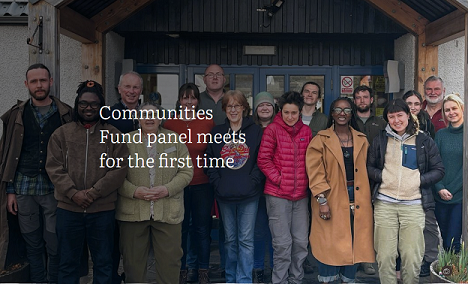
Last week the Strathy ran an article on how the CNPA had refused, when asked, to publish the full names of the 18 panel members (see here). After an excellent explanation of the background, I was pleased to be quoted near the end of the article:
“In my view anyone performing a public function, whether elected, advisory or official should expect to have their full names made public.
“If people don’t want to be named that is fine but they should not be eligible for these positions.
“I don’t know how many meetings of the panel there will be but at £20 per hour and with travel costs for in-person meetings plus the CNPA member of staff involved in the ‘long period of planning, preparation and recruitment’ the administrative costs will be very high.
“The CNPA has local elected members who were built into the structure of national parks in order to create strong links with local communities.
“If that was working, wouldn’t it be better to ask them to do this work, in fact is that not the sort of thing we are already paying them to do?”
At the end of the article the Strathy listed, “for the record”, the first names of all eighteen members of the Panel together with the area they come from.
Sixteen of the eighteen appear to reside within the National Park and appear to have been selected in part to represent sixteen different community council areas. Why then did CNPA staff not simply ask each Community Council to nominate someone to the panel? That would have helped reinforce existing local democratic structures many of which are in need of support and the money saved could have been reinvested in community councils.
 For the volunteers on community councils, working away against the odd to represent the views of their local communities, it must stick in the craw to be bypassed by CNPA in favour of other people, about half of whom apparently have had no contact with the National Park before (see here). This failure is not the fault of the people who applied for or were selected for the panel. Given the low wages in the National Park, it is not surprising that there were so many applicants to the Panel:
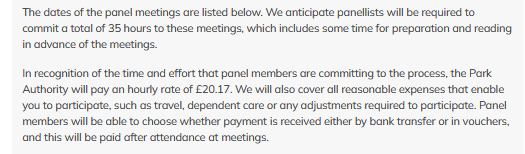
The public interest question is whether this money, a total of over £700 per person (topped up with any savings from not having to outsource the selection process to Involve) would have been better spent through community councils? Would that not have done far more to “Empower communities to share the future of their local area”, one of the core themes of the Cairngorms 2030 programme?
It is worth noting that in contrast to the members of the Community Panel, who apparently want to maintain their anonymity, the full names of community councillors are made public as a matter of course. Contact details are published on Communty Council websites and minutes of meetings often show who contributed what (see here for Nethybridge example).
The state of local democracy in the Cairngorms National Park
There is still a page on the revamped CNPA website about becoming a board member (see here) that states:
‘The first way is by being locally elected, with elections taking place every four years. These members represent the five wards in the National Park. They bring to the board their valuable understanding and perspective of the National Park’s local businesses and communities, and also champion, represent and help deliver our objectives within the wards they represent.’
The wording, which is repeated on the LLTNPA website, is significant. Instead of representing the interests of local communities on National Park boards, the role of local elected members is now being interpreted as being to represent the interests of those boards to local communities. Local champions for the CNPA!
The use of participatory decision making processes, like the Cairngorms 2023 Panel, plucked out of thin air without any regard to existing democratic structure is now being widely used to undermine the role of democratically elected representatives still further. This is because participants are selected, not elected, their position is completely dependant on the patronage of the organisation concerned and they have no independent power. Once the work of such participants is over, they have recourse if staff change what they have recommended or decide to ignore it completely The Cairngorms 2030 Panel therefore serves to give staff in the CNPA even more control.
If the CNPA had really wanted to increase participation in its Cairngorm 2030 programme, it would have started with its locally elected members who are paid to represent the local communities that elect them. Had those locally elected members decided more people needed to be involved, they should then have engaged with elected representatives on community councils and local councillors to work out how best to do this. Instead, CNPA staff have completely sidelined locally elected members, local councillors and community councils.
It says something about the power of staff that locally elected members on the CNPA board have not spoken out about the Communities 2023 Panel. Having lost their means of communicating with the people they represent and having lost their distinctive reasons for being on the board, it appears they no longer see it as their specific role to represent local communities and their interests on the board. Residents of both our National Parks should take note, with elections for local members due in the LLTNPA this July and the CNPA next year.
Part 2 of the Natural Environment (Scotland) Act 2026 received the Royal Assent last month. It should have been an opportunity to strengthen local democracy in both our National Parks. It could, for example, have:
- required the National Parks to support election hustings across their areas to promote debate and enable candidates to explain their views to electors;
- replaced the first past the post electoral system which has resulted in board members being elected by a tiny minority of the electorate;
- increased the number of locally elected members, some of whom like Paul Gibb serve impossibly large geographical areas, and reduce the number of ministerial appointments.
It did none of these things, which might helped improve democratic structures, but instead fiddled around with largely meaningless changes to the aims of National Parks while handing staff more enforcement powers against the public. My own view is that the decline in democracy within the CNPA is not an accident but part of a much wider trend across Scotland and the UK in which power is increasingly concentrated in the hands of unelected officials. The main purpose of projects like the Cairngorms 2030 Community Panel is to cover up what is happening.

I fully agree with the author’s last two sentences.
This undoing of democracy is happening all across the board in civic Scotland. Paid public servants retreating behind fire-walls of anonymity, centralised ‘communication’ teams and treating the public as no more than an irritating nuisance. Local people who care about their communities being marginalised, gagged and squeezed out of any process where power and control can be exercised.
No wonder people are becoming so distrusting and dispirited. They are being used as no more than window-dressing by cynical careerists.
What are these so-called public servants so afraid of? Why are they frightened to engage with local people on real issues? Why are they hiding?
bang on the button, William.
An excellent article giving numerous examples of the pretence CNPA and this Scottish Government makes on delivering local democracy, whilst stage by stage they centralise power and decision making. They know what’s good for us, and have stopped constructive listening.
I appreciate your references, Nick, to our hardworking community councils which are essentially ignored by Government, CNPA and our local authorities. These democratic organisations are way under funded, with power and finance being sucked up to the highest levels.
Our CNPA listens too much to what the Scottish Government wants, rather than listening to the people and providing strong advice to our ‘ivory tower’ Scottish Government.
We are watching the steady erosion of local democracy.
I thoroughly endorse the viewpoints of William and Gordon, but what we have to remind ourselves of, is that a national park is just that: a national NOT a local project,and the priorities are thus ranked accordingly. How that national project is manifested on the ground is something for a national conversation. I have frequently pointed out on this site and others, that the current concept and structure of what we laughingly call a ‘national’ park is somewhere between a tragedy and a farce and its still evolving doom was predicted way back in 1992 by environmental journalist and author Jim Crumley.
Aye, perhaps the only thing more tragically farcical than the current NP model is the structure and power at the Community Council level. Since 1985 my colleague Derek have been pointing the comparison with equivalent structures in similar biogeographical areas of Norway, which apart from empowering communities of empowered private individuals, also provides 200 local jobs. Their national community also owns its own national parks–funny that
Gordon and William, if you are on Twitter I have posted the local government paradigm example from Norway for comparison. It was gleaned in a conversation with the mayor of Vikesa in Bjerkreim in 1984, during a study tour with crofters from Skye. The SNP have been ignoring it since 1985.