On 1st April the BBC reported (see here) that Flamingo Land had decided to appeal Scottish Government’s Ministers decision to turn down their proposed Lomond Banks development in Balloch. They are in fact seeking a judicial review. The difference is important because, as I explained after Scottish Ministers made their announcement (see here), a judicial review can only be used top challenge procedural points, not Scottish Ministers’ judgement. Flamingo Land has said nothing about their decision to seek a judicial review on their Lomond Banks website (last updated in July 2025 – see here) and the reasons they have given to the media are vague:
“Having reviewed the Scottish ministers’ decision in detail, we believe there are fundamental issues with the way in which ministers reached their conclusion, and that it is appropriate for these to now be examined by the court.”
It is possible that, having sought legal advice about Scottish Ministers decision, Flamingo Land believe there are sound grounds for challenging it. However, having been asked to draft their own Section 75 Agreement (see here) and after taking five months to reach what was a carefully worded decision, its going to be very difficult for Flamingo Land to establish that Scottish Ministers treated them unfairly. What they may try and to do is argue that matters like flooding did not need to be dealt with at the Planning Permission in Principle stage, but rather in the detailed planning applications that would be required after permission in principle was granted: all that would do, however, is delay the fundamental issues at stake.
With the SNP likely to be returned to government in May, another developer might have recognised the political consequences of pursuing a judicial review and accepted the financial losses. Flamingo Land, however, does not appear to be in a position to incur the losses that would result from the development not going ahead. One possibility is that Flamingo Land does accept the political reality but is using the threat of judicial review to lever compensation for the costs it has incurred.
The costs of Flamingo Land’s two planning applications and appeal
Flamingo Land has been accumulating costs relating to the proposed development since 2015 when they bid for the site, a period of almost 11 years. For most of that time they have had a project team in place which in terms of pay, tax and national insurance, other overheads could have cost £3 million over the period. A greater sum was probably spent on planning consultants, architects, environmental consultants, lawyers etc for the two planning applications, the appeal and the various legal agreements with Scottish Enterprise. Added to which would be a host of miscellaneous costs.The total could be somewhere in the region of £10m.
We know that Scottish Enterprise (SE) were a party to the first application and paid some of the development costs because the Greens found out through an FOI request that they had, by November 2018, contributed £71,855 to site investigations (see here). The decision by the Information Commissioner in 2024 (see here) that the financial clauses in the subsequent legal agreements between SE and Flamingo Land should remain confidential, means we don’t know what other costs SE agreed to meet and in what circumstances.
On top of the development costs Flamingo Land spent £810k in August 2016 acquiring the Woodbank House site which was then included in both planning applications. Without planning consent, and without a revenue stream from the Riverside Site to restore the ruined listed building, that now represents another potential financial liability.
The financial position of Flamingo Land
If Flamingo Land were anywhere near £10m out of pocket, that could be a significant sum for a business of its size and in the current difficult economic climate. While highly profitable in the past and with very little external debt, there are indications its financial position may have changed:
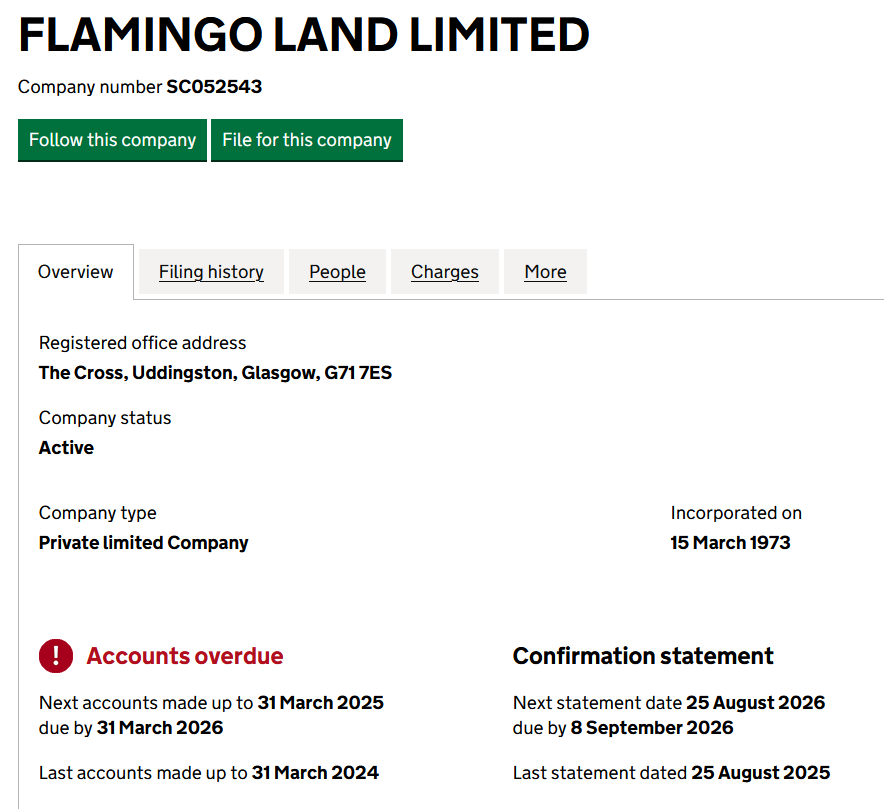
While the accounts of both Flamingo Land Ltd and its parent, Flamingo Land Resort Ltd, are at present only overdue by a few days late filing of accounts is often a warning sign that all is not well.
Looking back through the accounts of both companies there appears to have been no mention of the Lomond Banks planning applications for a number of years. Nor do the accounts transparently show how the development costs at Balloch have been financed. The most recent accounts for Flamingo Land Ltd (see here) show a fall in operating profit from £4,072,030 to £659,788. While the company had net assets of £32,371,219, £26,380,619 of this was in the form of fixed assets. That meant that the company was cash poor because years ago, before the Flamingo Land planning application, it had lent almost £8.5m to its parent company, a sum which appears on the balance sheet under debtors and is explained in Note 11 to the accounts:
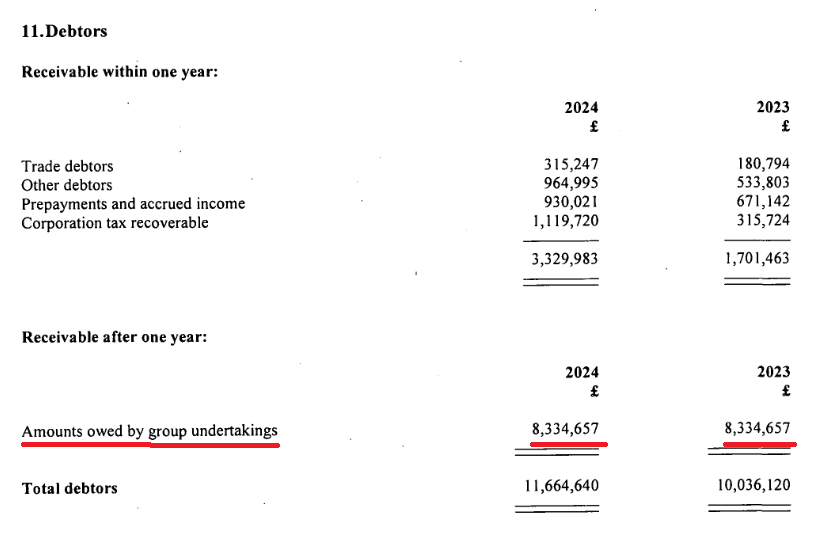
As a result of cash shortage caused by this loan, the Directors had been lending it money for a number of years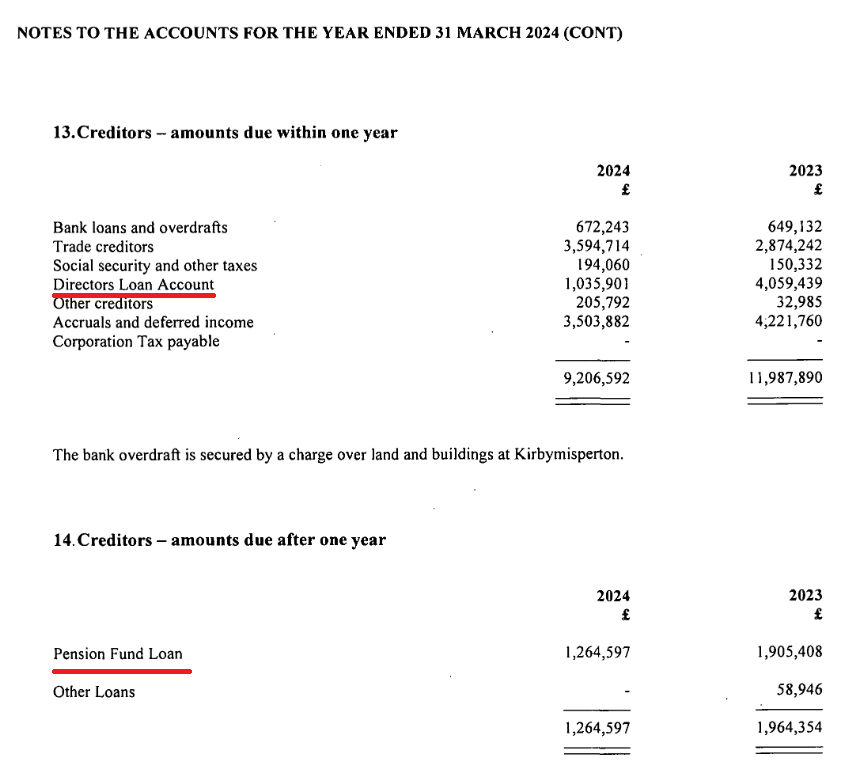 :.
:.
It would be wrong to exaggerate the challenges the company faced at the end of March 2024. It had reduced the total amount owed and been able to pay the two directors £459,050 while in July that year the Directors had enough money to make a donation to Reform UK (see here). Changes to revenue and costs since then, however, could have made the accumulated losses at Balloch much more significant. Moreover, few capitalist entrepreneurs accept losses willingly. Whatever agreement was in place with SE on the development costs, a court hearing would risk the dirty linen (see here and here) of both the LLTNPA and SE being aired in public. The threat could be sufficient to help leverage a successful compensation claim.
The costs to the public of the development
However much SE has already paid to Flamingo Land and whatever might be agreed in future, that forms only part of the cost of this whole disastrous venture to the public purse. Those financial costs commenced the moment the current LLTNPA Local Development Plan, which paved the way for a major development in Balloch, began to be developed and SE decided to market the Riverside Site. They continued all the way through to Scottish Ministers decision. The costs include not just core staff costs for both SE and LLTNPA but the cost of reports from other public authorities, the employment of consultants, the costs of public consultation, legal fees etc. It would be surprising if those financial costs did not amount to at least another £10m.
On top of this and arguably as important are the social costs of over 12 wasted years
This money has been wasted and these losses incurred because SE and LLTNPA got together and agreed behind the scenes to develop the whole of the Riverside Site at Balloch. One can understand why SE staff did that, its their job. The lesson should be, as with HIE at Cairn Gorm, that no enterprise company should be allowed to own land in a National Park. The LLTNPA, however, was set up to do quite different things, conserve nature and promote the sustainable development of local communities rather than private interests.
I have recently found new evidence, not previously published on parkswatch, which shows that from the moment that SE and the LLTNPA secretly decided to appoint Flamingo Land as preferred developer for Balloch, they decided to ignore some basic problems with the proposed development, namely woodland loss and flood risk. These were the very same two issues Scottish Ministers used to justify their rejection of Flamingo Land’s appeal in February! .
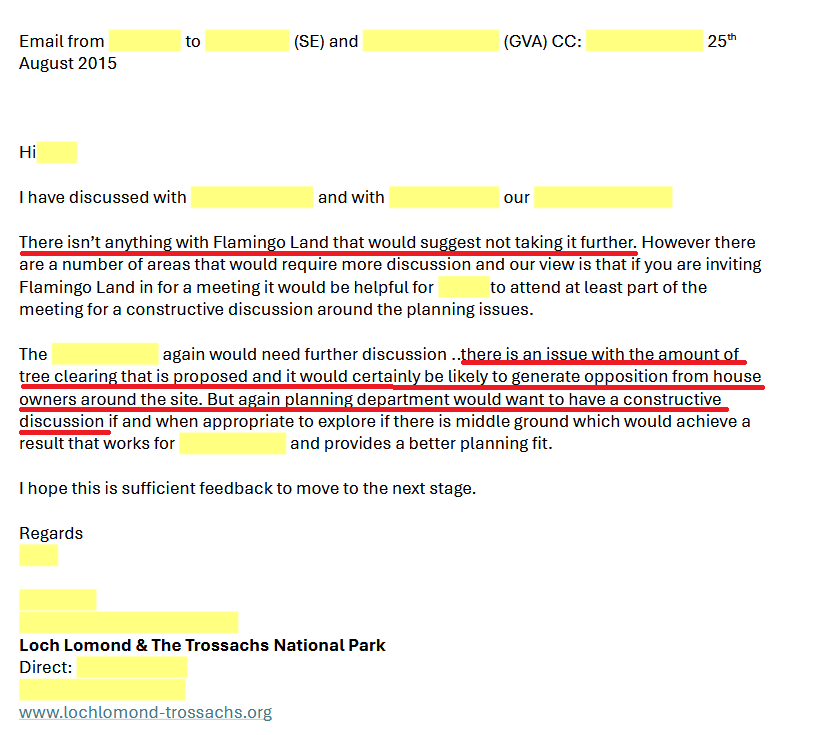
This email was almost certainly sent by Mairi Bell, the LLTNPA’s representative on the interview panel which recommended Flamingo Land be appointed, and suggests that she discussed the panel’s recommendation with planning colleagues. It provides further evidence that, contrary to LLTNPA denials, their planning department was deeply involved in the appointment of Flamingo Land.
The email shows that while at the time the LLTNPA planners identified woodland loss as an issue, their concern was about the response of local house owners and not whether the proposal was compatible with the statutory objectives of the National Park. It took nine years of trying to find ways round the “problem” before the LLTNPA planners were forced to do a U-turn and recommended to their Board that woodland loss made Flamingo Land’s proposed development unacceptable in principle.
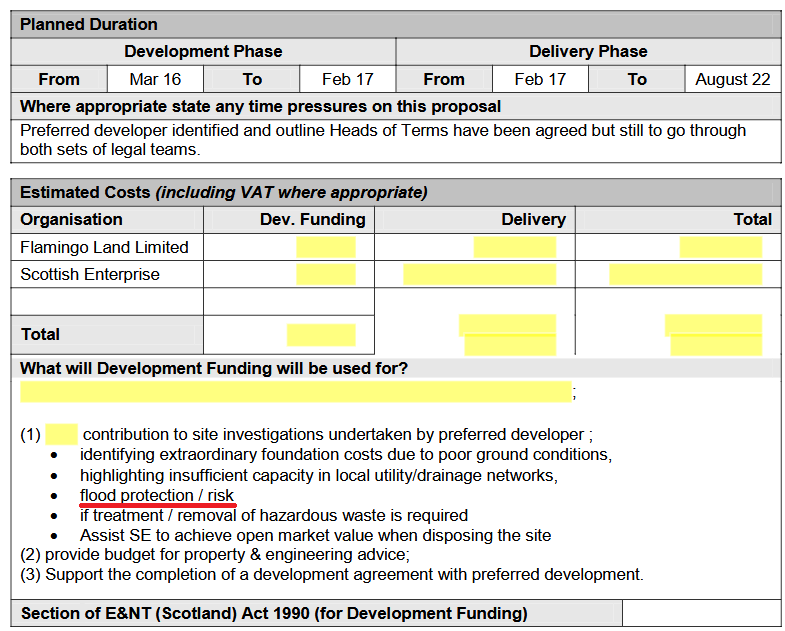
This extract from SE’s development brief shows that officials also knew that flood protection/risk was an issue from the start (as well as highlighting other fundamental issues which in my view have never been properly addressed).
Had these issues been properly addressed by the LLTNPA back in 2015/16, that could have avoided £20m of wasted expenditure and a wasted decade for the village of Balloch.
The costs of Flamingo Land and the crowdfunder for Sid Perrie
The only member of the LLTNPA board who has ever tried to challenge the role of LLTNPA staff and board Conveners during this wasted decade has been Sid Perrie, the locally elected member for Balloch. Had he been listened to in August 2024 (see here), the planning process would have collapsed because of how staff had tried to facilitate the development and the case would never have gone to appeal. That would have saved public money. Instead the LLTNPA devoted more staff resources and engaged lawyers to silence Sid by complaining to the Standards Commission for Scotland, which has then incurred yet more public costs.
Sid who has been off sick has now, with legal assistance from PBW Law, successfully lodged an appeal against the SCS decision to suspend him from the LLTNPA Board for six months for sending six emails (see here). While a number of people are now helping to prepare for the appeal, which has been scheduled for May, Sid would have a better chance if he could pay for representation at the hearing. This could be either by PBW Law, the same firm which is representing Fiona Higgins (see here), or another legal firm.
Last week a crowdfunder was launched for Sid (see here). If you believe in justice and the need to hold our public authorities to account, please consider contributing.

as usual, comes back down to having a model of a national park that is NOT national
Just so!
The Scottish Government and its agencies are now routinely putting corporate interests before the public interest and the protection of the environment.