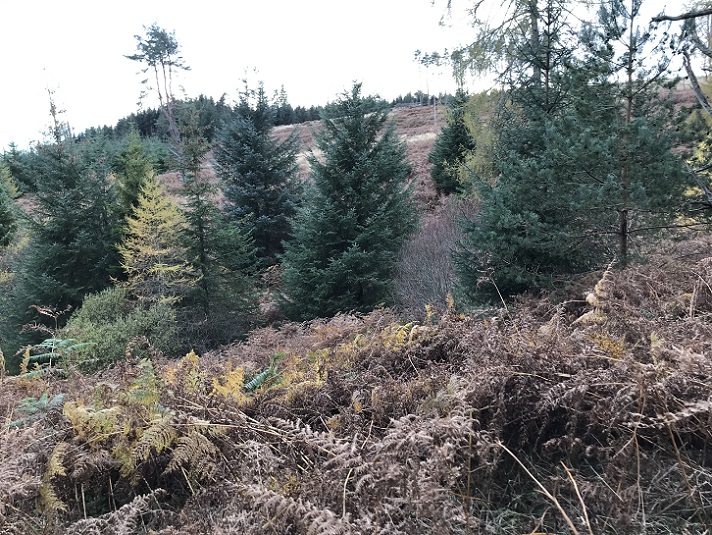
[This article originally appeared last year in Mountain Views, the excellent journal of the North East Mountain Trust. I am pleased to republish it, following my post on Seedy Sitka (see here), using some additional photos from other areas to illustrate the points Drennan makes]
A walk up Bern Vrackie is a good day out when you are staying Pitlochry. The way up the lower slopes is lined with a scattering of diverse trees. Among the selfsown birch although there are others like holly and oak that seem to have been planted through some local initiative. But there is another selfsown species whose presence I find increasingly foreboding -Sitka spruce. This is something that can be increasingly observed in the Scottish hills.
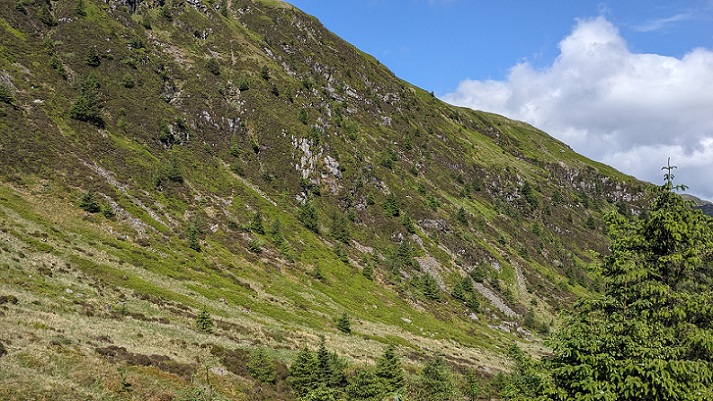
If you take to the hills from east of Ballater up towards Peters Hill and towards Morven, you find whole hillsides colonised with young Sitka trees. As a more advanced example of Sitka colonisation, a recent visit to Loch Goilhead area in Argyllshire showed fenced Sitka plantations up to the timberline – the altitude at which the rate of tree growth will yield an economic yield of timber. But above that lies the treeline – the altitude at which trees will still grow and that was well colonised by scattered young Sitka that had effectively established lengthy young forests.
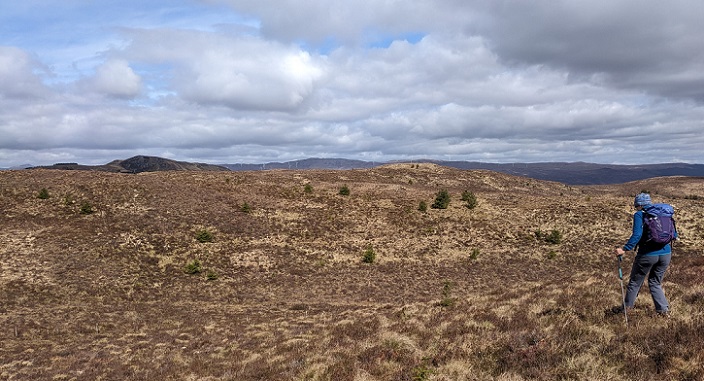
The spread of invasive exotic species is a subject of widespread concern but, looking ahead a good few years, the spread of selfsown Sitka is surely the most significant – even most threatening! A recent publication by the Botanical Society of Britain and Ireland “Britain’s Changing Flora – A Summary of the Results of Plant Atlas 2020”, considering the spread of Sitka, noted that it had the greatest estimated increase in range of any species covered by the project. It concluded that:
“Since the mid-20th century it has become the most widely planted commercial forestry species, especially on peaty soils in the north and west of Britain. Whilst many of the mapped records will be of planted trees, it has been increasingly found naturally regenerating on moorlands distant from plantations, even at high altitudes. Its ability to regenerate successfully on peaty soils that are so vital for native biodiversity and carbon sequestration means that future planting of Sitka Spruce will need to be carefully controlled and managed to ensure that important peatland habitats, species and carbon stores are protected.”
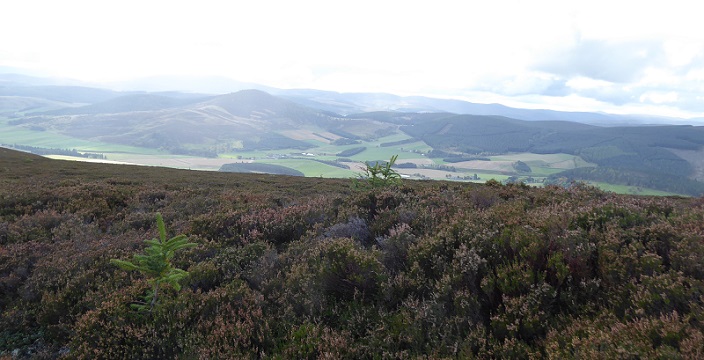 The photo of Sitka regenerating at nearly 600 metres on Clachmaddy Hill on the ridge above Glen Buchat, nearly 300metres above the nearest seed source, demonstrates the point. A further paper in 2023 concluded more than half of trees recorded above 900m recently are Sitka spruce.
If trying to restrain the spread of a problem like this, one would first of all remove the source of the problem and simultaneously remove the errant individuals. But the sources – Sitka plantations – are increasing under reforestation measures and there are no effective measures in place to remove invasive populations. Few of the self sown Sitka have reached the stage of seeding but, as they do, the colonisation of open ground will accelerate. Whatever else muirburn or heavy grazing pressures did, they contained Sitka colonisation.
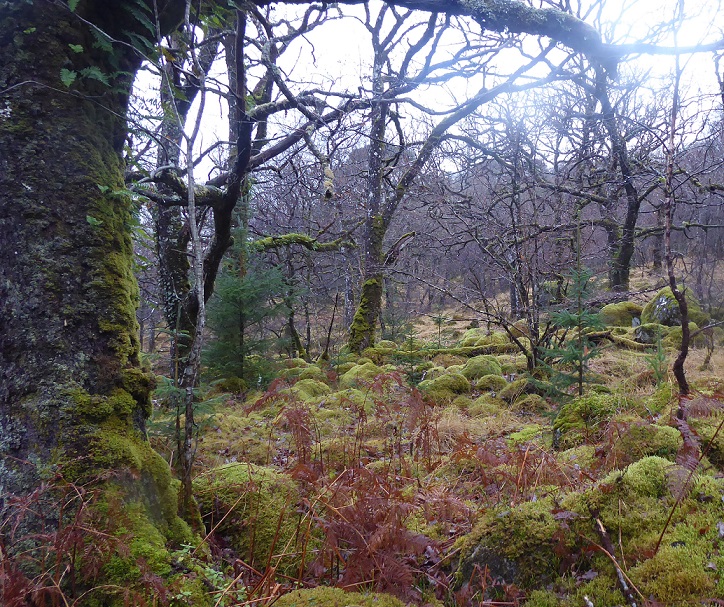
A further twist is that the species revived under current efforts to revive native forests, chiefly birch species and Scots Pine, are what is called “pioneer species.” They colonise open ground. But pioneer species are shade intolerant and do not readily colonise established woodlands and forests. Sitka however is a species of the deep forest, shade tolerant, and hence readily invade Scots Pine and birch stands. This can already be seen happening in parts of Glen Tanar.
Somehow, this growing problem has yet to be properly acknowledged, far less addressed with effective measures, although it would seem to be an appropriate one for the National Park Authority and Nature Scotland to address. Perhaps because nobody had yet to perceive how it may be effectively managed?

There would appear to be only two options: go with the flow, managing its direction; permanent incessant ‘warfare’ at great effort and expense.
Sitka seeding is a big problem in Argyll too. I remember many, many years ago being involved in cutting down young Sitka which were seeding on open land. I recall a great deal of enthusiasm – maybe local groups could make a start in getting rid of young plants. But how can this be achieved?
An issue I have raising for years, Drennan, but foresters just wash their hands of the problem. Whatever happened to polluter pays?
In 2024 I made a suggestion for dealing with it: see https://www.fenton.scot/ecology/Spread%20of%20Sitka%20-%20A%20Suggestion%20-%20J%20Fenton%20-%20Oct%202024.pdf
since the polluter is the government, should the government write out checks to itself
National Parks would be a good startjng point but there is no chance of the NP leadership supporting this….it would mean they would have to go against the big landowners.
why are there big landowners in a national park; why is a national park not owned by the nation.; what makes a national park national?
Yes, this is a major problem all over Scotland. It is a tree from British Columbia, where the rainfall is even higher than in Scotland, so it naturalises very easily.
The hard, sharp needle is not eaten by sheep or deer. Birch, a rowan, oak and most other leaves and needles are eaten, while the inedible Sitka are left to grow.
The size of the seeds adds to the problem, because they are so small that they can be carried by the wind for kilometres, while an acorn, rowan, birch or hazel seed hardly travels further than the height of the tree.
Books say Sitka are not fertile until they are 15 to 20 years old. However, colonies grow around trees that are only 6 or 8 feet high.
In the New Forest, they run campaigns to remove Sitka seedlings, as we did some years ago with ponticum.
Planting grants for Sitka could be discontinued in favour of Noble Fir in the West or Douglas Fir in the East.
These species are probably equally good for CO2 capture over 100 years.
https://www.fas.scot/crops-soils/farm-woodlands/woodland-creation-commercial/#:~:text=Commercial%20forestry%20describes%20woodlands%20grown,both%20site%20and%20tree%20selection.
The important thing to remember in this is that one in every two trees in Scotland is a sitka spruce, so the resource is huge, and very well distributed across much of the country. Some-one has mentioned a £10/ ha levy to help deal with it, but that would mean only £200 from a 20 ha shelter belt that might be seeding an area several multiples of that area in size. That does not add up. This sitka seeding is also not spreading because of reduction in browsing pressures. Sitka can withstand very heavy grazing, and in a moorland environment, almost everything else an animal finds will provide it with more nutrition that sitka. If anything, trampling and tracking will aid its spread. The only thing that can be done is to get ahead of it, draw a line, and try to defend the land beyond a certain point. Burning and grazing may have a place in any strategy, but the reality is that once it gets going, it is very difficult to stop. The “polluter pays” theory will not work.
I agree, the government writing out polluter pays cheques to itself would be a farce. Strategic, holistic and integrated are dirty words to the political class and the NGO-Quangocracy. Future gaslighting is assured.
May I comment on the phrase “more nutrition”? I do not believe animals eat Sitka. Unlike many native broadleaf trees (like Rowan, Birch, or Oak), which have soft, nutritious leaves that deer and sheep and the unseen night riders, slugs and snails find edible. (I would also speculate that birds and hares eat soft seedlings.) The Sitka spruce has sharp, stiff needles that can pierce skin and irritate the mouths of grazers. Like many conifers, they contain terpenes and resins that make them difficult to digest and unappealing.
Hard seedlings are more likely to be frost-damaged than eaten.
Hi Bill, there are studies showing deer eat Sitka eg https://nora.nerc.ac.uk/id/eprint/8525/ Where you are right is Sitka are are more difficult to eat and less digestible than other tree species. Deer are most likely to eat Sitka when no other food is available, eg in winter
There is also some evidence that Highland Cattle eat young Sitka particularly if winter grazing on the Hill. I see this on my own hill ground compared to neighbour who runs sheep. they have more Sitka and are further away from seed source.
Interesting debate here and encouragement to get out and sort the problem. At the end of the day it’s down to education and encouragement to get land managers to cut them. Perhaps some encouragement in hill farmers subsidy payments might be a useful incentive?
~Yes – As Bill Gilmour says sitka are very grazing resistant and hence it spreads where other tree species cannot
There is one aspect of the situation that Victor has pointed out that one in very two trees in Scotland is a Sitka. There is a lot of stupid planting of sitka – driving through Aberdeenshire countryside yesterday I was struck by the single or double lines of sitka planted on farmland as shelter belt. It makes bad shelter belts – too dense.I had one on our land on our croft – not planted by us. I had it felled – at significant cost – as the timber was not much use.
A broader point that gets to me is that so much of the timber resource is concentrated on one species in dense stands. As one trained originally on diseases of crops that signals to me we are asking for trouble. ~There may not be a pathogen or crop pest around at present that could cause serious epidemics but we are heading into climate change and things are on the move.
Colins observation that highland cattle may graze sitka does not surprise me. Highland cattle are one of the old celtic breads and they were noted for being hardy, easily handled and – good foragers!