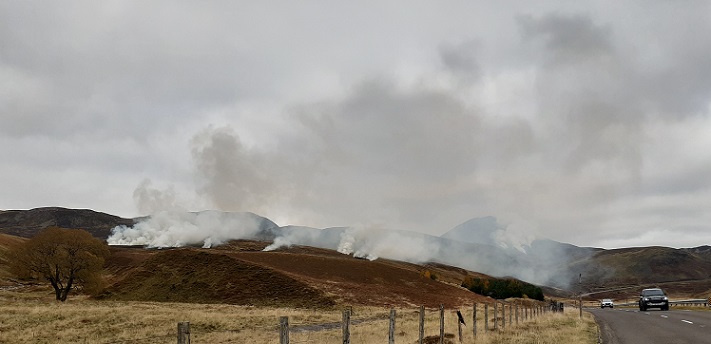
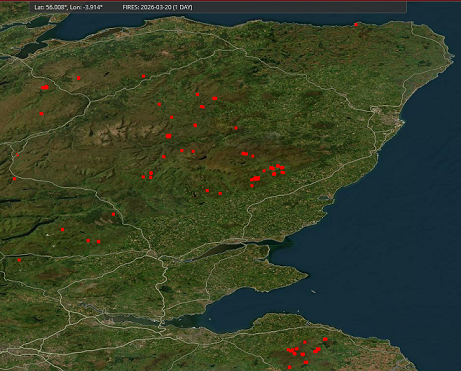
Having burned late into the autumn last year, NASA Firms data base (see here) shows Scotland’s grouse moor owners and managers started burning again at the start of March. At the end of this last week the Scottish Fire and Rescue Service (SFRS) issued their first very high fire risk warning (see here) of the year, for the period 20th-21st March:
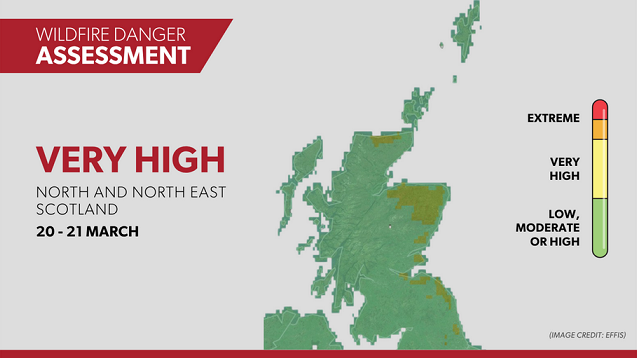
The warning was for areas along the east coast, in the North East on the north coast of Scotland:
“SFRS is strongly urging the public in these impacted areas to avoid lighting fires outdoors during this period………………………..There’s no such thing as a harmless fire. Every spark, even the smallest, has the potential to become a wildfire and cause a large amount of damage. As Spring approaches, we often find vast areas of dead and dry vegetation across the countryside which has just finished thawing. These vulnerable areas are essentially wildfire fuel. Most wildfires are human caused, which means they are also preventable. It is imperative that we all act responsibly while enjoying the outdoors – not just during a period of heightened risk, but all year long.”
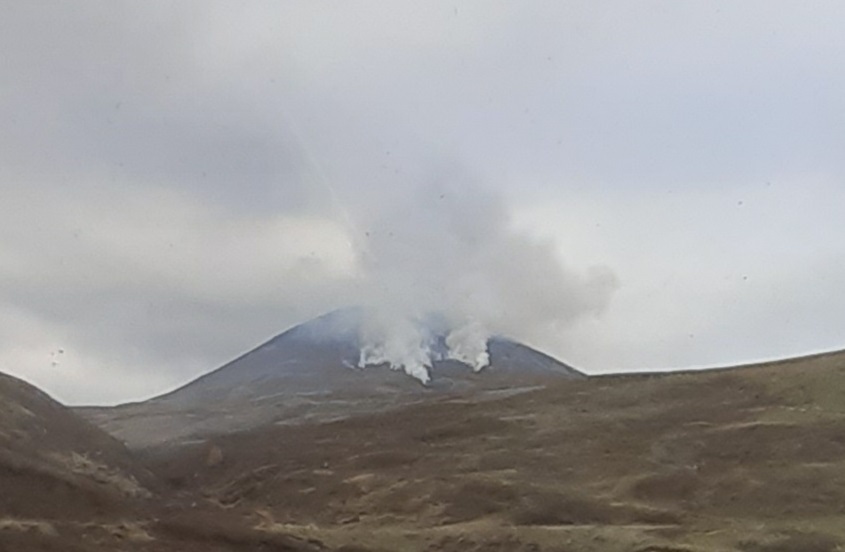
While the SFRS was urging the public not to light any fires in the affected areas, grouse moor managers in the east and north east of Scotland carried on regardless:
The Cairngorms National Park Authority (CNPA) also issued a fire alert, which was again targeted at the general public and failed to mention landowners.
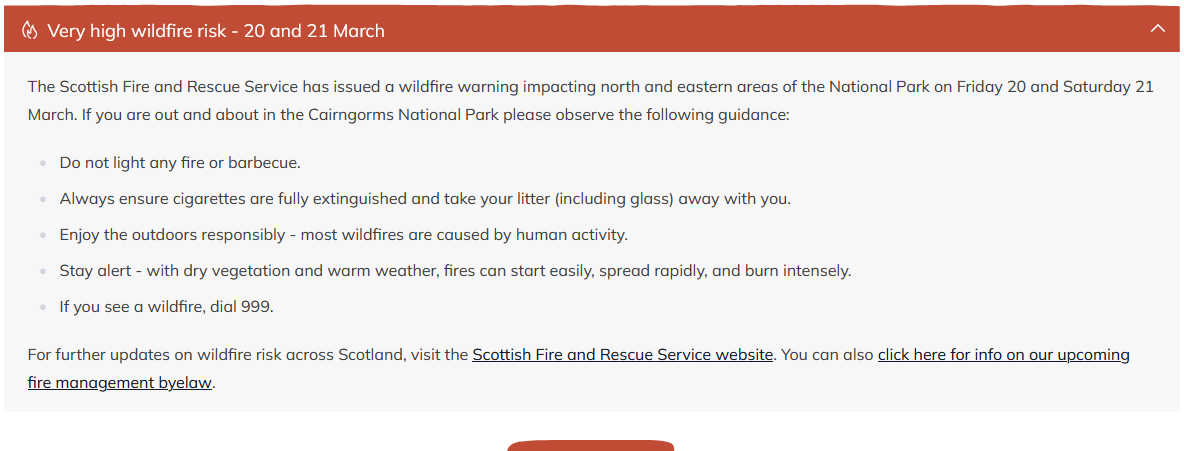
On 1st April, the CNPA’s fire management byelaws, approved by Scottish Ministers, come into effect. They make it an offence punishable by a £500 fine for any member of the public, but not landowners, to light a fire or barbecue in the National Park until the end of September. After the Scottish Government last year delayed the implementation of the Muirburn Licensing Scheme, grouse moor owners and other landowners can still burn the land, whatever the risks, until 15th April (see here). To quote the SFRS again:
“There’s no such thing as a harmless fire. Every spark, even the smallest, has the potential to become a wildfire and cause a large amount of damage.”
The hypocrisy of our public authorities and the Scottish Government, who single out the public while ignoring landowners, stinks. As if the very high fire risk was not enough, Windy.com, shows that muirburn was being conducted in some places despite wind speeds being above the 12 mph maximum recommended in the current iteration of the Muirburn Code. So where has been the condemnation of landowners by our public authorities?
Prof Douglas MacMillan has written an excellent article on muirburn in the latest issue of Reforesting Scotland. This brings together some of the research he has conducted with Euan Stevenson and has been featured on Parkswatch (see here). His conclusion goes to the heart of government hypocrisy:
“Our findings raise challenging questions for decision-makers in the CNP [Cairngorms National Park] and the Scottish Government, as they would cast doubt on two influential claims about muirburning and wildfire: campfires are not the greatest source of wildfire in the CNP and muirburning does not mitigate the intensity or spread of wildfire”.

how will it ever be possible to re-establish upland and montane woodland as long as the current burning and grazing regime, to suit a few hundred private owners, is allowed to persist. Land reform? my tartan bahookie!!
Just so!
Another year and here you are again Nick peddling lines and information that are simply wrong about Muirburn. If you overlay your FIRMS map of likely muirburn fires and the area subject to a yellow Wildfire risk assessment (notice it was not amber or red), you will notice that the areas with this yellow risk assessment are not moorland. They are all farming, coastal, scrub and pasture areas, and east or north east of moorland. So why would any moorland manager need to take any notice of this as it was not in their area? It’s wrong of you to imply that moorland managers were ignoring them or that there is one rule for one group and one for another.
But in any case the two groups are different… members of the public do not leave home with fire fighting equipment and they are not subject to any training requirement … moorland managers have the kit and expertise.
Last winter was the wettest on record and there was zero risk of moorland wildfire in the last week from burning heather.
Regarding Ronald comment above……trees won’t generally grow in Highlands above 500-600m as the soil is too infertile and it’s too windy (quite apart from deer numbers). The best focus for montane woodland should be below 400m where muirburn takes place less. Above 400/450m hares and ground nesting birds and the fabulous wildlife on our stunning heather clad hills don’t want trees (as they don’t roost)!!
Colin, what map of moorland did you use to overlay the FIRMS map? Are the Lammermuirs, for example, not moorland? I am interested too in your comment that during all the muirburn last week there was zero risk of moorland wildfires – if that was the case how was the muirburn possible? I would also be interested in your view on how many people and what fire fighting equipment should the Rhiedorrach Estate have deployed to manage the fires in the Glen Shee photograph taken last October? And if estates have all the right fire fighting equipment, why did the CNPA create a fund to pay for such equipment after the Dava Moor fires last year?
Nick
I used my eyes to see that the area in North East Scotland was not moorland. I don’t have access to the precise mapping tools so cannot see for sure if the Lammermuirs were in the “yellow” zone or not but having asked someone who was burning that day in the Lammermuirs they confirmed that burning was difficult to get started and maintain that day which suggests that it was completely safe to carry out Muirburn, and this was certainly the case in CNPA. There was no risk of wildfire because burning was difficult to carry out.
In any case you haven’t noted my point that Estates/Moorland Managers have kit and members of the public do not.
Conditions for wildfire as you well know from the report on Dava Moor are:
1. Long periods of dry weather in advance….but as you know this has not been the case this March and we are off the back of one of the wettest winters on record
2. Timing of burning… the Dava Moor wildfire was in June which is outside the burning season, and followed an exceptionally dry period. (Caused by recreation and a rescue flare on a training exercise) The burning season is designed to be at times of year when ‘cool burn’ takes place. Adders and mammals, birds and most invertebrates move out of the way of Muirburn. In most cool burn invertebrates and most creatures are unaffected as the moss where they hang out is not burnt – hence famous video of £5 note not burning in the middle of managed muirburn.
3. Fuel load… this was a very significant factor in Dava Moor. Well managed moorland is less susceptible to wildfire as fuel loads are lower and moorland moor broken up due to combination of good burning practice and grazing. The Dava Moor fire entered the peat and the greatest cause of damage and CO2 was from this fact. Good muirburn practice must avoid deep peat and all practitioners support this.
4. Equipment …. as is well known it’s the Estates and keepers who come out and fight wildfire with their equipment when it happens. It’s very sensible that CNPA is creating a fund to help purchase more equipment. More tourism and climate change and poor moorland management practices in some areas (typically those managed by RSPB and other quangos), heighten the risk of wildfire.
5. High Wind…
Finally, Looking at the photos of the fires in October 2025 at the Cairnwell, these look very small and easy to maintain so very little equipment would be needed other than personal protection and a couple of brooms/heather beaters. I would say 2 people max. I would guess Rhiedorrach have the kit.
Yes – This is an interesting discussion.But there is always one thing that bugged me a bit about muirburn. Birds, deer etc move away as fire advances. However the much less mobile wildlife like adders, small rodents, amphibians etc have no such option. Does it not all perish – in a pretty horrible way? Nonflying insect life etc must similarly perish. Perhaps I am wrong.
But when I helped the Cairngorm Club establish a six acre woodland in Glen Ey through fencing some of the impacts were striking apart from rapid tree establishment -In particular the rapid growth in populations of small mammals etc. A really noticeable but telling feature was that if you entered and walked through these few acres you would almost always encounter and adder or at least see a discarded skin of one. How often do you encounter adders on the open hill? That in itself must indicate increased populations of their prey.
I agree Drennan …this point is often overlooked….muir burn cooks biodiversity ….whether controlled or not. Fire is bad for nature unless it has adapted to it over millenia. We do not have a fire adapted ecology in Scotland so fire is simply death and destruction.
I agree, Nick and Drennan, yet again our Cairngorm National Park ‘leaders’ avoid tackling the real problems with muirburn – high risk of wildfires (especially in times of high winds and low rainfall – which has occurred this year so far in the NE) and loss of biodiversity.
another example of this one-sided argument is this Channel 4 article on Substack – see https://channel4news.substack.com/p/barbecue-ban-for-uks-biggest-national?utm_campaign=email-half-post&r=6itxkn&utm_source=substack&utm_medium=email. I added a ‘polite’ comment on the article.
I like your words, “The hypocrisy of our public authorities and the Scottish Government, who single out the public while ignoring landowners, stinks”. They pretend to be taking appropriate action, and pat themselves on the back – hypocrites, who we pay for!
Sorry Gordon I think you have this wrong. The public are often ignorant of the dangers and risks of wildfire and do not have the equipment to put a fire out. So clearly Government have a heightened responsibility to communicate and message to the public, ban bbq’s and campfires etc. Moorland owners and managers whether public or private are distinct because they are either self regulated (muirburn Code) or regulated (new muirburn licensing scheme), have equipment and are well aware of the risks.