I thought we lived in a world where science guided our decisions about how best to protect nature and the planet. Sadly this would appear not to be the case.
Vested interests and the voices of the powerful now hold sway, with science only deployed by government where there is good reason to expect it’s findings will support the desired pro-growth, neo-liberal narrative.
Such narratives, not founded on good science are increasingly hegemonic in debates about Scotland’s natural heritage and especially in our National Parks.
In ‘Grouse Moor World’ supporters of muirburn argue that burning heather for grouse shooting must continue unchecked because the practice helps to mitigate dangerous wildfires. Jim Fairlie, the Scottish Government Minister responsible, is convinced. At a recent meeting with grouse moor managers on the site of the recent Dava fire he acknowledged and confirmed ‘the crucial role that controlled muirburn plays in reducing fuel load to mitigate risk’.
But does muirburn really mitigate wildfire damage? The recent Dava fires provide some insightful evidence to help answer this question.
The Dava Moor wildfires are the UK’s first official ‘mega fire’, burning an area close to 10,000 hectares. Although the sources and causes of the Dava fire have not been officially confirmed (see here– end of post), there is data available which allows us to explore the role muirburn played in mitigating the fire.
Using the most recent satellite derived data from the European Forest Fire System (EFFIS), which is based on real time satellite imagery, we explored the relationship between the fire and the pre-existing management of the land.
Our findings are interesting.
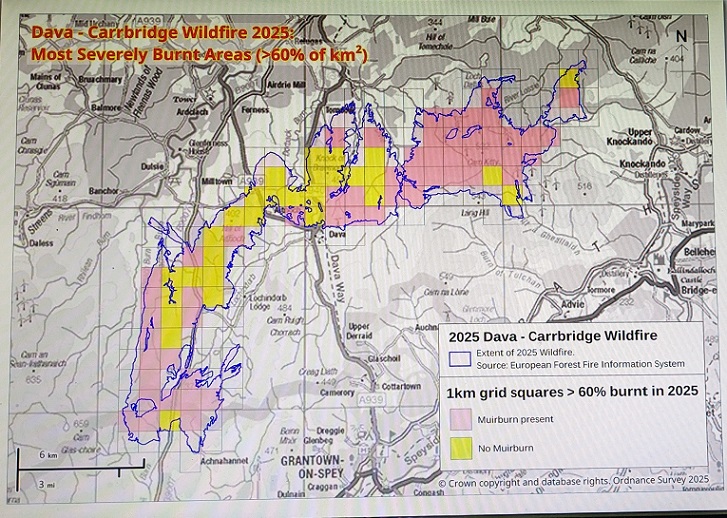
- 68% of land affected by the Dava Mega fire has been managed using controlled muirburn.
- 67% of the total area that was most extensively burned (over 60% of land area incinerated within each km) was managed using controlled muirburn.
- Within each km the average area burned where muirburn had been practised was 56%. On non-muirburn areas the equivalent figure was 58%.
In summary, it looks as if the practice of muirburn actually made no difference to the extent of the Dava mega-fire.
This should come as no surprise to anyone who understands the relationship between fire dynamics and hydrology on moorland. Muirburn dries out the land by killing off the vegetation and drying out the peat, making it less resistant to fire. Muirburn also leaves behind lots of dead stems of heather which which provide perfect fuel for wildfire.
If you want to mitigate wildfires it seems to me that science actually points toward ‘re-wetting’ moorland as a better wild fire mitigation strategy compared to perpetually burning them. Re-wetting is also better for nature, biodiversity and the climate.
But then again perhaps I just don’t understand Grouse Moor World sufficiently well.
[Ed. Note: Prof MacMillan first published this post on his linked-in feed]

It’s powerful stuff when a professor complains that science isn’t informing decisions, but he is not alone. Academics in Future Landscapes Forum say that their research contests the view that prescribed burning is as damaging to peat and peat forming species as Prof MacMillan and others say it is.
Furthermore, there are also academic from Exeter University’s WildFIRElab expressing concern that there could well be serious consequential wildfire risks of making the management of heather fuel load harder, regardless of its association with grouse moor management. Importantly the Chief Fire Officers Association have expressed exactly the same concerns.
Dismissal of those concerns by characterising them as the ill-informed views of the “grouse moor world” is far from accurate. The study cited by Prof MacMillan showing the relative correlation between wildfire impact between muirburn areas and non muirburn areas is very simplistic and appears to be a response to claims that prescribed burning will prevent wildfires.
Although some in the grouse shooting world erroneously claim that prescribed burning makes moorland safe from wildfire, most point to the positive correlation between high levels of heather fuel load and serious damage to peat due to the intensity of the wildfire and not simply its presence. Academics studying wildfire such as the team at Exeter University agree with this important point.
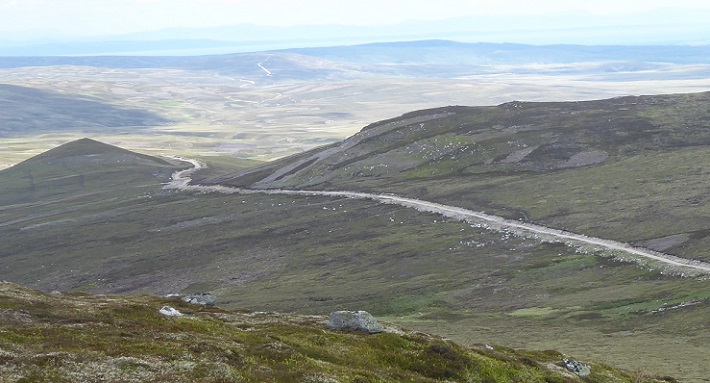
When we look at Carrbridge and Dava, I took photographs just after the surface fire was put out, there were still areas where it was clear that the fire continues to burn underground. Whilst my observations are anecdotal, it did appear that this destructive underground burning was in areas on Prof MacMillan’s map denoting no muirburn. This photograph, which I shared in my reply to Prof McMillan’s article on LinkedIn, also clearly shows areas that had previously been managed by muirburn still remaining green and undamaged by the wildfire. It is clear that these areas did not halt the wildfire progress because blown embers leapt across to the next area of combustible heather. But such areas offer two significant benefits – little or no damage to underlying peat and minimal damage to plant communities on the surface which will help in ecological re-colonisation and recovery, but also such areas give those fighting the wildfire a chance to get ahead of the fire-front at a time when the flames are lower and less intense a point confirmed by fire and rescue experts with years of practical experience fighting these fires.
If we are to draw any conclusions regarding whether muirburn can contribute to minimising the damage of wildfires, it will come from detailed studies of the damage to the underlying peat and not a superficial mapping study such as this. Luckily experts such as Claire Belcher of Exeter are studying wildfire sites to give us the information we need to have the sort of informed debate Prof MacMillan says he would like to see.
Thanks Owen, I have seen evidence to support your observation that muirburn does not stop wildfire because embers blow across it but also, if you look at the Tinto fire, it re-scorched many muirburn areas too. Whether a fire burns underground in the peat depends on the depth of the peat and how wet it is. My observations again are that in many areas which are regularly burned there is not much peat left so its not that surprising that those areas don’t burn underground. The question therefore is why do areas of deeper peat dry out? Some of that is quite natural, indeed James Fenton has shown its the mechanical compession of dried out dead vegetation by water which is how peat forms, but other causes are not. Of course we wouldn’t need to have this debate if wildfires were not being caused by careless flares, careless barbecues and careless muirburn……………….
Interesting comments Owen. In your opinion do you think muirburn should be allowed in periods of high wildfire risk?
Sorry for the late reply to your question. I monitor my local moorland here in mid Wales and feeds observations regarding vegetation dampness, peat surface wetness, wind direction , humidity, heather beetle damage, public access peaks, etc. This feeds into a weekly national/ regional weekly wildfire risk assessment conducted by moorland keepers that has been welcomed be regional FRS as it helps in their wildfire contingency planning on a weekly and daily basis. This is done throughout the spring and summer and in periods of raised wildfire risks. I, and all involved give daily updates when the situation becomes worse. So I’m well aware of when the prescribed burning season is and of course I don’t think that burning should be allowed in periods of high wildfire risk. If you’re referring to estates who conduct muirburn within the burning season but when conditions are dry they should be seriously taken to task for not adhering to the code of best practice. Furthermore as they are supposed to inform FRS before they burn they should be told not to be taking such a stupid risk.
Could you please respond to the points I made about academics who contest the view that prescribed burning dries our moorland so much it makes them vulnerable to wildfire. And also to my point that people and organisations other than the grouse shooting community are expressed concerns regarding high fuel load and consequential wildfire risk on moorland. These are the 10 wildfire experts at Exeter University’s FireLab and the National Fire Chiefs Council who have warned Defre and government minister about fuel loads and wildfire risk.
Although your article does a good job of comparing area burnt areas where muirburn has been conducted and where it has not, this doesn’t address the far more important points regarding depth of burn into the peat and duration of burning underground. Wildfire experts say the level of wildfire damage is far greater where fuel loads are higher, this is logical considering the laws of thermodynamics and entropy.
I drove across the area impacted by the part of this wildfire Carrbridge wildfire the day after it was put out on the surface. However, as we know there were many areas where the fire continued to burn under the peat surface for many days after this. It struck me as very significant that at that time the only places I could see evidence of such underground burning on my journey from Cambridge to Forres were “smokers” in the woodland to the west of Lochindorb. This is an area of youngish Scots pine where the fire burned down tree trunks and along their root tracks. Drying / shrinkage of the roots cause by the fire tracking creates a void down which air can then feed smouldering peat underground. You will probably know that efforts to fight wildfire where there are trees and very hot and intense crown fires makes it much harder to contain thus a larger area will burn, and more intensely so in these areas. Considering these planted/ regen areas have not been subjected to muirburn for a long time makes your comparison of fire damage area between muirburned and not muirburned pretty meaningless. This is particularly so when disregarding other important variable factors that must have influence firefighting effort across the entire area over several days. These would be access and availability of water around the forefront, changes in fighting effort between night and day, changes in wind direction, changes in convection rates related to fire intensity due to fuel load causing more surface wind or sudden changes in direction. All of this has been ignored to create a supposedly neat comparison to prove that muirburn has no influence on wildfire. With all due respect to your academic status there are wildfire experts and those who actually spend a lot of time fighting moorland fires who would tell you this is not a thorrough piece of work. Furthermore it appears to have been written in order to prove a point rather than add to our collective knowledge on this very complicated topic. Sorry if this sounds harsh, but I really can’t see it in any other way.