
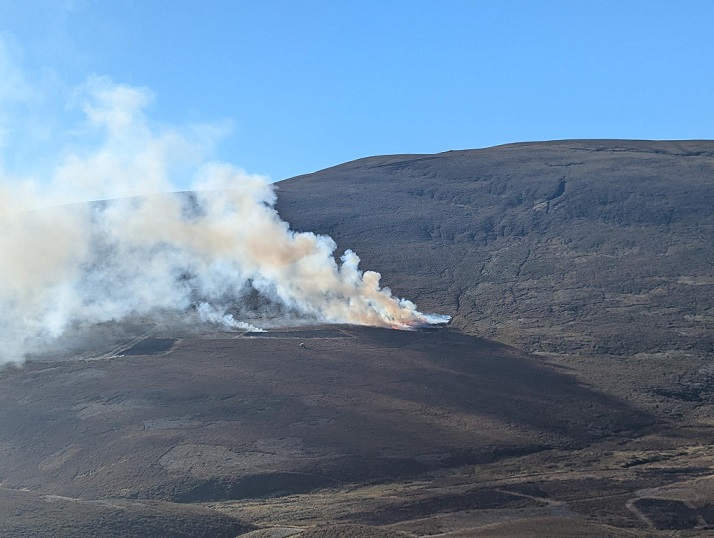
On Thursday 9th October, the same day Jim Fairlie the Scottish Government minister responsible announced a further 9 month delay in the “watered down” – excuse the phrase – muirburn licensing scheme, a “controlled fire” on Culblean Hill got out of control. This caused a wildfire which it took fire fighters over seven hours to put out. Raptor Persecution rightly responded “you could not make it up if you tried” (see here)
This post considers this wildfire in the context of some of the recent propaganda from grouse moor interests, designed to try and persuade the public that muirburn prevents rather than causes wildfires, and the “two-faced” position of the Cairngorms National Park (see here).
I will start with some facts.
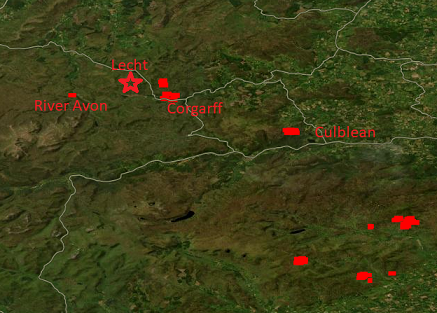
First as reported by the Press and Journal (see here). “Fire officials confirmed the seven-hour blaze is thought to have been sparked by controlled burning in the area.“, i.e muirburn. This was backed up by reports on local social media. It took five fire appliances, a water carrier and a helicopter over seven hours to put out the blaze which for a time was “a mile long fire wall” (other reports on social media said 3km, both may be an overestimate but the wildfire was clearly significant). The “scene was handed back to estate workers at 8pm”. There was no mention in the article of staff from neighbouring estates, such as Balmoral, playing any significant role in extinguishing this fire.
Second, a further blog from Raptor Persecution UK reported and provided photgraphic evidence that up to five hectare of the woodland in the Muir of Dinnet National Nature Reserve was also seriously damaged by the fire (see here).
These facts clearly contradict Mr Fairlie’s claim that the delay in introducing the muirburn licensing scheme will “provide us with the time and opportunity to carefully consider the upcoming changes to muirburn and how these changes can be brought forward in a way which does not adversely affect our ability to prevent and respond to wildfires.” The problem, which the Scottish Government is willfully ignoring, is that muirburn is responsible for a large number of wildfires and adds significantly to the demands being made on the Scotland’s Fire and Rescue Service who have suffered cut after cut in funding (see here).
Clearly tipped off about Mr Fairlie’s announcement, Scottish Land and Estates (SLE), which represents grouse moor estate owners, also issued a news release on Thursday (see here) welcoming “a pragmatic and evidence-based decision to postpone the implementation of muirburn licensing”. SLE’s news release illustrates how sporting estate interests have been trying to weaponise wildfire to justify the continuation of intensive grouse moor management.
Claim
Mr Fairlie’s “move acknowledges the crucial role that controlled muirburn plays in reducing fuel load to mitigate risk and support containment efforts by land managers and firefighters”.
“Without this delay, the ability to undertake controlled muirburn would have been significantly constrained, increasing the build-up of vegetation and, in turn, the risk of wildfire.
Fact

Comment
The question SLE and Scottish Ministers need to ask is if controlled muirburn prevents wildfire by stopping the build up (i.e growth) of vegetation, how come there was such a large wildfire on Thursday in in area that had been burned to bits?
The answer to that question, for anyone who has bothered to look when walking through intensively managed grouse moors, should be obvious. Muirburn dries out the land making it more prone to wildfire. It does this by killing off the vegetation that would otherwise help retain water on the hill – promoting water run-off and increasing flood levels in the rivers below – drying out the peat and, in the case of so-called shallow burns, leaving lots of dead stems of heather which provide perfect fuel for fires. Earlier this year I illustrated how muirburn had done virtually nothing to stop the spread of the “wildfire” on Tinto (see here), another case of out of control muirburn. The photos show how the fires crossed and re-burned most of the muirburn patches. It will have been the same on Culblean, with the hillside becoming even more combustible as a result of the recent dry period in the North-East.
Heather (calluna vulgaris) is a plant species which thrives on burning and dominates intensively managed grouse moors as a result. If landowners stopped promoting it through muirburn to produce more red grouse to shoot, there would be less of it and fewer red grouse but Scotland would have a wetter landscape covered with plants which are less combustible.
Claim
“If we make it harder for skilled land managers to carry out preventative muirburn, not only will we see fuel loads increase, but we also risk losing the very infrastructure and expertise that helped contain these recent fires. That would be catastrophic for rural Scotland.”
Comment
There is no disputing, as I have stated before, that some of those conducting muirburn are skilled. Also, broadly speaking, that those carrying out muirburn on grouse moors now carry it out more carefully than crofters in the wild west (see here). Neither this, nor the fact that sometimes burning a wide strip across the advancing front of a wildlfire may be the only way to control it, is a justification for intensive muirburn.
However, the evidence for wildfires in the Cairngorms National Park (see here) suggests either that muirburn is intrinsically very difficult to control or that many of the gamekeepers and other estate staff carrying out muirburn are not nearly as skilled as SLE and others claim. Culblean is only the most recent example but notable because it appears to have been the Scottish Fire and Rescue Service (SFRS) and NOT estate staff whom we have to thank for bringing the fire under control.
How the fire at Culblean was extinguished contrasts with the narrative in the CNPA’s “Integrated wildfire management plan” (see here) that the National Park is “blessed with a workforce on estates which are skilled, practiced and equipped to fight fires”. That is the same narrative SLE has been promoting after the two fires at Dava Moor and was explicitly referred to in their news release:
“As we revealed in our report to the Scottish Government, extensive resources, manpower and expertise was contributed by at least 36 businesses, including 30 estates, in fighting the Carrbridge and Dava wildfires. The collective value of specialist firefighting equipment deployed by private land managers is conservatively estimated at nearly £4 million, with at least 110 employees and contractors engaged in the containment effort.”
Just over a week ago, the Scotsman DID reveal some very interesting interesting information about the causes of the first of the two “wildfires” on Dava Moor (see here). Bristow helicopters confirmed that a flare set off during a training exercise had ignited a small fire but also that they had notified estate staff immediately and the fire had been brought under control. The problem, it appears, was the fire continued to smoulder unseen and then re-ignited days later – i.e estate staff had failed to put the fire out properly! I don’t blame them for that. The SFRS did the same two years ago when they failed to extinguish a fire caused (and promptly reported) by campers which re-ignited and was responsible for the enormous wildfire at Cannich.
The lesson is that extinguishing fires on peaty soils – whatever the cause – is very complex and easy to get wrong. That, however, provides another reason from a wildfire perspective for why all muirburn on peat needs to be banned ………………..and not just burning on peat over 40cms thick as the Scottish Government was proposing before Mr Fairlie postponed the introduction of the muirburn licensing scheme. Meantime, in England, burning on peat over 30cm thick has now been banned.
A conspiracy of silence?
The Culblean fire does not appear to have been covered by any national newspapers or the BBC. That may be because there has been no news release from either the CNPA or Nature Scot. The contrast with how those two public authorities responded last year to some vandalism that took place at the Muir of Dinnet NNR is striking. After a 2m strip of trees along the loch had been chopped down. NatureScot issued a news release, which included statements from the CNPA, about the need for “responsible access” (see here). That story was then picked up by the BBC (see here). Now, c5 ha of woodland in the NNR has been damaged and not a word has been said about the need for responsible land-management.
Its the same with all the other wildfires caused by muirburn. They are not being reported by the media, as evidenced by all the wildfire stories reported by the BBC which are collected here. That silence is allowing the SLE to promote their false claims that muirburn prevents wildfire when in fact it causes them. This is not the fault of frontline staff, most of whom know only too well what is going on, but their bosses who are in hock to land-owning interests.
The Cairngorms National Park Authority’s position on wildfire gets worse and worse
The report from the CNPA’s Chief Executive to the board meeting on 26th September contained two items on wildfire which were dealt with as two entirely unrelated topics (see here).
3) “Fire management: The Dava wildfire in late June covered some 10,000 hectares (ha) and was the biggest Scottish wildfire in recorded memory. Over 100 people from estates, farms and nature reserves tackled the fire. The Park Authority Grantown Office was used as the Incident Command Head Quarters by Scottish Fire and Rescue Service (SFRS) and as a central point to gather provisions for the firefighting efforts from the local community. The Park Authority has helped organise visits to the fire site by the Minister for Agriculture and Connectivity [i.e Mr Fairlie] and The Park Authority is providing funding, administered by Scottish Land and Estates (SLE), to help cover the cost of equipment and vehicles breakages incurred by the private sector during firefighting on Dava. The Integrated Wildfire Management Plan (IWMP) covers many of the issued raised and staff have been working with a number of estates on developing fire management plans”.
This report does not even say how much of the fire took place within the CNPA boundary and makes no attempt to assess the impact of habitats within the National Park or indicate whether the CNPA intends to do anything about it. The key point is the extraordinary statement that the CNPA is now giving SLE funding to disburse to landowners to help “the private sector” cover the costs of fighting the fire. Most of the fire took place outwith the CNPA boundary, so it appears that by doing this the CNPA may be acting “ultra vires”. If funding was required it should have gone through Highland Council but unlike the CNPA, who now appear to be totally controlled by the Scottish Government, they might have started asking questions. No explanation was given about what budgets the CNPA has had to raid to provide this money to very rich landowners nor why the CNPA has handed it over to SLE to disburse.
Item 8) was reported in the Strathy and while ostensibly about rangers is actually about campfires:
8). Ranger services: A ranger team of five permanent rangers, 12 seasonal rangers and four trainee rangers were in place in time for the main summer holiday period. This period saw fairly frequent fine weather and a number of high fire risk warnings meaning there was a focus on fire related engagement on many patrols. Despite more fine weather during the main holiday period than in 2024 including over the summer bank holiday weekend the number of live fires encountered fell
from 135 in both 2023 and 2024 to 74. When variations in the number of patrols is taken into account, the numbers have almost halved from 0.22 fires encountered per patrol in 2023 to 0.18 in 2024 and 0.12 in 2025 suggesting the significant focus on fire messaging is influencing visitor behaviour.
A gathering of Park Authority rangers and the wider family of rangers employed by partners took place on 12 September taking a look back at the season as well as looking ahead to 2026 and most notably the implications for rangers of the proposed fire byelaw.
This shows an educational approach to mitigating the risks of campfires and barbecues, as envisaged by the creation of the right to roam and the Scottish Outdoor Access Code, was working with the general public. The day before the board meeting the CNPA had announced (see here) Scottish Ministers had approved the introduction of fire byelaws from 1st April. They did this knowing that the work by their Rangers had completely undermined the case for what was always an unjustified blanket ban on campfires (see here).
The CNPA needs to start acting like a National Park, rather than as a park for sporting estate interests, and starting collecting and publishing data on how muirburn is being practised and its impact, not just on the natural environment but on those living in and visiting the area.
“Wildfire summit”
This coming week a ‘wildfire summit’ is to be led by Jim Fairlie, the Minister who has delayed the muirburn licensing scheme twice, and Siobhan Brown (Minister for Community Safety) in Grantown-on-Spey where the CNPA’s headquarters happens to be based.
Rather than asking the SFRS to report on the two Dava Moor fires Mr Fairlie asked SLE to do so. (That may help explain why SFRS was so reluctant to tell the Scotsman about how the first fire was caused). SLE is likely to be centre stage at the Wildfire summit because, in the absence of any information from the public sector, its report (see here) is the only show in town. While containing some useful information having been handed a license by Mr Fairlie to promote their own interests that is exactly what SLE have done.
The Culblean Hill fire is important for exposing SLE’s claims as nonsense. If Mr Fairlie wants to appear even-handed rather than as being in the pocket of grouse moor interests, he should now commission a report from Revive, the coalition for grouse moor reform, or failing that NatureScot on the causes and impact of both the Culblean and Tinto Hill fires.
Meantime, it is good to see that at least one MSP is trying to challenge what is going on. This week the Green MSP for the Highlands, Ariane Burgess (as reported by Raptor Persecution UK), called for the immediate implementation of muirburn licensing, proper investment in emergency services, and a supported shift away from land management practices that fuel ecological degradation. That would be in the interests of people living near to grouse moors all over Scotland.
My thanks to the reader who, on Thursday evening, first alerted me to the fire on Culblean Hill:
“There is a wild fire right now on Culblean Hill, within the CNP. Unlikely to be a campfire given that it started up a infrequently accessed part of the hill and at the start of muirburn season. Lit on a windy morning, affecting road visibility and billowing smoke everywhere. You can smell it indoors with the windows closed”.
Inhalation of smoke from fire causes serious risks to health (which is gamekeepers now wear protective masks) while that may be declining in most of Europe compared to the less developed world (see here), rural areas in Scotland where muirburn is practised remain an exception. Perhaps the health minister could organise an alternative wildfire summit?

Why are landowners not charged for the cost of firefighting when the start fires and lose control?
Some time ago we were walking in this area after an early thaw and the hill was covered with white hare. The dog managed to find some leverets in the heather. What happens to them during muirburn?.
Mtn Hares often get killed ( mmm Thats is handy now that they are legally protected) along with other protected species.
Some poor reporting by the BBC on the “wildfire summit”, particularlyin the section on the causes of wildfires, saying “Human activity is often to blame – with fires started by barbecues, glass bottles magnifying sunlight on dry vegetation, or discarded cigarettes.” No mention of muirbuirn (or flares from helicopters!) in the article:
https://www.bbc.co.uk/news/articles/c397k791g3do
No mention by pundits that Upland wild fires may be ignited by Lightning strikes. Lightning does not always occur during a period of heavy rain.
Then another cause… a little known factor not widely accepted by those who have never seen this happen for themselves…..on a windy day on open areas in spring time mainly, winter dried-grass fires can also be ignited by friction between woody stems.
No other source of ignition for a friction fire among dry material is required. Although the extent of friction based fire may only be small scale, if enough combustible material is present, any windborne sparks can spread the extent.
An excellent evidence based article, Nick. From the very limited reporting on the Grantown so-called ‘summit’ meeting last week, it would appear that SLE has got the Minister in the palm of their hand. As you rightly say, CNPA has demonstrated yet again that it mainly manages a park for sporting estate interests, rather than as a National Park. We have a CNPA Board and senior executives who don’t want to offend SLE or the Scottish Government. Instead they should be leading the environmental cause, and not just following what SLE and the Scottish Government want.
It will be interesting to actually see detailed minutes of this Grantown meeting, including who was actually invited.
That’s exactly the sort of exposure the SLE needs to show the public that it’s for the boys club !
Corrupted lobbyists working on behalf of land owners that care only for their shooting rights while stopping the public from roaming and having controlled fires while enjoying the atmosphere of camping ⛺️ which will be affected by this decision and keep the public in the towns not encouraging our tax money to be spent providing more spaces for campers with enough space for fires instead of the blame game SLE play and our government!
Not sure I like that sort of control
The public need to take back their rights and create designated areas for camping enjoy nature and be more at one with the environment over and above a few snobs rubbing the publics face in it!
Same old nothing has changed just got worse ! For tax payers !
Now we know how they like to dodge that unlike us PAYE employees unable to avoid tax and burn the hell out of our environment
Time they all went , as far as I’m concerned !
This has to be the final exposure for the public to back what is rightfully theirs !
So pleased that you are keeping up the pressure on muirburn and the licensing delays.
My own particular complaint, as well as the destruction, appearance and dangers of muirburn, is the nuisance and adverse health effects. Because muirburn is undertaken by multiple estates in favourable weather, usually anticyclonic calm sunny days, the smoke fills valleys where people usually live, and can persist for days during inversions. No other industry could possibly get away with this. I am sick to death of the estates, including the King’s, who persist with this activity when we are lecturing poor countries for burning forests. It should be banned.