[Author note. Andy was previously an Ecologist, now retired, working for an NGO in the Cairngorms. He is currently the Botanical Society of Britain and Ireland (BSBI) vice-county recorder for East Inverness-shire (https://bsbi.org/easterness)].
Introduction
Twinflower (Linnaea borealis) is an iconic and charismatic flower of the Caledonian Pinewood. It is a Nationally Scarce mat-forming creeping perennial, mainly found in native pinewoods and plantations of Scots Pine (Pinus sylvestris), occasionally in birch woods, and rarely, as a relict of former woodland cover, growing under Heather (Calluna vulgaris).
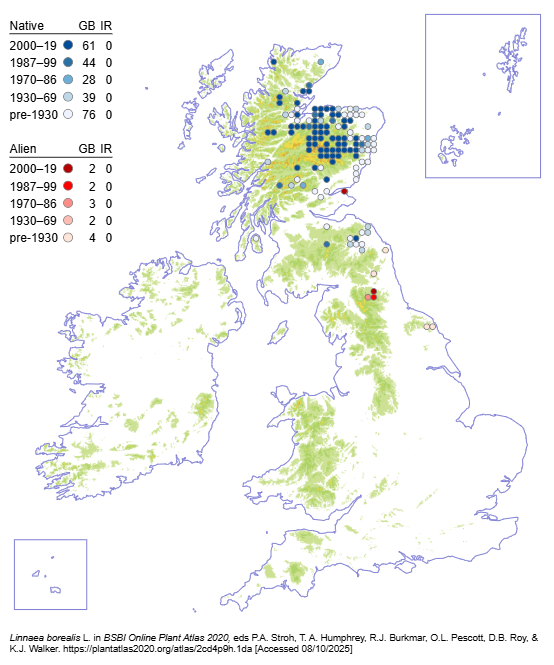
Its core range in Britain is centred on the Cairngorms National Park (CNP) (map below and here).
Twinflower was a Priority Species in the Cairngorms Nature Action Plan 2019-2024. The Plan Partners were Plantlife, Scottish Natural Heritage (now NatureScot), and the Cairngorms National Park Authority (CNPA). The next Cairngorms Nature Action Plan is currently in development.
Actions listed for Twinflower in the 2019-2024 plan were to support the Cairngorms Wild Plants project and its successor (see here) to:
- provide advice and support to land managers at existing sites
- establish new translocation sites across the Park
- recruit, train and support Plantlife Flora Guardians to monitor existing populations
- develop citizen science survey projects
Twinflower at Creag Bheithe Bheag
Twinflower was discovered here in 2007 by Roberts & Kortland. The patch was re-found in 2010 by Pomeroy, who recorded an accurate eight figure grid reference. The patch was then surveyed in detail by Scobie in 2020. He described it as a “Healthy patch growing at high density under planted Scots pine with occasional Lodgepole pine. Patch had flowered well. Patch size: 20 m (N-S) x 16 m (E-W). Cover: 80-90%“. Scobie gave a central grid ref for the patch of NJ 01349 31328. The location is just inside the Cairngorms National Park boundary.
Clear-felling, and restocking of the site
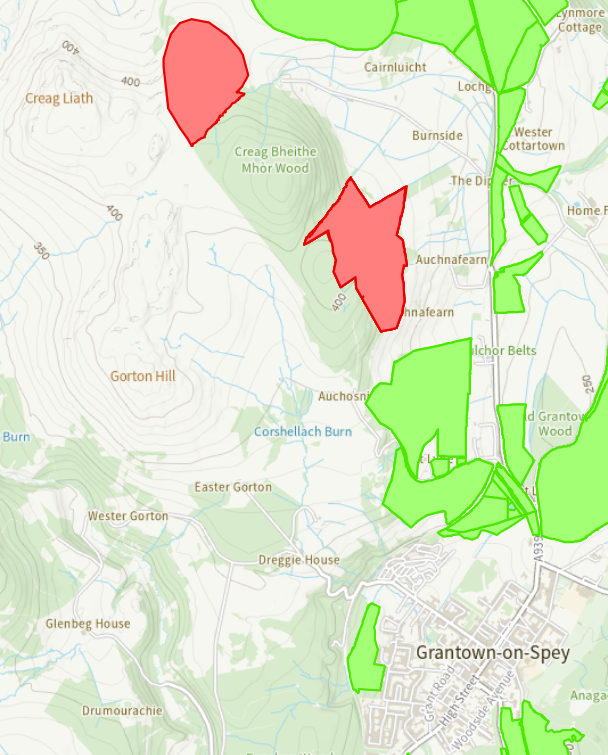
An Application for Permission to Fell Growing Trees (Case Reference Number: FPA-11014) was lodged on 08/09/2023 by the landowner’s agent (Premier Woodlands). The Property name is given as Camerory and the Registers of Scotland show the wood was bought in 2016 by the owner of a commercial construction company who may well have never been informed there was Twinflower in the wood. Public Consultation ran from 23/10/2023 to 19/11/2023. A felling licence was issued on 03/01/2024 permitting the clear-fell of 27.16 hectares (map below), comprising 16.29 ha of Scots Pine and 10.87 ha of Sitka Spruce, both species c.50 years old. Restocking was to be (by percentage area): Sitka Spruce 54, Scots Pine 29, Broadleaves 7 and Open Ground 10.
The felling licence, under ‘Felling Notes’ says “The felling aims to clear the area and to replant using improved planting stock. All felling works (will be) carried out using best practice and adherence to forest and water guidelines. Broadleaves along the minor watercourse will be retained. A two-year permission is required to avoid capercaillie lekking season“. The clear-fell and restocking area includes ground both within and outwith the Cairngorms National Park boundary.
Site visit 27/08/2025
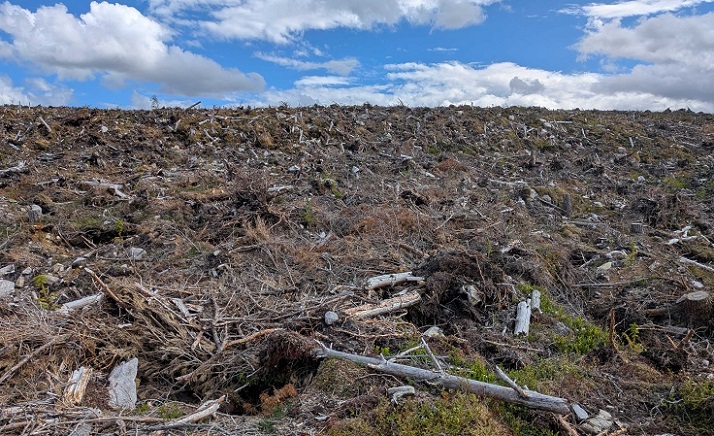
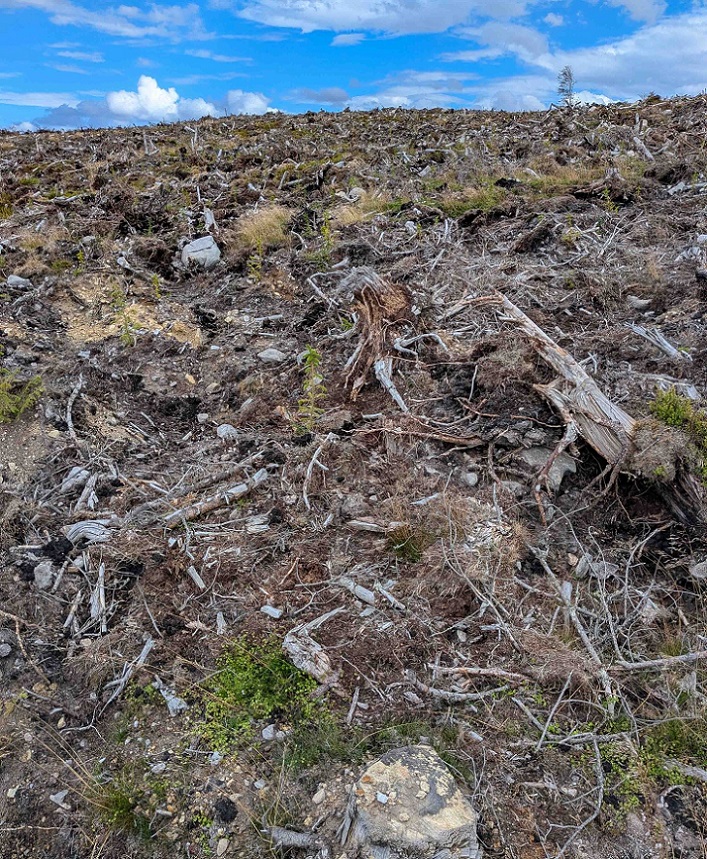
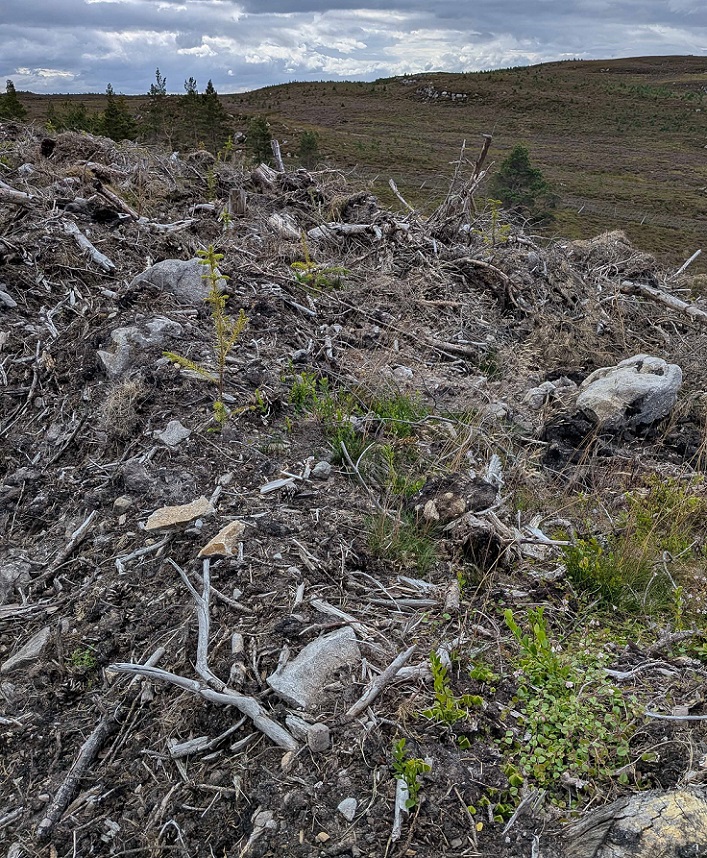
Andy Amphlett (accompanied by Liz Amphlett) visited Creag Bheithe Bheag on 27/08/2025. The area covered by Case Reference Number FPA-11014 had been clear-felled in its entirety. The felled area had been mounded at close spacing, leading to a very high percentage of the surface being disturbed or overturned (photo at head of this blog post).
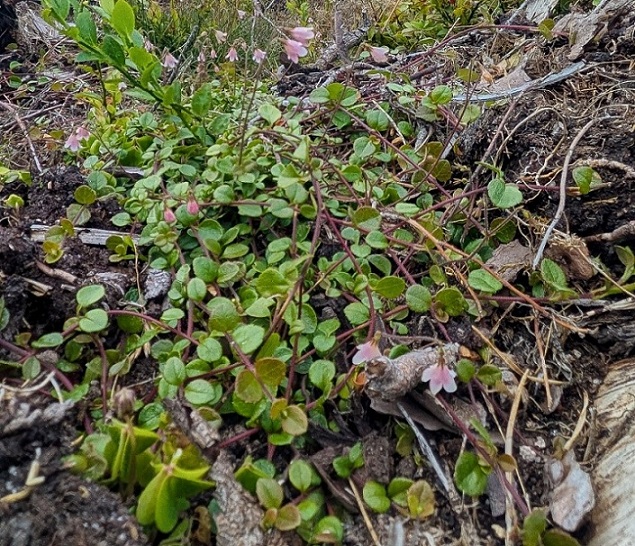
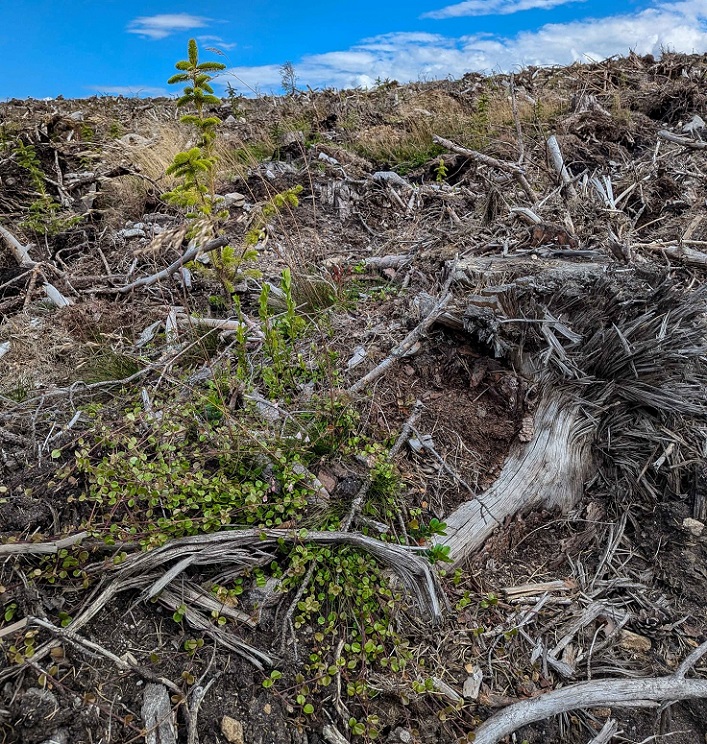
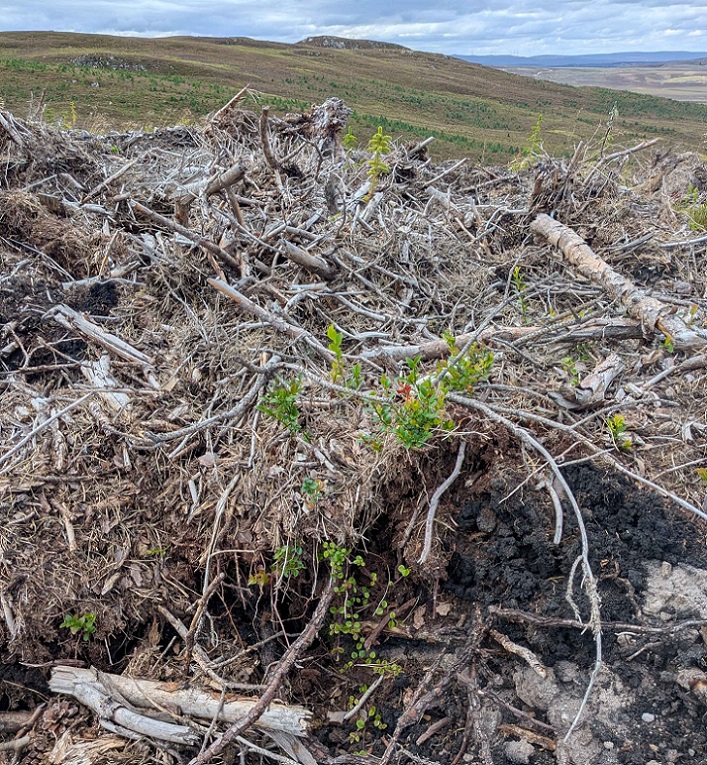
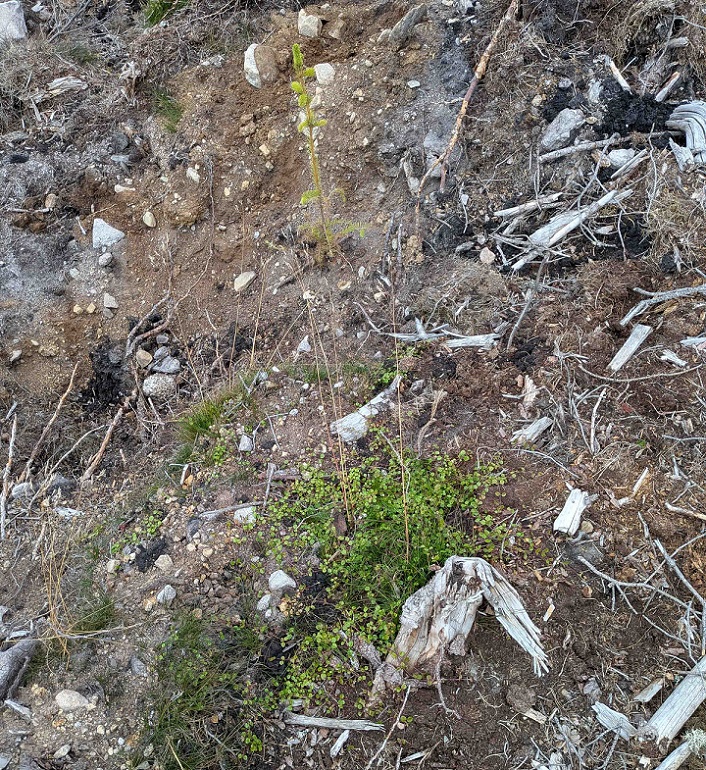
Surprisingly we were able to find c. eight discrete patches of Twinflower in the vicinity of the grid reference recorded in 2020, all in close proximity, some still in flower. These varied in area from 0.01 to 0.5 m2. The total area occupied by Twinflower was no more than 1m2. Scobie’s measurements in 2020 (20 m x 16 m) allow the former patch area to be estimated: 320 m2 if a rectangle, and c.250 m2 if an ellipse. Therefore more than 99% of the Twinflower at this site has been destroyed. It is likely that much of the plant was buried, under brash, or soil when the area was mounded.
Twinflower requires a moderate level of shade, typically provided by a canopy of trees. It is very uncertain if the population at Creag Bheithe Bheag will survive the total loss of tree cover. The immediate area has now been planted with Sitka Spruce, at high density. In the medium term these planted trees might provide the necessary cover for Twinflower to expand, assuming it survives that long. But in the longer term Twinflower may be eliminated by too dense shading from the planted Spruce.
Photographs of the remaining Twinflower patches are below.
The Cairngorms Nature Action Plan 2019 – 2024 Final Report (see here) states that all Twinflower actions were delivered, and the target ‘recovery curve position’ was exceeded.
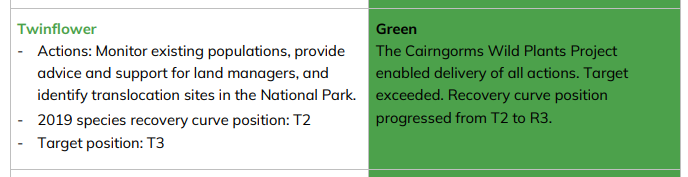
How can this very positive assessment by CNPA be true, given the near total destruction of this population? I wondered if the Actions listed in the Cairngorms Nature Action Plan i.e. to “monitor existing populations” and “provide advice and support for land managers” had applied to the Creag Bheithe Bheag site.
Freedom of Information (FOI) requests
I therefore submitted Freedom of Information requests to CNPA and NatureScot, as Partners in the Action Plan, on 28/08/2025.
The requests were copied to Scottish Forestry (Highland Conservancy) and Plantlife. Scottish Forestry did not reply. Plantlife is not obligated to respond under the Freedom of Information (Scotland) Act (FOISA), but as the Lead Partner for Twinflower in the Cairngorms Nature Action Plan, I hoped they would do so. Plantlife’s Senior Ecological Advisor in Scotland replied in general terms as follows:
Reply from Plantlife
“Thanks very much for raising this to our attention. I’m sure I speak for everyone here first of all to say we’re saddened and disappointed by this.
I agree with you completely that there is evidently a hole in the system which protects Twinflower sites from destruction. We have less than 500 patches left in Scotland, and every year I hear of one or two being clear-felled. Twinflower simply will not survive total clear-fell, and we must prevent it happening at remaining sites at all costs.
The burden of responsibility for this falls on all organisations, as you mentioned, and I think we need to take that on board. While ultimately the site was managed by Scottish Forestry, other organisations here have been involved with the permissions to fell and should also take this as a lesson to avoid similar loss. Equally, Plantlife, now taking on a leadership role in Twinflower recovery, are seeking to ensure that all landowners supporting Twinflower are aware of what they protect and how to prevent loss.
At its core I suspect this may be a lack of information on both locations of Twinflower, and on how to manage appropriately. We have been considering how to address these issues already. I will also raise this issue at the upcoming meeting (of the) Twinflower steering group to address it, once the group is established.”
FOI questions and the responses received (from CNPA and NatureScot)
Question. What prior contacts did the CNPA, NatureScot and Plantlife (as Cairngorms NatureAction Plan partners for Twinflower) have with the owner / manager of Creag Bheithe Bheag?
Reply from NatureScot. “There was a consultation with the landowner’s agent (Premier Woodlands) on the long-term forest plan. But NatureScot staff were not aware of any consultation from Scottish Forestry about a felling licence.”
Reply from CNPA. “We’re not aware that the Park Authority had any prior contact with the owner / manager of Creag Bheithe Bheag prior to the contact described in (answer to the following question).”
Question. Did the CNPA, NatureScot or Plantlife alert the owner / manager of the wood that Twinflower was present? If not, why not?
Reply from NatureScot. “The Operations Team did have a consultation but did not comment on twinflower. Our comments were restricted to the nearby designated site Anagach Woods and measures to protect any capercaillie interests. Our service level statement sets out what can be expected from NatureScot staff, and it does not include trawling for information on rare/scarce species or even usually protected species.”
Reply from CNPA. “In Nov/Dec 24, we had a LTFP due-diligence consultation from the woodland manager, Premier Woodlands, where we repeated the exact same response we gave to the felling consultation in Oct/Nov ’23 (see answer to (the following question).”
Question. Did the CNPA, NatureScot or Plantlife respond to the consultation on the clear-fell / restock proposal in autumn 2023? If not, why not?
Reply from NatureScot. “The Operations Team was consulted by the landowner’s agents, and our response was limited to the effects of the felling on capercaillie, as part of our Service Level Statement.”
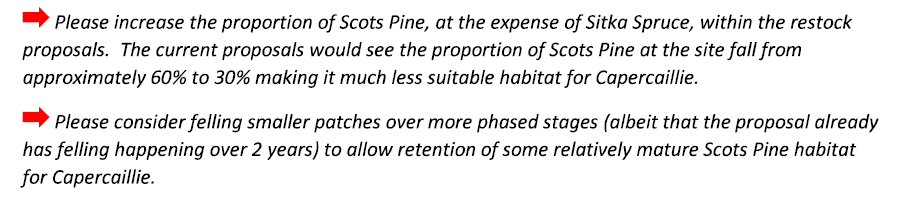
Reply from CNPA. “The Park Authority responded to this consultation on 16/11/2023. In this consultation response to Scottish Forestry we included specific comment alerting that Twinflower had been recorded within the area proposed for felling, and requested a walkover ecological survey to check for Twinflower plus then mark for exclusion from felling. CNPA also requested the following:
Question. Do the CNPA and NatureScot have GIS based systems that allow for plotting notable species occurrences, including Twinflower, against land management polygons, including clear-felling operations? If not, why not? If they do, why was the occurrence of Twinflower not highlighted and communicated to Scottish Forestry and the land owner / manager? It should have taken relevant staff a matter of minutes to realise that a Twinflower patch occurred within a proposed clear-fell. The solution to that potential conflict is obvious, as would apply to e.g. a badger sett.
Reply from NatureScot. NatureScot has a GIS based system that allows for the plotting of species occurrences from select datasets. The GIS system permits access to a dataset “Rare Plants Register – Cairngorms NP” which contains data on a vascular plants species including twinflower, but only up to 2010, and a second dataset covering the Central Highlands titled “Priority Vascular Plant Species”. NatureScot staff do not search datasets for rare or scarce species every time there is a consultation. Our comments address the likely effects on national interest. In this case we considered the effects on capercaillie, from a proposal outwith protected areas, but which might have an impact upon protected areas.
Reply from CNPA. Yes, we utilise available GIS based ecological recording systems to alert us to presence of notable species.
Question. Twinflower is surviving (just) at Creag Bheithe Bheag. As an isolated population, possibly of a unique clone, what actions will CNPA, NatureScot and Plantlife (as Cairngorms Nature Action Plan partners for Twinflower) undertake to ensure the plant’s survival at this site? (The Creag Bheithe Bheag population was not sampled for the study by Wiberg at al (2016). The genetic consequences of long term habitat fragmentation on a self-incompatible clonal plant, Linnaea borealis L. Biological Conservation, 201, 405-413. (see here)).
Reply from NatureScot. “We will recommend that as part of a project being led by Plantlife that clonal material is collected from the site and propagated ex-situ. We will also liaise with CNPA and Plantlife on how to proceed, for example liaising with the owner or land manager which might include advising the owner or land manager of the clear-felled site that twinflower is present, providing the location of the surviving twinflower and recommending that the twinflower be taped off during re-stocking to avoid damage. However, it would be up to the owner or land manager to decide whether to act upon this advice.”
Reply from CNPA. “Whilst the Park Authority does not have any plans specific to Creag Bheithe Bheag we will continue to work in partnership with NatureScot and Plantlife to support Twinflower conservation in line with the Cairngorms Nature Action Plan.”
What went wrong, and what could be done to avoid similar disasters in future?
The first thing to say is that the landowner’s agent (Premier Woodlands) bears the primary responsibility for the damage to this Twinflower population. They were informed by CNPA that Twinflower was present (but CNPA did not disclose the actual location of the Twinflower patch, even though they had access to that data). The landowner’s agent also ignored CNPA’s request to increase the proportion of Scots Pine to be planted, and to fell smaller patches over a longer time period, which would have allowed for the retention of patches of relatively mature Scots Pine.
Secondly, it appears that when granting a felling licence, Scottish Forestry did not stipulate that the immediate area around the Twinflower patch was to be retained. Leaving a patch of woodland with radius 20 metres would have only amounted to 0.5% of the area for which a felling licence was sought, and retaining an area with a 30 metre radius, would only have been 1%.
Although Twinflower was discovered at Creag Bheithe Bheag in 2007, and despite the Cairngorms Nature Action Plan listing “provide advice and support for land managers” as an Action, there was no contact by any of the Plan Partners (Plantlife, CNPA and NatureScot) with the owner or Agent prior to the consultation on the Long Term Forest Plan. An obvious solution is that the Cairngorms Nature Action Plan Partners contact all landowners within the CNP who have Twinflower on their land, providing them with full details of locations. That should have been done years ago.
The CNPA should have a) provided the landowner’s agent with the detailed grid reference of the Twinflower patch, and b) alerted Plantlife (who lead on the species for the Cairngorms Nature Action Plan) that a Twinflower site was potentially under threat from felling. Despite being Plan Partners, communication between CNPA and Plantlife seems to have failed. As Plantlife said “there is evidently a hole in the system which protects Twinflower sites from destruction“. Plantlife or CNPA staff should then have offered to mark the Twinflower patch prior to felling taking place.
I analysed Twinflower records from within the CNP. The species is recorded from 371 100 metre Ordnance Survey grid squares. 55% of these locations are outwith Site of Special Scientific Interest (SSSI), Special Area of Conservation (SAC), and National Nature Reserve (NNR) designations, and outwith National Trust for Scotland ownership or RSPB reserves. While some of the non designated sites may be under Forestry and Land Scotland ownership, it is likely that something approaching half of the Twinflower sites in the CNP are in non designated areas and in private ownership. Given what happened at Creag Bheithe Bheag, how many of these sites are safe?
NatureScot’s involvement at Creag Bheithe Bheag was in line with their service level statement (see here), and followed the ‘Agreement on roles in advisory casework between NatureScot and Scottish National Park Authorities’ (see here). Therefore they only addressed the likely effects of tree felling on national interests. In this case this was reduced to consideration of possible impacts on Capercaillie within the Anagach Woods Special Protection Area (SPA), c. 4 km away. The key line in the ‘Agreement on roles in advisory casework’, is that CNPA will lead on provision of advice concerning effects of a proposal on nature conservation or biodiversity interests that are not internationally or nationally designated.
NatureScot said in their FOI response that they “do not search datasets for rare or scarce species every time there is a consultation” and “our service level statement … does not include trawling for information on rare/scarce species or even usually protected species.” They also said that their “GIS system permits access to a dataset “Rare Plants Register (RPR) – Cairngorms NP” which contains data on a vascular plants species including twinflower, but only up to 2010“. They did not say if they looked at this dataset with respect to Creag Bheithe Bheag. I actually created this dataset (of threatened, rare and scarce plant species within the CNP) with support from CNPA and Scottish Natural Heritage. It includes records up to 2013, and was published in May of that year. Records of qualifying species have continued to be collected within the CNP since 2013, and to date an additional c. 19,000 RPR plant records have been added to the BSBI database, of which c. 15,000 have so far been supplied to the NBN (National Biodiversity Network) Atlas Scotland.
As NatureScot “do not search datasets for rare or scarce species every time there is a consultation“, as a test I searched the BSBI online database (which NatureScot staff have access to) for records of plant species included in the CNP Rare Plant Register that were within the one km grid square that encompassed the Creag Bheithe Bheag felled area. I then downloaded the results as a shapefile, the format suitable for importing to GIS. It took me one minute. One minute; hardly an onerous task! The problem is not with Operations staff on the ground, but rather with those at a senior level in NatureScot who drew up a service level statement that seems to preclude their staff paying any attention to existing and easily accessed datasets of species records.
In England, BSBI have worked with Natural England (NE) to create botanical heat-maps, combining occurrence records of Rare, Scarce, Threatened, and habitat indicator species (see here); Technical Report (see here); and a summarised botanical value map at the scale of 1 x 1 km grid squares (see here). The full dataset includes a ‘Rare/Scarce/Threatened’ layer that maps records of interest at 100m resolution and this is now being used routinely to screen woodland planting proposals within NE and the Forestry Commission. NatureScot are apparently funding similar work in Scotland, but this is at an early stage of development.
The claim in the Cairngorms Nature Action Plan 2019 – 2024 Final Report that all Twinflower actions were delivered, and the target ‘recovery curve position’ was exceeded, clearly paints too rosy a picture of the actual situation on the ground. Inevitably I have to wonder if other assessments in the Cairngorms Nature Action Plan 2019 – 2024 Final Report are also overly optimistic.

Very sad to learn about this destruction of nature. I suspect it is the tip of the iceberg!
One of the problems here is that the owner and managers dont know what they have…absentee investors who may have never walked the ground. Put simply they dont care.
We need land reform to change the nature of ownership…to encourage people who care about nature and forests to own the land. Just like other countries ….normal ones.
Doesn’t the fault ultimately lie with Scottish Forestry? If CNPA responded to the consultation highlighting presence of twinflower, surely the ecological survey should have been made a condition of felling licence?
The fault lies at multiple levels, but yes, in this instance Scottish Forestry could have stipulated that the area around the Twinflower should not have been felled. As a priority species in the Cairngorms Nature Action Plan, Scottish Forestry ought to have taken the presence of Twinflower into account when granting the felling licence.
At a national level, the Scottish Government rationalised the way SNH and FC (SEPA and HES etc) worked with each other. In a deliberate effort to mitigate inter-organisational conflicts, they decided that every Scottish Government organistaion should set aside the reason they were created and that they would all work for “Team Scotland”. Policy and role overlap was to be removed reducing conflict and duplication. Superficially this probably sounds very sensible however, practically this has been a disaster. SNH (trading as Naturescot) was told to “but out” of Forestry and Forestry Commission was told to take nature into account. They even told the FC to take the lead on woodland nature conservation on nature reserves!
It worked well….for about a week. They then started to cut staff and load FC with “planting targets, production targets and renewables targets”. FC’s targets became their priority and nature conservation went over the horizon…. In the mean time, Scottish Government put a series of career administrators (just passing through) with minimal conservation knowledge in charge of SNH (trading as Naturescot). SNH staff were ordered to back off and dumb down. I would be shocked if the local SNH staff dealing with the forestry consultation response were unaware of the twinflower and its peril, however if they had mentioned it, their response would not have been approved. They may have been tempted to phone the forestry office and have a quiet word….but if they had been caught they would have been cautioned to stick to the lower standards.
What if it turns out that this site is not one single clone and in fact all of the remaining patches are different clones making this site one of the most important genetic reservoirs for twinflower? Lost because of the misplaced trust that Forestry Scotland can see past Sitka spruce?
Just so. Bridget Campbell’s rearrangement of the deckchairs at Scotland’s natural heritage and forestry agencies was an unmitigated disaster.
Very much agree with your thoughts ….. but I would say it goes a bit deeper than rearranging deck chairs and government reorganisation. The people being put in charge of these institutions are there to promote and accelerate neoliberalism, specifically to enable private capital to accelerate growth by removing checks and balances that hitherto have been essential to ensure the public interest is being served. Government is now working for the corporations not the people.
I think that’s exactly right. I cadre of officials has been put in place in the Scottish Government and its agencies to drive forward a neoliberal agenda, and to hell with the environmental and social consequences.