
Following my post on King Charles and the muirburn which took place on his estate at Delnadamph on 27th February, a very windy day (see here), I submitted a Freedom of Information request to the Scottish Fire and Rescue Service (SFRS) to see if their control centre at Dundee had been notified, as per the provisions of Muirburn Code. They replied on 31st March: 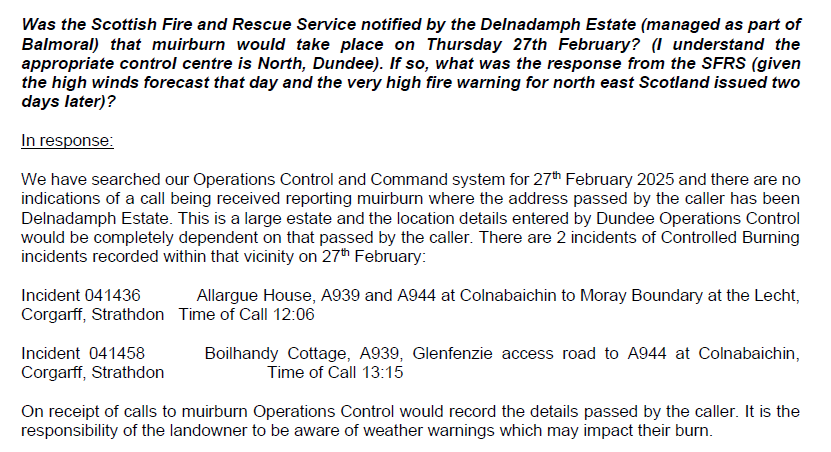
What this tells you is that some estates are notifying the SFRS, as per the Muirburn Code, but not Delnadamph owned by the King. It is no wonder voluntary measures to improve land management don’t work if King Charles ignores them. Where the royals lead, others follow.
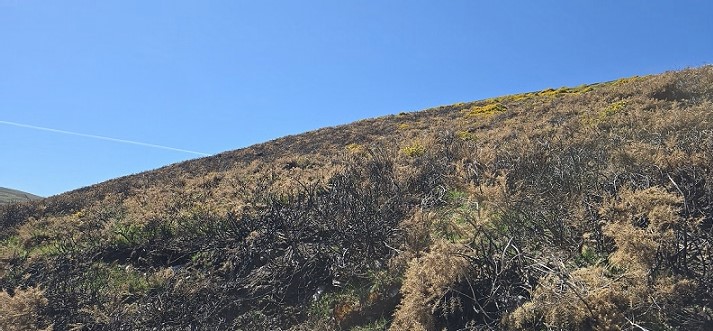
While notifications to the SFRS may not seem as important as the damage that muirburn is wreaking on the natural environment, the two issues are actually connected. After writing about the out of control muirburn which resulted in even more damaging wildfires in Glen Shee (see here) and Glen Banchor (see here), I submitted another Information Request to the SFRS at the end of April – with links to these two posts – asking a) if they had been notified of the muirburn along Glen Shee and Glen Clunie undertaken by the Invercauld and Rhiedarroch Estates b) if so, the SFRS response and c) if any wildfires in the Cairngorms National Park had been reported to them.
I received a very helpful response from SFRS’ on 10th June EIR-0004-2025.26 NIck Kempe apologising for the delay, explaining the information team was short staff and they had to do a manual trawl through their Control system to see if they held the information. Their efforts are appreciated and provide further information that the current system for reporting muirburn and recording wildfires is completely unfit for purpose. The SFRS had no record of either the Invercauld or the Rhiedarroch Estates notifying them of any occasion they conducted muirburn this year. Where King Charles leads, others follow.
Even more seriously neither the Rhiedorrach nor the Glen Banchor estate notified the SFRS of the wildfires they had caused:
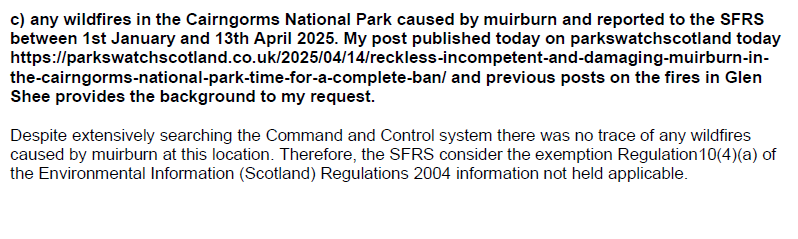 The explanation for the extraordinary claim by Marcus Humphrey, the national wildfire lead for SFRS, that “Current evidence does not suggest muirburn causes wildfires” (see here) is very simple. Landowners and their staff don’t report them and no-one else is monitoring the number of fires caused by muirburn.
In the last few days wildfires have been in the news again because of the huge wildfire/s reported on Dava Moor (see here). There were in fact two distinct wildfires, one of which was within the Cairngorms National Park and the other to the north of it:
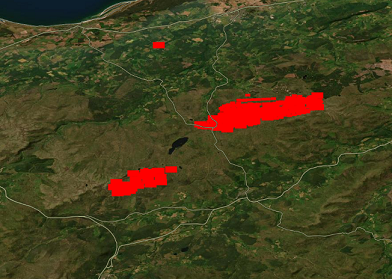
Both fires would appear to have burned areas subject to muirburn, new native woodland plantations and commercial forestry and are likely to have caused serious economic and environmental costs. Since then at least one further fire has broken out in the area when no warnings of high fire risk appear to have been issues by SFRS. Why?
SFRS, which recently issued a news release (see here) staying over 3000 fires were started deliberately last summer in Scotland – as this post has shown they have no means of recording deliberate Muirburn and when it gets out of control – must now produce a public report on the cause of these fires (one was claimed on social media to have been caused by an angler’s fire getting out of control). And the Cairngorms National Park Authority needs to report on lessons for their Integrated Wildfire Management Plan (see here).
If the Scottish Government is serious about limiting the damaging impacts of muirburn and wildfires, however, it needs to ensure that SFRS has the (digital) systems in place to monitor and record both muirburn and wildfires and their impacts. Until we have that data any fire prevention and management plans, like that in the Cairngorms National Park Authority (see here), will continue to be driven by the interests of sporting landowners like King Charles rather than those of public.
The public consultation on the future of the fire service, launched on 25th June (see here), contains no proposals to address these issues but instead lays out options for further reductions in provision of appliances and crews. The inability of the SFRS to put out wildfires around Moray shows how foolhardy that is and how out of touch their management are with reality.

By now it should be obvious to everyone that out of control muirburn will continue across Scotland until King Charles sets a better example on the land which he owns. A complete cessation of muirburn on the Balmoral and Delnadamph estates is now required. Altering the pattern of vegetation to suite sporting interests is perfectly feasible, by cutting instead of burning the heather. This method of grouse moor management, as an alternative to muirburn, needs the royal seal of approval asap.
The smoke from the fires either near Carrbridge or the Dava (north of Grantown on Spey) fires reached Nethy Bridge (~15 to 17km away) around 17:30 on Monday 30th June. The arrival was so sudden and the smoke so thick that it appeared at first to have come from a fire much closer (Nethy has numerous pinewoods nearby), but was probably just the result of a change in wind direction. Fortunately, a few hours later a band of rain delivering around 14mm of rain overnight arrived and has hopefully greatly helped in extinguishing the flames.
The fire itself spread as far as Mannachie Avenue, Forres (57.598041, -3.614774) at the start of the Dava Way, which is just a mile or so from the town centre. There are a lot of new housing developments in that area that could have ended up in a lot worse state.
Apologies for late approval of this comment, I have been away
When walking high ground on a windy day after a long period of drought, it is sometime possible to find smouldering vegetation. This ignition can be due to prolonged friction on a hot day between woody stems.
It amazes me that in all the vitriol poured out on social media this past week ref Dava: wholesale condemnation of picknickers and general carelessness of the hillwalking public….. no one speaking to the press on behalf of SFRS recently appears to be telling the whole story. Sporadic hill grass fires can begin all of their own, even when no rain falls, some blazes may be initiated by lightning strikes.
Other sources of ignition : Particles of glass from bottles -discarded by those on foot all across the highlands over centuries – perhaps re-exposed after increasing incidence of heavy rainfall. Another likely cause will be the automotive debris left uncollected near roadsides after road accidents. Sources of ignition in remote places are not “restricted” to the much talked about ones.
Seems fairly certain that one of the two fires was started by a flare, the other by a campfire. There was another smaller one as well, allegedly started by a farmer. The hills did not spontaneously combust.
Hi Victor, do you know why and who would be setting off flares over Dava Moor and the source of this info? Even more reason why we need SFRS to confirm cause of fires. The aerial photos of an area of gorse burning within fields did look as if it might have been set alight by the farmer. Interesting whether such fires on such land would be covered by muirburn licensing or not – I will try and find out from NatureScot.
We had better stop relying on rain to extinguish fires and go to the underlying cause…not just the presenting and obvious “cause”!
I saw the fact that one was a fire started in a ring of stones in media. With abandoned camp seats around it. That would be the angler’s fire.
Apologies for late approval of this comment, I have been away
The question is “were any of the fires due to muirburn”? There are a number of ways in which to start a muirburn and petrol is the obvious method. This however brings serious risks to the person starting the muirburn. While pouring petrol there is a possibility of fumes building up around the person pouring the petrol, throw a match at it and whoosh, one life at risk. A second method would be to carry a gas canister and torch, heavy and cumbersome. The third option and therefore the easiest and safest is a flare, not set off OVER the moor but into it.
Dearie me, so many different levels of misunderstanding in this post. No-one conducts muirburn at the end of June because they would be destroying the resource that they put value on, be that grouse or grazing for sheep or deer. No-one lights fires with petrol, which is a whole new level of stupid. A simple hand held gas cylinder gives you all the speed and effectiveness required to get a fire going, with zero safety implications. Better for everyone that we wait on outcome of investigation by SFRS/ Police Scotland, so that people can understand properly what really happened.
But land managers do have reasons to set fire to gorse at the end of June – as appears to have been the case with one of the recent fires in the Moray area – and gorse colonises moorlands. And while grouse moors on the east of Scotland may use gas cylinders to set fire to heather, I have been told that farmers and crofters can use petrol. What is your evidence that they don’t? That points to yet another gap in the muirburn code which is supposed to result in better practice – it does not specify how muirburn should be started.
I would like to add to Tom’s “Other sources of ignition”
Muirburn out of control;
and other “land-managers”, starting much smaller fires, and walking away,leaving them unattended, with the expected consequences, Its time more effort was put in to investigate who started these fires.
You mention in the blog that “The SFRS had no record of either the Invercauld or the Rhiedarroch Estates notifying them of any occasion they conducted muirburn this year.“ This is however exactly what would be expected as when proposed muirburn is called in to the SFRS in the morning, SFRS ask for the name of the caller and a nearby postcode, not the name of the estate where the muirburn will be undertaken. Some enquiries with the estates prior to publishing your blog would have confirmed this and saved the SFRS’s time looking for something that doesn’t exist!
You have confirmed my point the provisions onthe muirburn code which requires the landowner to notify SFRS are a total waste of time because SFRS has no idea of the locations of the muirburn or whi is responsible