
On 27th February I was sent this photo of muirburn on King Charles’ estate of Delnadamph, which has no deer and is managed intensively for grouse shooting (see here). The reader commented it was very windy that day, as is evident from the near horizontal plume of smoke. That was confirmed by the forecast for the Lecht, about 6km away as the crow flies, which was for 20 mph WNW winds gusting to 35mph.
While the muirburn provisions of the Wildlife Management and Muirburn (Scotland) Act 2024 are not yet in force (see here), the current voluntary Muirburn Code is clear. The appropriate Scottish Fire and Rescue Service (SFRS) Control Centre should be notified before burning each day and there should be no burning in winds above 8-12 mph:

Two days after the 27th the SFRS issued a warning of VERY HIGH fire risk for the North East of Scotland, which included the area around Delnadamph:
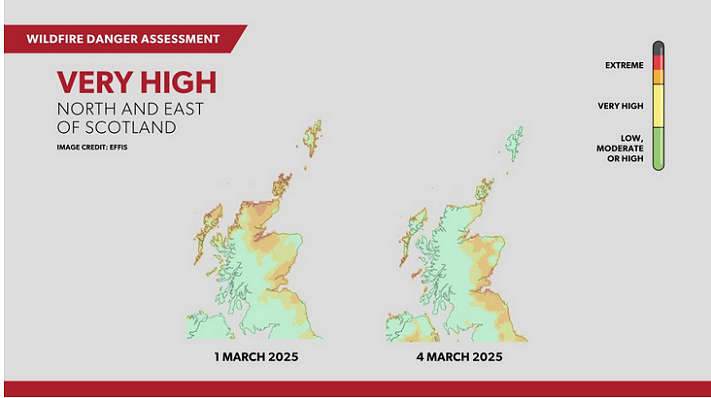 Had SFRS been asked by Charles’ staff, therefore, one would have expected them to strongly advise against any muirburn both because of the dry conditions and the wind. I have submitted a Freedom of Information request therefore to SFRS to find out what communications took place.
A good test for the adequacy of the provisions of the muirburn licensing scheme, if and when they eventually appear, is whether King Charles would have lost his license at Delnadamph for what was done under his aegis on 27th February.
Muirburn – the failure of the Cairngorms National Park Authority
Meantime, our public authorities continue to allow King Charles to mismanage his land at Balmoral and Delnadamph, in what is supposed to be a National Park, without any regard for the voluntary Muirburn Code, as limited as it is, or the natural environment.
The most recent example of this is the draft Integrated Wildfire Management Plan presented to the CNPA Board last month along with the draft fire byelaws (see here). It contains just one reference to the Muirburn Code in 44 pages. That concerns how estate staff must first complete e-learning on the Muirburn Code to get on “a recognised muirburn training course”. The plan highly recommends such a course since “wildfires themselves are obviously not training environments” but otherwise completely ignores the Code, from a fire prevention perspective. It also contains not a single reference to the risks of wildfires caused by muirburn getting out of control, as happens in high winds. As the SFRS website states, one of the main causes of wildfires is “controlled burns gone wrong” and a consequence of its failure to address this issue the CNPA’s plan is worthless.
This failure appears to originate in Section A7 on Fire Management in the CNPA’s National Park Partnership Plan 2022-27 (see here) which omits any reference to the Muirburn Code and created a rigid distinction between muirburn and wildfires, with the former being up to the Scottish Government to address. As a result the CNPA’s commitment to ensuring muirburn follows best practice will apparently only come into effect when the “muirburn licensing scheme” is implemented:

It is wrong that the CNPA is apparently prepared to wait years before doing anything about muirburn. They could now be putting pressure on King Charles by publicly criticising the irresponsible behaviour of his gamekeepers, in as strong terms as they do members of the public who light fires in dry and windy conditions. They could also withhold all future public funding for the Royal Estates.
There is a precedent for this under the cross compliance conditions of the Rural Payments Scheme, which contains some provisions to abide by the Muirburn Code (see here). Having helped pay for peatland restoration at Delnadamph (see here) one would have thought the very very least the CNPA should require is that King Charles abides by the Muirburn Code.
The CNPA’s failure, however, goes far deeper than that.
Paying King Charles to restore peatland to reduce carbon emissions while allowing him to continue to spew carbon into the atmosphere through muirburn does nothing to address climate change and is complete waste of public money. It brings the £250m Peatland Action scheme into disrepute.
Delnadamph, along with Mar Lodge, Mar, Balmoral, Glenavon and Glenlivet is also part of the East Cairngorms Moorland Partnership which, under the National Park Partnership Plan, is supposed to be a key vehicle for improving moorland management:
“specifically, the purpose of the partnership is to collaborate on a landscape scale across land holdings on woodland and scrub expansion, peatland restoration, raptor and other priority species conservation, and landscape enhancement”.
Section A11 of the NPPP is about Ecological Restoration and commits the CNPA to work with “Cairngorms Connect, the East Cairngorms Moorland Partnership and others to expand the area of the National Park under ecosystem restoration.” The photo above shows there is absolutely not a chance of that happening at Delnadamph because King Charles is burning the land to bits in an attempt to produce more grouse to shoot.

While the map is now almost five years old, it illustrates the extent of muirburn in the ECMP area and that the percentage of land burned on Delnadamph appears to be higher than the other estates. What an example from the King! The reinforces the fact the only real conservation going on in the ECMP area is on Mar Lodge where the National Trust for Scotland eventually stopped all muirburn (see here).
Meantime, if the idea was that the ECMP was going to be a vehicle to influence others, the news from the CNPA on 28th February (see here) that a Red Kite had been shot in Glen Buchat, not far from Delnadamph, provides further confirmation that that hasn’t worked either. When King Charles is allowed to flout the rules in order to produce as many red grouse to shoot as possible, it is hardly surprising others take the law into their own hands.
An alternative approach to fires and fire risk
The SFRS’ current very high fire risk warning figures shows that both CNPA’s Fire Management byelaws agreed last month, which would impose a complete ban on fires by visitors between 1st April and 30th September, and the muirburn season, which currently operates from 1st October to 15th April, are unfit for purpose. Neither covers the current very dry period in the Cairngorms, while the fire management byelaws cover all the wet periods during the summer months when there is little fire risk over most of the National Park. As the SFRS states “almost 80% of large outdoor fires since 2010 were recorded between March and May”.
In my view we need a completely different approach to the risk of wildfires which covers the whole of Scotland. This should be based on the SFRS being given the statutory power to ban all types of fire during periods of high fire risk. Consideration would need to be given as to who would be given powers to enforce such bans.
Where further protection is necessary for conservation purposes, such as protecting areas of Caledonian Pine Forest or peaty soils, this should also apply on a Scotland-wide basis and not just to areas like the Cairngorms. This protection should involve not just bans on fires/barbecue for visitors but also bans on muirburn and the like by landowners.
Such an approach would be proportionate and fair to all unlike what is happening at present.

Nick,
I need to call you out on this article (whilst for context commenting that much of what you write in other blogs is interesting and stimulating and often well researched). However, I fear you have a ‘political’ bias against heather burn and management which is clouding your judgement.
In no particular order:
1. The photograph shows two very small fires. I have 40 years experience of heather burning and can tell you these fires are no more than 2-3 metres wide, burning slowly (smoke colour is the key indicator here). They are also being burnt into a grid matrix of previous fires. They are well controlled and clearly being run by experienced people.
2. These kinds of fires and indeed all burning in season are highly beneficial to the environment. They are low carbon burns as they only burn the tops of the heather not the moss, and peat layers below (they are known as ‘cool burn’ fires). As you well know this kind of burning is highly regenerative allowing new carbon soaking heather to grow back rapidly and to stimulate all forms of wildlife providing feed and habitat for birds, deer etc. This kind of burning is in complete contrast to out of season fires during late spring and summer months. These fires (never started by moorland managers), however large, are very damaging burning into peat layer and releasing huge amounts of carbon dioxide. The Saddle Moor blaze a few years ago near Manchester (in summer) did untold damage…. and was made significantly worse because regular burning and moorland management had been stopped. The CO2 release from Saddle Moor in just one fire was estimated at greater than all the CO2 release from all UK legal Muirburn that year. Saddle Moor will take tens of years to recover… the heather now regenerating on ‘cool burns’ in the same year is now busy soaking up CO2, and helping feed birds and mammals.
3. Your criticisms of King Charles are disrespectful, implying that his land managers only do it for the pursuit of grouse shooting. King Charles has throughout his life shown to be right on the key environmental issues and behaviours and he knows that ‘cool muirburn’ is great for the environment.
4. Your suggestion that King Charles flouting rules on muirburn means others might break laws on bird persecution is dangerous territory. It is an unfair and incorrect link to make, and you should be careful what you write, and hope you will consider retracting this.
5. Giving the SFRS the decision point on lighting fires in the muirburn season is a ridiculous suggestion. They cannot be the eyes and ears of what is going on locally on the ground. In my area local people make sensible decisions taking account of local conditions, SFRS advice, the number of people they have, and the areas they may go and burn.
Unfortunately this article reveals a mindset which borders on obsession to boss people around and tell them what to do. The last thing we want to do is to give bureaucrats more powers to tell us what to do. The SFRS is not here to make judgements on whether people should carry out muirburn. ie advise not decide.
I sense you have a highly politicised agenda which is anti anyone who engages in any form of land management where there may be any form of field sport. The unshakeable fact is that moorland management with man managed Muirburn leads to higher numbers of all birds and wildlife. There are huge bodies of evidence on this, and plenty of information to show that wildlife numbers are lower on Mar estate and other land areas run by public bodies eg RSPB etc. Mar estate is a ticking time bomb as one day there will be a large fire, and it will be deep peat, and it will release huge quantities of CO2… it’s only a matter of time.
Hi Colin, just to be clear about your position, are you 1) defending the right of King Charles and other landowners to carry out muirburn in dry conditions when SFRS has issued a warning of very high fire risk AND when its windy both contrary to the Moorland Code 2) and, if yes, does that mean you believe the Moorland Code should be ignored everywhere? Nick
Hi Nick,
1. The Muirburn code, which is an excellent document, is advisory. It should be followed because it highlights good practice and guidance but its whole content is not statutory.
2. There is nothing in the Muirburn code which states (and you should note where it says MUST to mean statutory and where it does not say MUST) that heather burning managers MUST follow the SFRS web site.
3. There is ‘should’ advice on wind speeds however as you well know the wind speed at the bottom of the hill is very different from the top. Experienced managers on the ground assess where it is safest to burn.
4. Importantly, On 27th February – the date of your photo there was no very high risk or exceptional risk warning in place from SFRS, so you are being somewhat unfair linking 27th Feb photo to post 1st March advice. However, as above they would also be completely in their right to assess conditions on the ground in their local area (after 1st March) rather than follow the SFRS web site – (which naturally issues with ‘an abundance of caution’).
5. A key point is that SFRS info is advisory and should not become mandatory and they should not be given the role to decide when they don’t have the expertise. (The photo in the muirburn section on their web site is of someone burning a large bush. To be fair when they advise extreme we don’t burn but we would know that anyway from our local knowledge on the ground.
I get the feeling Nick you love banning things you don’t like and are therefore searching for a mechanism to do just that, ban intelligent folk from getting on with their jobs. SFRS need to focus resources on their core task of protecting people in their homes and workplace not banning experience professionals from conducting muirburn.
6. On the ground at the time I can tell you that it was not dry or too dry to burn… local teams in our area in north east could not get a fire to start at the end of February as the heather was too damp but were concerned about the number of people they had available, and wind on some higher faces on 1st/2nd March so decided not to burn.
7. I suggest you go out heather burning and learn a little bit more about it from the experts.
Further muirburn was taking place in this area on Friday 28th February. As I drove towards and approached The Lecht at around 9.00am there was a significant smoke plume from a glen to the right of the road. It is high time this practice ceases or, at least, is strongly curtailed.
Hi Roger
What’s your argument here for curtailing or stopping muirburn?
Here is a link to useful info on the purposes of muirburn.
https://www.gwct.org.uk/policy/briefings/driven-grouse-shooting/heather-burning/
I was up on Ben Avon at the weekend and could see muirburn happening south of Braemar (Invercauld?)- on a day where the forecast was for 30-40mph winds, and have seen a few instances that would be near Delnadamph recently.
A useful tool for remotely monitoring and confirming muirburn activity and where exactly it occurred is the NASA Thermal Anomaly map. It will pick up most activity as long as there’s a reasonable size of fire and not very thick cloud cover. Here’s an example showing the last 2 weeks in The Cairngorms / Angus (The Angus glens in particular getting hammered):
https://firms.modaps.eosdis.nasa.gov/map/#d:2025-02-19..2025-03-04;l:fires_all,topo;@-2.97,57.03,10.43z
Hi Mike, my apologies, because your comment was automatically approved I did not see it and your link to NASA before writing my post on NASA today, Nick
Hi Nick, where exactly on the SFRS website does it state “one of the main causes of wildfires is “controlled burns gone wrong” ?
Having looked at the website, I cannot find this statement – but I can find the statement “Common causes of wildfires
Wildfires are destructive, but did you know most of them are started by human activity? They can be on purpose or by accident. The most common offenders are:
1. Unattended flames
This includes barbecues, campfires, and bonfires left unattended or not properly extinguished. Even a small spark can ignite dry leaves and brush, leading to a major wildfire.
2. Glass bottles
Sunlight shining through a glass bottle can act like a magnifying glass, focusing heat and igniting dry materials nearby.
3. Controlled burns gone wrong
Planned burns are sometimes used to manage land, but they can spiral out of control if not done properly.
4. Deliberate fire setting
This is sadly a reality, with some people starting fires intentionally. If you see suspicious activity, report it immediately to Police Scotland or Crimestoppers.
5. Careless cigarette disposal
Even a seemingly extinguished cigarette can reignite and spark a fire in dry conditions.
6. Hot and dry weather
Prolonged periods of hot, dry weather create a tinderbox environment, where even a small spark can easily ignite a wildfire.
7. Cold, dry, and sunny weather
Believe it or not, cold, dry days with strong sunshine can also be risky. The combination of low humidity and strong winds can quickly dry out vegetation and fuel wildfires.
I am unsure if thesecauses given by SFRS are ranked in order of severe a cause they are – BUT – I cannot find anywhere on the website where SFRS state that “controlled burns gone wrong” is a MAJOR cause – although there is no doubt that it can be a cause.
Hi Deirdre, you have provided the answer to your question, its at number 3 on the list above from SFRS, Nick
The SFRS website does not say “one of the main causes” – you have chosen to interpret it that way Nick. Unless you know whether the causes listed on the SFRS website were ranked in order of causation – is it not fair to say that your assertion is merely an assumption?
The SFRS statement states “controlled burns gone wrong” are one of the “most common offenders” for wildfires as per what you quoted. The SFRS list does not include “uncommon offenders”, so it is effectively a list of the main causes. Would you have preferred that I had described muirburn as “a common offender”?
Invercauld Estate were burning again last Sunday (9th March) on the Baddoch sector. This was clearly not compliant with the Muirburn Code on at least 4 points:
1 The wind was 15-20 mph.
2 There was only one practitioner on site (the code says a minimum of 3).
3 A large proportion of the recent burns was on steep ground, up to 40 degrees. (The code says a max of 27 degrees)
4 A large proportion of the burns were on thin, rocky soils.