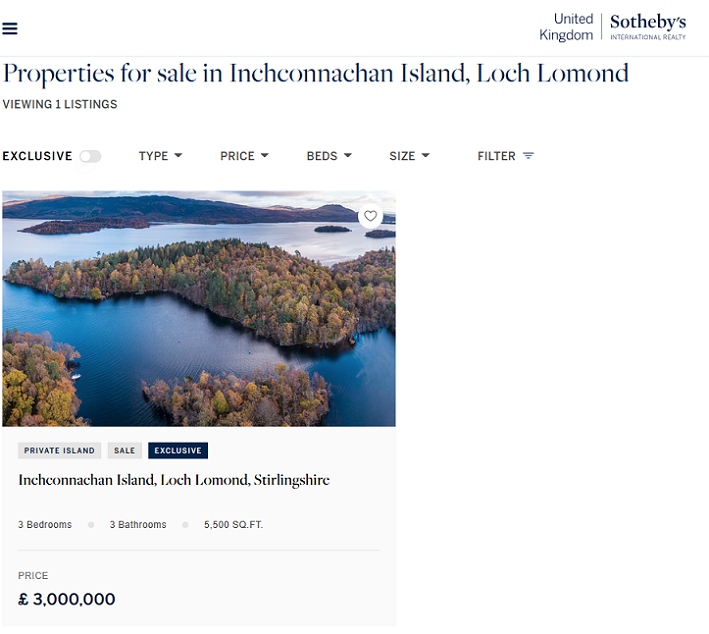
 Kirsty Young, the broadcaster, and her husband Nick Jones have put Inchconnachan back on the market through Sotheby’s, with two options for purchase:
 Mr and Mrs Young bought the island, famed for its Wallabies, four years ago for just £1,550,000 (see here). The Loch Lomond and Trossachs National Park Authority (LLTNPA) then allowed them to use loopholes in the planning system to gain consent to build a a luxury lodge in the heart of the Loch Lomond Oakwoods Special Area of Conservation (see here) and (here).
While the planning application will have cost Mr and Mrs Young a significant amount and building lodges on islands does not come cheap, £7m is a lot for a house and it appears the celebrity couple may profit handsomely if the full deal goes ahead.
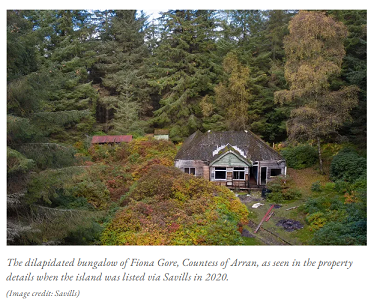
Meantime, it is unclear what Mr and Mrs Young have been doing to manage the island since it came into their ownership. The LLTNPA’s planning committee had agreed to the development going ahead in December 2023, subject to finalisation of a Section 75 legal agreement. This took another year to complete and it was only in January 2025 that formal planning consent was granted (see here for papers).
The S75 Agreement, which is not mentioned in the Sotheby’s blurb or the BBC article on the sale (see here), gives legal force to the planning deal: in return for being allowed to build the luxury lodge Nick and Kirsty Young committed to manage the rest of the island they owned for conservation purposes.
The Section 75 Agreement and accompanying Island Management Plan came into force on 10th January 2025. Among other things it required was for Mr and Mrs Young:
- to submit an annual report to the LLTNPA, starting in January 2026;
- to set up a Formal Working Group which would meet in March and September each year to advise on management of the island; and,
- to employ an Island Warden to help manage visitors.
There is nothing on the LLTNPA’s planning portal to indicate whether Mr and Mrs Young have done any of these things, nor whether they have cleared up the ruins of the lodge pictured above. I will submit an Freedom of Information request to the LLTNPA to find out.
Nick Jones was reported in Country Life (see here ) as saying ‘This is a once in a lifetime opportunity to own an island and to care for its flora, fauna, and wildlife, under the guidance of Nature Scot.’. The moot question for the LLTNPA and the wider public is what Mr Jones has been doing to care for the island in the four years since he and his wife bought it?
The wider issue here is how do we pay for conservation of the countryside? The neo-liberal model, which dominates how our National Parks think and operate, asserts the most effective way to fund conservation is through private interests. Hence attempts to set up markets in carbon and nature credits and hence the planning deal at Inchconnachan or what the LLTNPA was originally offering to Flamingo Land: ‘we will grant you the opportunity to make a lot of money if you promise to put something back into nature’.
What’s happening at Inchconnachan is important because it shows trying to use development in special areas as a means of conserving them does not work. Mr Jones is reportedly a billionaire and could have started to fund conservation on the island the moment he and Kirsty Young bought it. There is little evidence of them doing that. If a new owner decides not to build the new lodge, the S75 and the island management agreement falls and will be back to square one for the LLTNPA. If a new owner does want to go ahead with the lodge, they could still decide to re-negotiate the management agreement.
While the lawyers and consultants earn handsome fees through these processes, nothing happens on the ground despite the declaration of a nature emergency by the LLTNPA.
The answer to how areas, like Inchconnachan, important for conservation are managed lies in land reform not the planning system. This requires further reform about who is allowed to own land, including that which is important for conservation, and under what conditions.

The BBC report states that there are capercaillie on the island. I know there used to be, but does anyone know if they’re still there? If they are, shouldn’t they be in the forefront of ANY plans? If the LLTNPA were worth their salt (or anything at all for that matter) they would be doing their utmost to protect such special places. The hypocrisy of Nick Jones’ words is sickening. He no more loves the place for its ecological importance than he has to wonder where his next meal is coming from. It’s a money making exercise, pure and simple.
I should have said, I think that was poor reporting by the BBC, the capercaillie have not been seen for years although the signs on the islands are still up and they are still designated Special Protection Areas for capercaillie.
Capercaillie on Loch Lomond are almost certainly now extinct. That this has happened without any comment is one of the great natural heritage scandals of the last 15 years.
The Loch Lomond and Trossachs National Park Authority do not want to admit that happened on their watch
I wonder if they actually care? I remember the words of a Highland Councillor in the 1980s ‘The Highlands are a wasteland ripe for development”. Sadly and disastrously that mentality still pervades the political culture of Scotland.
once again it comes down to not having a nationally owned national park