Last week the Cairngorms National Park Authority (CNPA) issued a news release (see here) which started with the following statement:
“Members of the Public are being advised not to use the following paths into Abernethy Forest from Glenmore and Nethy Bridge during early mornings (before 8.30am) over the next few weeks to avoid disturbing breeding capercaillie:
- Ryvoan Bothy to Forest Lodge path
- Vehicle access track to Forest Lodge
- Dell Road to Forest Lodge track
- Forest Lodge to Rynettin path”.
The Lek It Be “campaign” (see here), a product of the CNPA’s Capercaillie Project advises that “From 1 April to 31 August, when capercaillie are breeding and raising their young, avoid capercaillie areas if you can, or stay on the main paths, avoid stopping and keep noise to a minimum.” Now the CNPA is advising the public to stop using those main paths before 8.30am, which represents a further attempt to restrict access rights.
This latest “advice” is likely to be counterproductive. The number of people normally walking these routes before 8.30am is small, but anyone desperate to see a capercaillie now knows where to go. The CNPA should have learned from what happened at Carrbridge (see here). My post on what happened there also contained a link to the Guidance for Responsible Capercaillie Watching. This advises the public in two places that if you come across a capercaillie, don’t share its location! One wonders if volunteers will now be recruited, as at Carrbridge, to police the public?
The news release claims that capercaillie “are easily spooked by people passing by, which can stop them from breeding”. This claim appears based on the widespread general presumption that people always disturb wildlife. While there is evidence that people, and more particularly their dogs, can disturb capercaillie, whether they are “easily spooked” is another matter. Had the CNPA read the minutes (see here) of their very own Local Outdoor Access Forum held in March 2025 they would have seen evidence to thecontrary: 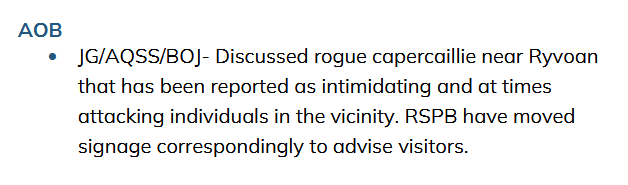 In their informative book “Grouse” Adam Watson and Robert Moss estimated that “perhaps one cock in a thousand loses his fear of humanity” (P143). With capercaillie numbers now around 500 in Scotland that estimate appears rather low. The authors reported, however, that the peck of an irate cock can break the skin “through a thick tweed jacket”and “a blow from his wings leaves a painful bruise”. Rather than claiming capercaillie are “easily spooked” the CNPA might be better repeating the author’s advice:
“If you are attacked, stand on one leg and place the sole of your boot against this chest. He pushes against the boot in a trial of strength, but stops the pecking and buffeting, You can then hop an inelegant retreat”.
Capercaillie are actually doing very well at Abernethy, despite the visitors, with numbers reported to have increased 50% since 2020 (see here). After all the support the RSPB received from those visitors against the proposed telecommunications mast at Ryvoan (see here), it is disappointing that they still can’t bring themselves to trust the public.
While I have been critical of the Capercaillie Emergency Plan 2025-30 (see here), in a welcome move the CNPA have brought all the information relating to it together (see here). This includes information from the scientific advisory group. In July last year this considered the “Capercaillie Integrated Population Model” developed by Glasgow University(see here):
“The model currently incorporates covariates for diversionary feeding and fencing and predicts that the population is likely to recover if both are implemented effectively.”
This is a reference to the diversionary feeding scheme for pine marten, perhaps the most significant predator of capercaillie eggs and chicks, and the plan to remove all deer fences within 5km of a capercaillie lek. The important point is that reducing any disturbance by outdoor recreation is not seen as critical to the species recovery.
The minutes also record that “It is essential that on-the-ground interventions are targeted where they will deliver the greatest benefit to the capercaillie population, and not just where there is proactive engagement from land managers.”
One can understand why the RSPB, as a proactive landmanager, is keen to do whatever it can to increase capercaillie numbers further. The real issue, however, is not whether or not capercaillie numbers at Abernethy might have increased still further if there were fewer visitors. That is a complex issue because whatever the disturbance, people also help to keep predators like foxes on the move. The real issue is what happens when young capercaillie from Abernethy disperse from their natal areas.
Research (see here) shows capercaillie disperse between 1-30 km, with the median distance being 11km. I have heard from two different sources reports of a capercaillie from Abernethy being found on Deeside downstream from Braemar. Within 11km of Abernethy there are many deer fences, the biggest proven killer of capercaillie. Despite that, the Capercaillie Emergency Plan only commits to removing fences within 5km.
Fifteen months ago I wrote about the killer fences at Dorback, the estate on the northern side of Abernethy which was bought by Oxygen Conservation (see here). A few months later three of us went to meet OC staff and their woodland advisers, Tree Story, to ask them to remove the boundary fence. They were sympathetic – I don’t know whether they have acted before this breeding season – but were adamant new deer fencing would be required to protect the new woodland they were planning to plant.
In January, I obtained through an FOI request a copy of Oxygen Conservation’s Herbivore Management Plan (Implementation date 1st August 2025). The wording in the Plan is far from clear and the maps hard to read but the worst case appears to be that, whatever happens to the boundary fence with Abernethy, OC’s “conservation management” will end up with the rest of Dorback being criss-crossed with killer fences:
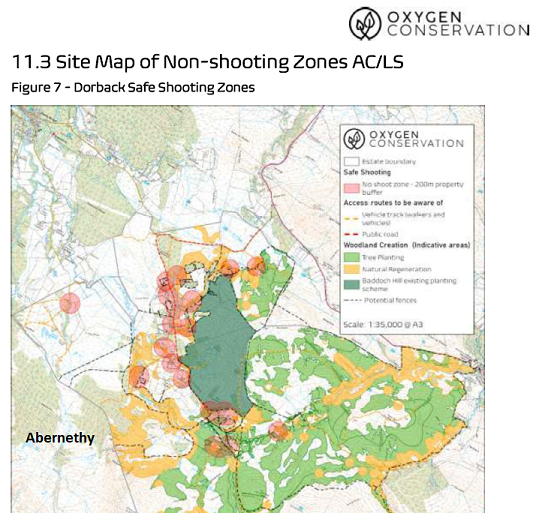
The map shows most of OC’s “potential fences” are less than 5km from Abernethy and well within the 11km capercaillie dispersal zone from existing leks. Although OC would no doubt mark the fences, that will only reduce the carnage, not stop it. The crucial conservation point is that the more young capercaillie Abernethy produces, the more that will garotte themselves at Dorback and on other estates in Strathspey while dispersing.
Rather than spending staff time and resources trying to deter walkers from visiting Abernethy, the RSPB and the CNPA would have more impact if they directed their attentions to OC and other such landowners (as per the minute of the scientific advisory group.) In the case of OC, they should be publicly calling on them not to erect ANY new deer fences at Dorback and remove all existing ecocidal deer fences at Dorback and the Lost Forest (see here) which they acquired last year.
The underlying problem here is political. It is far easier to blame the general public for the plight of the capercaillie, than tackle the landowners who are responsible for the erection of deer fencing and the loss of capercaillie habitat. Unfortunately, the CNPA has let itself become an integral part of that political problem.

You’re confusing the behaviour of rogue males, which can be very aggressive, to ‘normal’ males, which certainly are easily spooked, and make up the majority of the population. The quoted text from ‘Grouse’ is describing rogues.
Yes, but there is nothing in Grouse which says a walker comes past and capercaillie flee………….the word “rogue” suggests that these capercaillie are completely different from other capercaillie. Why would all capercaillie either be “easily spooked” or “rogue”?
The real underlying problem for capercaillie is that we have this private vs NGO/ public sector impasse regarding what we need to do to protect them, and maintaining that ideological divide is more important to people than resolving it. Capercaillie will go extinct in Scotland, although it will take a long time, not least because actual extinction takes a long time to prove conclusively. At that point, people will invest significant resources in trying to determine why that was, and how it was allowed to happen, but it will be too late then. OC put up deer fences because carbon trading mechanisms do not like “natural” woodlands or regeneration schemes. They are not uniform enough, and too difficult to account for in a spreadsheet. Carbon trading demands higher density woodlands of a type that do not arise naturally, at least in the short to medium term. This is important to understand because ultimately, capercaillie are not a bird of the pinewoods, they are a bird of the pinewood woodland edge, and hence we want to have relatively open, low density woodlands of the type that natural regeneration gives you. If people want to lobby for something, lobby CNPA to stop all carbon trading schemes within the park boundary, and do that on the basis that it is encouraging adverse environmental outcomes.
Or lobby to change carbon trading so it is more accepting of natural regeneration.
Aye, hard to imagine a national park that isn’t owned by the nation and calling it a national park. Those foreign Johnny countries have got it all so wrong and we Brits are the only ones getting it right. Billionaires and big banks are the way forward, BUT oops, let’s not forget the NGO-Quango-thwartocracy.
When it comes to Capers, IMO they need all the help they can get.
The latest national survey in 2021/22, carried out by the RSPB and part-funded by the Cairngorms Capercaillie Project, estimated that there are now only 542 capercaillie in Scotland. 542 birds is the lowest recorded level since the start of the national survey in 1992 – 1994; 51% lower than the 2015/16 estimate; and 85% of the Scottish capercaillie population now lives in the Cairngorms National Park.
Re: disturbance by people: ‘absence of evidence is not evidence of absence’. What is evident is that 99% of Capers avoid areas where there is disturbance by people.
Equally, there is no evidence that the population of human visitors is significantly harmed by being asked to avoid limited areas at limited times.
So yes, let’s get rid of bird-killing fences: but make that the headline to the story.
Aye, now what happened to wildlife activity during the Covid lockdowns. Did they miss our presence?
Yes building new fences should be avoided & removal of present ones encouraged.
However the detrimental effect of recreation on capercaillies is now probably the biggest factor in their demise.