As I demonstrated in my first post (see here), seven minutes after the locally elected board member for Balloch, Sid Perrie, sent an email to Park Convener, Heather Reid, and Board Members on 26th August 2024 raising serious concerns about the involvement of senior members of staff in the Flamingo Land application, Dr Reid had forwarded that email on to a member of staff, the governance manager, Douglas Smith. Within 41 minutes Mr Smith had then passed the contents of that email, which were clearly confidential, to the senior staff concerned.
Given this background, readers may be surprised that part of Heather Reid’s subsequent complaint to the Ethical Standards Commissioner, Mr Ian Bruce, was that Sid Perrie had committed very serious conduct by copying in “variously Government Ministers, MSPs and the Community Council” to these emails and “revealing” personal email addresses of Board Members”.
“My complaint centres on a series of six emails which have been sent by Mr Perrie between 26th and 28th August. These emails are attached to this complaint, and I consider these to represent very serious misconduct. This is not only because of their content but also because who he has copied them to (variously Government Ministers, MSPs and the Community Council) making these
statements public criticisms of the National Park Authority and in so doing revealing personal email addresses of Board members”.
Within the overall context, who was really culpable of revealing what to whom? The Commissioner for Ethical Standards, however, ignored the background and framed Heather Reid’s complaint as follows:
[that Sid Perrie] “e) disclosed confidential information or information which should reasonably be regarded as being of a confidential or private nature by making public the private email addresses of fellow board members, contrary to paragraphs 3.22 and 3.24 of the Code.”
He then investigated the complaint in two parts. First that Sid Perrie had in his first email (below) disclosed the private emails of board members to MSPs and Scottish Ministers. And second that Sid Perrie had provided the Balloch and Haldane Community Council with the personal email addresses of board members.
The facts
Two of the emails sent by Sid Perrie between 26th and 28th August were to Heather Reid alone and two further emails to her and board, all intended to get her to take his first email seriously. As it has subsequently emerged, those four emails – the substance of which I will come back to in a further post – were a complete waste of time because Heather Reid had almost immediately informed staff about Sid Perrie’s first email. The important point here, however, is that the fifth part of Heather Reid’s complaint, which alleges Sid Perrie shared private information, concerns just two emails, the first of which was addressed to the following people:.
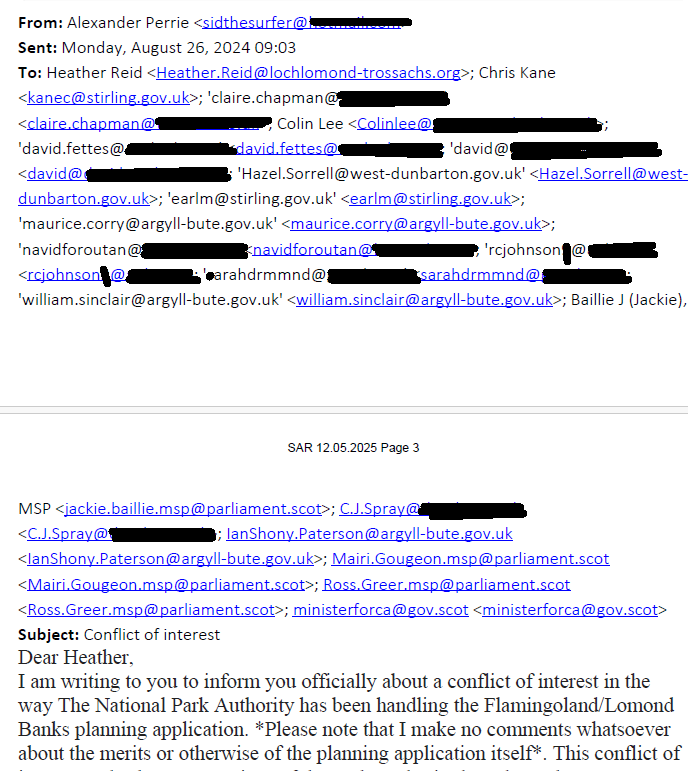
The substance of this part of Heather Reid’s complaint was that by including MSPs and Scottish Ministers in this email, trying to alert them to his concerns about the Flamingo Land Planning process, Sid Perrie had “made public” his criticisms. The implications of this are far reaching. It implies the Convener of the Loch Lomond and Trossachs National Park Authority (LLTNPA) believes no board member should ever notify politicians or the Scottish Government of their concerns, no matter how serious they might be. In my view being able to alert politicians to such concerns is an essential democratic safeguard and is integral to the governance of public authorities.
There is therefore in my view an important question here about how including MSPs in an email to board members on a matter of public interest could ever be regarded as “making public private email addresses”. Many would regard this as whistleblowing. In addition, Scottish Ministers almost certainly already had the private email addresses of board members as part of the appointment process to the board.
It is also worth putting Sid Perrie’s alleged misdemeanour into perspective. In March 2022 a member of staff at the LLTNPA accidentally made no less than 260 private email addresses public (see here). These things happen. However, if Heather Reid now believes sharing the emails of board members with a handful of politicians is a crime, the implications for staff working in the LLTNPA should be horrendous.
The scandal is that Commissioner for Ethical Standards nevertheless decided to investigate this aspect of the complaint without any consideration of these wider issues or the fact that Heather Reid had deliberately passed on Sid Perrie’s email to staff. What’s more, in respect to Sid Perrie’s first email, his report to the Standards Commission describes this aspect of Dr Reid’s complaint as “proven”.
The second email Sid Perrie copied to others was in response to an email to LLTNPA Board Members from Balloch and Haldane Community Council (BHCC):
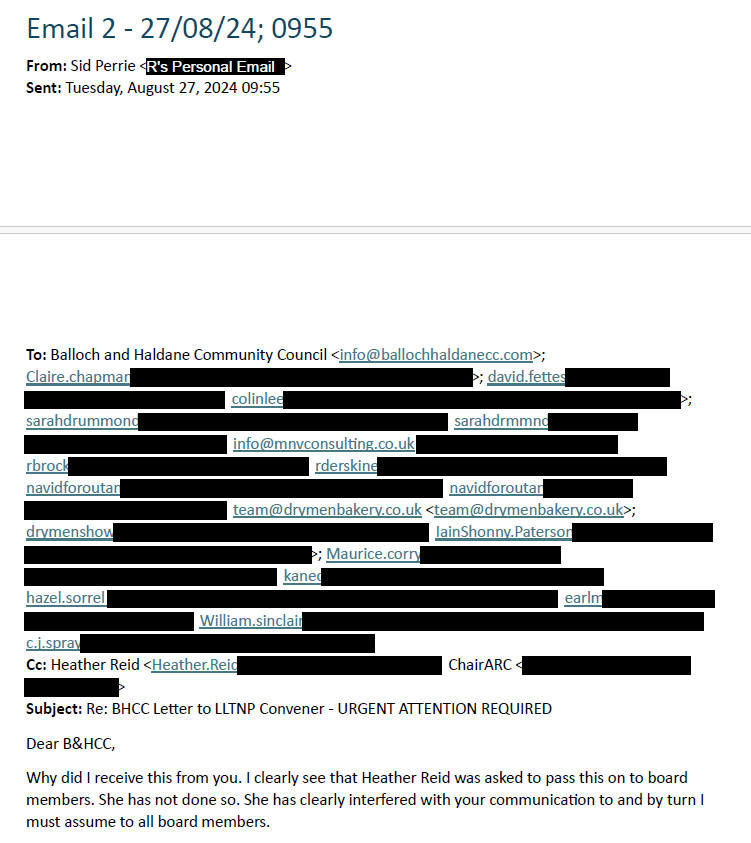
The BHCC had also written to Heather Reid before the papers for the Special Board Meeting on Flamingo Land had been made public, expressing concerns about the planning process. When Dr Reid failed to respond quickly, they then sent an email with those concerns directly to board members – time was pressing before the special board meeting. Sid Perrie then responded to that email (see above) as a result of which he was accused by Heather Reid of sharing board members private email addresses with the BHCC.
Heather Reid got it completely wrong. Sid Perrie had simply replied to an email sent by BHCC. Unfortunately, the Ethical Standards Commissioner then decided to conduct an extensive investigation into whether Sid Perrie might have provided the BHCC with the email addresses they had used behind the scenes. A cursory comparison of the board members and email addresses included in the two emails shows those suspicions were nonsense: there is no “rbrock”, or “rderskine” in Sid Perrie’s email while at least two of the email addresses used in email 2 are different to those he used in his email.
The Ethical Standards Commissioner (ESC) nevertheless decided to conduct an extensive investigation as to whether Sid Perrie might have passed on email addresses to the BHCC behind these scenes (this takes up no less than ten paragraphs in this report). The ESC hecked with BHCC how they had obtained the email addresses they used and was very sceptical when they explained they had obtained them from the internet. Given Sid Perrie is dyslexic, is neurodiverse and finds electronic communications difficult (he gets paper copies of all LLTNPA papers because of this) they would have been better advised to ask themselves how Sid Perrie could ever have managed to share board emails with the BHCC?
While the ESC eventually concluded he was unable to substantiate the allegation Sid Perrie had shared board emails with the BHCC this aspect of his investigation forms an extensive part of his report to the Standards Commission when it should have been dismissed. This implies guilt by association and is another illustration of how the whole investigation process has been biased.
Who is responsible for LLTNPA board members having to use private emails?
The LLTNPA has always refused to provide public emails for most board members. This makes it impossible for the public to contact most board members without going through staff and impossible for most board members to then respond to the public without revealing their private email addresses. The democratic deficit has been particularly serious for the locally elected members on the board – they have no means of communicating with their constituents except through staff.
Since he was elected as the locally member for Balloch and the south west of Loch Lomond, Sid Perrie has been the one board member who has tried to rectify this democratic deficit. Under Any Other Business at the board meeting on Monday 12th Dec 2022 Sid Perrie asked that all board members should be given public emails. He was not supported by a single other other board member. That included Heather Reid who had recently been elected convener (see here). The minute of the meeting recorded:

An update of what happened next was recorded under Matters Arising at the Board Meeting on 13th March 2023. This described the action as complete:
“Complete. Two responses received. Discussed at the February Chairs and Executive Group meeting. Based on feedback, our plan is to update the text on the website to increase clarity of how to contact Members via the committeeclerk email address (now complete). We have also included text n
how the public can view and comment on planning applications. In addition, we are exploring the creation of National Park email addresses for Convener, Chair of Planning and Access Committee and Chair of Audit and Risk Committee to be listed on the Park Authority website”
Just two members out of a board of 17 who bothered to respond to a matter of fundamental democratic importance, the right of the public to be able to contact board members without going through staff. The fact that Douglas Smith passed on Sid Perrie’s email of 26th August to his bosses within 41 minutes of receiving it provides the perfect illustration of why staff cannot be trusted to pass on confidential emails to board members.
Ross Greer, MSP, subsequently made representations to the LLTNPA about the need for board members to have public emails but got nowhere. (That is not his fault, it is a reflection of the unaccountable power wielded by officials in Scotland). It is Sid Perrie whom the public has to thank for now being able to contact the chairs of the Audit and Risk Committee and Planning and Access Committee directly. If public emails could be set up for those two board members, it could have been done for the whole board.
The irony here is that the only reason Heather Reid was able to make this complaint about Sid Perrie sharing “private emails” is that she and the other members of the LLTNPA board had blocked his suggestion that all board members should, as a matter of principle, have public emails. To the extent that this aspect of Heather Reid’s complaint against Sid Perrie has any merit, it is an argument for Dr Reid to instruct staff to give all board members their own LLTNPA emails immediately.
The findings of the ESC on this aspect of Heather Reid’s complaint against Sid Perrie
Sadly, the Ethical Standards Commissioner has failed to explain most of what I have described above in their report to the Standards Commission and completely lost sight of the ethics involved. Instead, their factual findings into this aspect of the complaint are as follows:
“the Respondent [i.e Sid Perrie] disclosed information which should reasonably be regarded as being of a confidential or private nature by making public the private email addresses of fellow board members”
In short, according to the Ethical Standards Commissioner, it was not reasonable for Sid Perrie to copy MSPs and Scottish Ministers into an email to other board members, using the only emails available to him and other board members, even when raising matters of serious concern about the process behind the Flamingo Land Planning Application. In my view this shows the ESC has completely lost sight of what matters.
Sid Perrie’s case is not the only one where there has been an ethical failure. In an interesting article at the start of October John McLellan, a former councillor in Edinburgh, explained how the Ethical Standards Commission chooses to take action in some cases but not others (see here). As I will illustrate in my next post, the ESC appears far more concerned about issues relating to behaviour, such as councillors and members of public boards being polite to each other at all times, than it is about substantive issues relating to how democracy should work.
Postscript
I published this post before reading the excellent article by Glasgow Labour Councillor, Fiona Higgins, about why she, like Sid Perrie, is being hauled before the Standards Commission in February (see here). What she says equally applies to Sid Perrie, as I illustrate below:
Fiona Higgins Sid Perrie
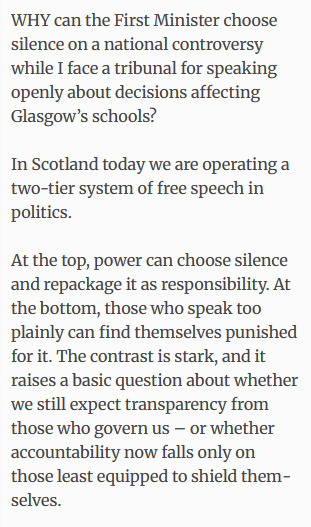 Why can the Planning Minister, Ivan McKee, choose silence on the most controversial planning application in Scottish history, Flaming Land, while Sid Perrie faces a tribunal for speaking openly about decisions affecting the village of Balloch which he represent.
In Scotland today we are operating a two-tier system of free speech in our National Parks.
At the top, power can choose silence (Heather Reid has refused to say anything about LLTNPA staff involvement in the Flamingo Land planning application) and repackage it as responsibility. At the bottom, those who speak too plainly can find themselves punished for it. The contrast is stark, and it raises a basic question about whether we still expect transparency from those who govern our National Parks – or whether accountability now falls only on those least equpped to shield themselves (Sid Perrie is neurodiverse and dyslexic)

I don’t think any of the posts have given me enough information to form an opinion overall if I agree with Sid Perrie’s position. However I do have enough information to form an opinion on the clear abuse of power.
It should be possible to reach out to The LLTNP board, in the same way as you can contact any elected politician. This should be the backbone of local democracy.
The recipients of the email are also bound by GDPR and would not have passed the email un-redacted without due cause. The implication is that there is no legal business as to why politicians should be able to contact directly other locally elected officials??
If I was elected to The LLTNP board I would not want my personal email available, but I would expect to be provided with an official email address – as I would be expecting to conduct official business. If I didn’t have a separate email, I guess the choice is to have my personal email address in the public domain, or not be a board member.
It is unethical to hide elected representatives, this should have been the opinion of any report into this. Or are we destined to exist in a Trump style state where we are told what our thoughts should be.
Unbelievable attitude!
How can people hold a “public office” but not be readily contactable by the public they purport to serve? Why do public-servant employees, governed by a board, feel empowered to insist that any communication to their governors, from a member of the public, is routed & screened through themselves?
Email addresses are a communication route. That is their function.
I’m old enough to remember when the phone number, name and address of almost every person owning a telephone was published in print and distributed to everyone. We called it “The Phone Book”. Until recently the names and office contact details of every executive manager in public-facing roles was published on the agency’s website.
This story highlights a growing trend. Officials who are employed to serve the public retreating behind closed doors, holding closed meetings, refusing to respond to public concerns and instead serving up development deals to business at the expense of the communities and environments they were employed or elected to protect.
You’ll have to contact Bletchley Park to decipher these coded messages from the Reichstag. I would also add, as if I haven’t said it enough already, if you value your health stay away from The Wolf’s Lair. There’s people who went in there and never came out again. They know about the Crown/Royal Charter. That’s buried with the rest of the bodies in the basement. Sure, they’re here “to encourage public participation in planning.” That’s an old joke. You have been warned!
There is a whole cultural issue over the Code of Conduct covering such Board Members and the way in which this highly restrictive Code of Conduct is interpreted and implemented by officials and in various parts of the Scottish Government. I think Fiona Higgins summed it up quite well. It would seem that councillors and NP Board Members have to be so cautious about what they say publicly and what their views are before a Board Meeting or a Planning Committee, whereas MSPs can almost say what they want, including highly critical statements in the Scottish Parliament without redress.
Double standards and a restriction on free speech – no wonder the whole of the Scottish Government administration is in such a mess.
I would refer readers to an interesting paper “Fixing Broken Government” – see https://ourscottishfuture.org/wp-content/uploads/2025/12/Fixing-Broken-Government-1-1-1.pdf?fbclid=IwY2xjawOfqeNleHRuA2FlbQIxMQBzcnRjBmFwcF9pZAEwAAEeB7YIX4ClDAynxz6IUzS-TaILs_EsP5zfg0x3QAHoLB3_qXCpTjhiPTDyYzE_aem_4tD1bajmTpvKSqJ-ROWgjg.
I appreciate that this reference is well off the terrible treatment of Sid Perrie, but the failings we see in the Scottish establishment are everywhere.