
One wonders how much further the price of the Abrdn Property Income Trust (APIT) will drop from the current asking price of offers over £6.9m once prospective buyers become aware sheep are grazing among the newly created native woodland plantation at Far Ralia (see here)?

As Drennan Watson has observed, once planted trees start to emerge from their plastic tree shelters they are at a perfect height for herbivores to graze without having to bend their necks too far!
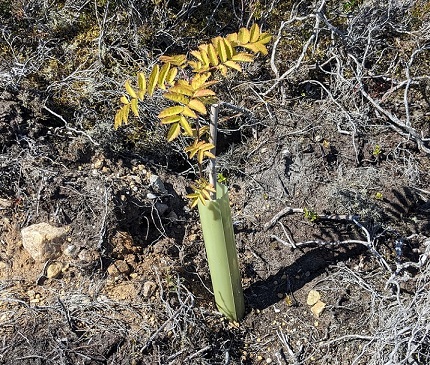
One suspects the sheep spotted by Dave Morris last week will have taken advantage of the bounty. Nursery grown trees are usually far more nutritious and far more attractive to grazing animals because they have been boosted with fertiliser. And if the saplings have not yet emerged from the tubes, as in the second photo, and the sheep are particularly hungry many have learned to knock over the tree shelters to eat what is inside.
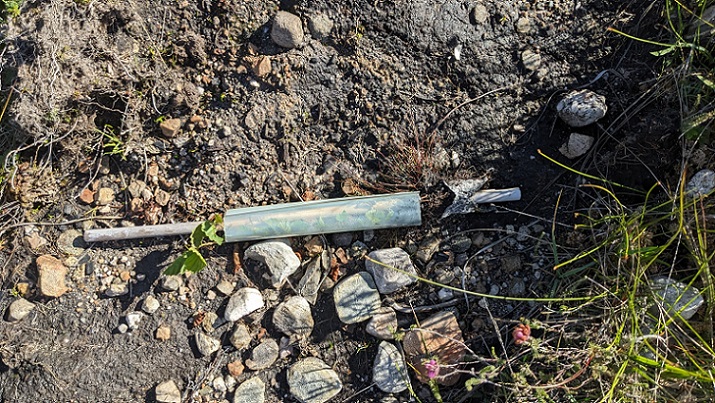
Sheep, like deer, pose a serious threat to both native woodland and commercial forestry schemes. In Scotland, unlike European countries (see here), instead of requiring farmers to control their sheep government forks out large amounts of public money to “protect” newly planted trees. Although the owners of the Ralia Estate (see here) had benefited to the tune of £7.5m by selling part of their estate to Abrdn for “nature restoration” purposes, there was no requirement on them to control the sheep on the land they retained.
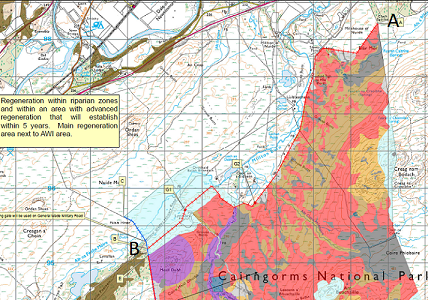
Hence, it was decided to erect a new stock fence, over 5km long, along the boundary between the two estates as set out in Scottish Forestry’s contract with APIT:
“The area identified for planting has a boundary of approximately 19.2km with its neighbours. The site will be protected by using a deer fence (2595m) along the boundary with Phonies Estate. With a stock fence (5265m) being used along the Ralia Estate boundary. The deer fence will not be marked with regards to Black Grouse as is the Lek is over 2km away from the fence on site. No fencing will occur along the wildland boundary, this will leave an open boundary of approximately 8720m. A stock
fence will be erected along the boundary with Ralia Estate, due to sheep farming on Ralia” (Operational Plan)
Scottish Forestry agreed to pay for this, as part of their £2,523,301.96 grant to APIT, as follows:
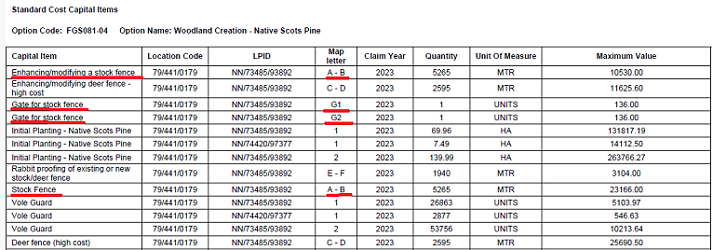
While only a small proportion of the total, the c£40,000 of public money spent on the stock fence and gates effectively enabled the Ralia Estate to continue grazing sheep as it wished (with no consideration given to the important wader habitats along the Milton Burn) while protecting the trees planted for Abrdn by Akre Trees (which is owned by another member of the family who own Ralia).
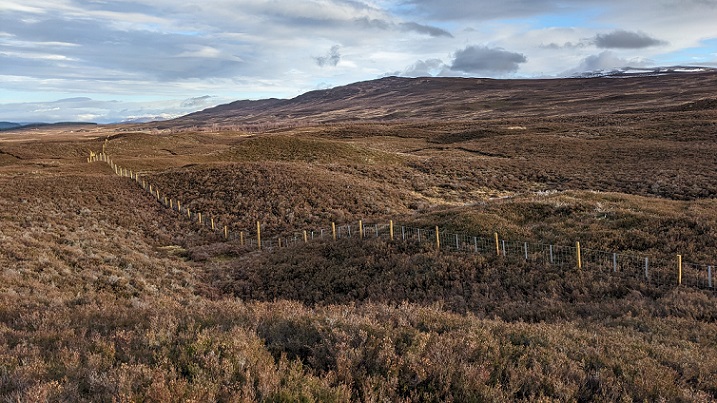
While sheep are surprisingly good at jumping stock fences and an undulating fence like this may have presented opportunities for doing so, in this case they probably just walked through an open gate and along the access track.
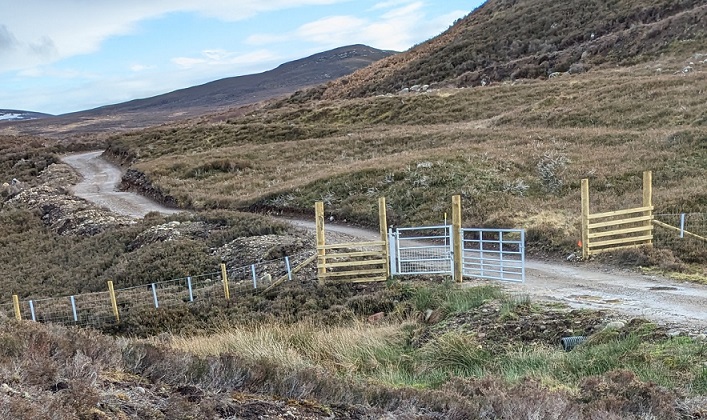
It just needs one person to leave a gate open and no-one employed on the ground to manage the land for significant damage to trees, again paid for by public money, to follow. As far as I am aware the only local jobs APIT created at Far Ralia was to build the new bothy further up the access track – like BrewDog at Kinrara they employed no permanent foresters to care for the trees or the land more generally.
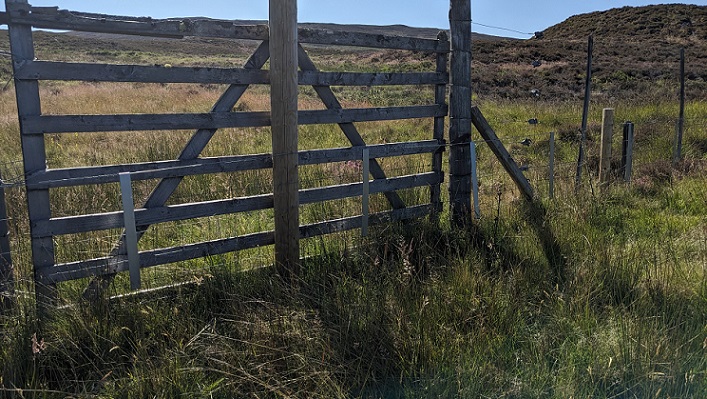
Eagle eyed readers may have noted from the map above that Scottish Forestry and Abrdn only allowed for two gates in over 5km of stock and deer fence. Part of the new stock fence was erected alongside an old unmarked deer fence, a considerable hazard for birds, and there was no requirement from Scottish Forestry either to remove that fence or to protect existing access points. Hence why the stock fence now runs in front of the gate removing a former access point to the moorland.
I will report the fence to the Cairngorms National Park Authority as an obstruction to access rights and the sheep to Scottish Forestry. Both are liabilities APIT needs to address before selling the land. There is a strong case now for Scottish Forestry reclaiming the £40k it awarded APIT for the stock fence as a total waste of public money. There is, however, an even stronger case for reforming the rural payments system so that farmers who fail to control their sheep or other livestock lose all eligibility for public funding.
