[Post updated to include data from most recent Forest Research statistices and corrected 27th September].
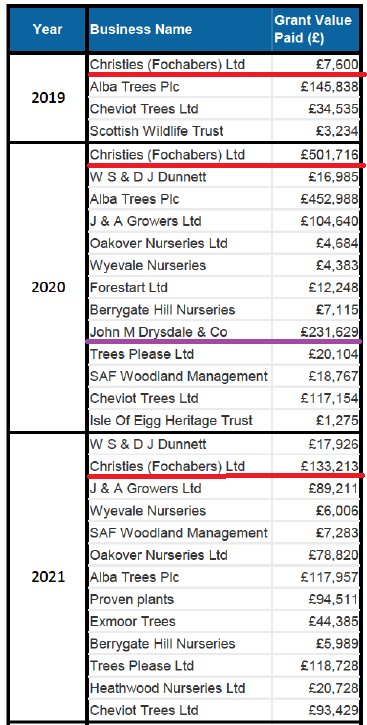
Eighteen months ago I wrote a critical post (see here) about how Scottish Forestry is not only funding companies like BrewDog (see here) and Abrdn (see here) to plant trees, they have also been subsidising the production of trees by tree nurseries. Further evidence that there is something very wrong with the Scottish Forestry grant system came ten days ago when Christies (Fochabers) Ltd, which had received £640k in public funding, went into administration after selling off the Garden Centre part of its business in June (see here).
 Christies’ accounts for the year 31st August 2023 to 31st August 2024 (see here) and those of its parent company, Christies Fochabers Holdings Ltd (see here), are both overdue – an offence under the Companies Act. The absence of the most recent accounts makes it harder to see what has happened to the business in the last two years.
There was nothing, however, in the accounts before that to indicate that a business which went back 200 years was in trouble. The financial years to 31st August 2021 and 2022 showed the nursery as making c£1m profit a year on turnover of £7.5-8.5m. While Christies made a small loss in 2023, it reported net assets of over £6,344,720. So it went from being an apparently sound company to administration in just two years.
The Directors, however, started warning the firm was in trouble 18 months ago, when I wrote my post. This included claims that they would not have invested £3m in upgrading their facilities over the previous 5 years had they thought Scottish Government grants for tree planting would be cut (see here).
The lack of recent accounts makes it impossible to tell if there has been any recent movement of funds between Christies (Fochabers) Ltd and its parent company, Christies Fochabers Holdings Ltd which is NOT in administration. Information at Companies House shows while Christies (Fochabers) Ltd had borrowed significant sums from the banks, which were secured over its physical assets, the holding company was debt free. (In July the standard securities that had been lodged over the garden centre part of the Christie’s Fochabers Ltd business were released, presumably paid off with the sale proceeds).
The owners, the Christie family, therefore appear insulated to an extent from the consequence of the nursery business going bust, although how much they we be left with won’t be known until the accounts of Christies Fochabers Holdings Ltd for the last two years are published. Whatever the amount it is likely to be at least £640k more than it would be if Scottish Forestry had not awarded those grants to Christies (Fochabers) Ltd.
There is nothing unlawful here but it provides a good example of how the public funds being used to support companies ultimately benefit private interests as Common Weal recently explained (see here). (I convene Common Weal’s Care Reform Group which is looking at similar issues care sector). How the Scottish Forestry grants system operates in Scotland exemplifies Common Weal’s analysis, for example:
“There is remarkably low levels of scrutiny of the money that the public sector gives to private, commercial interests”
and,
“This is the system which has all-but broken down in British (indeed, European and Western) economics and politics. The public spends money, it increases the wealth of the already wealthy, a small proportion of that wealth trickles down to wider society, GDP goes up – but the wealth of citizens does not really gain much noticeable improvement at all and inequality grows.”
The Christie Family are small fry compared to the international companies extracting public money through Scotland’s forestry industry. They are still, however, likely to walk off with significant sums of money while 32 employees are made redundant.
While the halving of the forestry grants budget may have played a role in the large drop in the number of trees planted in Scotland in the last year and contributed to Christies financial fall, it does not tell the whole story:
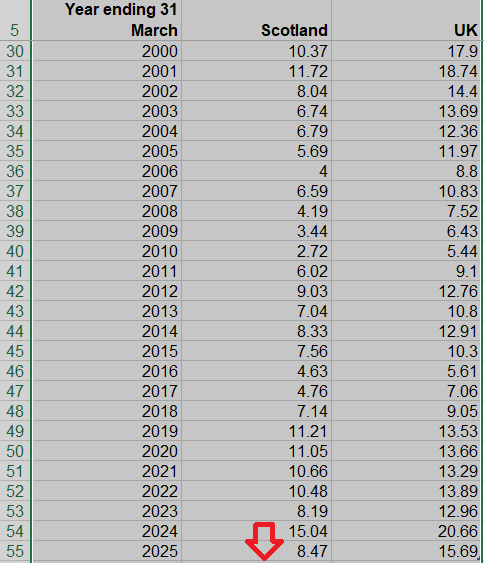
The data illustrates the volatility of the tree planting industry and also how far the Scottish Government was from meeting its target to create 18,000 hectares of new woodland a year by 2025.
Christies, however, has survived previous periods of volatility and the area of new woodland planted in 2025 (the tree planting year reported is from April to April) is not that much lower than in the years 2021 and 2022 when they were making handsome profits. More new woodland too has been planted since 2020 than any other five year period this century.
Moreover, new woodland planting only forms part of the demand for trees, with restocking of felled plantations also playing an important role.
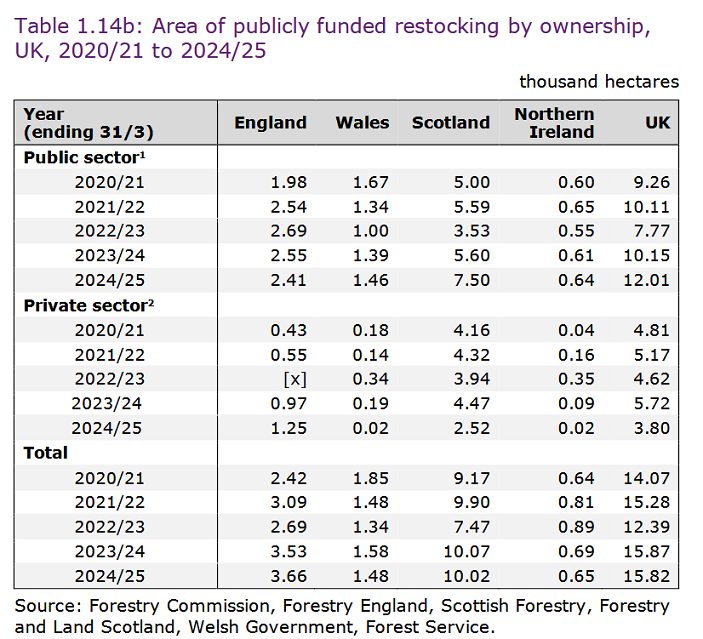
Unfortunately, the statistics published by Forest Research only cover publicly funded not private restocking [and my apologies, in the original version of this post I had incorrectly stated Scottish Forestry funding for private restocking had ceased completely]. . Nevertheless this helps illustrate that the demand for trees for restocking purpose is as important to tree nurseries as new woodland creation. The drop in new woodland creation in the last year does not in itself explain therefore why Christie’s has gone under.
There are also regional factors to consider with the commercial forestry shifting its focus southwards to Dumfries and Galloway and more recently the Borders (see here). This may have made it increasingly difficult for Christies to compete with tree nurseries located further south.
Christies accounts for the year till August 2019 show that at that time they faced little competition:

However, just as Christie’s started to be awarded Forestry Grants to increase capacity so did other other tree nurseries. The list of grants above includes Alba Trees, which claims to be Scotland’s largest producer of cell grown trees and is based in East Lothian, and Akre in Fife (through John Drysdale) which hoped to be producing 6.4m trees a year by 2024. Those nurseries were better located to take advantage of the demand from the south of Scotland.
The nail in the coffin, however, may have been FLS’ new tree nursery at Newton, near Elgin – not much more than a stone’s throw from Fochabers in forestry terms. The new facility, which is highly automated, is intended to treble FLS production from 7m to nearly 20m trees a year by 2029 and was officially opened by John Swinney in August (see here) – just before Christies went into administration It was funded by a £20m grant from the Scottish Government and £6m from FLS, which will almost certainly have had to sell off other assets to pay for its contribution. This “investment” puts all the grants disbursed by Scottish Forestry to other tree nurseries into the shade and makes the £3m Christies invested in upgrading their production over 5 years look like peanuts.
While FLS produces trees for its own use, its new nursery has added significant production capacity to the sector as a whole and reduces the likelihood of FLS sourcing trees from elsewhere. Coupled with other private sector developments, there now appears to be a crisis of overproduction in the forestry nursery sector and in those circumstances the weakest businesses go to the wall. Unless there is a sudden significant increase in demand, it will be difficult to find a buyer for Christies and it may well be liquidated.
This is a crisis that has been created by a government which does not have a clue what it is doing in respect of forestry. On the one hand Scottish Ministers find £20m of public money to invest in their own empire, on the other they disburse sweeteners encouraging the private sector to invest. They do this without ever considering the overall need, how the two sectors interrelate or the potential consequences. . Whatever you think of the respective merits of public sector v private sector “enterprise”, the £640k awarded to Christies in the last five years has turned out to be a total waste of public money. The inability of the Scottish Government to plan strategically for a sector it claims is essential for meeting Scotland’s climate change climates, for creating rural employment etc etc is striking.
The even bigger issue is whether investing money in tree nurseries to produce more and more trees is a good idea in the first place. Walking for almost four weeks in the Italian Alps this summer, not only did I not see a single deer fence or plastic tree tube (see here) and (see here), I didn’t see a single planted tree. There was no need, trees used for timber and the forest as a whole regenerated naturally. As a result there is zero demand in the Italian Alps for the sort of gigantic tree nurseries the Scottish Government has promoted in Scotland.
The only reason we have or need large tree nurseries in Scotland is because our entire model of forestry is so wrong. If we reduced deer numbers, controlled where livestock grazed and banned muirburn, woodland in Scotland would expand and develop naturally as it does in the Italian Alps and other places in Europe. There would still be a need for small tree nurseries, growing trees for specialist purposes, but not for the enormous production facilities that have been developed in the last ten years. If we got the ecological fundamentals right, we could move from the plantation model of forestry, which has been driven by commercial interests and does such damage to the natural environment, towards a model of continuous cover forestry as practised on the continent. That would not only be good for nature, it could produce more timber (as I heard at a seminar held by the Royal Society of Edinburgh last week – about which I hope to write soon) and would create more and better rural jobs..
Unfortunately, having invested £26m on a new tree nursery at Newton that was never needed, the Scottish Government and FLS are probably now even less likely to move towards a model of continuous cover forestry on the land they own and mis-manage on behalf of the public (see here).

A very interesting post. I hope lots of people see it.
An excellent article, thank you. It ought to have a wide readership!
To achieve 25% coverage, by say 2045, nae, 2050. With an increase in timber production from 7.5 million tonnes annually to 10 million, I firmly believe that Scotland must plant an annual average of 140 million trees. 60,000 acres of sitka etc to restock the 9 million tonnes of timber (average) at YC15 ,16 down south, 12 in Sutherland at 1000 per acre
Scotland 19.35 million acres. 1%=200,000. Woodland cover at 2025, claimed to be 19%. Scottish Government Goal of 21% cover by 2032, requires 400,000 additional new acres of woodland. 57,000 acres (23,000 Ha.) annually @ 1600 trees per acre=90 million mixed trees.
Scottish timber industry, currently 7.5 million tonnes, expected to rise to 10 million tonnes annually. Will require the restocking of 45-65,000 acres of sitka etc @ 1,000 trees per acre. So, 45-65 million commercial timber trees.
Someone doing the book keeping for the Scottish Government should have their wrist slapped.