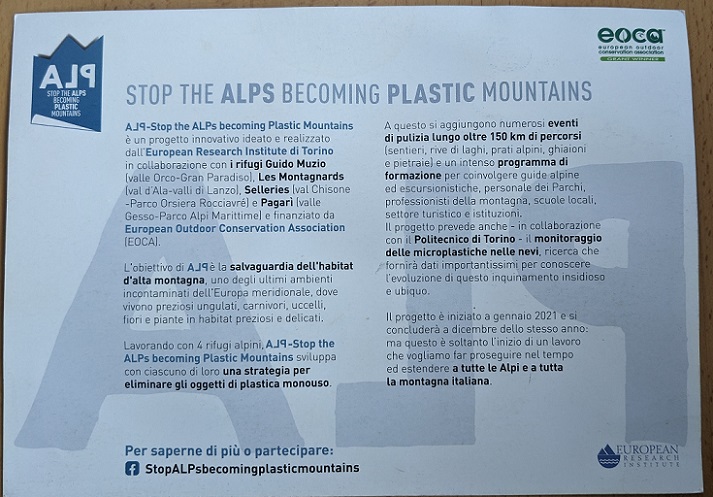
I really liked the message on this leaflet and the wider message of the ALP Project, which “aimed to safeguard high alpine habitat, one of the last pristine environments in southern Europe” (see here).
Having not seen a single plastic tree tube and next to no litter in something like 300km and 25,000m of ascent along the GTA (see here), I wondered whether opposition to plastic might be stronger in Italy than it is in Scotland. Here thousands of hectares of the Cairngorms National Park, some near pristine (e.g see here) and some not (e.g see here) have now been covered with polluting plastic tree tubes, many fabricated from oil and none proven to be biodegradable in natural conditions. I explained to the people running the Posta Tappa that this was being done in the name of conservation and offsetting carbon emissions and they thought we must be bonkers.
In fact the ALP project was very small and had limited objectives, an attempt to get four mountain refuges in Italy to stop using plastic products and a clean-up of the areas around them.
Back home I found a video about the project (see here). This is worth viewing even if you don’t understand Italian just to see what efforts volunteers made to remove tiny pieces of plastic from the environment. A great story about people caring for the natural environment. A contrast to Scotland where politicians (see here) public agencies (see here) and conservation organisations (see here) have been encouraging volunteers to plant trees in plastic tree tubes, which then start to break up and pollute soils and watercourses, in the name of conservation.
The ALP Project was funded by the European Outdoor Conservation Association. This was set up in 2006 by the European Outdoor Group to “enable companies from the outdoor sector to have a bigger impact looking after the natural environment by working together”. For 2025 EOCA are funding three projects in the UK. One is similarly motivated to the ALP project, the removal of litter from the crags of Yr Wyddfa/Snowdon in Wales to help the arctic alpine plants growing there. A welcome initiative. The other two are in Scotland and both involve planting trees. The first, managed by the Borders Forest Trust (BFT), is at Talla and Gameshope in the Scottish borders (see here) . The second, managed by the National Trust for Scotland (NTS) is to “create wildlife-rich corridors of native woodland, along the iconic River Coe and River Etive, through the creation of tree islands”.
Both BFT and NTS have used plastic tree tubes to plant trees in the past and it is not clear from the description of these projects whether they intend to do so again. While BFT has gone to significant efforts to remove plastic tree tubes from the Carrifran wildwood, there is still a tendency from conservation organisations to claim its fine to use plastic tree tubes as long as they are later removed. This ignores the fact that the tree tubes start breaking up the moment they start being used shedding plastic into ecosystems. Many are so small that not even the most determined of volunteers would ever retrieve them.
If EOCA really wants to have “a bigger impact looking after the natural environment” it could insist that those applying for funding from Scotland learn from how the natural environment is managed and protected in other European countries. It could also encourage a European wide approach by asking organisations like BFT and NTS to promote a call for Scotland’s Mountains to become plastic free as the ALP project did in Italy.

The biggest problem with plastic tree tubes is that they very rarely seem to be removed. I wonder how many are actually in use througout Britain?
For clarity, the ‘Riverwoods’ project being carried out at Glencoe (NTS), with funding from EOCA, is based on using tree islands, or small wooden-fenced exclosures, with no plastic tubes.
Hi Peter, that is a step forward – the fences aren’t – but why won’t organisations like NTS clearly state they are totally opposed to the use of plastic in the countryside? NTS is slowly moving in the right direction but has a lot to do. Last year, for example, when I last went up the drive to Mar Lodge there were still plastic tree shelters on either side (many empty). Why? And this just by the River Dee a Special Area of Conservation? We need conservation organisations like the NTS to be actively challenging organisations like the National Park Authorities and Scottish Forestry on these issues.
Commenting on Scottish/Alpine mountain comparisons, Drennan Watson pointed out to me that the Alps don’t have wildernesses like we have in Scotland. You can usually see a village, hear bells, or are within reach of a mountain hut serving food. The Alps also have a bigger problem with wild toileting. More people and tightly constrained paths/routes.
Hi David, the Alps cover a huge area, much bigger than Scotland, and while this is true in some places, its not in others. The Tour de Mont Blanc is mobbed for example while on the GTA there is almost no-one, on the first toileting is an issue, on the second not. What is also different is that while in Scotland remoteness is related to distance, in the Alps it often relates to altitude – the time it takes to walk up 2000m, which I did several days in the Alps, would enable you to walk 10 miles plus in Scotland. In terms of distance you can be quite close to villages etc in the Alps, but in terms of time you can be as far away as anywhere in Scotland and in terms of experience, if you cannot see and hear those villages – and my experience of the GTA is that most of the time that was the case – its not dissimilar. That remote experience in Italy was reinforced by the absence of hill tracks in most places (not the case in other parts of the Alps). You are right about the constrained paths and related to that the terrain – in the Alps there are large areas where few people ever go and which require mountaineering skills to get to. Nick